


 |
市场调查报告书
商品编码
1907269
油漆和涂料:市场份额分析、行业趋势和统计数据、成长预测(2026-2031)Paints And Coatings - Market Share Analysis, Industry Trends & Statistics, Growth Forecasts (2026 - 2031) |
||||||

※ 本网页内容可能与最新版本有所差异。详细情况请与我们联繫。
预计到 2026 年,油漆和涂料市场规模将达到 1,924.6 亿美元,高于 2025 年的 1,857.4 亿美元。
预计到 2031 年将达到 2,299 亿美元,2026 年至 2031 年的复合年增长率为 3.62%。
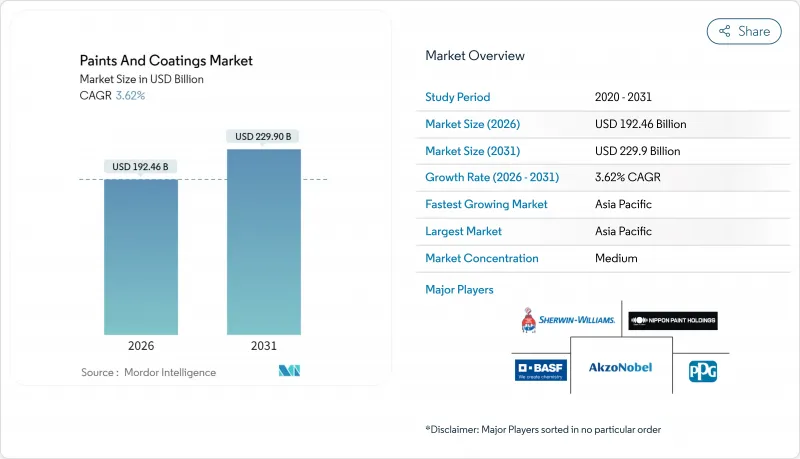
儘管原材料成本波动剧烈,且环保法规日益严格,但住宅、基础设施建设和永续产品创新带来的稳定需求支撑着这一逐步扩张的趋势。亚太地区兼具结构性优势、快速的都市化、大规模资本计划和不断扩大的工业生产,所有这些因素都推动着区域消费以远超成熟经济体的速度成长。在技术方面,向低VOC水性化学品的转型仍然是最具影响力的趋势,政府排放上限和消费者对环保规格的偏好进一步强化了这一趋势。同时,製造商正在将配色、工厂排产和品管流程数位化,以缓解劳动力短缺并加快产品上市速度。全球涂料产业的竞争日益激烈,前12位的供应商正透过收购和剥离来建构更精简的产品组合,实现规模经济。
全球油漆和涂料市场趋势及洞察
全球住宅建设活动激增
诸如《北美基础设施投资与就业法案》等立法正将资金投入道路、桥樑和公共产业,从而推动了新建和维修资产对防护和装饰涂料的需求。同时,亚太地区各国政府继续优先发展经济适用住宅项目,刺激了住宅开工和室内粉刷週期。多个经济体的历史低房屋抵押贷款利率正在提振翻新预算,并推动了对符合绿色建筑认证标准的优质零VOC墙面涂料的需求增长。供应商正积极回应,推出快干水性涂料系列,这些涂料在满足严格的室内空气品质标准的同时,也保证了施工速度。这些因素共同作用,将在预测期内巩固油漆和涂料行业的稳定销售基础。
汽车产量增加
预计轻型车产量将于2024年復苏,并在2026年恢復疫情前的成长轨道。中国、印度和东南亚预计将占据新增产能的大部分。现代汽车修理厂越来越多地采用水性底涂层和低温烘烤透明涂层,以缩短工期并减少排放,从而推动了原厂配套(OEM)和修补漆生产线之间的技术融合。树脂配方商、喷漆房製造商和汽车製造商之间的战略联盟正在加速整合涂装平台的普及,从而降低单位涂料的能耗。这种持续的产能扩张正在显着提升工业涂料的消费量,并推动涂料市场的发展趋势。
全球严格的VOC法规
加州南海岸空气品质管理区定期执行第1113号规则,强制不合规产品重新配方或撤离市场,这增加了中小型供应商的研发成本。在欧洲,修订后的CLP法规将增加内分泌干扰物的标籤要求,要求生产商审查其原料组合併更新安全资料表。在中国,拟议的统一建筑规范将把VOC限量扩大到底漆和密封剂等辅助材料,进一步增加了合规的复杂性。总而言之,这些法规正在挤压油漆和涂料行业的利润空间,并凸显快速产品开发平臺的重要性。
细分市场分析
预计到2025年,丙烯酸类化学品将占油漆和涂料行业的35.78%,并在2031年之前保持3.98%的复合年增长率。这主要得益于其优异的耐候性、保色性和低VOC含量,能够满足建筑和轻工业的需求。配方师不断改进交联结构,以增强其耐磨性和抗污性,从而延长DIY使用者和专业油漆工的维护週期。新兴市场的都市化推动了这一成长,乳化乳胶漆在住宅室内市场占据主导地位。製造商正在扩大区域反应器产能,以缩短前置作业时间并实现颜色系列的本地化,这一策略增强了其相对于溶剂型涂料的竞争优势。
随着跨国公司将产品组合重点转向盈利的丙烯酸分散体平台,树脂市场正逐步整合。醇酸树脂在金属和木器涂料领域仍占有一席之地,但由于大豆油价格波动,其利润率面临压力。环氧树脂在重度维护应用领域的需求稳定,但2025年实现的价格稳定反映的是产能平衡而非结构性復苏。聚氨酯和聚酯树脂分别占据耐磨地板材料和粉末涂料等特定性能领域,但其需求尚未像丙烯酸树脂那样广泛。整体而言,丙烯酸树脂仍将是涂料和油漆市场配方师成长策略的基石。
本涂料市场报告按树脂类型(丙烯酸树脂、醇酸树脂、聚氨酯树脂、环氧树脂等)、技术类型(水性涂料、溶剂型涂料、粉末涂料、UV固化涂料)、终端用户行业类型(建筑、汽车、木材、防护涂料等)以及地区(亚太地区、北美、欧洲、南美、中东和非洲)进行分析。市场预测以美元以金额为准。
区域分析
预计到 2025 年,亚太地区将占全球收入的 46.21%,并在 2031 年前保持 4.91% 的强劲复合年增长率。该地区油漆和涂料市场规模受益于持续的特大城市发展、工业回流以及公共基础设施投资的持续扩张,这些因素共同推动了对防护性和装饰性涂料的需求。
北美地区受益于联邦政府资助的交通走廊建设和房屋抵押贷款利率稳定推动下的住宅维修週期加速成长。对符合ESG(环境、社会和管治)标准的房产需求不断增长,加速了经认证的低排放量室内涂料的普及,为水性涂料製造商在涂料行业中赢得市场份额提供了机会。欧洲正经历逐步復苏,主要经济体正着手解决住宅短缺问题,并推动与欧盟绿色交易相关的节能维修计画。然而,修订后的CLP法规收紧了标籤框架,导致整个供应链成本上升。
预计南美洲将出现选择性成长,其中巴西将引领成长。剪切机司收购BASF装饰涂料部门后,其门市网路迅速扩张,使承包商更容易获得品牌涂料。中东和非洲地区预计将在大型企划和资源主导基础设施的推动下实现早期成长,但与亚太地区相比,政治风险和资金筹措限制了需求。严酷的沙漠和沿海气候促使人们使用高性能聚硅氧烷和氟聚合物面漆来保护资本资产。
其他福利:
- Excel格式的市场预测(ME)表
- 3个月的分析师支持
目录
第一章 引言
- 调查先决条件
- 调查范围
第二章调查方法
第三章执行摘要
第四章 市场情势
- 市场概览
- 市场驱动因素
- 全球住宅建设活动激增
- 汽车产量不断扩大
- 亚太地区城市人口快速成长
- 政府对绿建筑(低VOC)的奖励措施
- 人工智慧驱动的色彩匹配平台的崛起
- 市场限制
- 全球对挥发性有机化合物(VOC)的监管非常严格
- 二氧化钛原料价格波动
- 水性体系的干燥和固化时间延长
- 价值链分析
- 波特五力模型
- 供应商的议价能力
- 买方的议价能力
- 新进入者的威胁
- 替代品的威胁
- 竞争程度
第五章 市场规模与成长预测
- 树脂
- 丙烯酸纤维
- 醇酸树脂
- 聚氨酯
- 环氧树脂
- 聚酯纤维
- 其他树脂类型
- 科技
- 水溶液
- 溶剂型
- 粉末涂装
- 紫外光固化涂层
- 终端用户产业
- 建筑学
- 车
- 木头
- 保护涂层
- 一般工业
- 运输
- 包装
- 地区
- 亚太地区
- 中国(包括台湾)
- 印度
- 日本
- 印尼
- 澳洲和纽西兰
- 韩国
- 泰国
- 马来西亚
- 菲律宾
- 孟加拉
- 越南
- 新加坡
- 斯里兰卡
- 亚太其他地区
- 北美洲
- 美国
- 加拿大
- 墨西哥
- 欧洲
- 德国
- 英国
- 法国
- 义大利
- 比荷卢经济联盟
- 俄罗斯
- 土耳其
- 瑞士
- 斯堪地那维亚国家
- 波兰
- 葡萄牙
- 西班牙
- 其他欧洲地区
- 南美洲
- 巴西
- 阿根廷
- 哥伦比亚
- 智利
- 南美洲其他地区
- 中东
- 沙乌地阿拉伯
- 卡达
- 阿拉伯聯合大公国
- 科威特
- 埃及
- 其他中东地区
- 非洲
- 南非
- 奈及利亚
- 阿尔及利亚
- 摩洛哥
- 其他非洲地区
- 亚太地区
第六章 竞争情势
- 市场集中度
- 策略趋势
- 市占率(%)/排名分析
- 公司简介
- Akzo Nobel NV
- Asian Paints
- Axalta Coating Systems Ltd.
- BASF
- Beckers Group
- Benjamin Moore & Co.
- Berger Paints India
- Chugoku Marine Paints, Ltd.
- DAW SE
- Hempel A/S
- Jazeera Paints
- Jotun
- Kansai Paint Co. Ltd
- Masco Corporation
- NATIONAL PAINTS FACTORIES CO. LTD.
- Nippon Paint Holdings Co., Ltd.
- NOROO Paint & Coatings co.,Ltd.
- PPG Industries, Inc.
- RPM International Inc.
- Russian Paints Company
- SK Kaken Co. Ltd
- The Sherwin-Williams Company
第七章 市场机会与未来展望
Paints And Coatings Market size in 2026 is estimated at USD 192.46 billion, growing from 2025 value of USD 185.74 billion with 2031 projections showing USD 229.9 billion, growing at 3.62% CAGR over 2026-2031.
Steady demand from residential construction, infrastructure upgrades and sustainable product innovation underpins this moderate expansion even as raw-material costs swing sharply and environmental regulations tighten. Asia-Pacific holds structural advantages, rapid urban migration, large-scale capital projects and expanding industrial output, that collectively fuel regional consumption at a noticeably faster rate than mature economies. Across technologies, the migration to low-VOC water-borne chemistries remains the single most influential trend, reinforced by government emission caps and customer preference for greener specifications. Simultaneously, producers are digitizing color-matching, plant scheduling and quality-control workflows to mitigate labor shortages and compress time-to-market. Competitive intensity is rising as the top dozen suppliers pursue targeted acquisitions and divestitures that create leaner portfolios and unlock scale efficiencies in the global paints and coatings industry.
Global Paints And Coatings Market Trends and Insights
Surge in Global Residential Construction Activity
North American legislation such as the Infrastructure Investment and Jobs Act is funneling capital toward roads, bridges and utilities, lifting demand for protective and decorative coatings on both new and renovated assets. In parallel, Asia-Pacific governments continue to prioritize affordable housing programs that stimulate fresh residential starts and interior repaint cycles. Historically low mortgage rates in several economies have revived remodeling budgets, channeling incremental gallons into premium zero-VOC wall finishes that qualify for green-building credits. Suppliers are responding with fast-dry water-borne lines that meet stringent indoor-air benchmarks without sacrificing application speed. Combined, these factors reinforce a stable base of volume for the paints and coatings industry during the forecast window.
Expanding Automotive Production Volumes
Light-vehicle output rebounded in 2024 and is projected to regain its pre-pandemic trajectory by 2026, with China, India and Southeast Asia capturing the lion's share of incremental capacity additions. Modern body shops increasingly specify water-borne basecoats and low-temperature bake clearcoats to cut cycle times and VOC emissions, strengthening technology convergence between OEM and refinish lines. Strategic partnerships among resin formulators, spray-booth makers and carmakers are accelerating the adoption of integrated coating platforms that lower energy use per unit sprayed. This ongoing production expansion delivers a meaningful uplift to industrial consumption boosts the paints and coatings market trends.
Stringent Global VOC Regulations
California's South Coast Air Quality Management District periodically tightens Rule 1113, forcing reformulation or withdrawal of non-compliant products and raising research and development costs for smaller suppliers. Europe's upcoming CLP amendments add endocrine-disruptor labeling, obliging producers to review raw-material portfolios and update safety data sheets. China's proposed unified architectural standard will extend VOC limits to auxiliary materials such as primers and sealers, broadening compliance complexity. Collectively, these regulations compress margins in the paints and coatings industry and elevate the importance of agile product-development pipelines.
Other drivers and restraints analyzed in the detailed report include:
- Rapid Urban Population Growth in APAC
- Government Incentives for Green Building (Low-VOC)
- Longer Drying/Curing Times for Water-Borne Systems
For complete list of drivers and restraints, kindly check the Table Of Contents.
Segment Analysis
Acrylic chemistries delivered 35.78% paints and coatings industry share in 2025 and are projected to post a 3.98% CAGR through 2031, underpinned by proven weatherability, color retention and low-VOC credentials that meet architectural and light-industrial demands. Formulators continue to refine cross-linked structures that boost scrub resistance and stain blocking, giving do-it-yourself and professional painters longer service intervals. Growth momentum stems from emerging market urbanization where acrylic emulsion paints dominate new housing interiors. Producers are scaling regional reactor capacity to shorten lead times and localize color assortments, a strategy that enhances competitiveness against solvent-borne rivals.
The resin landscape is gradually consolidating as multinationals streamline portfolios toward high-margin acrylic dispersion platforms. Alkyds maintain niche relevance in metal and wood finishes but face margin pressure from soybean-oil price fluctuations. Epoxy demand remains steady in heavy-duty maintenance; however, price stability achieved in 2025 reflects balanced capacity rather than a structural upswing. Polyurethane and polyester systems occupy specialized performance niches, abrasion-resistant floors and powder coatings respectively, yet lack the broad-based volume of acrylics. Overall, acrylics will continue to anchor formulators' growth strategies across the paints and coatings market.
The Paints and Coatings Report is Segmented by Resin (Acrylic, Alkyd, Polyurethane, Epoxy, and More), Technology (Water-Borne, Solvent-Borne, Powder Coating, and UV-Cured Coating), End-User Industry (Architectural, Automotive, Wood, Protective Coating, and More), and Geography (Asia-Pacific, North America, Europe, South America, Middle-East, and Africa). The Market Forecasts are Provided in Terms of Value (USD).
Geography Analysis
Asia-Pacific contributed 46.21% of worldwide sales in 2025 and is tracking a robust 4.91% CAGR to 2031. The region's paints and coatings market size benefits from ongoing megacity development, industrial reshoring and sustained public infrastructure outlays that collectively require ever larger volumes of protective and decorative finishes.
North America is buoyed by federally funded transport corridors and an accelerating residential remodeling cycle boosted by stable mortgage rates. The push for ESG-aligned assets cats up adoption of certified low-emission interior paints, positioning water-borne suppliers for incremental share gains in the paints and coatings industry. Europe shows a measured recovery as major economies work through housing shortages and energy-retrofit pipelines tied to the EU's Green Deal; however, tightening labeling frameworks under the updated CLP regulation add costs across supply chains.
South America provides selective upside, headlined by Brazil where Sherwin-Williams' purchase of BASF's decorative unit instantly enlarges store footprints and gives contractors easier access to branded formulations. The Middle-East and Africa offer early-stage growth premised on mega-projects and resource-driven infrastructure, yet political risk and financing limitations restrain volume relative to Asia-Pacific. Harsh desert and coastal climates underpin specification of high-performance polysiloxane and fluoropolymer topcoats that protect capital assets.
- Akzo Nobel N.V.
- Asian Paints
- Axalta Coating Systems Ltd.
- BASF
- Beckers Group
- Benjamin Moore & Co.
- Berger Paints India
- Chugoku Marine Paints, Ltd.
- DAW SE
- Hempel A/S
- Jazeera Paints
- Jotun
- Kansai Paint Co. Ltd
- Masco Corporation
- NATIONAL PAINTS FACTORIES CO. LTD.
- Nippon Paint Holdings Co., Ltd.
- NOROO Paint & Coatings co.,Ltd.
- PPG Industries, Inc.
- RPM International Inc.
- Russian Paints Company
- SK Kaken Co. Ltd
- The Sherwin-Williams Company
Additional Benefits:
- The market estimate (ME) sheet in Excel format
- 3 months of analyst support
TABLE OF CONTENTS
1 Introduction
- 1.1 Study Assumptions
- 1.2 Scope of the Study
2 Research Methodology
3 Executive Summary
4 Market Landscape
- 4.1 Market Overview
- 4.2 Market Drivers
- 4.2.1 Surge in Global Residential Construction Activity
- 4.2.2 Expanding Automotive Production Volumes
- 4.2.3 Rapid Urban Population Growth in APAC
- 4.2.4 Government Incentives for Green Building (Low-VOC)
- 4.2.5 Emergence of AI-Driven Colour-Matching Platforms
- 4.3 Market Restraints
- 4.3.1 Stringent Global VOC Regulations
- 4.3.2 Volatility in Titanium-Dioxide Feedstock Prices
- 4.3.3 Longer Drying/Curing Times for Water-Borne Systems
- 4.4 Value Chain Analysis
- 4.5 Porter's Five Forces
- 4.5.1 Bargaining Power of Suppliers
- 4.5.2 Bargaining Power of Buyers
- 4.5.3 Threat of New Entrants
- 4.5.4 Threat of Substitutes
- 4.5.5 Degree of Competition
5 Market Size and Growth Forecasts (Value)
- 5.1 Resin
- 5.1.1 Acrylic
- 5.1.2 Alkyd
- 5.1.3 Polyurethane
- 5.1.4 Epoxy
- 5.1.5 Polyester
- 5.1.6 Other Resin Types
- 5.2 Technology
- 5.2.1 Water-borne
- 5.2.2 Solvent-borne
- 5.2.3 Powder Coating
- 5.2.4 UV-cured Coating
- 5.3 End-user Industry
- 5.3.1 Architectural
- 5.3.2 Automotive
- 5.3.3 Wood
- 5.3.4 Protective Coating
- 5.3.5 General Industrial
- 5.3.6 Transportation
- 5.3.7 Packaging
- 5.4 Geography
- 5.4.1 Asia-Pacific
- 5.4.1.1 China (Including Taiwan)
- 5.4.1.2 India
- 5.4.1.3 Japan
- 5.4.1.4 Indonesia
- 5.4.1.5 Australia and New Zealand
- 5.4.1.6 South Korea
- 5.4.1.7 Thailand
- 5.4.1.8 Malaysia
- 5.4.1.9 Philippines
- 5.4.1.10 Bangladesh
- 5.4.1.11 Vietnam
- 5.4.1.12 Singapore
- 5.4.1.13 Sri Lanka
- 5.4.1.14 Rest of Asia-Pacific
- 5.4.2 North America
- 5.4.2.1 United States
- 5.4.2.2 Canada
- 5.4.2.3 Mexico
- 5.4.3 Europe
- 5.4.3.1 Germany
- 5.4.3.2 United Kingdom
- 5.4.3.3 France
- 5.4.3.4 Italy
- 5.4.3.5 Benelux
- 5.4.3.6 Russia
- 5.4.3.7 Turkey
- 5.4.3.8 Switzerland
- 5.4.3.9 Scandinavian Countries
- 5.4.3.10 Poland
- 5.4.3.11 Portugal
- 5.4.3.12 Spain
- 5.4.3.13 Rest of Europe
- 5.4.4 South America
- 5.4.4.1 Brazil
- 5.4.4.2 Argentina
- 5.4.4.3 Colombia
- 5.4.4.4 Chile
- 5.4.4.5 Rest of South America
- 5.4.5 Middle-East
- 5.4.5.1 Saudi Arabia
- 5.4.5.2 Qatar
- 5.4.5.3 United Arab Emirates
- 5.4.5.4 Kuwait
- 5.4.5.5 Egypt
- 5.4.5.6 Rest of Middle East
- 5.4.6 Africa
- 5.4.6.1 South Africa
- 5.4.6.2 Nigeria
- 5.4.6.3 Algeria
- 5.4.6.4 Morocco
- 5.4.6.5 Rest of Africa
- 5.4.1 Asia-Pacific
6 Competitive Landscape
- 6.1 Market Concentration
- 6.2 Strategic Moves
- 6.3 Market Share (%)/Ranking Analysis
- 6.4 Company Profiles (includes Global-level Overview, Market-level Overview, Core Segments, Financials, Strategic Information, Market Rank/Share, Products and Services, Recent Developments)
- 6.4.1 Akzo Nobel N.V.
- 6.4.2 Asian Paints
- 6.4.3 Axalta Coating Systems Ltd.
- 6.4.4 BASF
- 6.4.5 Beckers Group
- 6.4.6 Benjamin Moore & Co.
- 6.4.7 Berger Paints India
- 6.4.8 Chugoku Marine Paints, Ltd.
- 6.4.9 DAW SE
- 6.4.10 Hempel A/S
- 6.4.11 Jazeera Paints
- 6.4.12 Jotun
- 6.4.13 Kansai Paint Co. Ltd
- 6.4.14 Masco Corporation
- 6.4.15 NATIONAL PAINTS FACTORIES CO. LTD.
- 6.4.16 Nippon Paint Holdings Co., Ltd.
- 6.4.17 NOROO Paint & Coatings co.,Ltd.
- 6.4.18 PPG Industries, Inc.
- 6.4.19 RPM International Inc.
- 6.4.20 Russian Paints Company
- 6.4.21 SK Kaken Co. Ltd
- 6.4.22 The Sherwin-Williams Company
7 Market Opportunities and Future Outlook
- 7.1 White-space and Unmet-Need Assessment

 2026-2030年全球液体、粉末及特殊涂料设备市场
 中东和非洲油漆涂料:市场份额分析、行业趋势、统计数据和成长预测(2026-2031 年)拉丁美洲油漆和涂料:市场份额分析、行业趋势、统计数据和成长预测(2026-2031 年)
 石膏板纹理:全球市场份额和排名、总收入和需求预测(2025-2031年)
 建筑涂料和涂料市场(按树脂类型、技术、应用、最终用途和分销管道)—全球预测,2025-2032木材压榨油市场按产品类型、应用、分销管道和最终用户划分-2025-2032年全球预测煅烧页岩市场按产品类型、应用、终端用户产业和分销管道划分 - 全球预测 2025-2032油漆和涂料市场(按树脂类型、技术、产品类型、基材、最终用途产业和分销管道)—2025-2030 年全球预测
 全球烧页岩市场
 全球油漆和被覆剂市场:行业分析、规模、份额、成长、趋势和预测(2025-2032)