


 |
市场调查报告书
商品编码
1910610
印度容器玻璃市场-份额分析、产业趋势与统计、成长预测(2026-2031)India Container Glass - Market Share Analysis, Industry Trends & Statistics, Growth Forecasts (2026 - 2031) |
||||||

※ 本网页内容可能与最新版本有所差异。详细情况请与我们联繫。
2025年印度容器玻璃市场价值为427万吨,预计2031年将达到564万吨,高于2026年的447万吨。
预计在预测期(2026-2031 年)内,复合年增长率将达到 4.75%。
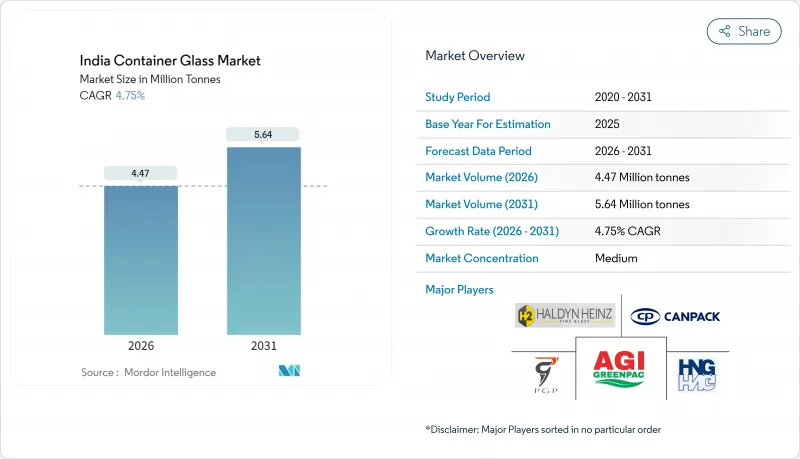
这一成长轨迹反映了印度包装食品和饮料消费的扩张,而这主要得益于都市化和可支配收入的增加。同时,政府政策也日益重视永续包装解决方案,而非一次性塑胶製品。预计到2024年,饮料业将占终端用户市场的63.85%,这主要得益于印度精酿啤酒厂的扩张(从2016年的45家小型酿酒厂增至如今的500多家)以及强劲的酒精消费增长,预计到2027年,酒精饮料市场规模将达到550亿美元。化妆品和个人护理行业正成为成长最快的应用领域,2025年至2030年的复合年增长率将达到6.09%,这反映了优质化趋势,消费者倾向于选择玻璃包装而非塑胶包装,以及ESG(环境、社会和管治)倡议的推动。就颜色细分市场而言,预计到 2024 年,无色玻璃将占 58.71% 的市场份额,而琥珀色玻璃预计将以 5.96% 的复合年增长率引领增长,这主要得益于需要紫外线防护的製药和特种饮料应用。
印度容器玻璃市场趋势与洞察
包装食品和饮料行业的快速成长推动了对玻璃容器的需求。
在超过35%的都市化和日益壮大的中产阶级的推动下,印度的包装食品和饮料产业持续成长,中产阶级越来越注重便利性和品质。食品加工产业的生产关联奖励计画(PLI)已承诺向171家活跃的受益企业投资1,090亿印度卢比。这项投资正在创造下游对符合国际食品安全标准的优质玻璃包装的需求。由于加工食品公司采用I型硼硅酸容器来包装需要长保质期和化学惰性的优质产品,医药级玻璃製造商也从中受益。此外,该行业向出口导向生产的转变也进一步推动了对玻璃的需求,因为许多国际市场对包装的要求高于国内塑胶替代品通常能够达到的标准。
酒精消费量的成长巩固了对玻璃瓶的需求基础。
预计到2027年,印度酒精饮料市场规模将达到550亿美元。保乐力加计划在印度那格浦尔投资178.5亿卢比兴建亚洲最大的麦芽酒厂之一,这表明该公司对高端烈酒市场的增长充满信心,并推动了对琥珀色和无色玻璃瓶的需求,这些玻璃瓶既能保护产品质量,又能传递品牌的高端形象。随着各邦税务部门加强品管和防伪措施,玻璃包装凭藉其防篡改瓶盖和压印品牌标誌等特性,能够完美满足这些要求。
塑胶和软包装的替代会削弱需求
对成本敏感的行业,尤其是食品业,正转向软包装,因为玻璃包装的重量会增加物流成本。先进的阻隔薄膜和多层结构在提供与玻璃包装相当的保质期保护的同时,还能降低包括运输和处理在内的总成本40%至60%。电子商务的蓬勃发展正在加速这一趋势。玻璃製品的破损率超过3%至5%,而软包装的破损率低于1%,这削弱了玻璃包装在价格敏感型市场的价值提案。
细分市场分析
受优质化和消费者对可靠、永续性包装的偏好驱动,化妆品和个人护理品行业预计将在2026年至2031年间以5.85%的复合年增长率增长。饮料业将持续引领市场,到2025年将占63.20%的市场份额,这主要得益于酒精市场规模预计到2027年将达到550亿美元,以及500多家精酿啤酒厂的涌现。在食品加工领域,政府已向171家受益企业发放了总额达1,090亿卢比的生产关联奖励(PLI),这也推动了对符合出口标准的医药级玻璃包装的需求。
印度作为学名药中心,推动了对药品的需求。印度19个邦的118个丛集每年生产约118.726万吨I型硼硅酸玻璃,这种玻璃是无菌应用所必需的。香水产业虽然产量不高,但由于其对感官品质和化学相容性的严格要求,价格却很高。
印度玻璃容器市场报告按最终用户(饮料[含酒精饮料(啤酒、葡萄酒、烈酒和其他酒精饮料)]、非酒精饮料[碳酸软性饮料(CSD)、乳製品饮料等]、食品[果酱、果冻、调味品、酱料等]、化妆品、个人护理用品、香水等])和颜色(无色、琥珀色、绿色等)进行细分。市场预测以吨为单位。
其他福利:
- Excel格式的市场预测(ME)表
- 3个月的分析师支持
目录
第一章 引言
- 研究假设和市场定义
- 调查范围
第二章调查方法
第三章执行摘要
第四章 市场情势
- 市场概览
- 市场驱动因素
- 包装食品和饮料需求的成长正在推动玻璃容器的需求。
- 酒精消费量的成长推动了对玻璃瓶的需求。
- ESG承诺和优质质感使玻璃比塑胶更受欢迎。
- 精酿啤酒和小型酿酒厂的快速成长推动了对优质瓶装啤酒及快速交货的需求。
- 政府针对一次性塑胶製品的倡议
- 强制回收PET导致供应紧张,促使人们重新使用玻璃纤维。
- 市场限制
- 塑胶和软包装的替代作用日益增强,将侵蚀市场。
- 由于高能耗的熔炼过程和二氧化碳排放,成本风险增加。
- 原物料价格波动对中小型熔炼炉带来压力。
- 泰姬陵三角洲地区的高天然气价格限制了菲罗扎巴德的生产能力
- PESTEL 分析
- 产业供应链分析
- 印度容器玻璃熔炉的产能和位置
- 工厂选址及投产
- 生产能力
- 炉型
- 所产玻璃的颜色
- 货柜玻璃进出口资料-涵盖主要进出口目的地
- 进口量及进口额(2021-2024 年)
- 出口量和出口额(2021-2024 年)
- 波特五力分析
- 新进入者的威胁
- 供应商的议价能力
- 买方的议价能力
- 替代品的威胁
- 竞争对手之间的竞争
- 原料分析
- 玻璃包装的回收趋势
- 玻璃包装需求与供给分析
第五章 市场规模与成长预测
- 最终用户
- 饮料
- 酒精饮料
- 啤酒
- 葡萄酒
- 烈酒
- 其他酒精饮料(苹果酒和其他发酵饮料)
- 非酒精性
- 果汁
- 碳酸软性饮料(CSD)
- 乳製品饮料
- 其他非酒精饮料
- 酒精饮料
- 食品(果酱、果冻、橘子酱、蜂蜜、香肠和调味品、食用油、腌菜)
- 化妆品和个人护理
- 药品(不含管瓶和安瓿瓶)
- 香水
- 饮料
- 按颜色
- 绿色的
- 琥珀色
- 无色透明
- 其他颜色
第六章 竞争情势
- 市场集中度
- 策略趋势与发展
- 公司市占率分析(基于当前产能)
- 公司简介
- AGI Greenpac Limited
- CANPACK India Private Limited
- Hindusthan National Glass & Industries Limited
- PGP Glass Private Limited
- Haldyn Heinz Fine Glass Private Limited
- Gerresheimer AG
- Sunrise Glass Industries Private Limited
- Pragati Glass Private Limited
- Empire Industries Limited
- Borosil Limited
- Kapoor Glass India Private Limited
- Khemka Glass Private Limited
- Jagdamba Glass Works Private Limited
- Mono Industries Limited
第七章 市场机会与未来展望
The India Container Glass Market was valued at 4.27 million tonnes in 2025 and estimated to grow from 4.47 million tonnes in 2026 to reach 5.64 million tonnes by 2031, at a CAGR of 4.75% during the forecast period (2026-2031).
This growth trajectory reflects India's expanding packaged food and beverage consumption, driven by urbanization and rising disposable incomes, while government policies increasingly favor sustainable packaging solutions over single-use plastics. Beverages dominate the end-user landscape with a 63.85% market share in 2024, fueled by India's craft brewery expansion from 45 microbreweries in 2016 to more than 500 today, alongside robust alcohol-consumption growth that positions India's alcoholic-beverage segment to reach USD 55 billion by 2027. The cosmetics and personal-care segment emerges as the fastest-growing application at a 6.09% CAGR for 2025-2030, reflecting premiumization trends and ESG commitments that favor glass over plastic packaging. By color segmentation, flint glass commands a 58.71% market share in 2024, while amber glass leads growth prospects at a 5.96% CAGR, driven by pharmaceutical and specialty-beverage applications requiring UV protection.
India Container Glass Market Trends and Insights
Packaged Food and Beverage Boom Fuels Glass-Container Demand
India's packaged-food and beverage sector continues to expand, driven by urbanization rates exceeding 35% and rising middle-class consumption that favors convenience and quality. The Production-Linked Incentive (PLI) scheme for food processing has attracted INR 10,900 crore in committed investments across 171 active beneficiaries.This investment creates downstream demand for premium glass packaging that meets international food-safety standards. Pharmaceutical-grade glass manufacturers benefit as processed-food companies adopt Type I borosilicate containers for premium products requiring extended shelf life and chemical inertness. The sector's shift toward export-oriented production further amplifies glass demand because many international markets mandate higher packaging standards than domestic plastic alternatives typically provide.
Alcohol-Consumption Growth Expands Core Glass Bottle Demand
India's alcoholic-beverage segment is on track to reach USD 55 billion by 2027. Pernod Ricard's planned investment of INR 1,785 crore in Asia's largest malt distillery in Nagpur underscores confidence in premium-spirits growth and calls for specialized amber and flint glass bottles that protect product integrity while conveying brand prestige. State excise departments are imposing stricter quality controls and anti-counterfeiting measures that glass packaging inherently supports through tamper-evident closures and embossed-branding capabilities.
Plastic and Flexible-Packaging Substitution Erodes Demand
Cost-sensitive segments continue to migrate toward flexible packaging, notably in food applications where glass's weight adds logistics costs. Advanced barrier films and multilayer structures offer comparable shelf-life protection at 40-60% lower total cost, including transportation and handling. E-commerce growth amplifies the trend because glass breakage rates can exceed 3-5%, versus less than 1% for flexible alternatives, diminishing glass's value proposition in price-sensitive markets.
Other drivers and restraints analyzed in the detailed report include:
- ESG Commitments and Premium Perception Favor Glass Over Plastics
- Craft Microbrewery Surge Spurs Demand for Short-Run Premium Bottles
- Energy-Intensive Melting and CO2 Emissions Raise Cost Risks
For complete list of drivers and restraints, kindly check the Table Of Contents.
Segment Analysis
The cosmetics and personal-care segment is projected to grow at a 5.85% CAGR during 2026-2031, buoyed by premiumization and consumer preference for packaging that signals authenticity and sustainability. Beverages maintain market dominance with a 63.20% share in 2025, supported by alcohol-market expansion toward USD 55 billion by 2027 and the proliferation of more than 500 microbreweries. Food-processing PLI incentives totaling INR 10,900 crore across 171 beneficiaries also spur demand for pharmaceutical-grade glass containers meeting export standards.
Pharmaceutical demand accelerates through India's role as a generics hub, with 118 clusters across 19 states producing roughly 1,187,260 tonnes annually and requiring Type I borosilicate glass for sterile applications. The perfumery niche, though smaller in tonnage, commands premium pricing because of stringent aesthetic and chemical-compatibility requirements.
India Container Glass Market Report is Segmented by End-User (Beverages [Alcoholic {Beer, Wine, Spirits, Other Alcoholic Beverages}, and Non-Alcoholic {Carbonated Drinks (CSDs), Dairy Product Based Drinks, and More}], Food [Jam and Jelly, Condiments and Sauces, and More], Cosmetics and Personal Care, Perfumery and More), Color (Flint, Amber, Green, and More). The Market Forecasts are Provided in Terms of Volume (Tonnes).
List of Companies Covered in this Report:
- AGI Greenpac Limited
- CANPACK India Private Limited
- Hindusthan National Glass & Industries Limited
- PGP Glass Private Limited
- Haldyn Heinz Fine Glass Private Limited
- Gerresheimer AG
- Sunrise Glass Industries Private Limited
- Pragati Glass Private Limited
- Empire Industries Limited
- Borosil Limited
- Kapoor Glass India Private Limited
- Khemka Glass Private Limited
- Jagdamba Glass Works Private Limited
- Mono Industries Limited
Additional Benefits:
- The market estimate (ME) sheet in Excel format
- 3 months of analyst support
TABLE OF CONTENTS
1 INTRODUCTION
- 1.1 Study Assumptions and Market Definition
- 1.2 Scope of the Study
2 RESEARCH METHODOLOGY
3 EXECUTIVE SUMMARY
4 MARKET LANDSCAPE
- 4.1 Market Overview
- 4.2 Market Drivers
- 4.2.1 Packaged Food and Beverage Boom Fuels Glass Container Demand
- 4.2.2 Alcohol Consumption Growth Expands Core Glass Bottle
- 4.2.3 ESG Commitments and Premium Perception Favor Glass Over Plastics
- 4.2.4 Craft Microbrewery Surge Spurs Demand for Short-Run Premium Bottles
- 4.2.5 Government Push Against Single-Use Plastics
- 4.2.6 Recycled-PET Mandate Tightens Supply, Prompting Shift Back to Glass
- 4.3 Market Restraints
- 4.3.1 Plastic and Flexible Packaging Substitution Erodes
- 4.3.2 Energy-Intensive Melting and CO2 Emissions Raise Cost Risks
- 4.3.3 Raw Material Price Volatility Squeezes Smaller Furnaces
- 4.3.4 Gas Price Spike in Taj Trapezium Zone Curtails Firozabad Capacity
- 4.4 PESTEL Analysis
- 4.5 Industry Supply-Chain Analysis
- 4.6 Container Glass Furnace Capacity and Locations in India
- 4.6.1 Plant Locations and Year of Commencement
- 4.6.2 Production Capacities
- 4.6.3 Types of Furnaces
- 4.6.4 Color of Glass Produced
- 4.7 Export-Import Data of Container Glass - Covering Key Import and Export Destinations
- 4.7.1 Import Volume and Value, 2021-2024
- 4.7.2 Export Volume and Value, 2021-2024
- 4.8 Porter's Five Forces Analysis
- 4.8.1 Threat of New Entrants
- 4.8.2 Bargaining Power of Suppliers
- 4.8.3 Bargaining Power of Buyers
- 4.8.4 Threat of Substitutes
- 4.8.5 Competitive Rivalry
- 4.9 Raw Material Analysis
- 4.10 Recycling Trends for Glass Packaging
- 4.11 Demand vs Supply Analysis for Glass Packaging
5 MARKET SIZE AND GROWTH FORECASTS (VOLUME)
- 5.1 By End-user
- 5.1.1 Beverages
- 5.1.1.1 Alcoholic
- 5.1.1.1.1 Beer
- 5.1.1.1.2 Wine
- 5.1.1.1.3 Spirits
- 5.1.1.1.4 Other Alcoholic Beverages (Cider and Other Fermented Drinks)
- 5.1.1.2 Non-Alcoholic
- 5.1.1.2.1 Juices
- 5.1.1.2.2 Carbonated Drinks (CSDs)
- 5.1.1.2.3 Dairy Product Based Drinks
- 5.1.1.2.4 Other Non-Alcoholic Beverages
- 5.1.1.1 Alcoholic
- 5.1.2 Food (Jam, Jelly, Marmalades, Honey, Sausages and Condiments, Oil, Pickles)
- 5.1.3 Cosmetics and Personal Care
- 5.1.4 Pharmaceuticals (excluding Vials and Ampoules)
- 5.1.5 Perfumery
- 5.1.1 Beverages
- 5.2 By Color
- 5.2.1 Green
- 5.2.2 Amber
- 5.2.3 Flint
- 5.2.4 Other Colors
6 COMPETITIVE LANDSCAPE
- 6.1 Market Concentration
- 6.2 Strategic Moves and Developments
- 6.3 Company Market Share Analysis, (Based on Latest Production Capacity)
- 6.4 Company Profiles (includes Global level Overview, Market level overview, Core Segments, Financials as available, Strategic Information, Market Rank/Share for key companies, Products and Services, and Recent Developments)
- 6.4.1 AGI Greenpac Limited
- 6.4.2 CANPACK India Private Limited
- 6.4.3 Hindusthan National Glass & Industries Limited
- 6.4.4 PGP Glass Private Limited
- 6.4.5 Haldyn Heinz Fine Glass Private Limited
- 6.4.6 Gerresheimer AG
- 6.4.7 Sunrise Glass Industries Private Limited
- 6.4.8 Pragati Glass Private Limited
- 6.4.9 Empire Industries Limited
- 6.4.10 Borosil Limited
- 6.4.11 Kapoor Glass India Private Limited
- 6.4.12 Khemka Glass Private Limited
- 6.4.13 Jagdamba Glass Works Private Limited
- 6.4.14 Mono Industries Limited
7 MARKET OPPORTUNITIES AND FUTURE OUTLOOK
- 7.1 White-space and Unmet-Need Assessment

 德国容器玻璃:市场占有率分析、产业趋势与统计、成长预测(2026-2031)越南容器玻璃:市场占有率分析、产业趋势与统计、成长预测(2026-2031)
 日本玻璃容器市场规模、份额、趋势和预测:按产品、最终用途行业和地区划分,2026-2034年
 2026年全球容器玻璃市场报告2026年全球运动水壶市场报告
 容器玻璃市场 - 全球产业规模、份额、趋势、机会及预测(按玻璃类型、容器类型、成型方法、终端用户产业、地区和竞争格局划分,2021-2031年)广口瓶市场-全球产业规模、份额、趋势、机会和预测(按材料、产能、应用、分销管道、地区和竞争格局划分),2021-2031年酒瓶市场-全球产业规模、份额、趋势、机会、预测:按玻璃类型、应用、容量、地区和竞争格局划分,2021-2031年
 全球卧螺离心机市场(2026-2030 年)
 保温瓶市场规模、份额及成长分析(按类型、材质、应用、通路及地区划分)-2026-2033年产业预测