


 |
市场调查报告书
商品编码
1910925
北美印刷标籤市场:市场占有率分析、产业趋势与统计、成长预测(2026-2031)North America Print Label - Market Share Analysis, Industry Trends & Statistics, Growth Forecasts (2026 - 2031) |
||||||

※ 本网页内容可能与最新版本有所差异。详细情况请与我们联繫。
预计到 2026 年,北美印刷标籤市场规模将达到 105.2 亿美元,从 2025 年的 101.7 亿美元成长到 2031 年的 124.4 亿美元,2026 年至 2031 年的复合年增长率为 3.42%。
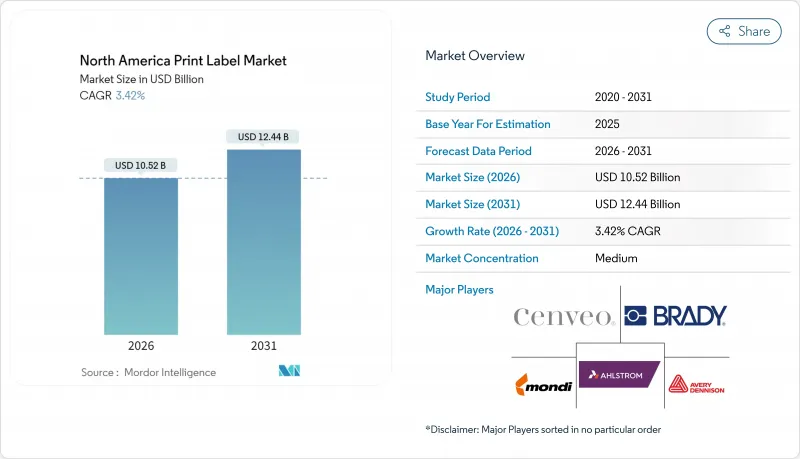
这项稳定扩张反映了市场环境的日趋成熟,数位转型、电子商务物流和永续性需求正在融合,重新定义加工商的经济模式和终端用户需求。可变数据工作流程的加速应用支援即时供应链可视性,而医疗保健产业则受美国食品药物管理局 (FDA)主导的UDI 要求持续推动高端产品成长。墨西哥作为区域生产中心,透过製造商迁址优化成本结构和缩短前置作业时间,补充了美国国内市场的主导地位。儘管柔版印刷仍占据主导地位,但喷墨技术的快速普及标誌着数位化优先营运模式的重大转变,这种模式可以缓解劳动力短缺并减少设置废弃物。永续性持续影响材料的选择,随着企业为满足监管标准而收紧包装目标,无底纸和生物基材越来越受欢迎。
北美印刷标籤市场趋势与洞察
对数位印刷技术的需求日益增长
随着原物料价格上涨和劳动力短缺导致胶印经济效益下降,北美标籤印刷市场正在加速采用数位技术。Ricoh的数据显示,数位排放的损益平衡点将从2010年的2000张A4纸提高到2025年的约10,000张。Canon的LabelStream LS2000(预计于2025年下半年发布)正是这一趋势的体现,它采用高浓度水性墨水,支持FSC认证的承印物并减少VOC排放。惠普加拿大的数据显示,在品牌对大规模客製化的需求推动下,数位印刷目前已占感压标籤产量的10%以上。加工商正在转向即时生产模式,以降低库存成本并实现高利润的小批量订单。这种转变正在重塑资本配置,使模组化、可升级的喷墨平台优先于设定废弃物高、製版成本高的类比印刷机。
电子商务物流中可变数据印刷的激增
电子商务的爆炸性成长推动了对可变资料的需求,因为配送网路需要序列化的QR码和资料矩阵码来实现即时追踪。亚马逊的包装效率计画推广能够根据库存位置、配送路线和客户偏好等参数动态调整的标籤。支援API的列印系统可直接与ERP和仓库管理软体集成,从而加快订单到发货的周期并降低错误率。品牌正在将促销内容和会员优惠嵌入到运输标籤中,将最后一公里配送转变为行销触点。对于加工商而言,可变资料功能是其服务差异化的关键,并有助于在价格战中保护其利润。
在极低温环境下耐久性不足
标准黏合剂在低于-40°F(约-40°C)的温度下会发生分层,从而威胁疫苗和冷冻食品的可追溯性。采用硅胶黏合剂和PET基材的专用低温标籤,可在低至-196 度C(约-318°F)的温度下保持黏合力,但成本是普通替代品的2到3倍。斑马公司的Z-Xtreme 5000T就是一个可行的解决方案,但加工商指出,运输低利润生鲜食品的客户对价格非常敏感。除非价格合理的优质高性能黏合剂能够得到更广泛的应用,否则这项技术难题将限製低温运输产业在不断成长的市场中的应用规模。
细分市场分析
到2025年,柔版印刷将占北美印刷标籤市场37.92%的份额,反映出其在大批量食品饮料行业的强势地位。同时,喷墨平台正以6.69%的复合年增长率快速增长,这标誌着随着加工商寻求更快的换版速度、更少的印版浪费以及可变数据支持,印刷业正发生向数位化的重大转变。受整体拥有成本(TCO)下降的推动,预计到2031年,北美喷墨印刷标籤市场规模将成长一倍以上。
混合工作流程正在兴起,柔版印刷单元负责白色和局部上光,喷墨印表机头则负责四色印刷,从而优化不同SKU的批量经济性。柯达的PROSPER 7000 Turbo和FUJIFILM的Jet Press FP790均配备高速水性印刷系统,速度可达每分钟50米,分辨率为1200 dpi,缩小了与传统模拟印刷机的生产效率差距。静电照相印刷仍然适用于需要不透明白色和品牌标誌性金属色的短版化妆品和保健品应用,但每平方英尺的油墨成本限制了其广泛应用。
由于用途广泛,到2025年,压敏胶标籤将占据北美印刷标籤市场36.35%的份额,其中无底纸标籤的复合年增长率最高,达到6.98%。电商履约中心正积极采用无底纸标籤,因为每卷标籤数量可增加40%,运输成本降低50%;零售商也采用这种标籤形式,以支援零废弃物的后台营运计画。收缩和拉伸套也因创新技术的进步而发展迅速,例如CCL公司的EcoFloat聚烯套管,这种套管在标准回收过程中即可剥离,从而提高了标籤的可回收性。套模标籤在耐用消费品领域仍占有一席之地,因为在这些领域,耐刮擦性是首要考虑因素。
带有RFID和NFC迭加层的多联追踪标籤正在监管严格的製药和工业领域得到应用。虽然湿胶标籤因其传统的品牌美学而在高级啤酒和烈酒类别中继续使用,但由于铝罐的广泛应用,其市场份额正在下降。随着无底纸包装的普及,压敏胶标籤的出货量可能在预测期中期达到峰值,这将迫使加工商拓展其应用范围,或实施支援两种包装形式的自动化印刷和贴标系统。
其他福利:
- Excel格式的市场预测(ME)表
- 3个月的分析师支持
目录
第一章 引言
- 研究假设和市场定义
- 调查范围
第二章调查方法
第三章执行摘要
第四章 市场情势
- 市场概览
- 市场驱动因素
- 对数位印刷技术的需求日益增长
- 电子商务物流领域的可变资料印刷正在兴起
- 转向永续性的无衬纸和收缩套标形式
- 医疗领域强制UDI(产品识别)标籤
- 利用人工智慧实现列印工作流程自动化,以缩短交付时间
- 整合品牌保护与防伪功能
- 市场限制
- 在极低温环境下耐久性不足
- 特殊标籤纸供应波动
- 从类比印刷机转型为数位印刷机需要大量资金投入
- 更严格的VOC和油墨迁移法规将于2026年生效
- 供应链分析
- 监管环境
- 技术展望
- 波特五力分析
- 供应商的议价能力
- 买方的议价能力
- 新进入者的威胁
- 替代品的威胁
- 竞争对手之间的竞争
- 宏观经济因素如何影响市场
第五章 市场规模与成长预测
- 透过印刷技术
- 胶印
- 凹版印刷
- 柔版印刷
- 萤幕
- 凸版印刷
- 静电照相术
- 喷墨
- 按标籤类型
- 湿胶标籤
- 压敏胶标籤
- 无底纸标籤
- 多部分追踪标籤
- 套模标籤
- 缩水/拉伸套
- 按基础材料
- 纸
- 塑胶
- 金属
- 永续生物基
- 按最终用户行业划分
- 食物
- 饮料
- 卫生保健
- 化妆品
- 家用
- 工业的
- 物流与电子商务
- 其他终端用户产业
- 按国家/地区
- 美国
- 加拿大
- 墨西哥
第六章 竞争情势
- 市场集中度
- 策略趋势
- 市占率分析
- 公司简介
- Avery Dennison Corporation
- CCL Industries Inc.
- Multi-Color Corporation
- Brady Corporation
- Smurfit WestRock
- Mondi Group
- Ahlstrom-Munksjo Oyj
- Cenveo Worldwide Limited
- Resource Label Group
- Blue Label Packaging
- OMNI Systems Inc.
- Inovar Packaging Group
- Fort Dearborn Company
- RR Donnelley & Sons Co.
- Fortis Solutions Group
- Traco Packaging
- UPM-Raflatac
- Brook+Whittle
- Lux Global Label
- Consolidated Label Co.
第七章 市场机会与未来展望
North America print label market size in 2026 is estimated at USD 10.52 billion, growing from 2025 value of USD 10.17 billion with 2031 projections showing USD 12.44 billion, growing at 3.42% CAGR over 2026-2031.
This steady expansion reflects a maturing landscape in which digital transformation, e-commerce logistics, and sustainability mandates collectively redefine converter economics and end-user demand. Accelerating adoption of variable-data workflows supports real-time supply-chain visibility, while FDA-driven UDI requirements in healthcare sustain premium growth niches. Mexico's role as a regional production hub complements the United States' domestic dominance, as manufacturers relocate to optimize cost structures and shorten lead times. Flexography remains dominant, yet inkjet's rapid gains signal a decisive pivot toward digital-first operations that alleviate labor constraints and cut setup waste. Sustainability continues to reshape material selection, with linerless and bio-based substrates gaining traction as corporate packaging goals tighten against regulatory benchmarks.
North America Print Label Market Trends and Insights
Growing Demand for Digital Print Technologies
Digital adoption in the North America print label market accelerates as offset economics weaken under rising raw-material prices and labor shortages. Ricoh data show the digital crossover point shifting from 2,000 A4 prints in 2010 to roughly 10,000 prints in 2025. Canon's LabelStream LS2000, slated for H2 2025, exemplifies the trend with high-density aqueous inks that support FSC-compliant substrates and reduce VOC emissions. HP Canada notes digital now accounts for more than 10% of pressure-sensitive label volumes, driven by brand demand for customization at scale. Converters transition toward just-in-time models that slash inventory costs and enable premium, short-run orders with higher margins. The resulting shift restructures capital allocation, favoring modular, upgradeable inkjet platforms over analog presses with high setup waste and plate costs.
Surge in Variable Data Printing for E-commerce Logistics
Explosive e-commerce growth boosts variable-data requirements as fulfillment networks demand serialized QR and data-matrix codes for real-time tracking. Amazon's packaging-efficiency programs drive labels that adapt dynamically to inventory location, shipping route, and customer preference parameters. API-ready printing systems integrate directly with ERP and warehouse software, accelerating order-to-ship cycles and reducing error rates. Brands now embed promotional content or loyalty incentives inside shipping labels, turning the last mile into a marketing touchpoint. For converters, variable-data capability differentiates service offerings and insulates margins against commodity price competition.
Inadequate Durability in Extreme Cold-Chain Applications
Standard adhesives delaminate below -40 °F, jeopardizing traceability for vaccines and frozen food. Specialty cryogenic labels using silicone-based adhesive and PET facestocks maintain adhesion down to -196 °C but cost 2-3 times more than commodity products. Zebra's Z-Xtreme 5000T illustrates available solutions, yet converters cite price sensitivity among customers shipping low-margin perishable goods. The technical challenge limits addressable volume in cold-chain growth segments pending broader adoption of affordable, high-performance adhesives.
Other drivers and restraints analyzed in the detailed report include:
- Sustainability-Driven Switch to Linerless and Shrink-Sleeve Formats
- Healthcare UDI-Labeling Mandates
- Supply Volatility of Specialty Label-Stock Papers
For complete list of drivers and restraints, kindly check the Table Of Contents.
Segment Analysis
Flexography captured 37.92% of the North America print label market share in 2025, reflecting its entrenched role in large-volume food and beverage lines. Inkjet platforms, however, are accelerating at a 6.69% CAGR, signaling a decisive move toward digitization as converters seek quick changeovers, reduced plate waste, and variable-data capability. The North America print label market size attached to inkjet presses is expected to more than double by 2031 as the total cost of ownership declines.
Hybrid workflows are emerging where flexo units lay white or spot varnish while inkjet heads manage four-color builds, optimizing run-length economics across SKUs. Kodak's PROSPER 7000 Turbo and Fujifilm's Jet Press FP790 exemplify high-speed, water-based systems that reach 50 m/min at 1,200 dpi, closing the productivity gap versus legacy analog machines. Electrophotography remains relevant for small-batch cosmetics and nutraceutical applications requiring opaque whites and brand-centric metallics, though ink cost per square foot limits broader adoption.
Pressure-sensitive solutions held 36.35% of the North America print label market size in 2025, owing to application versatility, but linerless alternatives are registering the fastest 6.98% CAGR. E-commerce fulfillment centers value linerless for 40% more labels per roll and 50% lower transport cost, while retailers adopt the format to meet zero-waste back-of-store initiatives. Shrink and stretch sleeves advance on recyclability innovations such as CCL's EcoFloat polyolefin sleeve, which delaminates in standard recycling processes. In-mold labels maintain a niche presence in durable consumer goods where scuff resistance is paramount.
Multi-part tracking labels supporting RFID or NFC overlays serve regulated pharma and industrial sectors. Wet-glue labels persist in premium beer and spirits categories for heritage branding aesthetics but lose share as aluminum can adoption surges. As the linerless scale improves, pressure-sensitive volumes could plateau mid-forecast, pressuring converters to diversify application portfolios or integrate print-and-apply automation that accommodates both formats.
The North America Print Label Market Report is Segmented by Printing Technology (Offset Lithography, Gravure, Flexography, Screen, and More), Label Type (Wet-Glue Labels, Pressure-Sensitive Labels, Linerless Labels, and More), Substrate Material (Paper, Plastic, and More), End-User Industry (Food, Beverage, Healthcare, Cosmetics, Household, and More), and Geography. The Market Forecasts are Provided in Terms of Value (USD).
List of Companies Covered in this Report:
- Avery Dennison Corporation
- CCL Industries Inc.
- Multi-Color Corporation
- Brady Corporation
- Smurfit WestRock
- Mondi Group
- Ahlstrom-Munksjo Oyj
- Cenveo Worldwide Limited
- Resource Label Group
- Blue Label Packaging
- OMNI Systems Inc.
- Inovar Packaging Group
- Fort Dearborn Company
- R.R. Donnelley & Sons Co.
- Fortis Solutions Group
- Traco Packaging
- UPM-Raflatac
- Brook + Whittle
- Lux Global Label
- Consolidated Label Co.
Additional Benefits:
- The market estimate (ME) sheet in Excel format
- 3 months of analyst support
TABLE OF CONTENTS
1 INTRODUCTION
- 1.1 Study Assumptions and Market Definition
- 1.2 Scope of the Study
2 RESEARCH METHODOLOGY
3 EXECUTIVE SUMMARY
4 MARKET LANDSCAPE
- 4.1 Market Overview
- 4.2 Market Drivers
- 4.2.1 Growing demand for digital print technologies
- 4.2.2 Surge in variable data printing for e-commerce logistics
- 4.2.3 Sustainability-driven switch to linerless and shrink-sleeve formats
- 4.2.4 Healthcare UDI-labeling mandates
- 4.2.5 AI-enabled print workflow automation reducing turnaround time
- 4.2.6 Brand protection and anti-counterfeit features integration
- 4.3 Market Restraints
- 4.3.1 Inadequate durability in extreme cold-chain applications
- 4.3.2 Supply volatility of specialty label-stock papers
- 4.3.3 Capital-intensive transition from analog to digital presses
- 4.3.4 Stringent VOC and ink-migration regulations tightening in 2026
- 4.4 Supply-Chain Analysis
- 4.5 Regulatory Landscape
- 4.6 Technological Outlook
- 4.7 Porter's Five Forces Analysis
- 4.7.1 Bargaining Power of Suppliers
- 4.7.2 Bargaining Power of Buyers
- 4.7.3 Threat of New Entrants
- 4.7.4 Threat of Substitutes
- 4.7.5 Competitive Rivalry
- 4.8 Impact of Macroeconomic Factors on the Market
5 MARKET SIZE AND GROWTH FORECASTS (VALUES)
- 5.1 By Printing Technology
- 5.1.1 Offset Lithography
- 5.1.2 Gravure
- 5.1.3 Flexography
- 5.1.4 Screen
- 5.1.5 Letterpress
- 5.1.6 Electrophotography
- 5.1.7 Inkjet
- 5.2 By Label Type
- 5.2.1 Wet-glue Labels
- 5.2.2 Pressure-sensitive Labels
- 5.2.3 Linerless Labels
- 5.2.4 Multi-part Tracking Labels
- 5.2.5 In-mold Labels
- 5.2.6 Shrink and Stretch Sleeves
- 5.3 By Substrate Material
- 5.3.1 Paper
- 5.3.2 Plastic
- 5.3.3 Metallic
- 5.3.4 Sustainable bio-based
- 5.4 By End-user Industry
- 5.4.1 Food
- 5.4.2 Beverage
- 5.4.3 Healthcare
- 5.4.4 Cosmetics
- 5.4.5 Household
- 5.4.6 Industrial
- 5.4.7 Logistics and E-commerce
- 5.4.8 Other End-user Industries
- 5.5 By Country
- 5.5.1 United States
- 5.5.2 Canada
- 5.5.3 Mexico
6 COMPETITIVE LANDSCAPE
- 6.1 Market Concentration
- 6.2 Strategic Moves
- 6.3 Market Share Analysis
- 6.4 Company Profiles (includes Global level Overview, Market level overview, Core Segments, Financials as available, Strategic Information, Market Rank/Share for key companies, Products and Services, and Recent Developments)
- 6.4.1 Avery Dennison Corporation
- 6.4.2 CCL Industries Inc.
- 6.4.3 Multi-Color Corporation
- 6.4.4 Brady Corporation
- 6.4.5 Smurfit WestRock
- 6.4.6 Mondi Group
- 6.4.7 Ahlstrom-Munksjo Oyj
- 6.4.8 Cenveo Worldwide Limited
- 6.4.9 Resource Label Group
- 6.4.10 Blue Label Packaging
- 6.4.11 OMNI Systems Inc.
- 6.4.12 Inovar Packaging Group
- 6.4.13 Fort Dearborn Company
- 6.4.14 R.R. Donnelley & Sons Co.
- 6.4.15 Fortis Solutions Group
- 6.4.16 Traco Packaging
- 6.4.17 UPM-Raflatac
- 6.4.18 Brook + Whittle
- 6.4.19 Lux Global Label
- 6.4.20 Consolidated Label Co.
7 MARKET OPPORTUNITIES AND FUTURE OUTLOOK
- 7.1 White-space and Unmet-need Assessment

 印刷标籤:市场占有率分析、产业趋势与统计、成长预测(2026-2031)美国印刷标籤:市场占有率分析、产业趋势与统计、成长预测(2026-2031 年)
 印刷标籤市场报告:按原料、印刷工艺、标籤格式、最终用途行业和地区划分(2026-2034年)
 2026年全球印刷标籤市场报告
 印刷组件和标籤(热转印、数位印刷、网版印刷):全球市场份额和排名、总收入和需求预测(2025-2031 年)日本印刷标籤市场规模、份额、趋势及预测(按原材料、印刷工艺、标籤格式、最终用途行业和地区),2025 年至 2033 年
 印刷标籤市场规模、份额及成长分析(依印刷製程、标籤格式、原料、最终用途产业、地区及细分市场预测),2025 年至 2032 年
 2025-2029年全球印刷标籤市场
 印刷标籤市场:按标籤格式、印刷工艺、最终用户产业和地区划分标籤印刷和贴标设备:市场占有率分析、行业趋势和统计、成长预测(2025-2030 年)