


 |
市场调查报告书
商品编码
1911421
北美跨境公路货运:市占率分析、产业趋势与统计、成长预测(2026-2031 年)North America Cross Border Road Freight Transport - Market Share Analysis, Industry Trends & Statistics, Growth Forecasts (2026 - 2031) |
||||||

※ 本网页内容可能与最新版本有所差异。详细情况请与我们联繫。
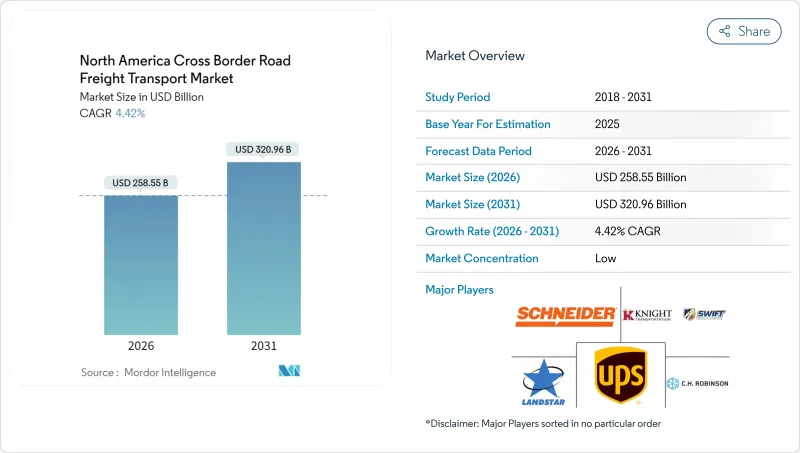
预计北美跨境公路货运市场规模将从 2025 年的 2,476 亿美元成长到 2026 年的 2,585.5 亿美元,到 2031 年将达到 3,209.6 亿美元,2026 年至 2031 年的复合年增长率为 4.42%。
美国-墨西哥-加拿大协定(USMCA)下的贸易整合以及墨西哥近岸外包的加速发展正在重塑货运走廊,将货运量从跨太平洋路线转移到深入美国和加拿大消费区的陆路跨境路线。强大的製造业合作、电子商务的快速普及以及大规模公共基础设施项目共同推动了北美跨境公路货运市场的发展,扩大了负载容量机会并缩短了订单到交货的周期。将自动化海关程序、即时视觉化工具和预测分析融入边境营运的承运商的表现优于传统承运商。然而,网路安全准备和司机可用性仍然是显着的能力差距。对兆瓦级充电走廊和数位化「Complemento Carta Porte」(边境通行证补充)合规平台的投资进一步巩固了智慧边境标准,并凸显了竞争格局中的技术差距。
北美跨境公路货运市场趋势与洞察
近岸外包的快速发展正在重塑北美货运走廊格局
製造业从亚洲向墨西哥的转移,推动墨西哥对美国的出口在2024年增长23%,并使I-35和I-10州际公路沿线的重型货运交通得以集中,绕过太平洋门户。如今,专业承运商已在这些走廊部署专用车辆,以优化墨西哥工厂和美国配送中心之间的往返运输利用率。北向运输的稳定性促使拉雷多、埃尔帕索和圣地牙哥等跨境口岸的基础设施投资增加。同时,美国中西部地区的转运枢纽也迎来了组装中间零件运输量的成长。同时,南向原材料运输的增加,使路线密度更加均衡,并提高了资产回报率。这些结构性变化正在巩固永久性贸易路线,并为北美跨境公路货运市场的长期扩张奠定基础。
电子商务加速发展促进跨境小包裹运输
预计到2024年,跨境电子商务支出将达到261亿加币(192亿美元),其中31%来自美国零售商向加拿大的出货。小包裹运输的快速成长推动了边境地区附近收货点的需求。拥有自动化分类系统、仲介代理服务和费率优化引擎的零担货运公司,如今正以高价提供两日达的跨境配送服务。全通路模式的兴起进一步连结了零售门市的补货和供应商的退货环节,提高了回程传输货运的密度。因此,北美跨境公路货运市场正迅速向高频次、轻型货物运输转型,而这些运输需要详细的海关数据和动态调度。
长期CDL司机和技术人员短缺
到2025年,该行业将面临超过8万名司机的缺口,而跨境的特殊要求更使招聘工作变得困难。货运公司被迫为持有跨境运输资格证书的司机提供18%至22%的工资溢价,但由于司机为了避免文件延误而转向国内路线,导致员工离职率超过95%。技术人员短缺导致的维护週期延长,增加了设备停机时间,并降低了资产运转率。高昂的更换成本迫使小规模的车队营运商考虑合併或退出,加速了北美跨境公路货运市场的整合。
细分市场分析
到2025年,製造业将占北美跨境公路货运市场的31.68%,凸显了涵盖汽车、电子和工业机械的三方生产网路的深度。该领域依赖零件在最终组装前多次跨境运输,从而确保了稳定的运输路线和较高的拖车运转率。随着原始设备製造商(OEM)继续在美国和加拿大采购零件,同时扩大在墨西哥的最终组装规模,预计北美跨境公路货运市场的製造业货运量将进一步成长。拥有保税堆场、堆场管理系统和经认证的安全车队通讯协定的承运商,在OEM实施严格的供应商评分系统后,正赢得大规模的合约。
批发和零售业将达到最高成长率,2026年至2031年的复合年增长率将达到5.07%,这主要得益于电子商务平台的普及,这些平台能够统一三个国家的产品目录。位于主要入境口岸20英里范围内的转运中心将简化当日拼箱货物的分割流程,从而帮助零售商实现准时交货。北美跨境公路货运市场日益分散,商品种类日益丰富,推动了对用于运输食品杂货的温控货车和用于运输家具的高箱拖车的需求。农业、石油天然气和建筑等其他行业也在扩大货物种类,为车队营运商提供了调整设备配置的机会,以适应季节性週期和大型计划进度。
其他福利:
- Excel格式的市场预测(ME)表
- 3个月的分析师支持
目录
第一章 引言
- 研究假设和市场定义
- 调查范围
第二章调查方法
第三章执行摘要
第四章 市场情势
- 市场概览
- 按经济活动分類的GDP分配
- 按经济活动分類的GDP成长
- 经济表现及概况
- 电子商务产业的趋势
- 製造业的发展趋势
- 运输和仓储业GDP
- 物流绩效
- 道路长度
- 出口趋势
- 进口趋势
- 燃油价格趋势
- 卡车运输营运成本
- 卡车运输车队规模(按类型)
- 主要卡车供应商
- 公路货运量趋势
- 公路货运价格趋势
- 透过交通方式分享
- 通货膨胀
- 法律规范
- 价值炼和通路分析
- 市场驱动因素
- 近岸外包的快速发展正在重塑北美货运走廊格局
- 电子商务加速发展促进跨境小包裹运输
- 联邦和州公路再投资(IIJA、IFC 等)
- 数位化Complemento Carta Porte(货物运输单据)合规性正在推动智慧边境技术的应用。
- 兆瓦级充电走廊使电动长途卡车运输成为现实
- 经由中国运输的跨墨西哥航运可以抵消环太平洋地区的波动。
- 市场限制
- 长期缺乏持有商业驾驶执照 (CDL) 的司机和技术人员
- 柴油价格和通行费的波动对利润率带来压力。
- 由于安保人员数量波动,检查站停留时间难以预测。
- TMS网路安全漏洞损害了货物运输的可视性
- 市场创新
- 波特五力分析
- 新进入者的威胁
- 买方的议价能力
- 供应商的议价能力
- 替代品的威胁
- 竞争对手之间的竞争
第五章 市场规模与成长预测
- 终端用户产业
- 农业、渔业、林业
- 建设业
- 製造业
- 石油天然气、采矿和采石
- 批发和零售
- 其他的
- 按国家/地区
- 美国
- 加拿大
- 墨西哥
- 北美其他地区
第六章 竞争情势
- 市场集中度
- 关键策略倡议
- 市占率分析
- 公司简介
- Bison Transport
- CH Robinson
- Cowtown Logistics Freight Management
- CSA Transportation
- DHL Group
- EP Logistics
- Fastfrate Inc.
- Hub Group, Inc.
- Integrity Express Logistics, LLC
- JB Hunt Transport, Inc.
- Knight-Swift Transportation Holdings Inc.
- Landstar System Inc.
- Midland
- Ryder System, Inc.
- Schneider National, Inc.
- Trans International Trucking, Inc.
- Trans-Pro Logistics
- United Parcel Service of America, Inc.(UPS)
- Werner Enterprises Inc.
- XPO, Inc.
第七章 市场机会与未来展望
The North America cross border road freight transport market is expected to grow from USD 247.6 billion in 2025 to USD 258.55 billion in 2026 and is forecast to reach USD 320.96 billion by 2031 at 4.42% CAGR over 2026-2031.
Trade integration under the United States-Mexico-Canada Agreement (USMCA) and the acceleration of nearshoring into Mexico are recalibrating freight corridors, shifting volumes from trans-Pacific lanes toward over-the-road cross-border routes that extend deep into U.S. and Canadian consumer zones. Strong manufacturing linkages, rapid e-commerce adoption, and large-scale public infrastructure programs together bolster the North America cross border road freight transport market by enlarging payload opportunities and shortening order-to-delivery cycles. Carriers that automate customs, deploy real-time visibility tools, and embed predictive analytics into border-crossing routines are outpacing conventional operators, while cybersecurity preparedness and driver recruitment remain critical capability gaps. Investments in megawatt-class charging corridors and digital Complemento Carta Porte compliance platforms further cement smart-border standards, sharpening the technology divide across the competitive field.
North America Cross Border Road Freight Transport Market Trends and Insights
Near-Shoring Boom Reshapes North America Freight Corridors
Manufacturing migration from Asia to Mexico lifted Mexican exports to the United States by 23% in 2024, anchoring heavy freight flows along I-35 and I-10 that bypass Pacific gateways. Specialized carriers now deploy dedicated fleets on these corridors, optimizing round-trip utilization between Mexican plants and U.S. distribution nodes. Northbound stability encourages infrastructure investments at Laredo, El Paso, and San Diego crossings, while U.S. Midwestern hubs receive higher volumes of intermediate components for assembly lines. In parallel, southbound shipments of raw materials create balanced lane density that fortifies asset returns. These structural shifts are embedding permanent trade lanes that underpin long-run expansion of the North America cross border road freight transport market.
E-commerce Acceleration Lifts Cross-Border LTL Volumes
Cross-border e-commerce spending reached CAD 26.1 billion (USD 19.2 billion) in 2024, with 31% tied to U.S. retailers shipping into Canada. The proliferation of small-parcel flows fuels demand for consolidation gateways close to border zones. LTL carriers equipped with automated sortation, broker-of-record services, and tariff optimization engines now capture premium premiums for two-day cross-border delivery. Growth of omnichannel models further links retail storefront replenishment with return-to-vendor loops, adding backhaul cargo density. Consequently, the North America cross border road freight transport market is experiencing rapid segmentation toward higher-frequency, lower-weight consignments that require granular customs data and dynamic scheduling.
Chronic CDL Driver and Technician Gap
The industry entered 2025 with an 80,000+ driver shortfall, and specialized cross-border requirements compound recruitment difficulty. Carriers must offer 18-22% wage premiums for border-certified drivers, yet turnover exceeds 95% as workers chase domestic lanes that avoid documentation delays. Equipment downtime rises as technician shortages lengthen maintenance cycles, squeezing asset availability. High replacement costs drive smaller fleets to consider mergers or exit, accelerating consolidation within the North America cross border road freight transport market.
Other drivers and restraints analyzed in the detailed report include:
- Federal and Provincial Highway Reinvestment
- Digitized Complemento Carta Porte Compliance Drives Adoption of Smart-border Tech
- Diesel-Price and Toll Volatility Compress Margins
For complete list of drivers and restraints, kindly check the Table Of Contents.
Segment Analysis
Manufacturing captured 31.68% of the North America cross border road freight transport market in 2025, underlining the depth of trilateral production networks spanning automotive, electronics, and industrial machinery. This segment benefits from components that cross borders multiple times before final assembly, stabilizing lane volumes and enabling high trailer utilization. The North America cross border road freight transport market size for manufacturing shipments is set to expand as OEMs ramp up Mexico-based final assembly while retaining U.S. and Canadian component sourcing. Carriers with bonded yards, yard-management systems, and certified secure fleet protocols win larger contracts as OEMs enforce stringent vendor scorecards.
Wholesale and retail trade posts the fastest growth at a 5.07% CAGR between 2026-2031, fueled by e-commerce platforms harmonizing catalog offerings across the three countries. Cross-dock facilities positioned within 20 miles of primary ports of entry streamline same-day deconsolidation, enabling retailers to hit promise-date metrics. The North America cross border road freight transport market continues to fragment across SKU profiles, heightening demand for temperature-controlled vans for grocery and high-cube trailers for home-furnishings. Additional segments such as agriculture, oil and gas, and construction also broaden cargo diversity, giving fleets opportunities to calibrate equipment mixes against seasonal cycles and mega-project timelines.
The North America Cross Border Road Freight Transport Market Report is Segmented by End User Industry (Agriculture, Fishing, and Forestry, Construction, Manufacturing, Oil and Gas, Mining and Quarrying, Wholesale and Retail Trade, and Others), and Country (Canada, Mexico, United States, Rest of North America). The Market Forecasts are Provided in Terms of Value (USD).
List of Companies Covered in this Report:
- Bison Transport
- C.H. Robinson
- Cowtown Logistics Freight Management
- CSA Transportation
- DHL Group
- EP Logistics
- Fastfrate Inc.
- Hub Group, Inc.
- Integrity Express Logistics, LLC
- J.B. Hunt Transport, Inc.
- Knight-Swift Transportation Holdings Inc.
- Landstar System Inc.
- Midland
- Ryder System, Inc.
- Schneider National, Inc.
- Trans International Trucking, Inc.
- Trans-Pro Logistics
- United Parcel Service of America, Inc. (UPS)
- Werner Enterprises Inc.
- XPO, Inc.
Additional Benefits:
- The market estimate (ME) sheet in Excel format
- 3 months of analyst support
TABLE OF CONTENTS
1 Introduction
- 1.1 Study Assumptions and Market Definition
- 1.2 Scope of the Study
2 Research Methodology
3 Executive Summary
4 Market Landscape
- 4.1 Market Overview
- 4.2 GDP Distribution by Economic Activity
- 4.3 GDP Growth by Economic Activity
- 4.4 Economic Performance and Profile
- 4.4.1 Trends in E-Commerce Industry
- 4.4.2 Trends in Manufacturing Industry
- 4.5 Transport and Storage Sector GDP
- 4.6 Logistics Performance
- 4.7 Length of Roads
- 4.8 Export Trends
- 4.9 Import Trends
- 4.10 Fuel Pricing Trends
- 4.11 Trucking Operational Costs
- 4.12 Trucking Fleet Size by Type
- 4.13 Major Truck Suppliers
- 4.14 Road Freight Tonnage Trends
- 4.15 Road Freight Pricing Trends
- 4.16 Modal Share
- 4.17 Inflation
- 4.18 Regulatory Framework
- 4.19 Value Chain and Distribution Channel Analysis
- 4.20 Market Drivers
- 4.20.1 Near-Shoring Boom Reshapes N-America Freight Corridors
- 4.20.2 E-Commerce Acceleration Lifts Cross-Border LTL Volumes
- 4.20.3 Federal and Provincial Highway Reinvestment (IIJA, IFC, etc.)
- 4.20.4 Digitised Complemento Carta Porte Compliance Drives Adoption of Smart-Border Tech
- 4.20.5 Megawatt Charging Corridors Unlock Electric Long-Haul Trucking
- 4.20.6 China-via-Mexico Trans-Shipment Offsets Trans-Pacific Volatility
- 4.21 Market Restraints
- 4.21.1 Chronic CDL Driver and Technician Gap
- 4.21.2 Diesel-Price and Toll Volatility Compress Margins
- 4.21.3 Security Staffing Waves Create Unpredictable Checkpoint Dwell
- 4.21.4 TMS Cybersecurity Breaches Interrupt Load Visibility
- 4.22 Technology Innovations in the Market
- 4.23 Porter's Five Forces Analysis
- 4.23.1 Threat of New Entrants
- 4.23.2 Bargaining Power of Buyers
- 4.23.3 Bargaining Power of Suppliers
- 4.23.4 Threat of Substitutes
- 4.23.5 Competitive Rivalry
5 Market Size and Growth Forecasts (Value, USD)
- 5.1 End User Industry
- 5.1.1 Agriculture, Fishing, and Forestry
- 5.1.2 Construction
- 5.1.3 Manufacturing
- 5.1.4 Oil and Gas, Mining and Quarrying
- 5.1.5 Wholesale and Retail Trade
- 5.1.6 Others
- 5.2 Country
- 5.2.1 United States
- 5.2.2 Canada
- 5.2.3 Mexico
- 5.2.4 Rest of North America
6 Competitive Landscape
- 6.1 Market Concentration
- 6.2 Key Strategic Moves
- 6.3 Market Share Analysis
- 6.4 Company Profiles (Includes Global Level Overview, Market Level Overview, Core Segments, Financials as Available, Strategic Information, Market Rank/Share for Key Companies, Products and Services, and Recent Developments)
- 6.4.1 Bison Transport
- 6.4.2 C.H. Robinson
- 6.4.3 Cowtown Logistics Freight Management
- 6.4.4 CSA Transportation
- 6.4.5 DHL Group
- 6.4.6 EP Logistics
- 6.4.7 Fastfrate Inc.
- 6.4.8 Hub Group, Inc.
- 6.4.9 Integrity Express Logistics, LLC
- 6.4.10 J.B. Hunt Transport, Inc.
- 6.4.11 Knight-Swift Transportation Holdings Inc.
- 6.4.12 Landstar System Inc.
- 6.4.13 Midland
- 6.4.14 Ryder System, Inc.
- 6.4.15 Schneider National, Inc.
- 6.4.16 Trans International Trucking, Inc.
- 6.4.17 Trans-Pro Logistics
- 6.4.18 United Parcel Service of America, Inc. (UPS)
- 6.4.19 Werner Enterprises Inc.
- 6.4.20 XPO, Inc.
7 Market Opportunities and Future Outlook
- 7.1 White-Space and Unmet-Need Assessment


