


 |
市场调查报告书
商品编码
1937296
中国豪华车市场:市场占有率分析、产业趋势与统计及成长预测(2026-2031年)China Luxury Car - Market Share Analysis, Industry Trends & Statistics, Growth Forecasts (2026 - 2031) |
||||||

※ 本网页内容可能与最新版本有所差异。详细情况请与我们联繫。
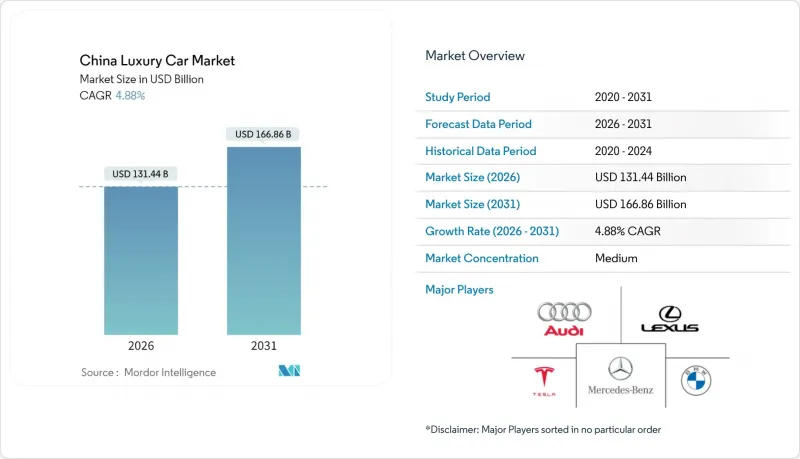
中国豪华车市场预计将从 2025 年的 1,253.2 亿美元成长到 2026 年的 1,314.4 亿美元,到 2031 年达到 1,668.6 亿美元,2026 年至 2031 年的复合年增长率为 4.88%。
这一扩张得益于电气化进程的加速、区域城市居民可支配收入的成长以及对新能源汽车(NEV)的有利政策支持。消费者对高阶汽车作为行动技术平台的态度转变也推动了需求成长,迫使製造商提升自动驾驶能力和连网服务生态系统。随着国内高端电动车品牌缩小技术差距,而外国品牌则寻求透过平台在地化巩固其在中国高端市场的地位,竞争日益激烈。半导体国产化程度的提高和税制改革的趋势预计将继续影响整个价值链的利润率、供应链策略和产品组合决策。
中国豪华车市场趋势与洞察
区域城市富裕消费者的扩张
区域城市居民家庭收入逐年增长,成长超过大都会圈,由此催生了一批新的豪华车买家,他们将汽车视为身份的象征和科技的展示。理想汽车等国产品牌预计到2024年将交付500,508辆汽车,显示追求品质生活的家庭正在拥抱配备ADAS(高级驾驶辅助系统)的大型豪华SUV。高达2万元人民币(约2,800美元)的旧车置换补助提升了消费者的购买力,使中产阶级家庭也能进入中国豪华车市场。
国内豪华电动车品牌扩张
国内领先的汽车製造商正利用换电网路、L2+级自动驾驶技术和OTA空中升级等多种手段来满足市场需求:蔚来汽车预计2024年交付221,970辆汽车,而理想汽车在成立五年内就实现了年交付50万辆的目标。这种成长正在重塑中国高端汽车市场,将竞争格局从传统的内燃机模式转向软体生态系统和服务模式。
联网汽车资料安全法规
中国的资料安全法要求汽车製造商将车辆产生的资料储存在国内,这增加了外国製造商的成本,迫使他们复製全球云端架构。跨境数据流动的限制使空中下载(OTA)升级流程复杂化,扩大了与全球平台的功能差距,并阻碍了中国高端汽车市场的差异化。
细分市场分析
到2025年,SUV将占据中国高端汽车市场63.12%的份额,凸显了消费者对更高驾驶视野和更适合家庭使用的内部空间的偏好。随着蔚来ES6和理想汽车L9等旗舰纯电动车的推出,SUV细分展示室预计到2031年将以6.25%的复合年增长率成长。虽然轿车仍然是商务人士出行的首选,但销售成长正转向专为多代家庭设计的多功能车型。广汽集团推出的L3级自动驾驶技术以及理想MEGA灵活的座椅布局,都展现了自动化和内装多功能性如何树立新的豪华车标竿。
次要影响包括长轴距底盘和自适应气压悬吊套件的需求增加,以提升省道行驶的乘坐舒适性。掀背车虽然属于小众车型,但却受益于都市区停车位紧张的现状,尤其是在拥挤的沿海大都会圈。 SUV 的主导也推动了电池更换技术的普及,因为更大的底盘可以容纳标准化的电池模组,从而增强了中国高端市场固有的基础设施网路效应。
到2025年,内燃机汽车仍将占中国汽车销量的61.95%,目前仍占中国高端汽车市场的最大份额。然而,在购置税减免、电池成本下降以及全国充电桩密度不断提高的推动下,预计到2031年,纯电动车的年复合成长率将达到9.72%。插电式混合动力汽车可以有效缓解里程焦虑,并填补沿海地区基础设施的不足。由于氢气物流的挑战,燃料电池汽车的试验仍处于实验阶段,短期内其影响力有限。
纯电动车(BEV)的优势在于强化了以软体为中心的价值提案,例如高级驾驶辅助系统、身临其境型资讯娱乐系统和持续的空中升级,从而开闢了内燃机汽车无法企及的领域。国内汽车製造商正利用垂直整合的电力电子供应链来降低零件成本,并满足半导体国产化的要求。因此,预计到2031年,售价在30万至60万元人民币之间的电动车品牌将占据中国高端市场55%以上的份额,取代传统上受注重身份的高管青睐的涡轮增压六缸轿车。
其他福利:
- Excel格式的市场预测(ME)表
- 3个月的分析师支持
目录
第一章 引言
- 研究假设和市场定义
- 调查范围
第二章调查方法
第三章执行摘要
第四章 市场情势
- 市场概览
- 市场驱动因素
- 二、三线城市消费者财富不断成长
- 政府对高端新能源汽车的奖励措施
- 对优质化和品牌地位的需求日益增长
- 国内豪华电动车品牌(蔚来、理想汽车)的扩张
- L3级自动驾驶功能提昇平均售价
- 基于NFT的数位所有权奖励
- 市场限制
- 高昂的前期成本和奢侈税
- 联网汽车资料安全法规
- 高端半导体供应受限
- 高阶叫车服务的普及抑制了人们的购买意愿
- 价值/供应链分析
- 监管环境
- 技术展望
- 波特五力模型
- 新进入者的威胁
- 买方的议价能力
- 供应商的议价能力
- 替代品的威胁
- 竞争对手之间的竞争
第五章 市场规模及成长预测(价值(美元)及销售量(单位))
- 按车身样式
- 掀背车
- 轿车
- 运动型多用途车(SUV)
- 多用途汽车(MPV)
- 依动力传动系统类型
- 内燃机车辆
- 电动车(纯电动车、插电式混合动力车、油电混合车、燃料电池电动车)
- 按品牌和原产国
- 中国本土品牌
- 外国品牌
- 按销售管道
- 授权经销商
- 直营店
- 线上直销
第六章 竞争情势
- 市场集中度
- 策略趋势
- 市占率分析
- 公司简介
- Mercedes-Benz Group AG
- BMW Group
- Volkswagen Group(Audi AG)
- Lexus(Toyota Motor Corp.)
- Tesla Inc.
- Zhejiang Geely Holding(Zeekr)
- Dongfeng Motor Company
- China FAW Group(Hongqi)
- NIO Inc.
- Li Auto Inc.
- XPeng Motors
- SAIC-GM(Cadillac)
- GAC Aion
- Infiniti(Nissan Motor Co.)
- Acura(Honda Motor Co.)
- Porsche AG
- Jaguar Land Rover Ltd.
- Lincoln Motor Co.(Ford)
- Rolls-Royce Motor Cars
- Maserati SpA
第七章 市场机会与未来展望
The China luxury car market is expected to grow from USD 125.32 billion in 2025 to USD 131.44 billion in 2026 and is forecast to reach USD 166.86 billion by 2031 at 4.88% CAGR over 2026-2031.
This expansion is underpinned by accelerating electrification, rising disposable income in lower-tier cities, and policy support that favors new-energy vehicles. Demand momentum also stems from consumers who now view premium vehicles as mobile technology platforms, prompting manufacturers to elevate autonomous-driving capabilities and connected-services ecosystems. Competitive intensity has sharpened as domestic electric-luxury brands close traditional technology gaps, while foreign marques localize platforms to safeguard their positions within the China premium car market. Ongoing semiconductor localization and evolving tax regulations will continue to reshape margins, supply-chain strategies, and product-mix decisions across the value chain.
China Luxury Car Market Trends and Insights
Growing Consumer Wealth in Tier-2 and Tier-3 Cities
Household incomes in secondary urban centers are growing annually, outpacing tier-1 growth and spawning a new cohort of premium buyers who view vehicles as status symbols and technology showcases. Domestic brands such as Li Auto delivered 500,508 units in 2024, illustrating how aspirational families embrace large premium SUVs equipped with ADAS. Trade-in subsidies worth up to RMB 20,000 (~USD 2,800 ) have amplified purchasing power, allowing middle-class households to enter the China premium car market.
Expansion of Domestic EV-Luxury Brands
Domestic champions have combined battery-swapping networks, Level 2+ autonomy, and over-the-air upgrades to capture demand. NIO delivered 221,970 vehicles in 2024, and Li Auto reached half a million annual deliveries within five years of launch. Such growth reshapes the China premium car market by shifting the basis of competition from combustion-engine heritage to software ecosystems and service models .
Data-Security Regulation on Connected Vehicles
China's Data Security Law compels automakers to store vehicle-generated data domestically, inflating costs for foreign OEMs that must duplicate global cloud architectures. Limitations on cross-border data flows complicate over-the-air update pipelines, diminishing feature parity with global platforms and restraining differentiation in the China premium car market.
Other drivers and restraints analyzed in the detailed report include:
- L3 Autonomy Features Driving Higher ASP
- NFT-Based Digital Ownership Perks
- Premium Ride-Hailing Curbing Ownership Intent
For complete list of drivers and restraints, kindly check the Table Of Contents.
Segment Analysis
SUVs captured 63.12% of the Chinese premium car market 2025, underscoring consumer preference for commanding driving positions and family-oriented interiors. The SUV sub-segment will expand at a 6.25% CAGR through 2031 as battery-electric flagships like the NIO ES6 and Li Auto L9 dominate showroom traffic. Sedans maintain gravitas in executive transport, but incremental volume shifts to versatile multi-purpose vehicles designed for multi-generational households. GAC's forthcoming Level 3 rollout and Li MEGA's flexible seating highlight how automation and interior versatility set new luxury benchmarks.
The second-order effects include a stronger demand for long-wheelbase chassis and adaptive air-suspension packages that enhance ride comfort on variable road quality in lower-tier cities. Hatchbacks remain niche yet benefit from tight urban parking constraints, particularly in coastal megacities where congestion is severe. SUV leadership also advances battery-swapping adoption because larger underbodies accommodate standardized modules, reinforcing infrastructure network effects unique to the Chinese premium car market.
Internal-combustion vehicles still represented 61.95% of the 2025 volume, translating to the most significant current slice of the China premium car market size. Yet battery-electric models will climb at a 9.72% CAGR through 2031, propelled by purchase-tax exemptions, falling battery costs, and growing charger density nationwide. Plug-in hybrids serve as range-anxiety hedges, bridging coastal infrastructure gaps. Fuel-cell pilots remain experimental owing to hydrogen logistics, limiting near-term influence.
Battery-electric leadership amplifies software-centric value propositions-advanced driver-assistance, immersive infotainment, and continuous over-the-air updates-that combustion rivals cannot match. Domestic OEMs leverage vertically integrated power-electronics supply chains to reduce bill-of-materials and comply with chip-localization directives. Consequently, the China premium car market share for electric nameplates in the RMB 300,000-600,000 bracket is projected to exceed 55% by 2031, displacing turbocharged six-cylinder sedans historically favored by status-conscious executives.
The China Luxury Car Market Report is Segmented by Vehicle Body Style (Hatchbacks, Sedans, and More), Powertrain Type (Internal Combustion Engine Vehicles and Electric Vehicles), Brand Origin (Domestic Chinese Brands and Foreign Brands), and Sales Channel (Authorized Dealerships, Company-Owned Stores, and Online Direct-To-Consumer). The Market Forecasts are Provided in Terms of Value (USD) and Volume (Units).
List of Companies Covered in this Report:
- Mercedes-Benz Group AG
- BMW Group
- Volkswagen Group (Audi AG)
- Lexus (Toyota Motor Corp.)
- Tesla Inc.
- Zhejiang Geely Holding (Zeekr)
- Dongfeng Motor Company
- China FAW Group (Hongqi)
- NIO Inc.
- Li Auto Inc.
- XPeng Motors
- SAIC-GM (Cadillac)
- GAC Aion
- Infiniti (Nissan Motor Co.)
- Acura (Honda Motor Co.)
- Porsche AG
- Jaguar Land Rover Ltd.
- Lincoln Motor Co. (Ford)
- Rolls-Royce Motor Cars
- Maserati S.p.A.
Additional Benefits:
- The market estimate (ME) sheet in Excel format
- 3 months of analyst support
TABLE OF CONTENTS
1 Introduction
- 1.1 Study Assumptions and Market Definition
- 1.2 Scope of the Study
2 Research Methodology
3 Executive Summary
4 Market Landscape
- 4.1 Market Overview
- 4.2 Market Drivers
- 4.2.1 Growing Consumer Wealth in Tier-2 and Tier-3 Cities
- 4.2.2 Government NEV Incentives for the Premium Segment
- 4.2.3 Rising Demand for Premiumization and Brand Status
- 4.2.4 Expansion of Domestic EV-Luxury Brands (NIO, Li Auto)
- 4.2.5 L3 Autonomy Features Driving Higher ASP
- 4.2.6 NFT-Based Digital Ownership Perks
- 4.3 Market Restraints
- 4.3.1 High Upfront Cost and Luxury Tax
- 4.3.2 Data-Security Regulation on Connected Vehicles
- 4.3.3 High-End Semiconductor Supply Constraints
- 4.3.4 Premium Ride-Hailing Curbing Ownership Intent
- 4.4 Value / Supply-Chain Analysis
- 4.5 Regulatory Landscape
- 4.6 Technological Outlook
- 4.7 Porter's Five Forces
- 4.7.1 Threat of New Entrants
- 4.7.2 Bargaining Power of Buyers
- 4.7.3 Bargaining Power of Suppliers
- 4.7.4 Threat of Substitutes
- 4.7.5 Competitive Rivalry
5 Market Size & Growth Forecasts (Value (USD) and Volume (Units))
- 5.1 By Vehicle Body Style
- 5.1.1 Hatchbacks
- 5.1.2 Sedans
- 5.1.3 Sport-Utility Vehicles (SUVs)
- 5.1.4 Multi-purpose Vehicles (MPVs)
- 5.2 By Powertrain Type
- 5.2.1 Internal-Combustion (ICE) Vehicles
- 5.2.2 Electric Vehicles (BEV, PHEV, HEV, FCEV)
- 5.3 By Brand Origin
- 5.3.1 Domestic Chinese Brands
- 5.3.2 Foreign Brands
- 5.4 By Sales Channel
- 5.4.1 Authorized Dealerships
- 5.4.2 Company-Owned Stores
- 5.4.3 Online Direct-to-Consumer
6 Competitive Landscape
- 6.1 Market Concentration
- 6.2 Strategic Moves
- 6.3 Market Share Analysis
- 6.4 Company Profiles (Includes Global Level Overview, Market Level Overview, Core Segments, Financials as Available, Strategic Information, Market Rank/Share for Key Companies, Products & Services, and Recent Developments)
- 6.4.1 Mercedes-Benz Group AG
- 6.4.2 BMW Group
- 6.4.3 Volkswagen Group (Audi AG)
- 6.4.4 Lexus (Toyota Motor Corp.)
- 6.4.5 Tesla Inc.
- 6.4.6 Zhejiang Geely Holding (Zeekr)
- 6.4.7 Dongfeng Motor Company
- 6.4.8 China FAW Group (Hongqi)
- 6.4.9 NIO Inc.
- 6.4.10 Li Auto Inc.
- 6.4.11 XPeng Motors
- 6.4.12 SAIC-GM (Cadillac)
- 6.4.13 GAC Aion
- 6.4.14 Infiniti (Nissan Motor Co.)
- 6.4.15 Acura (Honda Motor Co.)
- 6.4.16 Porsche AG
- 6.4.17 Jaguar Land Rover Ltd.
- 6.4.18 Lincoln Motor Co. (Ford)
- 6.4.19 Rolls-Royce Motor Cars
- 6.4.20 Maserati S.p.A.
7 Market Opportunities & Future Outlook

 2026年全球豪华车市场报告
 豪华车市场规模、份额和趋势分析报告:按车辆类型、驱动方式、地区和细分市场分類的预测(2026-2033 年)
 豪华车市场规模、份额、趋势及报告:按车型、燃料类型、价格范围和地区划分(2026-2034 年)
 豪华车市场分析及预测(至2035年):依类型、产品类型、服务、技术、零件、应用、材质、最终用户、安装类型、解决方案划分
 欧洲豪华车市场-份额分析、产业趋势、统计和成长预测(2026-2031)
 2026-2034年全球豪华车市场规模、份额、趋势及成长分析报告豪华车:市场占有率分析、产业趋势与统计、成长预测(2026-2031)
 豪华车市场机会、成长要素、产业趋势分析及预测(2026-2035)日本豪华车市场报告:按车辆类型、燃料类型、价格范围和地区划分(2026-2034 年)
 豪华车市场规模、份额及成长分析(依动力系统、车辆类型、燃料类型、零件和地区划分)-2026-2033年产业预测