


 |
市场调查报告书
商品编码
1937307
美国乙烯基复合地板材料:市场份额分析、产业趋势与统计、成长预测(2026-2031)US Vinyl Floor Covering - Market Share Analysis, Industry Trends & Statistics, Growth Forecasts (2026 - 2031) |
||||||

※ 本网页内容可能与最新版本有所差异。详细情况请与我们联繫。
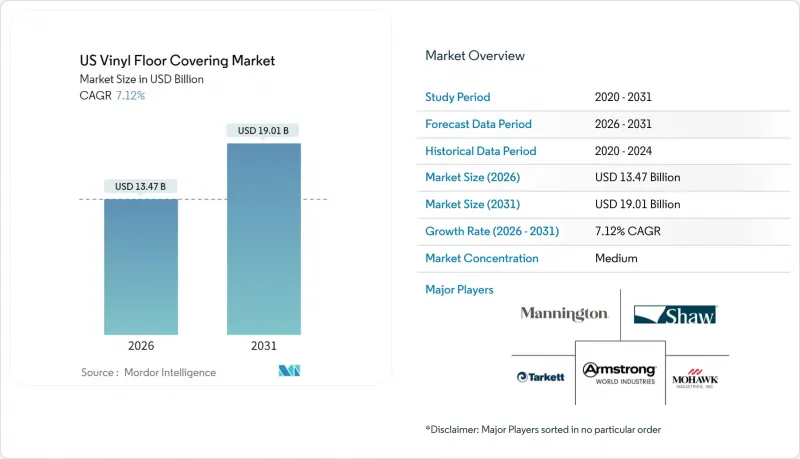
美国乙烯基地板材料市场预计将从 2025 年的 125.7 亿美元增长到 2026 年的 134.7 亿美元,到 2031 年达到 190.1 亿美元,2026 年至 2031 年的复合年增长率为 7.12%。
美国PVC地板材料市场持续保持稳健成长势头,强劲的房屋翻新支出、多用户住宅竣工量的增加以及硬芯技术的快速普及抵消了原材料成本波动和监管审查的影响。住宅维修继续支撑着销量,而随着办公室、医疗机构和住宿设施优先考虑感染控制、隔音效果和低维护成本,商用级PVC地板的需求也在復苏。
在美国国内,製造商正利用对中国产品征收关税的机会,提升本地生产能力并缩短前置作业时间,从而在全球供应链中断的情况下,进一步增强美国PVC地板材料市场的竞争力。与联邦灾害缓解计画相关的紧急资金,加上消费者对防水地板材料的需求,正在推动石塑复合材料(SPC)和木塑复合材料(WPC)产品的销售成长。数位印刷技术和卡扣系统的不断改进,提升了地板的美观度并缩短了安装时间,促进了专业通路和DIY通路的普及。这确保了美国PVC地板材料市场能够持续满足不断变化的终端用户需求。
美国乙烯基复合地板材料市场趋势与洞察
住宅翻新需求加速成长
预计到2025年,美国房屋翻新总支出将达到5,090亿美元,较2024年成长1.22%,仍比疫情前水准高出50%。平均房龄44年的老旧住宅对兼具美观和易于安装的地板材料需求持续增长。乙烯基(PVC)地板材料满足了注重预算的住宅的需求,它拥有与实木地板相似的外观,安装成本却比实木地板低40%至60%,而且无需像瓷砖那样进行勾缝维护。不断上涨的房价推动了住宅净值贷款的增加,刺激了自由裁量权的维修支出,从而促进了美国乙烯基(PVC)地板材料市场的发展。老年家庭是目前房屋翻新支出最大的群体,他们越来越倾向于选择易于维护的地板材料,进一步推动了这个成长要素。不同种族家庭参与房屋翻新活动的增加,拓宽了人们的风格偏好,并促使大型零售商的产品种类(库存单位)不断增加。儘管出现了竞争性的覆膜产品,但印刷精度和压纹精度的持续创新将有助于乙烯基材料保持其受欢迎程度,预计这种成长势头至少会持续到 2020 年代中期。
刚性芯材(SPC/WPC)技术的应用日益广泛
Rigid Core产品线已在豪华乙烯基瓷砖市场占据63%的市场份额,而SPC产品凭藉其低调的设计和低成本优势,正在不断扩大市场份额。尺寸稳定性使得建筑商能够在传统上以捲材为主的区域,例如地下室、浴室和人流量大的大厅等潮湿环境,指定使用乙烯基产品。卡扣式锁扣技术缩短了安装时间,即使在技术纯熟劳工持续短缺的情况下,也能帮助计划按时完成。 Mohawk公司正在增设一条自动化SPC生产线,并计划在未来几年内投入9亿美元,以维持其19%的市占率领先地位。 Shaw公司正在升级位于卡尔霍恩的工厂,以生产WPC产品,扩大国内产能并降低关税风险。建筑规范中关于防水性能的要求从表面水测试改为“安装后防水性能”,这增强了SPC产品的价值提案,并促进了高密度石灰石芯材的研发。这些因素共同作用,将巩固Rigid Core产品在2030年后美国乙烯基地板材料市场的主导地位。
加强对邻苯二甲酸酯和全氟烷基物质的监管。
美国环保署 (EPA) 的 DINP 评估草案得出结论,儿童接触乙烯基塑胶地板材料粉尘构成不合理的风险,并已启动公众意见征询期,建议未来收紧监管。同时,《综合环境反应、赔偿和责任法》(CERCLA) 将全氟烷基和多氟烷基物质 (PFAS) 列入有害物质清单,增加了使用含氟加工助剂的製造商的法律责任风险。合规措施促使人们开发出不含聚氯乙烯 (PVC) 的弹性体,例如 Schau 公司的 EcoWorx Resilient,该产品符合「从摇篮到摇篮」铂金标准,并荣获 2025 年爱迪生奖。配方调整成本和产品停产的可能性正在挤压毛利率,尤其是对于那些规模小规模、无法承担测试成本的製造商。加州和华盛顿州的产品资讯揭露要求使标籤标註更加复杂,并延长了新产品商店的时间。零售买家提出的额外供应链问卷调查也导致采购决策延迟,并暂时减缓了计划进度。儘管对替代化学技术的投资未来可能会带来溢价,但美国乙烯基地板材料市场在短期内仍将持续放缓。
细分市场分析
预计到2025年,豪华乙烯基瓷砖(LVT)将占据美国乙烯基地板材料市场67.62%的份额,并在2031年之前以8.64%的复合年增长率增长,成为规模最大且增长最快的产品线。由于其主导地位,在整个预测期内,美国乙烯基地板材料市场的规模将继续高度依赖LVT的性能指标。 SPC(超聚苯乙烯复合材料)结构减少了基材微小不规则性造成的透光现象,使其在租赁物业的维修中得到更广泛的应用,因为长时间的停工是不可接受的。 WPC(木塑复合材料)因其吸音性能和柔软的触感,在住宅生活空间中仍然很受欢迎,通常采用软木或IXPE背衬,从而提高了声学性能。捲材乙烯基在医疗保健和教育场所的室内装饰中保持着需求,焊接接缝有助于无菌清洁程序。然而,黏合剂技术的进步正在推动市场份额转移到焊接LVT板材。儘管乙烯基复合地砖(VCT)因其低成本而在工业设施中仍占有一席之地,但日益繁重的维护工作正促使人们转向免打蜡的LVT地砖,后者可最大限度地减少地面维护工作。数位装饰层在不显着增加重量的情况下增加了地砖的复杂性,即使在燃油价格上涨时期,也能保持运输效率并控製到岸成本。
儘管产品组合发生了显着变化,但整体产能扩张仍采取谨慎策略,以避免供应过剩。国内工厂正逐步调整运作计划,根据提前六个月确定的自有品牌产品陈列图进行生产。这项策略维持了美国乙烯基复合地板材料市场良好的工厂使用率和价格纪律。供应商提供的硬质和软质同步装饰托盘,使零售商能够销售配套产品组合,从而促进多房间计划的实施。从欧洲引进的连续压制技术,实现了媲美实木的深度压纹效果,开闢了高端市场,在不影响产品价值认知的前提下,提高了平均售价。
到2025年,互锁地板材料将占出货量的53.65%,这印证了消费者对无需黏合剂、方便週末自行安装的地板计划的偏好。黏合式地砖虽然市场占有率较小,但正以7.62%的复合年增长率成长,因为医疗机构、超市和办公室等终端用户对在集中荷载下耐用性的需求日益增长。预计到2026年,美国黏合式乙烯基地板材料市场规模将达到44.1亿美元,反映出商业建筑的稳定需求。自黏式地板捲材受到注重价格的房东的青睐,他们希望在租户更迭时无需聘请专业安装人员即可更换地板。混合型解决方案结合了紧密的互锁结构和周边剥离式黏合剂,以减少高人流量走廊的横向剪切力。
互锁技术的进步取决于精确的加工公差。 SPC芯材最大限度地减少了膨胀,即使在美国常见的湿度波动下也能保持锁扣的完整性。零售商建议使用与相同凹槽相符的装饰条,从而简化配件SKU的复杂性。商业安装人员使用涂胶滚筒在过渡区域涂抹互锁地板的黏合剂,既保证了现场安装速度,也确保了地板的耐用性。领先製造商提供的培训模组使安装人员能够在不到两小时内获得认证。在人手不足的情况下,这是一个关键的卖点,也是推动美国乙烯基复合地板材料市场普及的催化剂。
其他福利:
- Excel格式的市场预测(ME)表
- 3个月的分析师支持
目录
第一章 引言
- 研究假设和市场定义
- 调查范围
第二章调查方法
第三章执行摘要
第四章 市场情势
- 市场概览
- 市场驱动因素
- 住宅装修需求快速成长
- 刚性芯材(SPC/WPC)技术的应用日益广泛
- 与实木地板和瓷砖相比,价格更具竞争力
- 多用户住宅数迅速增加
- 联邦紧急事务管理局(FEMA)资助的灾害易发州对抗灾地板材料的需求
- 零售商自有品牌扩张推动 SKU周转率
- 市场限制
- 加强对邻苯二甲酸酯和全氟烷基物质的监管审查
- PVC树脂价格的波动与石油和天然气价格的波动有关。
- 掩埋成本不断上涨,给最终废弃物处理带来了压力。
- 墨西哥湾沿岸停产后,国内氯气供应网紧张。
- 产业价值链分析
- 波特五力分析
- 新进入者的威胁
- 供应商的议价能力
- 买方的议价能力
- 替代品的威胁
- 竞争对手之间的竞争
- 洞察市场最新趋势与创新
- 深入了解市场近期发展动态(新产品发表、策略性倡议、投资、合作、合资、扩张、併购等)
第五章 市场规模及成长预测(金额:美元)
- 依产品类型
- 豪华乙烯基瓷砖(LVT)
- 石塑复合材料(SPC)
- 木塑复合材料(WPC)
- 豪华乙烯基木地板(LVP)
- 乙烯基片材
- 其他(乙烯基复合地砖(VCT)、弹性乙烯基背衬橡胶混合材料)
- 豪华乙烯基瓷砖(LVT)
- 透过施工方法
- 自黏乙烯基瓷砖
- 黏合剂类型
- 互锁式乙烯基瓷砖
- 其他的
- 最终用户
- 住宅
- 商业的
- 饭店及休閒
- 零售和购物中心
- 医疗设施
- 教育
- 总公司
- 公共和政府设施
- 其他商业用户
- 依建筑类型
- 新建工程
- 重建和维修
- 透过分销管道
- B2C/零售
- 家居建材商店
- 专业地板商店
- 在线的
- 其他分销管道
- B2B/承包商/建筑商
- B2C/零售
- 按地区
- 东北
- 中西部
- 东南
- 西南
- 西方
第六章 竞争情势
- 市场集中度
- 策略趋势
- 市占率分析
- 公司简介
- Mohawk Industries
- Shaw Industries
- Armstrong Flooring
- Tarkett North America
- Mannington Mills
- Gerflor USA
- Karndean Designflooring
- The Dixie Group
- CFL Flooring
- Novalis Innovative Flooring
- Interface Inc.
- LG Hausys America
- Congoleum
- Roppe Corporation
- Forbo Flooring Systems
- Stonhard
- Parterre Flooring Systems
- Polyflor Ltd.
- Metroflor
- Halstead New England(LifeProof)
第七章 市场机会与未来展望
The US vinyl floor covering market is expected to grow from USD 12.57 billion in 2025 to USD 13.47 billion in 2026 and is forecast to reach USD 19.01 billion by 2031 at 7.12% CAGR over 2026-2031.
Strong Remodeling spending sustained multi-family completions, and rapid adoption of rigid-core technologies counterbalance input-cost volatility and regulatory scrutiny, keeping the US vinyl floor covering market on a firmly expansionary trajectory. Residential renovations continue to underpin volume, while commercial specification rebounds as offices, healthcare facilities, and hospitality venues prioritize infection control, acoustic comfort, and lower maintenance costs.
Domestic producers leverage tariffs on Chinese imports, boosting local capacity and shortening lead times, which further fortifies the competitive stance of the US vinyl floor covering market amid global supply disruptions. Resilience funding tied to federal hazard-mitigation programs, together with consumer demand for waterproof flooring, amplifies sales of Stone Plastic Composite (SPC) and Wood Plastic Composite (WPC) formats. Ongoing technological improvements in digital printing and click-lock systems enhance aesthetics, reduce installation time, and spur broader acceptance across both professional and do-it-yourself channels, ensuring that the US vinyl floor covering market remains responsive to evolving end-user expectations.
US Vinyl Floor Covering Market Trends and Insights
Accelerated Residential Remodeling Boom
The remodeling expenditure pool touched USD 509.0 billion in 2025, 1.22% higher than 2024, and outlays remain 50% above pre-pandemic benchmarks. Aging homes with a median age of 44 years sustain demand for floor upgrades that combine aesthetics and ease of installation. Vinyl formats satisfy budget-conscious homeowners by offering hardwood visuals at 40-60% lower installed cost while avoiding grout maintenance common to ceramic tiles. Rising property values enhance home-equity borrowing capacity, encouraging discretionary renovation spending that lifts the US vinyl floor covering market. Older householders, now the largest spenders on remodeling, gravitate toward low-maintenance surfaces, reinforcing this driver. Elevated participation of racially diverse households in renovation activity widens style preference ranges, adding tailwinds for SKU proliferation across big-box assortments. Continuous innovation in print fidelity and embossed-in-register textures helps vinyl maintain mindshare despite competing laminate launches, ensuring momentum through at least mid-decade.
Growing Adoption of Rigid-Core (SPC/WPC) Technologies
Rigid-core lines reached 63% penetration within Luxury Vinyl Tile, with SPC commanding incremental share because of a thinner profile and lower material cost. Dimensional stability lets builders specify vinyl in moisture-exposed basements, bathrooms, and high-traffic lobbies where sheet goods once dominated. Click-lock formats cut labor hours, meeting project schedules amid ongoing skilled-labor shortages. Mohawk's USD 900.0 million multi-year capex adds automated SPC lines that help the company defend its 19% leadership share. Shaw upgrades Calhoun facilities for WPC production, widening domestic capacity and lowering tariff exposure. Building-code wording on in-place water resistance, rather than topical spill testing, strengthens SPC's value proposition and funnels R&D toward higher-density limestone cores. Together, these forces guarantee rigid-core dominance in the US vinyl floor covering market well beyond 2030.
Increasing Regulatory Scrutiny on Phthalates & PFAS
EPA's draft DINP evaluation concludes unreasonable risk to children from vinyl flooring dust exposure, prompting public-comment rounds that signal future restrictions. Parallel PFAS designations under CERCLA widen liability exposure for manufacturers using fluorinated processing aids. Compliance drives R&D into PVC-free elastomers such as Shaw's EcoWorx Resilient, which met Cradle-to-Cradle Platinum criteria and captured the 2025 Edison Award. Re-formulation costs and potential product delistings compress gross margins, especially for small producers lacking scale to spread testing expense. Product-disclosure mandates in California and Washington increase labeling complexity, lengthening time-to-shelf for new lines. Retail buyers add supply-chain questionnaires that can delay award decisions, temporarily slowing project pipelines. Over time, investment in alternative chemistries may unlock premium pricing, but near-term drag persists on the US vinyl floor covering market.
Other drivers and restraints analyzed in the detailed report include:
- Surge in Multi-Family Housing Completions
- FEMA-Funded Resilient-Flooring Demand in Disaster-Prone States
- Volatile PVC Resin Prices Linked to Oil & Gas Swings
For complete list of drivers and restraints, kindly check the Table Of Contents.
Segment Analysis
Luxury Vinyl Tile held 67.62% of US vinyl floor covering market share in 2025, and the segment is tracking an 8.64% CAGR to 2031, underscoring its status as both the largest and fastest-expanding product line. This dominance ensures that the US vinyl floor covering market size remains anchored in LVT performance metrics over the forecast horizon. SPC compositions reduce telegraphing over minor subfloor irregularities, widening retrofit use cases in rental units that cannot tolerate extended downtime. WPC remains popular in single-family living areas for its softer underfoot feel, absorbing footfall noise with cork or IXPE backers that enhance acoustic ratings. Sheet vinyl still claims pockets of medical and education interiors where welded seams support sterile cleaning regimes, though incremental shares migrate toward welded LVT planks as adhesive chemistries improve. Vinyl Composition Tile (VCT) defends industrial installations through low material cost yet rising maintenance favors migration to no-wax LVT that minimizes floor-care labor. Digital decor layers add complexity without meaningfully raising unit weight, enabling freight efficiency that protects landed cost even during fuel-price spikes.
Although product-mix evolution is pronounced, overall capacity additions proceed cautiously to avoid oversupply. Domestic mills stagger commissioning schedules, aligning runs with private-label planograms secured six months ahead. The strategy maintains healthy mill utilization, preserving price discipline in the US vinyl floor covering market. As suppliers synchronize decor palettes across rigid and flexible formats, retailers can bundle coordinated offerings, stimulating multi-room projects. Continuous-press technology imports from Europe promise deeper embossing registers that rival real wood, opening premium niches that lift average selling prices without detracting from value perceptions.
Interlocking planks represented 53.65% of shipments in 2025, validating consumer preference for adhesive-free methodologies that facilitate weekend projects. Glue-down tiles, while a smaller slice, are growing at 7.62% CAGR because healthcare, grocery, and office end-users demand permanence under heavy point loads. The US vinyl floor covering market size for glue-down formats equaled USD 4.41 billion in 2026, reflecting steady commercial pull. Self-adhesive sheets serve price-sensitive landlords who replace floors between tenants without hiring certified installers. Hybrid solutions combine tight-fit tongue-and-groove engagement with peel-film tackifiers at perimeter courses, mitigating lateral shear in rolling-load corridors.
Interlocking advances hinge on precision milling tolerances; SPC cores show minimal expansion, holding lock integrity across humidity swings common in U.S. climates. Retailers promote coordinating moldings that click into the same groove, reducing accessory SKU complexity. Commercial installers leverage adhesive rollers to back-butter interlocking planks in transition zones, ensuring long service life without losing speed advantages in field areas. Training modules from leading manufacturers certify installers in under two hours, a key selling point during labor-short conditions and a catalyst for wider adoption throughout the US vinyl floor covering market.
The US Vinyl Floor Covering Market Report is Segmented by Product Type (LVT, Luxury Vinyl Plank, and More), Installation Method (Self-Adhesive Vinyl Tiles, Glue-Down, and More), End User (Residential, Commercial), Construction Type (New Construction, Remodeling / Retrofit), Distribution Channel (B2C/Retail, B2B/Contractors), and Geography (Northeast, Midwest, and More). The Market Forecasts are Provided in Terms of Value (USD).
List of Companies Covered in this Report:
- Mohawk Industries
- Shaw Industries
- Armstrong Flooring
- Tarkett North America
- Mannington Mills
- Gerflor USA
- Karndean Designflooring
- The Dixie Group
- CFL Flooring
- Novalis Innovative Flooring
- Interface Inc.
- LG Hausys America
- Congoleum
- Roppe Corporation
- Forbo Flooring Systems
- Stonhard
- Parterre Flooring Systems
- Polyflor Ltd.
- Metroflor
- Halstead New England (LifeProof)
Additional Benefits:
- The market estimate (ME) sheet in Excel format
- 3 months of analyst support
TABLE OF CONTENTS
1 Introduction
- 1.1 Study Assumptions and Market Definition
- 1.2 Scope of the Study
2 Research Methodology
3 Executive Summary
4 Market Landscape
- 4.1 Market Overview
- 4.2 Market Drivers
- 4.2.1 Accelerated residential remodeling boom
- 4.2.2 Growing adoption of rigid-core (SPC/WPC) technologies
- 4.2.3 Cost-competitiveness versus hardwood and ceramic tiles
- 4.2.4 Surge in multi-family housing completions
- 4.2.5 FEMA-funded resilient-flooring demand in disaster-prone states
- 4.2.6 Retailers' private-label expansion boosting SKU velocity
- 4.3 Market Restraints
- 4.3.1 Increasing regulatory scrutiny on phthalates and PFAS
- 4.3.2 Volatile PVC resin prices linked to oil and gas swings
- 4.3.3 Growing landfill fees pressuring end-of-life disposal
- 4.3.4 Tight domestic chlorine supply chain after Gulf-Coast outages
- 4.4 Industry Value Chain Analysis
- 4.5 Porter's Five Forces Analysis
- 4.5.1 Threat of New Entrants
- 4.5.2 Bargaining Power of Suppliers
- 4.5.3 Bargaining Power of Buyers
- 4.5.4 Threat of Substitutes
- 4.5.5 Competitive Rivalry
- 4.6 Insights into the Latest Trends and Innovations in the Market
- 4.7 Insights on Recent Developments (New Product Launches, Strategic Initiatives, Investments, Partnerships, JVs, Expansion, M&As, etc.) in the Market
5 Market Size & Growth Forecasts (Value in USD)
- 5.1 By Product Type
- 5.1.1 Luxury Vinyl Tile (LVT)
- 5.1.1.1 Stone Plastic Composite (SPC)
- 5.1.1.2 Wood Plastic Composite (WPC)
- 5.1.2 Luxury Vinyl Plank (LVP)
- 5.1.3 Sheet Vinyl
- 5.1.4 Others (Vinyl Composition Tile (VCT), Resilient Vinyl-Backed Rubber Hybrid)
- 5.1.1 Luxury Vinyl Tile (LVT)
- 5.2 By Installation Method
- 5.2.1 Self-Adhesive Vinyl Tiles
- 5.2.2 Glue-Down
- 5.2.3 Interlocking Vinyl Tiles
- 5.2.4 Others
- 5.3 By End User
- 5.3.1 Residential
- 5.3.2 Commercial
- 5.3.2.1 Hospitality and Leisure
- 5.3.2.2 Retail and Shopping Centers
- 5.3.2.3 Healthcare Facilities
- 5.3.2.4 Education
- 5.3.2.5 Corporate Offices
- 5.3.2.6 Public and Government Buildings
- 5.3.2.7 Other Commercial Users
- 5.4 By Construction Type
- 5.4.1 New Construction
- 5.4.2 Remodeling/Retrofit
- 5.5 By Distribution Channel
- 5.5.1 B2C/Retail
- 5.5.1.1 Home Centers
- 5.5.1.2 Specialty Flooring Stores
- 5.5.1.3 Online
- 5.5.1.4 Other Distribution Channels
- 5.5.2 B2B/Contractors/Builders
- 5.5.1 B2C/Retail
- 5.6 By Geography
- 5.6.1 Northeast
- 5.6.2 Midwest
- 5.6.3 Southeast
- 5.6.4 Southwest
- 5.6.5 West
6 Competitive Landscape
- 6.1 Market Concentration
- 6.2 Strategic Moves
- 6.3 Market Share Analysis
- 6.4 Company Profiles (includes Global level Overview, Market level overview, Core Segments, Financials as available, Strategic Information, Market Rank/Share for key companies, Products & Services, and Recent Developments)
- 6.4.1 Mohawk Industries
- 6.4.2 Shaw Industries
- 6.4.3 Armstrong Flooring
- 6.4.4 Tarkett North America
- 6.4.5 Mannington Mills
- 6.4.6 Gerflor USA
- 6.4.7 Karndean Designflooring
- 6.4.8 The Dixie Group
- 6.4.9 CFL Flooring
- 6.4.10 Novalis Innovative Flooring
- 6.4.11 Interface Inc.
- 6.4.12 LG Hausys America
- 6.4.13 Congoleum
- 6.4.14 Roppe Corporation
- 6.4.15 Forbo Flooring Systems
- 6.4.16 Stonhard
- 6.4.17 Parterre Flooring Systems
- 6.4.18 Polyflor Ltd.
- 6.4.19 Metroflor
- 6.4.20 Halstead New England (LifeProof)
7 Market Opportunities and Future Outlook
- 7.1 Increasing focus on sustainability, circularity and take-back/recycling programs
- 7.2 Surging demand for realistic visuals, textures, and customization

 2026年全球PVC地板材料市场报告
 2035年PVC地板材料市场分析及预测:类型、产品类型、应用、技术、安装方式、材质类型、最终用户、功能、解决方案
 乙烯基复合地板材料:市场占有率分析、产业趋势与统计、成长预测(2026-2031)
 日本PVC地板材料市场规模、份额、趋势和预测:按产品类型、行业和地区划分,2026-2034年
 2025-2029年全球抗衝击PVC地板材料市场
 乙烯基复合地板材料市场规模、份额及成长分析(按产品、类型、安装方式、应用、销售管道和地区划分)-2026-2033年产业预测
 乙烯基地板材料市场按产品类型、安装方式、耐磨层厚度、应用和分销管道划分-2025-2032 年全球预测
 全球乙烯基地板材料市场2025 年至 2033 年乙烯基地板市场规模、份额、趋势及预测(按产品类型、产业和地区)
 乙烯基地板市场-全球产业规模、份额、趋势、机会和预测,细分领域,按产品(乙烯基片材、乙烯基瓷砖、豪华乙烯基瓷砖)、按应用(住宅、商业)、按地区、按竞争,2020-2030 年预测