


 |
市场调查报告书
商品编码
1937381
美国汽车润滑油:市场占有率分析、产业趋势与统计、成长预测(2026-2031)United States Automotive Lubricants - Market Share Analysis, Industry Trends & Statistics, Growth Forecasts (2026 - 2031) |
||||||

※ 本网页内容可能与最新版本有所差异。详细情况请与我们联繫。
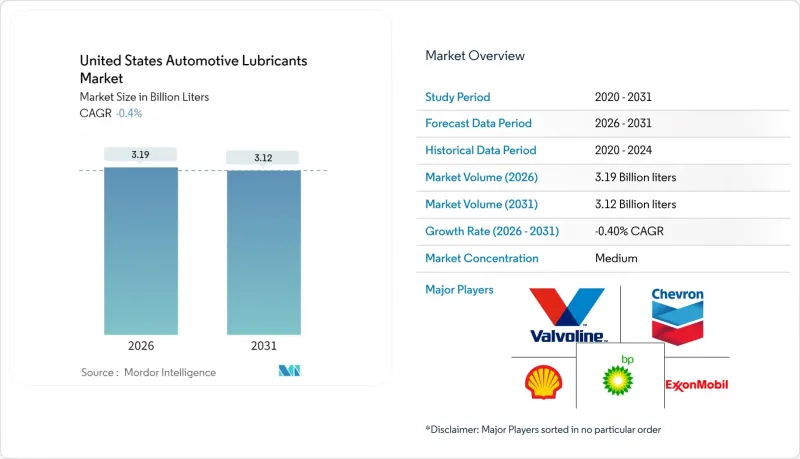
预计到 2026 年,美国汽车润滑油市场规模将达到 31.9 亿公升。
预计这一数字将从 2025 年的 32 亿公升下降到 2031 年的 31.2 亿公升,2026 年至 2031 年的年复合成长率(CAGR)为 -0.40%。
更严格的燃油经济性法规、延长换油週期技术以及加速发展的电气化趋势,正推动产品结构向利润更高的合成油倾斜,同时持续抑制总需求。商用车队正采用预测分析技术,将换油週期从3000英里延长至15,000英里。这降低了散装油的需求,同时提高了高端配方油的单升收益。原始设备製造商(OEM)正将自身的润滑油标准纳入车辆保固条款,并与拥有强大研发能力的供应商签订工厂填充合约。 III类和IV类基础油的供应瓶颈和添加剂短缺,压缩了调配商的利润空间,但也增强了能够保证品质和供应稳定性的成熟品牌的定价权。同时,由胜牌、雪佛龙、壳牌和嘉实多等公司组成的润滑油包装管理协会(LPMA)等行业合作表明,合规性已成为共用成本,而非竞争优势。
美国汽车润滑油市场趋势与洞察
严格的CAFE/GHG标准推动低黏度合成油的过渡
企业平均燃油经济性 (CAFE) 法规要求到 2026 年,所有车辆的燃油经济性每年提高 5%,这迫使汽车製造商从 5W-30 机油过渡到 0W-20 甚至 0W-16 机油。这些机油等级都高度依赖 III 或 IV 类合成油,以在更薄的油膜厚度下保持磨损保护。这种过渡最大限度地减少了内部摩擦损失,并降低了每辆车的润滑油需求。然而,这些超低黏度机油固有的较高原料成本和先进添加剂配方推高了平均售价,从而为能够配製出符合 OEM核准的化学配方的生产商创造了价值。鑑于加州新车註册量占比庞大,其提前实施该法规将加速区域发展。埃克森美孚和壳牌等主要供应商正在投资研发先进的抗氧化剂和摩擦改进剂,以保持领先于不断变化的标准。最终形成了一个高利润、低销售量的环境,奖励创新和监管前瞻性。
OEM工厂灌装规格推动了对优质润滑油的需求
汽车製造商越来越多地将特定品牌的润滑油要求纳入保固条款,并将部分品质保证工作委託给值得信赖的润滑油合作伙伴。通用汽车的Dexos认证和福特的WSS-M2C系列认证等项目要求供应商在核准前必须经过广泛的台架测试、引擎测功机测试和现场测试。例如,嘉实多供应全球约四分之三的OEM原厂润滑油,并利用其品牌优势实现高利润的售后服务加註。混合动力传动系统的出现使情况更加复杂,因为其需要添加防腐蚀添加剂,而这些添加剂在频繁的启动停止循环中可能会导致水汽凝结。雪佛龙最近获得了一项针对混合动力引擎此类化学添加剂的欧洲专利。这些技术壁垒阻碍了新市场进入,并加强了OEM与现有配方商之间的联繫,因为这些配方商能够满足专门的测试标准。
电动动力传动系统的普及将从根本上降低对内燃机油的需求。
电池式电动车(BEV) 的销量显着增长,占据了国内轻型汽车销量的相当大份额,并彻底消除了此类车辆对曲轴箱润滑油的需求。插电混合动力汽车由于部分里程依靠电力驱动,进一步降低了润滑油的需求,减少了 30% 至 50% 的润滑油用量。各州的零排放法规,特别是加州到 2035 年实现 100% 零排放汽车销售的目标,正在加速需求成长。用于电池冷却和电力驱动桥齿轮的特殊润滑油正在出现,但其用量仍远低于传统内燃机的用量。为了规避这一风险,多个领域的供应商正在将业务多元化,进入工业和船舶润滑油领域,或开拓新兴的电动汽车润滑油细分市场,这些市场需要硅基冷却液和介电润滑脂。
细分市场分析
截至2025年,汽车机油占美国汽车润滑油市场的60.10%。儘管汽油和柴油引擎的装置量有所下降,但其庞大的基数确保了对曲轴箱定期保养的持续需求。混合动力汽车也消耗少量引擎油,从而维持了其核心需求。同时,汽车製造商强制要求使用0W-20和0W-16黏度等级的机油,推高了每夸脱机油的平均价格。在这一类别中,同时满足低黏度和长寿命要求的全合成机油成长最快。同时,由于现代多速变速箱结构复杂,需要使用独特的摩擦改进剂配方,美国汽车润滑油市场中自动变速箱油(ATF)的市场规模预计只会略有萎缩。手排变速箱油 (MTF) 和煞车油虽然绝对吨位较小,但也会经历类似的下降,其中 DOT 3 和 DOT 4 油的需求保持稳定,因为混合动力汽车和纯电动车 (BEV) 仍然需要液压煞车系统。
合成润滑脂的应用逆势而上,卢卡斯石油公司于2024年在印第安纳州新增了25,000平方英尺的润滑脂产能,专注于其「Red & Tacky」系列磺酸磺酸盐增稠剂的生产,该系列产品可规避锂皂的供应限制。此次扩建不仅将缓解疫情期间的供不应求,还将促进售后市场从通用锂基润滑脂向非公路用车辆专用重型润滑脂的转换。同时,新兴的电动车温度控管液细分市场,例如奈米填充的乙二醇基冷却液,将开闢新的研发途径,但对总销量的贡献甚微,这凸显了未来成长领域与现有领域衰退之间的不对称性。
美国汽车润滑油市场报告按产品类型(汽车引擎油、手排变速箱油、自动变速箱油、煞车油、汽车润滑脂及其他产品类型)和车辆类型(乘用车、商用车和摩托车)进行细分。市场预测以公升为单位。
其他福利:
- Excel格式的市场预测(ME)表
- 3个月的分析师支持
目录
第一章 引言
- 研究假设和市场定义
- 调查范围
第二章调查方法
第三章执行摘要
第四章 市场情势
- 市场概览
- 市场驱动因素
- 严格的CAFE/GHG标准推动低黏度合成油的过渡
- 由于OEM工厂填充规格的扩大,对优质润滑油的需求增加。
- 船队数位化辅助数据驱动油品延寿服务
- 与远端资讯处理技术相关的维护合约推动了售后市场需求。
- 生物基添加剂创新降低废油毒性
- 市场限制
- 电动车动力传动系统的普及从根本上降低了对内燃机引擎油的需求。
- 延长换油週期可降低每辆车的润滑油消耗。
- 原料价格波动对搅拌机的利润率带来压力。
- 价值炼和通路分析
- 波特五力模型
- 新进入者的威胁
- 供应商的议价能力
- 买方的议价能力
- 替代品的威胁
- 产业间竞争
- 法律规范
- 汽车产业的趋势
第五章 市场规模与成长预测
- 依产品类型
- 汽车引擎油
- 0W-XX
- 5W-XX
- 10W-XX
- 15W-XX
- 单黏度油
- 其他年级
- 手排变速箱油(MTF)
- 自排变速箱油(ATF)
- 煞车油
- 汽车润滑脂
- 其他产品类型(动力方向盘机油等)
- 汽车引擎油
- 按车辆类型
- 搭乘用车
- 商用车辆
- 摩托车
第六章 竞争情势
- 市场集中度
- 策略趋势
- 市占率(%)/排名分析
- 公司简介
- AMSOIL INC.
- Bardahl Manufacturing Corporation
- BP plc
- Chevron Corporation
- CITGO Petroleum Lubricants
- ENEOS Corporation
- ExxonMobil Corporation
- FUCHS
- Gulf Oil International
- HollyFrontier(Petro-Canada Lubricants)
- Idemitsu Lubricants America
- Lucas Oil Products, Inc.
- Motul
- Phillips 66 Company
- Shell plc
- TotalEnergies
- Saudi Arabian Co. Ltd
第七章 市场机会与未来展望
第八章:执行长面临的关键策略挑战
United States Automotive Lubricants Market size in 2026 is estimated at 3.19 billion liters, growing from 2025 value of 3.20 billion liters with 2031 projections showing 3.12 billion liters, growing at -0.40% CAGR over 2026-2031.
A combination of aggressive fuel-economy mandates, extended oil-drain technologies, and accelerating electrification continues to pressure total volumes even as it shifts the product mix toward high-margin synthetics. Commercial fleets deploy predictive analytics that can stretch oil-change intervals from 3,000 miles to as high as 15,000 miles, a move that reduces bulk demand but increases revenue per liter due to premium formulations. Original-equipment manufacturers (OEMs) embed proprietary lube standards in vehicle warranties, locking in factory-fill contracts for suppliers with deep research capabilities. Supply bottlenecks for Group III and Group IV base oils, combined with additive shortages, squeeze blender margins but also reinforce the pricing power of established brands that can guarantee quality and continuity of supply. Meanwhile, collaborative industry responses, such as the Lubricant Packaging Management Association formed by Valvoline, Chevron, Shell, and Castrol, illustrate how regulatory compliance has become a shared cost center rather than a competitive wedge
United States Automotive Lubricants Market Trends and Insights
Stringent CAFE/GHG Standards Driving Shift to Low-Viscosity Synthetics
Corporate Average Fuel Economy (CAFE) rules require fleet-wide efficiency improvements of 5% annually through 2026, prompting automakers to transition from 5W-30 to 0W-20 and even 0W-16 grades, each of which relies heavily on Group III or Group IV synthetics to maintain wear protection at thinner film thicknesses. The transition reduces per-vehicle lubricant demand by minimizing internal friction losses. However, the higher raw-material costs and sophisticated additive recipes inherent in these ultralow viscosities raise average selling prices, enhancing value capture for producers able to formulate to OEM-approved chemistries. California's early enforcement adds a regional accelerator, given its large share of new-vehicle registrations. Key suppliers such as ExxonMobil and Shell invest in advanced antioxidants and friction modifiers to stay ahead of specification upgrades. The net result is a margin-rich but volume-light environment that rewards innovation and regulatory foresight.
OEM Factory-Fill Specifications Expanding Premium Lubricant Demand
Vehicle makers increasingly embed branded fluid requirements into warranty language, effectively outsourcing part of their quality assurance to trusted lubricant partners. Programs such as General Motors' Dexos and Ford's WSS-M2C series force suppliers through extensive bench, engine-dyno, and field trials before approval. Castrol, for instance, supplies roughly three-quarters of global OEM factory fills, leveraging the brand advantage into high-margin service-fill sales. Hybrid powertrains complicate matters further by introducing water condensation during repeated start-stop cycles, requiring corrosion-inhibiting additive blends; Chevron recently secured a European patent covering such chemistry for hybrid engines. These technical hurdles deter new entrants and tighten the bond between OEMs and the established formulators capable of meeting exotic test matrices.
EV Power-Train Adoption Structurally Reducing ICE Engine-Oil Volumes
Battery-electric vehicle (BEV) sales increased significantly, accounting for a considerable share of national light-duty sales, eliminating crankcase oil demand in those cars outright. Plug-in hybrids further dilute the need by relying on electric drive for a portion of miles traveled, trimming lubricant usage by 30-50%. State zero-emission mandates, notably California's 2035 target for 100% ZEV sales, pull demand forward. Although specialized fluids for battery cooling and e-axle gears emerge, their unit volumes remain a fraction of what internal-combustion engines historically absorbed. To hedge, multi-segment suppliers diversify into industrial and marine lubricants or chase nascent EV fluid niches that demand silicon-based coolants and dielectric greases.
Other drivers and restraints analyzed in the detailed report include:
- Fleet Digitalization Enabling Data-Driven Oil-Life Extension Services
- Telematics-Linked Maintenance Contracts Boosting Aftermarket Volumes
- Extended Drain Intervals Cutting Per-Vehicle Lubricant Consumption
For complete list of drivers and restraints, kindly check the Table Of Contents.
Segment Analysis
Automotive engine oil retained 60.10% of the US automotive lubricants market share in 2025. The large installed base of gasoline and diesel engines guarantees a continuing, if tapering, need for routine crankcase service. Hybrid vehicles still consume engine oil, though in smaller quantities, preserving a core demand bedrock while OEM mandates for 0W-20 and 0W-16 grades lift the average price per quart. Within this category, full synthetics expand fastest because they meet low-viscosity and extended-life requirements simultaneously. In parallel, the US automotive lubricants market size for automatic transmission fluids contracts only slightly, buoyed by the complexity of modern multi-speed gearboxes that rely on proprietary friction-modifier blends. Manual transmission fluids and brake fluids, though smaller in absolute tonnage, decline at similar rates because hybrids and BEVs still require hydraulic brake systems that maintain stable demand for DOT 3 and DOT 4 fluids.
Synthetic grease applications bucked the downtrend after Lucas Oil brought an additional 25,000 square feet of grease capacity online in Indiana in 2024, focusing on calcium-sulfonate thickened Red 'N' Tacky products that bypassed lithium-soap supply constraints. The expansion not only alleviates pandemic-era shortages but also catalyzes aftermarket conversions from multipurpose lithium grease to higher-load alternatives favored by off-highway fleets. Meanwhile, the emerging niche for EV thermal-management fluids-glycol-based coolants augmented with nano-fillers-creates new research and development pathways but contributes little to headline volume, illustrating the asymmetry between future growth pockets and legacy decline.
The US Automotive Lubricants Market Report is Segmented by Product Type (Automotive Engine Oil, Manual Transmission Fluids, Automatic Transmission Fluids, Brake Fluids, Automotive Greases, and Other Product Types), and Vehicle Type (Passenger Vehicles, Commercial Vehicles, and Two-Wheelers). The Market Forecasts are Provided in Terms of Volume (Litres).
List of Companies Covered in this Report:
- AMSOIL INC.
- Bardahl Manufacturing Corporation
- BP p.l.c.
- Chevron Corporation
- CITGO Petroleum Lubricants
- ENEOS Corporation
- ExxonMobil Corporation
- FUCHS
- Gulf Oil International
- HollyFrontier (Petro-Canada Lubricants)
- Idemitsu Lubricants America
- Lucas Oil Products, Inc.
- Motul
- Phillips 66 Company
- Shell plc
- TotalEnergies
- Saudi Arabian Co. Ltd
Additional Benefits:
- The market estimate (ME) sheet in Excel format
- 3 months of analyst support
TABLE OF CONTENTS
1 Introduction
- 1.1 Study Assumptions and Market Definition
- 1.2 Scope of the Study
2 Research Methodology
3 Executive Summary
4 Market Landscape
- 4.1 Market Overview
- 4.2 Market Drivers
- 4.2.1 Stringent CAFE/GHG standards driving shift to low-viscosity synthetics
- 4.2.2 OEM factory-fill specifications expanding premium lubricant demand
- 4.2.3 Fleet digitalisation enabling data-driven oil-life extension services
- 4.2.4 Telematics-linked maintenance contracts boosting aftermarket volumes
- 4.2.5 Bio-based additive breakthroughs lowering toxicity of spent oils
- 4.3 Market Restraints
- 4.3.1 EV power-train adoption structurally reducing ICE engine-oil volumes
- 4.3.2 Extended drain intervals cutting per-vehicle lubricant consumption
- 4.3.3 Volatile base-oil feedstock prices squeezing blender margins
- 4.4 Value Chain and Distribution Channel Analysis
- 4.5 Porter's Five Forces
- 4.5.1 Threat of New Entrants
- 4.5.2 Bargaining Power of Suppliers
- 4.5.3 Bargaining Power of Buyers
- 4.5.4 Threat of Substitutes
- 4.5.5 Industry Rivalry
- 4.6 Regulatory Framework
- 4.7 Automotive Industry Trends
5 Market Size and Growth Forecasts (Volume)
- 5.1 By Product Type
- 5.1.1 Automotive Engine Oil
- 5.1.1.1 0W-XX
- 5.1.1.2 5W-XX
- 5.1.1.3 10W-XX
- 5.1.1.4 15W-XX
- 5.1.1.5 Monogrades
- 5.1.1.6 Other Grades
- 5.1.2 Manual Transmission Fluids (MTF)
- 5.1.3 Automatic Transmission Fluids (ATF)
- 5.1.4 Brake Fluids
- 5.1.5 Automotive Greases
- 5.1.6 Other Product Types (Power Steering Fluid etc.)
- 5.1.1 Automotive Engine Oil
- 5.2 By Vehicle Type
- 5.2.1 Passenger Vehicles
- 5.2.2 Commercial Vehicles
- 5.2.3 Two-Wheelers
6 Competitive Landscape
- 6.1 Market Concentration
- 6.2 Strategic Moves
- 6.3 Market Share (%)**/Ranking Analysis
- 6.4 Company Profiles (includes Global level Overview, Market level overview, Core Segments, Financials as available, Production Capacity, Strategic Information, Market Rank/Share for key companies, Products and Services, and Recent Developments)
- 6.4.1 AMSOIL INC.
- 6.4.2 Bardahl Manufacturing Corporation
- 6.4.3 BP p.l.c.
- 6.4.4 Chevron Corporation
- 6.4.5 CITGO Petroleum Lubricants
- 6.4.6 ENEOS Corporation
- 6.4.7 ExxonMobil Corporation
- 6.4.8 FUCHS
- 6.4.9 Gulf Oil International
- 6.4.10 HollyFrontier (Petro-Canada Lubricants)
- 6.4.11 Idemitsu Lubricants America
- 6.4.12 Lucas Oil Products, Inc.
- 6.4.13 Motul
- 6.4.14 Phillips 66 Company
- 6.4.15 Shell plc
- 6.4.16 TotalEnergies
- 6.4.17 Saudi Arabian Co. Ltd
7 Market Opportunities and Future Outlook
- 7.1 White-space and Unmet-need Assessment
8 Key Strategic Questions for CEOs

 汽车润滑油市场:2026-2032年全球市场预测(依产品类型、基础油类型、黏度等级、包装、车辆类型及通路划分)非公路设备润滑油市场:依产品类型、基础油类型、设备类型、最终用途产业、应用与销售管道划分-2026-2032年全球市场预测
 汽车润滑油市场规模、份额、趋势和预测:按产品类型、车辆类型和地区划分,2026-2034年乘用车润滑油市场:2026-2032年全球市场预测(依产品类型、基础油类型、黏度等级、车辆类型及通路划分)商用车润滑油市场:2026-2032年全球市场预测(依基础油类型、润滑油类型、车辆类型、黏度等级、应用与销售管道)
 汽车润滑油市场:依产品类型、通路、车辆类型、国家及地区划分-产业分析、市场规模、市场占有率及2025年至2032年预测
 汽车润滑油市场分析及预测(至2035年):类型、产品、服务、技术、应用、形式、材质类型、介绍形式、最终用户、功能
 汽车润滑油:市场占有率分析、产业趋势与统计、成长预测(2026-2031)越南汽车润滑油:市场占有率分析、产业趋势与统计、成长预测(2026-2031)
 全球汽车润滑油市场规模、份额、趋势和成长分析报告(2026-2034)