


 |
市场调查报告书
商品编码
1937382
越南汽车润滑油:市场占有率分析、产业趋势与统计、成长预测(2026-2031)Vietnam Automotive Lubricants - Market Share Analysis, Industry Trends & Statistics, Growth Forecasts (2026 - 2031) |
||||||

※ 本网页内容可能与最新版本有所差异。详细情况请与我们联繫。
越南汽车润滑油市场在 2025 年的价值为 2.6834 亿公升,预计到 2031 年将达到 3.4586 亿公升,而 2026 年为 2.7995 亿公升。
预计在预测期(2026-2031 年)内,复合年增长率将达到 4.33%。
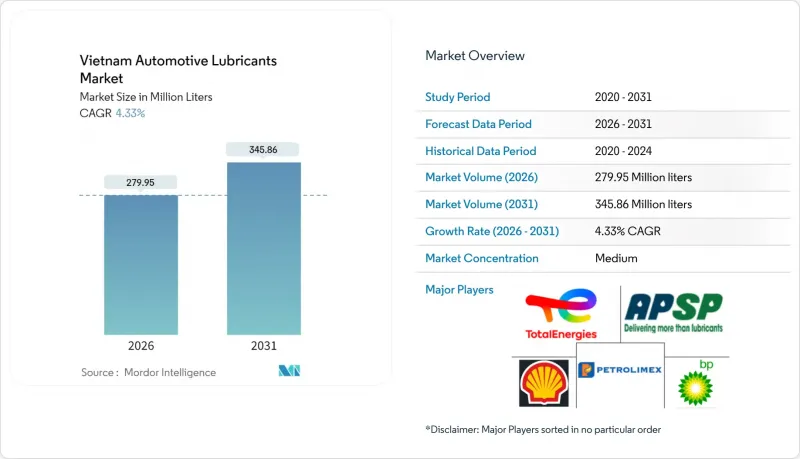
强劲的货运活动、老化的车辆以及不断扩大的电商车队正在支撑市场成长。同时,电气化政策正在重塑长期需求结构。 Petrolimex 的经销网络优势,加上壳牌、BP/嘉实多和摩特等公司在本地配方方面的投资,在维持供应韧性的同时,也促进了市场差异化竞争。优质合成油的快速普及、汽车製造商对延长保养週期的强制性要求以及对仿冒品的更严格打击,正在推高平均售价并扩大利润率。同时,河内即将禁止石化燃料摩托车在环城公路一号线内行驶,以及胡志明市引入低排放气体区的倡议,都预示着传统摩托车的需求将面临监管压力。
越南汽车润滑油市场趋势及分析
车队规模的扩大和车龄的增加将继续推动对润滑油的需求。
越南的车辆登记数量持续增加。车龄超过七年的车型比例不断上升,由于劣化和窜气等问题,需要更频繁地更换机油。卡车运输仍然高度分散,大多数商用车辆的吨位低于五吨,每家公司的平均车队规模仅为五辆车,导致维修事故频繁发生。儘管面临电气化趋势带来的不利影响,但上述因素共同推动越南汽车润滑油市场维持销售成长的趋势。
摩托车市场动态影响都市区润滑油的消费
预计越南将在2025年成为全球第二大电动摩托车市场,而本田预计同年将售出220万辆内燃机摩托车。遍布路边的洗车场提供的定期机油保养服务导致润滑油消耗量庞大。儘管一些监管禁令,例如河内市计划于2026年禁止石化燃料摩托车在1号环城公路上行驶,开始降低都市区的需求,但其他地区庞大的车辆运作量预计将确保越南的汽车润滑油市场在2030年之前继续得到摩托车需求的销售量。
电动车的普及将加速内燃机的淘汰。
VinFast计划在2024年交付97,399辆电池式电动车,并力争在2025年达到150,700辆。由于纯电动车无需使用引擎油,并降低了变速箱油的需求,越南汽车润滑油市场正面临结构性需求下滑,尤其是在都市区车队领域。然而,温度控管冷却液和专用电子润滑脂正在开闢新的高附加价值细分市场。
细分市场分析
截至2025年,汽车机油占越南汽车润滑油市场份额的52.88%。其在乘用车、摩托车和卡车中的广泛应用使其保持了销量主导。然而,自动变速箱油(ATF)的成长速度最快,年复合成长率达4.52%,这主要得益于乘用车自动变速箱普及率的提高以及零件保固范围的扩大。手排变速箱油在轻型卡车领域仍然占据相当大的份额,而煞车油则保持着稳定的、中等偏上的个位数市场份额。
猖獗的假冒仿冒品迫使品牌製造商在高级产品中加入可见和不可见的安全标记,虽然增加了成本,但却维护了品牌价值。调配商也正在将III类基础油与高性能添加剂混合,以满足API SP和欧盟6标准。摩特(Motul)位于越南的工厂已开始对再生基础油混合物进行商业试验,预计与全新II类基础油相比,这些混合物将减少碳排放。这些技术创新增强了竞争优势,并与越南汽车润滑油产业日益增长的OEM伙伴关係相契合。
越南汽车润滑油市场报告按产品类型(汽车引擎油(0W-XX、5W-XX、10W-XX、15W-XX、单一黏度等级机油及其他等级)、手动变速箱油、自动变速箱油、煞车油、汽车润滑脂及其他产品类型)和车辆类型(乘用车、商用车、摩托车)进行细分。市场预测以公升为单位。
其他福利:
- Excel格式的市场预测(ME)表
- 3个月的分析师支持
目录
第一章 引言
- 研究假设和市场定义
- 调查范围
第二章调查方法
第三章执行摘要
第四章 市场情势
- 市场概览
- 市场驱动因素
- 车辆拥有量和平均年龄的增长
- 摩托车在都市区交通中占据主导地位
- 电子商务物流车辆数量快速成长
- 依原厂规定加长排水间距
- 共乘单车租赁业务快速成长
- 市场限制
- 电动车在乘用车领域的渗透率不断提高
- 对价格敏感的消费者往往喜欢品质较低的矿物油。
- 假冒润滑油贸易日益猖獗
- 价值炼和通路分析
- 波特五力模型
- 新进入者的威胁
- 供应商的议价能力
- 买方的议价能力
- 替代品的威胁
- 产业间竞争
- 法律规范
- 汽车产业的趋势
第五章 市场规模与成长预测
- 依产品类型
- 汽车引擎油
- 0W-XX
- 5W-XX
- 10W-XX
- 15W-XX
- 单黏度油
- 其他年级
- 手排变速箱油(MTF)
- 自排变速箱油(ATF)
- 煞车油
- 汽车润滑脂
- 其他产品类型(动力方向盘机油等)
- 汽车引擎油
- 按车辆类型
- 搭乘用车
- 商用车辆
- 摩托车
第六章 竞争情势
- 市场集中度
- 策略趋势
- 市占率(%)/排名分析
- 公司简介
- AP SAIGON PETRO
- BP plc
- Chevron Corporation
- Exxon Mobil Corporation
- Fuchs Petrolub SE
- GS Caltex Corporation
- Idemitsu Kosan Co. Ltd
- Mekong Petrochemical Jsc
- Motul
- Petrolimex(PLX)
- PETRONAS Lubricants International
- PVOIL
- Repsol Vietnam
- Shell Plc
- TotalEnergies
- Wolf Oil Corporation
第七章 市场机会与未来展望
第八章:执行长面临的关键策略挑战
The Vietnam Automotive Lubricants Market was valued at 268.34 million liters in 2025 and estimated to grow from 279.95 million liters in 2026 to reach 345.86 million liters by 2031, at a CAGR of 4.33% during the forecast period (2026-2031).
Robust freight activity, an aging vehicle parc, and expanding e-commerce fleets underpin this growth, even as electrification policies begin to reshape long-term demand. Distribution dominance by Petrolimex, combined with localized blending investments from Shell, BP/Castrol, and Motul, sustains supply resiliency while intensifying competitive differentiation. The rapid adoption of premium synthetics, longer drain intervals mandated by OEMs, and stricter crackdowns on counterfeit products are increasing average selling prices and encouraging margin expansion. At the same time, Hanoi's impending ban on fossil-fuel motorcycles inside Ring Road 1 and Ho Chi Minh City's Low Emission Zone signal regulatory pressure on legacy two-wheeler demand.
Vietnam Automotive Lubricants Market Trends and Insights
Rising Vehicle Parc and Average Age Drive Sustained Lubricant Demand
National vehicle registrations continue to rise. A growing proportion of models are seven years or older, requiring more frequent oil replacements due to degradation and blow-by. Trucking remains fragmented; the majority of commercial vehicles are under 5 tons and average just five trucks per firm, which magnifies service incidents. These factors collectively sustain the Vietnam automotive lubricants market on an upward volume trajectory, despite the headwinds from the electrification trend.
Two-Wheeler Market Dynamics Shape Urban Lubricant Consumption
Although Vietnam became the world's second-largest electric two-wheeler market in 2025, Honda still projects selling 2.2 million ICE motorcycles that year. Routine oil services conducted at ubiquitous roadside washes yield high-frequency lubricant turnover. Legislated bans, such as Hanoi's 2026 exclusion of fossil-fuel motorcycles inside Ring Road 1, begin to narrow urban demand yet leave a vast in-use fleet elsewhere, allowing the Vietnam automotive lubricants market to retain two-wheeler volume support into 2030.
Electric Vehicle Adoption Accelerates ICE Displacement
VinFast shipped 97,399 battery EVs in 2024 and targets 150,700 units in 2025. Because BEVs eliminate engine oil usage and reduce transmission-fluid needs, the Vietnam automotive lubricants market faces structural demand erosion, especially in urban car fleets. Yet thermal-management coolants and specialized e-greases open new high-value niches.
Other drivers and restraints analyzed in the detailed report include:
- E-Commerce Logistics Fleet Expansion Drives Commercial Lubricant Growth
- OEM Extended-Drain Interval Specifications Reshape Product Mix
- Growing Counterfeit Lubricant Trade Undermines Market Integrity
For complete list of drivers and restraints, kindly check the Table Of Contents.
Segment Analysis
Automotive engine oil accounted for 52.88% of the Vietnam automotive lubricants market share in 2025. Embedded usage across cars, motorcycles, and trucks ensures volume leadership. However, automatic transmission fluid (ATF) displays the steepest growth trajectory at a 4.52% CAGR, benefiting from rising passenger-car automatic transmission penetration and intensified parts-warranty compliance. Manual transmission fluid still holds a share in light-duty trucks, whereas brake fluids maintain steady mid-single-digit contributions.
Persistent counterfeit activity forces branded suppliers to embed overt and covert security markers on premium SKUs, adding costs but preserving brand equity. Blenders also incorporate Group III base oils and high-performance additive chemistries to comply with API SP and Euro 6 requirements. Motul's Vietnamese plant has begun commercial trials of Re-Refined Base Oil blends, promising a reduction in carbon footprint compared to virgin Group II stocks. These innovations reinforce competitive positioning and align with evolving OEM partnerships inside the Vietnam automotive lubricants industry.
The Vietnam Automotive Lubricants Market Report is Segmented by Product Type (Automotive Engine Oil (0W-XX, 5W-XX, 10W-XX, 15W-XX, Monogrades, and Other Grades), Manual Transmission Fluids, Automatic Transmission Fluids, Brake Fluids, Automotive Greases, and Other Product Types), and Vehicle Type (Passenger Vehicles, Commercial Vehicles, and Two-Wheelers). The Market Forecasts are Provided in Terms of Volume (Litres).
List of Companies Covered in this Report:
- AP SAIGON PETRO
- BP p.l.c.
- Chevron Corporation
- Exxon Mobil Corporation
- Fuchs Petrolub SE
- GS Caltex Corporation
- Idemitsu Kosan Co. Ltd
- Mekong Petrochemical Jsc
- Motul
- Petrolimex (PLX)
- PETRONAS Lubricants International
- PVOIL
- Repsol Vietnam
- Shell Plc
- TotalEnergies
- Wolf Oil Corporation
Additional Benefits:
- The market estimate (ME) sheet in Excel format
- 3 months of analyst support
TABLE OF CONTENTS
1 Introduction
- 1.1 Study Assumptions and Market Definition
- 1.2 Scope of the Study
2 Research Methodology
3 Executive Summary
4 Market Landscape
- 4.1 Market Overview
- 4.2 Market Drivers
- 4.2.1 Rising vehicle parc and average age
- 4.2.2 Two-wheeler dominance in urban mobility
- 4.2.3 Surge in e-commerce logistics fleets
- 4.2.4 OEM extended-drain interval specifications
- 4.2.5 Rapid growth of ride-hailing motorbike rentals
- 4.3 Market Restraints
- 4.3.1 Rising EV adoption in passenger-car segment
- 4.3.2 Price-sensitive consumer base favouring low-grade mineral oils
- 4.3.3 Growing counterfeit lubricant trade
- 4.4 Value Chain and Distribution Channel Analysis
- 4.5 Porter's Five Forces
- 4.5.1 Threat of New Entrants
- 4.5.2 Bargaining Power of Suppliers
- 4.5.3 Bargaining Power of Buyers
- 4.5.4 Threat of Substitutes
- 4.5.5 Industry Rivalry
- 4.6 Regulatory Framework
- 4.7 Automotive Industry Trends
5 Market Size and Growth Forecasts (Volume)
- 5.1 By Product Type
- 5.1.1 Automotive Engine Oil
- 5.1.1.1 0W-XX
- 5.1.1.2 5W-XX
- 5.1.1.3 10W-XX
- 5.1.1.4 15W-XX
- 5.1.1.5 Monogrades
- 5.1.1.6 Other Grades
- 5.1.2 Manual Transmission Fluids (MTF)
- 5.1.3 Automatic Transmission Fluids (ATF)
- 5.1.4 Brake Fluids
- 5.1.5 Automotive Greases
- 5.1.6 Other Product Types (Power Steering Fluid etc.)
- 5.1.1 Automotive Engine Oil
- 5.2 By Vehicle Type
- 5.2.1 Passenger Vehicles
- 5.2.2 Commercial Vehicles
- 5.2.3 Two-Wheelers
6 Competitive Landscape
- 6.1 Market Concentration
- 6.2 Strategic Moves
- 6.3 Market Share (%) /Ranking Analysis
- 6.4 Company Profiles (includes Global level Overview, Market level overview, Core Segments, Financials as available, Production Capacity, Strategic Information, Market Rank/Share for key companies, Products and Services, and Recent Developments)
- 6.4.1 AP SAIGON PETRO
- 6.4.2 BP p.l.c.
- 6.4.3 Chevron Corporation
- 6.4.4 Exxon Mobil Corporation
- 6.4.5 Fuchs Petrolub SE
- 6.4.6 GS Caltex Corporation
- 6.4.7 Idemitsu Kosan Co. Ltd
- 6.4.8 Mekong Petrochemical Jsc
- 6.4.9 Motul
- 6.4.10 Petrolimex (PLX)
- 6.4.11 PETRONAS Lubricants International
- 6.4.12 PVOIL
- 6.4.13 Repsol Vietnam
- 6.4.14 Shell Plc
- 6.4.15 TotalEnergies
- 6.4.16 Wolf Oil Corporation
7 Market Opportunities and Future Outlook
- 7.1 White-space and Unmet-need Assessment
8 Key Strategic Questions for CEOs

 汽车润滑油市场:2026-2032年全球市场预测(依产品类型、基础油类型、黏度等级、包装、车辆类型及通路划分)非公路设备润滑油市场:依产品类型、基础油类型、设备类型、最终用途产业、应用与销售管道划分-2026-2032年全球市场预测
 汽车润滑油市场规模、份额、趋势和预测:按产品类型、车辆类型和地区划分,2026-2034年乘用车润滑油市场:2026-2032年全球市场预测(依产品类型、基础油类型、黏度等级、车辆类型及通路划分)商用车润滑油市场:2026-2032年全球市场预测(依基础油类型、润滑油类型、车辆类型、黏度等级、应用与销售管道)
 汽车润滑油市场:依产品类型、通路、车辆类型、国家及地区划分-产业分析、市场规模、市场占有率及2025年至2032年预测
 汽车润滑油市场分析及预测(至2035年):类型、产品、服务、技术、应用、形式、材质类型、介绍形式、最终用户、功能
 汽车润滑油:市场占有率分析、产业趋势与统计、成长预测(2026-2031)美国汽车润滑油:市场占有率分析、产业趋势与统计、成长预测(2026-2031)
 全球汽车润滑油市场规模、份额、趋势和成长分析报告(2026-2034)