


 |
市场调查报告书
商品编码
1939004
建筑化学品:市场占有率分析、产业趋势与统计、成长预测(2026-2031)Construction Chemicals - Market Share Analysis, Industry Trends & Statistics, Growth Forecasts (2026 - 2031) |
||||||

※ 本网页内容可能与最新版本有所差异。详细情况请与我们联繫。
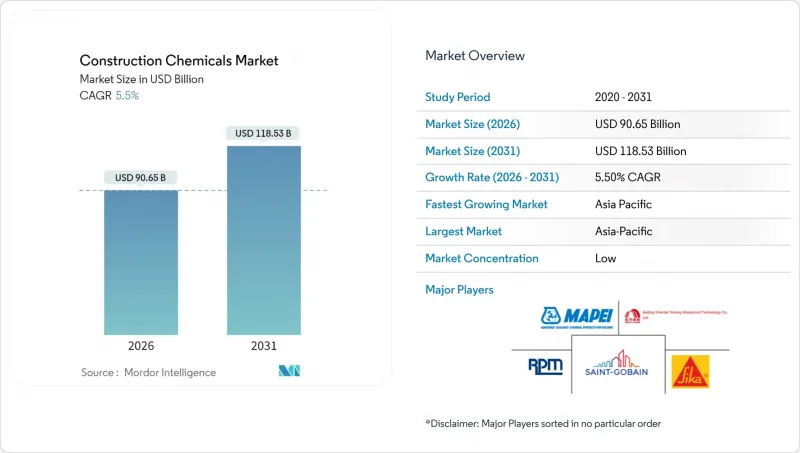
预计到 2026 年,建筑化学品市场规模将达到 906.5 亿美元,高于 2025 年的 859.2 亿美元。
预计到 2031 年将达到 1,185.3 亿美元,2026 年至 2031 年的复合年增长率为 5.5%。
稳健的城市基础设施规划、更严格的绿色建筑法规以及稳定的住宅需求共同推动了建筑化学品市场的成长前景。防水系统是产品收入的基石,因为保险公司和建筑规范机构都将防潮作为首要任务,而先进的表面处理技术在自动化预製构件厂中也日益普及。亚太地区的成长势头最为强劲,大型企划规划正在加速特种化学品的应用。在成熟经济体中,随着新建设活动趋于平稳,资产翻新计画将支撑市场需求。竞争环境有利于那些将配方技术与现场技术服务结合的供应商,他们可以帮助承包商满足更严格的性能规格。
全球建筑化学品市场趋势与洞察
都市化主导的基础建设热潮推动了新兴市场的需求。
亚太地区的永续城市建设计画正推动大量使用外加剂、防水剂和养护剂,以提高拥挤工地上的耐久性。印度耗资1.4兆美元的国家基础设施计画也起到了类似的催化作用,其大规模高速公路和地铁计划指定使用低收缩混凝土外加剂,以确保楼板的连续性。联合国人居住署预测,到2050年,城市居民将增加25亿,这意味着与交通、公共产业和高层住宅相关的化学物质具有长期成长潜力。建筑商也依赖快速凝固水泥浆来满足大型企划的工期要求。综上所述,这些因素表明,建设化学品市场具有超越短期波动的内在结构性需求。
绿建筑标准推动外加剂需求
能源性能指令迫使设计师设定碳排放限制,促使混凝土生产商采用高性能减水剂和水泥添加剂。欧盟根据《建筑能源性能指令》规定,所有新建建筑必须在2030年前净零排放。美国LEED v4.1和BREEAM标准同样评估低VOC密封剂和生物基涂料,从而推动了大豆多元醇基聚氨酯防水膜的高端细分市场发展。诸如EPA Safer Choice等产品註册计画进一步引导建筑商选择水性系统。在监管截止日期前改善产品的供应商能够增强市场信心,并在建设化学品市场中提升定价权。
石化产品价格波动
原油及其衍生原料价格的波动挤压了供应商的利润空间,并使承包商的预算编制变得更加复杂。 2024年全年,布兰特原油价格在每桶70至90美元之间波动,丙烯和环氧树脂的价格也随之波动。製造商采取的应对措施包括自行承担成本上涨或加收附加费,这在某些情况下导致高价值产品无法按时交付现场。不断上升的地缘政治风险进一步扰乱了供应链,促使配方商转向生物基多元醇和再生聚合物。因此,在原材料价格趋势稳定之前,短期内的不确定性预计将限制建设化学品市场的预期成长率。
细分市场分析
到2025年,防水解决方案将占据建设化学品市场35.10%的份额,凸显了其在保护混凝土和砖石结构免受潮气侵蚀方面的核心作用。这个细分市场受益于更严格的建筑规范,这些规范强制要求对地下室进行全面防水,采用绿色屋顶膜,并在蓄水结构中使用负压侧涂层。易受洪水侵袭地区的基建机构需要能够填充宽达2毫米裂缝的弹性体片材,儘管大宗聚合物价格波动,但其价格仍居高不下。製造商透过在聚合物链中加入奈米黏土阻隔层来打造差异化品牌,从而将透水性降低40%。
表面处理化学品领域成长最快,复合年增长率达6.65%,这主要得益于市场对采用机器人养护剂以提高批次均匀性的自动化预製构件厂的需求不断增长。此外,用于减少物流仓库粉尘产生的硅酸锂硬化剂的需求也在增加。外加剂产品组合持续发展,其中聚羧酸醚类高效减水剂可在24小时内达到25 MPa的强度,从而实现模板的重复使用,这对于模组化建筑至关重要。
建筑化学品报告按产品类型(黏合剂、锚固剂和水泥浆、混凝土外加剂、混凝土保护涂料、地板树脂、修补和修復化学品、密封剂等)、最终用途(商业、工业和公共、基础设施、住宅)和地区(亚太地区、北美、欧洲、南美、中东和非洲)进行细分。
区域分析
至2025年,亚太地区将占建筑化学品市场41.10%的份额,并在2031年之前保持6.12%的最高复合年增长率。在中国,「一带一路」倡议和沿海港口维修计画正在推动市场需求,其中低氯化物外加剂在海洋环境中尤其重要。印度的智慧城市计画正在推动100多个城市采购屋顶防水材料和路面密封剂。同时,东南亚工业园区的建设正在加速,带动了对耐二氧化碳涂料的需求。注重价格的建筑商倾向于选择本地配方,但也会就复杂的桥面工程咨询跨国供应商,从而达成合作生产协议,进一步扩大区域市场渗透率。
北美地区公共部门现代化进程持续推动稳定的收入成长。 5500亿美元的联邦基础设施法案将用于15,000英里车道的道路翻新,这需要使用纤维增强型修补砂浆。诸如《国际住宅规范》之类的建筑规范要求在地下室安装防潮层,从而促进了零售防水卷材的销售。因此,美国和加拿大的成长抵消了私人商业建筑开工量的周期性放缓,使建设化学品市场保持了稳健的成长动能。
欧洲正经历一场日趋成熟又充满创新的变革。欧洲绿色交易的碳中和目标要求使用低水泥熟料水泥,这推动了对高性能减水剂和无碳硅烷密封剂的需求。德国和义大利老旧桥樑的出现促使阴极防蚀水泥浆的应用,而斯堪地那维亚则正在开发用于地下隔热材料的生物基聚氨酯泡棉。
其他福利:
- Excel格式的市场预测(ME)表
- 3个月的分析师支持
目录
第一章 引言
- 研究假设和市场定义
- 调查范围
第二章调查方法
第三章执行摘要
第四章 市场情势
- 市场概览
- 市场驱动因素
- 都市化推动基础建设蓬勃发展
- 绿建筑标准推动外加剂需求
- 政府针对建设业的新冠疫情后经济措施
- 老旧资产导致维修和维修支出增加
- 3D列印混凝土的广泛应用需要一种特殊的配比。
- 市场限制
- 石化产品价格波动
- 加强溶剂型产品中挥发性有机化合物(VOCs)的监管
- 高级外加剂配比技能差距
- 价值链分析
- 法律规范
- 波特五力模型
- 新进入者的威胁
- 供应商的议价能力
- 买方的议价能力
- 替代品的威胁
- 竞争对手之间的竞争
- 价格趋势分析(选定原料)
第五章 市场规模与成长预测
- 副产品
- 黏合剂
- 热熔胶
- 反应性
- 溶剂型
- 水系统
- 锚栓和水泥浆
- 水泥基
- 树脂
- 混凝土外加剂
- 加速器
- 空气夹带
- 高效减水剂(超塑剂)
- 莱特德
- 收缩率降低
- 黏度调节剂
- 减水剂(增塑剂)
- 其他类型
- 混凝土保护涂层
- 丙烯酸纤维
- 醇酸树脂
- 环氧树脂
- 聚氨酯
- 其他树脂
- 地板树脂
- 丙烯酸纤维
- 环氧树脂
- 聚天门冬胺酸
- 聚氨酯
- 其他树脂
- 修復和修復化学品
- 纤维缠绕系统
- 水泥浆
- 微型混凝土砂浆
- 改质砂浆
- 钢筋保护罩
- 密封剂
- 丙烯酸纤维
- 环氧树脂
- 聚氨酯
- 硅酮
- 其他树脂
- 表面处理化学品
- 硬化剂
- 释放剂
- 其他类型
- 防水解决方案
- 化学品
- 电影
- 黏合剂
- 按最终用途
- 商业的
- 工业和公共设施
- 基础设施
- 住宅
- 按地区
- 亚太地区
- 中国
- 印度
- 日本
- 韩国
- 澳洲
- 印尼
- 马来西亚
- 泰国
- 越南
- 亚太其他地区
- 北美洲
- 我们
- 加拿大
- 墨西哥
- 欧洲
- 德国
- 法国
- 义大利
- 西班牙
- 英国
- 俄罗斯
- 其他欧洲地区
- 南美洲
- 巴西
- 阿根廷
- 其他南美洲
- 中东和非洲
- 沙乌地阿拉伯
- 阿拉伯聯合大公国
- 其他中东和非洲地区
- 亚太地区
第六章 竞争情势
- 市场集中度
- 策略趋势
- 市占率(%)/排名分析
- 公司简介
- 3M
- Akzo Nobel NV
- Ardex Group
- Arkema
- Asian Paints
- Beijing Oriental Yuhong Waterproof Technology Co., Ltd.
- CEMEX SAB de CV
- Dow
- HB Fuller Company
- Henkel AG and Co. KGaA
- Jiangsu Subote New Material Co., Ltd.
- KCC Corporation
- LATICRETE International, Inc.
- MAPEI SpA
- MC-Bauchemie
- Pidilite Industries Ltd.
- PPG Industries Inc.
- RPM International Inc.
- Saint-Gobain
- Sika AG
第七章 市场机会与未来展望
第八章:执行长面临的关键策略挑战
Construction Chemicals Market size in 2026 is estimated at USD 90.65 billion, growing from 2025 value of USD 85.92 billion with 2031 projections showing USD 118.53 billion, growing at 5.5% CAGR over 2026-2031.
Robust urban infrastructure pipelines, tighter green-building mandates, and steady residential demand together strengthen the construction chemicals market growth outlook. Waterproofing systems anchor product revenues because insurers and code officials prioritize moisture protection, while advanced surface treatments gain traction in automated precast yards. Regional momentum remains centered in Asia-Pacific, where megaproject pipelines accelerate specialty chemical adoption. Across mature economies, asset rehabilitation programs sustain volume when new-build activity plateaus. Competitive dynamics favor suppliers that marry formulation science with on-site technical service, helping contractors meet stricter performance specifications.
Global Construction Chemicals Market Trends and Insights
Urbanization-Led Infrastructure Boom Drives Emerging-Market Demand
Sustained city building programs in Asia-Pacific drive bulk consumption of admixtures, waterproofers, and curing compounds that improve durability in congested job sites. India's USD 1.4 trillion National Infrastructure Pipeline offers a similar catalyst, with large highway and metro packages specifying low-shrinkage concrete admixtures for slab continuity. UN-Habitat forecasts 2.5 billion additional urban residents by 2050, implying a long runway for chemical demand tied to transit, utilities, and high-rise housing. Contractors also lean on fast-setting grouts to keep megaproject schedules on track. Taken together, these factors embed a structural pull for the construction chemicals market that transcends short-cycle fluctuations.
Green-building Codes Boost Admixture Demand
Energy-performance directives now force designers to cap embodied carbon, pushing concrete producers to adopt high-range water reducers and supplementary cementitious materials. The European Union requires all new buildings to achieve net-zero emissions by 2030 under the Energy Performance of Buildings Directive. U.S. LEED v4.1 and BREEAM standards likewise reward low-VOC sealants and bio-based coatings, stimulating premium niches for soy-polyol polyurethane membranes. Product registries such as EPA Safer Choice further influence contractor specifications toward water-borne systems. Suppliers that reformulate ahead of code deadlines capture specification loyalty and reinforce pricing power within the construction chemicals market.
Petro-chemical Price Volatility
Fluctuating oil and derivative feedstock prices compress supplier margins and complicate contractor budgeting. Brent crude traded between USD 70 and USD 90 per barrel throughout 2024, pulling propylene and epoxy resin prices along the same path. Manufacturers absorb cost spikes or issue surcharges that sometimes delay jobsite adoption of premium products. Heightened geopolitical risks further disrupt supply chains, prompting formulators to diversify into bio-based polyols or recycled polymers. Short-term uncertainty therefore trims the forecast growth slope of the construction chemicals market until feedstock trends stabilize.
Other drivers and restraints analyzed in the detailed report include:
- Government Post-COVID Stimulus for Construction
- Aging Assets Spur Repair and Rehabilitation Spend
- Stricter VOC Limits on Solvent-borne Products
For complete list of drivers and restraints, kindly check the Table Of Contents.
Segment Analysis
Waterproofing solutions captured 35.10% of construction chemicals market share in 2025, illustrating their central role in safeguarding concrete and masonry against moisture intrusion. The sub-segment benefits from stricter building codes that specify full-basement tanking, green-roof membranes, and negative-side coatings on water-retaining structures. Infrastructure agencies in flood-prone regions demand elastomeric sheets that can bridge 2 mm-wide cracks, supporting premium pricing even when commodity polymers fluctuate. Manufacturers integrate nanoclay barriers into polymer chains to cut permeance by 40%, strengthening brand differentiation.
The fastest-growing surface-treatment chemicals segment posts a 6.65% CAGR, fueled by automated precast factories that apply curing compounds by robot to enhance batch consistency. Demand also rises for lithium-silicate hardeners that cut dusting in logistics warehouses. Admixture portfolios continue to evolve with polycarboxylate ether superplasticizers that deliver 25 MPa in 24 hours, enabling form-reuse cycles critical to modular construction.
The Construction Chemicals Report is Segmented by Product (Adhesives, Anchors and Grouts, Concrete Admixtures, Concrete Protective Coatings, Flooring Resins, Repair and Rehabilitation Chemicals, Sealants, and More), End-Use Sector (Commercial, Industrial and Institutional, Infrastructure, and Residential), and Geography (Asia-Pacific, North America, Europe, South America, and Middle-East and Africa).
Geography Analysis
Asia-Pacific held 41.10% construction chemicals market share in 2025 and maintains the highest 6.12% CAGR through 2031. China anchors demand with Belt and Road rail lines and coastal port upgrades that specify low-chloride admixtures for marine exposure. India's Smart Cities Mission triggers rooftop waterproofing and paving sealant purchases across 100 municipalities, while Southeast Asia accelerates industrial park builds that require anti-carbonation coatings. Price-sensitive contractors favor locally blended formulations yet consult multinational suppliers for complex bridge decks, enabling cooperative production agreements that deepen regional penetration.
North America contributes steady revenue on the back of public-sector modernization. The USD 550 billion federal infrastructure act channels funds into 15,000 highway-lane-mile resurfacing projects that need fiber-modified patching mortars. Building codes such as the International Residential Code mandate dampproof courses in basements, supporting retail membrane sales. Growth in the United States and Canada therefore offsets cyclic softness in private commercial starts, keeping the construction chemicals market on a positive slope.
Europe shows mature yet innovation-driven behavior. Carbon-neutrality goals in the European Green Deal demand clinker-reduced cements, advancing demand for high-range water reducers and silane sealers that restrict carbonation. Aging bridge stock in Germany and Italy spurs cathodic-protection grout usage, while Scandinavia pioneers bio-based polyurethane foams for below-grade insulation.
- 3M
- Akzo Nobel N.V.
- Ardex Group
- Arkema
- Asian Paints
- Beijing Oriental Yuhong Waterproof Technology Co., Ltd.
- CEMEX S.A.B. de C.V.
- Dow
- H.B. Fuller Company
- Henkel AG and Co. KGaA
- Jiangsu Subote New Material Co., Ltd.
- KCC Corporation
- LATICRETE International, Inc.
- MAPEI S.p.A.
- MC-Bauchemie
- Pidilite Industries Ltd.
- PPG Industries Inc.
- RPM International Inc.
- Saint-Gobain
- Sika AG
Additional Benefits:
- The market estimate (ME) sheet in Excel format
- 3 months of analyst support
TABLE OF CONTENTS
1 Introduction
- 1.1 Study Assumptions and Market Definition
- 1.2 Scope of the Study
2 Research Methodology
3 Executive Summary
4 Market Landscape
- 4.1 Market Overview
- 4.2 Market Drivers
- 4.2.1 Urbanization-led infrastructure boom
- 4.2.2 Green-building codes boost admixture demand
- 4.2.3 Government post-COVID stimulus for construction
- 4.2.4 Aging assets spur repair and rehabilitation spend
- 4.2.5 3D-printed concrete adoption needs specialty mixes
- 4.3 Market Restraints
- 4.3.1 Petro-chemical price volatility
- 4.3.2 Stricter VOC limits on solvent-borne products
- 4.3.3 Skill gap in dosing advanced admixtures
- 4.4 Value Chain Analysis
- 4.5 Regulatory Framework
- 4.6 Porter's Five Forces
- 4.6.1 Threat of New Entrants
- 4.6.2 Bargaining Power of Suppliers
- 4.6.3 Bargaining Power of Buyers
- 4.6.4 Threat of Substitutes
- 4.6.5 Competitive Rivalry
- 4.7 Pricing Trend Analysis (Selected Raw Materials)
5 Market Size and Growth Forecasts (Value)
- 5.1 By Product
- 5.1.1 Adhesives
- 5.1.1.1 Hot-melt
- 5.1.1.2 Reactive
- 5.1.1.3 Solvent-borne
- 5.1.1.4 Water-borne
- 5.1.2 Anchors and Grouts
- 5.1.2.1 Cementitious
- 5.1.2.2 Resin
- 5.1.3 Concrete Admixtures
- 5.1.3.1 Accelerator
- 5.1.3.2 Air-entraining
- 5.1.3.3 High Range Water Reducer (Super Plasticizer)
- 5.1.3.4 Retarder
- 5.1.3.5 Shrinkage-reducing
- 5.1.3.6 Viscosity Modifier
- 5.1.3.7 Water Reducer (Plasticizer)
- 5.1.3.8 Other Types
- 5.1.4 Concrete Protective Coatings
- 5.1.4.1 Acrylic
- 5.1.4.2 Alkyd
- 5.1.4.3 Epoxy
- 5.1.4.4 Polyurethane
- 5.1.4.5 Other Resins
- 5.1.5 Flooring Resins
- 5.1.5.1 Acrylic
- 5.1.5.2 Epoxy
- 5.1.5.3 Polyaspartic
- 5.1.5.4 Polyurethane
- 5.1.5.5 Other Resins
- 5.1.6 Repair and Rehabilitation Chemicals
- 5.1.6.1 Fiber-wrapping systems
- 5.1.6.2 Injection grouts
- 5.1.6.3 Micro-concrete mortars
- 5.1.6.4 Modified mortars
- 5.1.6.5 Rebar protectors
- 5.1.7 Sealants
- 5.1.7.1 Acrylic
- 5.1.7.2 Epoxy
- 5.1.7.3 Polyurethane
- 5.1.7.4 Silicone
- 5.1.7.5 Other Resins
- 5.1.8 Surface-treatment Chemicals
- 5.1.8.1 Curing compounds
- 5.1.8.2 Mold-release agents
- 5.1.8.3 Other Types
- 5.1.9 Waterproofing Solutions
- 5.1.9.1 Chemicals
- 5.1.9.2 Membranes
- 5.1.1 Adhesives
- 5.2 By End-Use Sector
- 5.2.1 Commercial
- 5.2.2 Industrial and Institutional
- 5.2.3 Infrastructure
- 5.2.4 Residential
- 5.3 By Geography
- 5.3.1 Asia-Pacific
- 5.3.1.1 China
- 5.3.1.2 India
- 5.3.1.3 Japan
- 5.3.1.4 South Korea
- 5.3.1.5 Australia
- 5.3.1.6 Indonesia
- 5.3.1.7 Malaysia
- 5.3.1.8 Thailand
- 5.3.1.9 Vietnam
- 5.3.1.10 Rest of Asia-Pacific
- 5.3.2 North America
- 5.3.2.1 United States
- 5.3.2.2 Canada
- 5.3.2.3 Mexico
- 5.3.3 Europe
- 5.3.3.1 Germany
- 5.3.3.2 France
- 5.3.3.3 Italy
- 5.3.3.4 Spain
- 5.3.3.5 United Kingdom
- 5.3.3.6 Russia
- 5.3.3.7 Rest of Europe
- 5.3.4 South America
- 5.3.4.1 Brazil
- 5.3.4.2 Argentina
- 5.3.4.3 Rest of South America
- 5.3.5 Middle-East and Africa
- 5.3.5.1 Saudi Arabia
- 5.3.5.2 United Arab Emirates
- 5.3.5.3 Rest of Middle-East and Africa
- 5.3.1 Asia-Pacific
6 Competitive Landscape
- 6.1 Market Concentration
- 6.2 Strategic Moves
- 6.3 Market Share (%)/Ranking Analysis
- 6.4 Company Profiles (includes Global level Overview, Market level overview, Core Segments, Financials as available, Strategic Information, Market Rank/Share, Products and Services, Recent Developments)
- 6.4.1 3M
- 6.4.2 Akzo Nobel N.V.
- 6.4.3 Ardex Group
- 6.4.4 Arkema
- 6.4.5 Asian Paints
- 6.4.6 Beijing Oriental Yuhong Waterproof Technology Co., Ltd.
- 6.4.7 CEMEX S.A.B. de C.V.
- 6.4.8 Dow
- 6.4.9 H.B. Fuller Company
- 6.4.10 Henkel AG and Co. KGaA
- 6.4.11 Jiangsu Subote New Material Co., Ltd.
- 6.4.12 KCC Corporation
- 6.4.13 LATICRETE International, Inc.
- 6.4.14 MAPEI S.p.A.
- 6.4.15 MC-Bauchemie
- 6.4.16 Pidilite Industries Ltd.
- 6.4.17 PPG Industries Inc.
- 6.4.18 RPM International Inc.
- 6.4.19 Saint-Gobain
- 6.4.20 Sika AG
7 Market Opportunities and Future Outlook
- 7.1 White-space and Unmet-need Assessment
8 Key Strategic Questions for CEOs

 建筑化学品市场:2026-2032年全球市场预测(依产品类型、技术、剂型、建筑类型、应用、最终用户和通路划分)固定式机械锚栓市场:依产品类型、材料、应用、终端用户产业及通路划分,全球预测,2026-2032年
 建筑化学品市场分析及预测(至2035年):类型、产品、应用、形态、材质类型、技术、最终用户、功能、安装类型、解决方案
 欧洲建设化学品:市场占有率分析、产业趋势与统计、成长预测(2026-2031)美国建设化学品:市场占有率分析、产业趋势与统计、成长预测(2026-2031)越南建设化学品:市场占有率分析、产业趋势与统计、成长预测(2026-2031)
 全球建筑化学品市场规模、份额、趋势和成长分析报告(2026-2034年)
 建筑化学品市场规模、份额、趋势及预测(按类型、应用和地区划分)(2026-2034 年)
 2026年全球建筑化学品市场报告
 建筑化学品市场-全球产业规模、份额、趋势、机会及预测(2021-2031 年)(依产品类型、应用、地区及竞争格局划分)