


 |
市场调查报告书
商品编码
1940854
越南建设化学品:市场占有率分析、产业趋势与统计、成长预测(2026-2031)Vietnam Construction Chemicals - Market Share Analysis, Industry Trends & Statistics, Growth Forecasts (2026 - 2031) |
||||||

※ 本网页内容可能与最新版本有所差异。详细情况请与我们联繫。
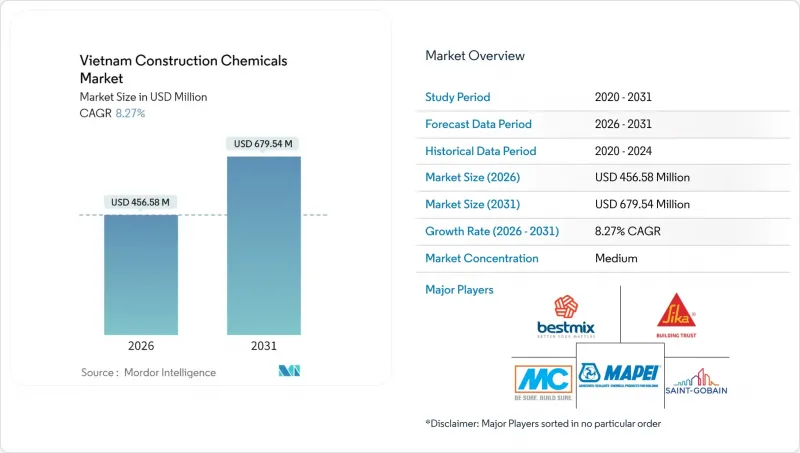
预计到 2026 年,越南建筑化学品市场规模将达到 4.5658 亿美元。
这代表着从 2025 年的 4.2171 亿美元成长到 2031 年的 6.7954 亿美元,2026 年至 2031 年的复合年增长率为 8.27%。
政府791兆越南盾公共投资计画下的强劲基础建设支出,加上2024年预计231.5亿美元的外国直接投资流入,共同支撑了对高性能化学配方的持续需求。开发人员正在寻求防水耐用的解决方案以应对越南的季风气候,同时,随着越南力争在2050年实现净零排放,低碳混凝土外加剂的应用也日益广泛。承包商正在采用数位化称重设备,将材料浪费减少高达20%,从而拉大了优质产品与一般产品之间的性能差距。同时,第10/2024/TT-BXD号通知强化了品质标准,提高了不合格供应商的进入门槛。
越南建设化学品市场趋势及洞察
基础建设主导公共部门支出激增
2025年正式核准的670亿美元公共投资正重新分配资金用于机场、港口、地铁和高速公路建设。混凝土用量巨大、计划工期紧张,以及基于TCVN和QCVN标准的严格品管,促使建筑公司采用高性能减水剂、快干修补砂浆和防腐蚀涂料。拥有准时物流和现场技术支援良好记录的供应商已报告2026年订单两位数。因此,越南建设化学品市场与优先采用国际标准材料的国家资本支出计画直接相关。
外资产业园区的快速扩张
预计2024年,越南实际外商直接投资(FDI)将达216.8亿美元,2030年计画新建221个工业园区。新加坡、中国和韩国的电子产品、电池和半导体製造商需要防静电地板材料、耐化学腐蚀的衬里和防潮水泥浆来维持GMP认证。每个新的VSIP专案阶段都会消耗1.5万至2万吨的添加剂、密封剂和地板涂料。提案符合ISO 14644无尘室标准的配方的产品经理正在将询价转化为多年供应协议,这巩固了越南建设化学品市场到2030年的成长趋势。
水泥和石化原料价格波动
2024年原油价格上涨时,PVC树脂价格在三个月内飙升了15%至20%。水泥运转率从2022年的58%下降到2023年的55%。水泥熟料出口税挤压了生产商的利润空间,迫使外加剂配方生产商每季重新谈判价格。由于库存缓衝不足,越南建设化学品市场的小规模品牌受到的衝击最大,它们通常会推迟创新投资,直到成本曲线稳定下来。
细分市场分析
至2025年,防水解决方案将占越南建设化学品市场45.02%的份额。在胡志明市,海拔3公尺以下的地下室指定使用高回弹防水卷材。由于自动喷涂设备和品质保证感测器的广泛应用,表面处理化学品预计将以8.41%的复合年增长率成长,超过越南建设化学品市场的整体成长速度。
承包商越来越多地将硅烷/硅氧烷防水剂与奈米二氧化硅密封剂结合使用,以实现两位数的吸水率降低。混凝土外加剂对于公路梁至关重要,其中高效减水剂的使用可确保即使在中部沿海地区常见的35°C以上的施工温度下也能保持坍落度。 1号国道沿线的老旧桥樑需要使用耐氯砂浆,推动了对修补组合药物的需求。地板树脂,特别是防静电环氧树脂,正在河内北部电子产业丛集中占据一席之地,其产品范围已不再局限于传统的以水泥为中心的产品。
其他福利:
- Excel格式的市场预测(ME)表
- 3个月的分析师支持
目录
第一章 引言
- 研究假设和市场定义
- 调查范围
第二章调查方法
第三章执行摘要
第四章 市场情势
- 市场概览
- 市场驱动因素
- 基础建设主导公共部门支出激增
- 外资产业园区的快速扩张
- 引入低碳混凝土外加剂
- 数位化现场称重和品质保证系统
- 循环经济对米糠灰奈米二氧化硅的需求
- 市场限制
- 水泥和石化原料价格波动
- 分散的承包商采购做法
- 国家产品标准协调统一进程缓慢
- 价值链分析
- 监管环境
- 波特五力模型
- 竞争对手之间的竞争
- 新进入者的威胁
- 供应商的议价能力
- 买方的议价能力
- 替代品的威胁
第五章 市场规模与成长预测
- 副产品
- 黏合剂
- 热熔胶
- 反应性
- 溶剂型
- 水溶液
- 锚栓和水泥浆
- 水泥基固定剂
- 树脂固定
- 混凝土外加剂
- 加速器
- 空气引射器
- 高效减水剂
- 缓速器
- 收缩抑制剂
- 黏度调节剂
- 增塑剂
- 其他的
- 混凝土保护涂层
- 丙烯酸纤维
- 醇酸树脂
- 环氧树脂
- 聚氨酯
- 其他树脂
- 地板树脂
- 丙烯酸纤维
- 环氧树脂
- 聚天门冬胺酸树脂
- 聚氨酯
- 其他树脂
- 修復和修復化学品
- 纤维缠绕系统
- 压浆
- 微型混凝土砂浆
- 改质砂浆
- 钢筋保护材料
- 密封剂
- 丙烯酸纤维
- 环氧树脂
- 聚氨酯
- 硅酮
- 其他树脂
- 表面处理化学品
- 固化剂
- 释放剂
- 其他的
- 防水解决方案
- 化学品
- 防水膜
- 黏合剂
- 按最终用户类别
- 商业的
- 工业和公共设施
- 基础设施
- 住宅
第六章 竞争情势
- 市场集中度
- 策略趋势
- 市占率**(%)/排名分析
- 公司简介
- Adchem Construction Chemical(Berry Global Inc.)
- BESTMIX
- GPS Vietnam
- MAPEI SpA
- MC-Bauchemie
- Saint-Gobain
- Schomburg
- Sika AG
- Thermax Limited
- Arkema(Bostik)
- Henkel AG & Co. KGaA
第七章 市场机会与未来展望
- 閒置频段与未满足需求评估
第八章:执行长面临的关键策略挑战
Vietnam Construction Chemicals Market size in 2026 is estimated at USD 456.58 million, growing from 2025 value of USD 421.71 million with 2031 projections showing USD 679.54 million, growing at 8.27% CAGR over 2026-2031.
Robust infrastructure spending under the government's VND 791 trillion public investment plan, coupled with USD 23.15 billion of foreign direct investment (FDI) inflows in 2024, underpins sustained demand for high-performance chemical formulations. Developers are pursuing waterproofing and durability solutions to address Vietnam's monsoon climate, while low-carbon concrete admixtures are gaining traction as the country advances toward achieving net-zero status by 2050. Contractors are adopting digitalized dosing equipment that cuts material waste by up to 20%, widening the performance gap between premium and commodity offerings. Meanwhile, Circular 10/2024/TT-BXD tightens quality standards, elevating entry barriers for non-compliant suppliers.
Vietnam Construction Chemicals Market Trends and Insights
Infrastructure-led Public-Sector Spending Surge
Public investment officially approved at USD 67 billion for 2025 is redirecting cash toward airports, seaports, metros, and expressways. Large concrete volumes, rigid project-delivery schedules, and tighter quality control standards under TCVN and QCVN codes are incentivizing contractors to specify high-range water reducers, rapid-set repair mortars, and corrosion-inhibiting coatings. Suppliers with a track record of on-time logistics and job-site technical support already report double-digit order backlogs for 2026. The Vietnam construction chemicals market, therefore, links directly to state capital expenditure plans that favor global-standard materials.
Rapid Expansion of Foreign-Invested Industrial
Realized FDI hit USD 21.68 billion in 2024, and 221 additional industrial parks are scheduled before 2030. Singaporean, Chinese, and Korean manufacturers building electronics, batteries, and semiconductors require antistatic floors, chemical-resistant linings, and moisture-tolerant grouts that preserve GMP certifications. Each new VSIP phase consumes 15,000-20,000 tons of admixtures, sealers, and floor toppings. Product managers that align formulations with ISO 14644 clean-room norms are converting inquiries into multi-year supply contracts, reinforcing upside for the Vietnam construction chemicals market through 2030.
Volatile Cement and Petro-Chemical Feedstock Prices
PVC resin spiked 15-20% within three months when crude oil rose in 2024. Cement utilization dipped from 58% in 2022 to 55% in 2023. Clinker export taxes trimmed producer margins, forcing admixture formulators to renegotiate quarterly prices. Smaller brands in the Vietnam construction chemicals market with low inventory buffers absorb the greatest shocks, often delaying innovation spending until cost curves stabilize.
Other drivers and restraints analyzed in the detailed report include:
- Adoption of Low-Carbon Concrete Admixtures
- Digitalized Job-Site Dosing and QA Systems
- Fragmented Contractor Purchasing Practices
For complete list of drivers and restraints, kindly check the Table Of Contents.
Segment Analysis
Waterproofing solutions held 45.02% of the Vietnam construction chemicals market share in 2025, with high-elasticity membranes specified for basements built three meters below sea level in Ho Chi Minh City. Surface-treatment chemicals, helped by automated sprayers and QA sensors, are set to outpace the broader Vietnam construction chemicals market at an 8.41% CAGR.
Contractors increasingly pair silane-siloxane repellents with nano-silica sealers to achieve double-digit reductions in water absorption. Concrete admixtures remain indispensable for expressway girders; super-plasticizers ensure slump retention under 35°C site temperatures common along the central coast. Repair formulations grow as aging bridges along National Route 1 require chloride-resistant mortars. Flooring resins, especially ESD-safe epoxies, move into electronics clusters north of Hanoi, signaling diversification beyond legacy cement-centric products.
The Vietnam Construction Chemicals Market Report is Segmented by Product (Adhesives, Anchors and Grouts, Concrete Admixtures, Concrete Protective Coatings, Flooring Resins, Repair and Rehabilitation Chemicals, Sealants, Surface-Treatment Chemicals, Waterproofing Solutions) and End-User Sector (Commercial, Industrial and Institutional, Infrastructure, Residential). The Market Forecasts are Provided in Terms of Value (USD).
List of Companies Covered in this Report:
- Adchem Construction Chemical (Berry Global Inc.)
- BESTMIX
- GPS Vietnam
- MAPEI S.p.A
- MC-Bauchemie
- Saint-Gobain
- Schomburg
- Sika AG
- Thermax Limited
- Arkema (Bostik)
- Henkel AG & Co. KGaA
Additional Benefits:
- The market estimate (ME) sheet in Excel format
- 3 months of analyst support
TABLE OF CONTENTS
1 Introduction
- 1.1 Study Assumptions and Market Definition
- 1.2 Scope of the Study
2 Research Methodology
3 Executive Summary
4 Market Landscape
- 4.1 Market Overview
- 4.2 Market Drivers
- 4.2.1 Infrastructure-led public-sector spending surge
- 4.2.2 Rapid expansion of foreign-invested industrial parks
- 4.2.3 Adoption of low-carbon concrete admixtures
- 4.2.4 Digitalised job-site dosing and QA systems
- 4.2.5 Circular-economy demand for rice-husk-ash nano-silica
- 4.3 Market Restraints
- 4.3.1 Volatile cement and petro-chemical feedstock prices
- 4.3.2 Fragmented contractor purchasing practices
- 4.3.3 Slow harmonisation of national product standards
- 4.4 Value Chain Analysis
- 4.5 Regulatory Landscape
- 4.6 Porter's Five Forces
- 4.6.1 Competitive Rivalry
- 4.6.2 Threat of New Entrants
- 4.6.3 Bargaining Power - Suppliers
- 4.6.4 Bargaining Power - Buyers
- 4.6.5 Threat of Substitutes
5 Market Size and Growth Forecasts (Value)
- 5.1 By Product
- 5.1.1 Adhesives
- 5.1.1.1 Hot-Melt
- 5.1.1.2 Reactive
- 5.1.1.3 Solvent-borne
- 5.1.1.4 Water-borne
- 5.1.2 Anchors and Grouts
- 5.1.2.1 Cementitious Fixing
- 5.1.2.2 Resin Fixing
- 5.1.3 Concrete Admixtures
- 5.1.3.1 Accelerator
- 5.1.3.2 Air-Entraining
- 5.1.3.3 Super-plasticizer
- 5.1.3.4 Retarder
- 5.1.3.5 Shrinkage-Reducer
- 5.1.3.6 Viscosity-Modifier
- 5.1.3.7 Plasticizer
- 5.1.3.8 Other Types
- 5.1.4 Concrete Protective Coatings
- 5.1.4.1 Acrylic
- 5.1.4.2 Alkyd
- 5.1.4.3 Epoxy
- 5.1.4.4 Polyurethane
- 5.1.4.5 Other Resins
- 5.1.5 Flooring Resins
- 5.1.5.1 Acrylic
- 5.1.5.2 Epoxy
- 5.1.5.3 Polyaspartic
- 5.1.5.4 Polyurethane
- 5.1.5.5 Other Resins
- 5.1.6 Repair and Rehabilitation Chemicals
- 5.1.6.1 Fiber-Wrapping Systems
- 5.1.6.2 Injection Grouting
- 5.1.6.3 Micro-concrete Mortars
- 5.1.6.4 Modified Mortars
- 5.1.6.5 Rebar Protectors
- 5.1.7 Sealants
- 5.1.7.1 Acrylic
- 5.1.7.2 Epoxy
- 5.1.7.3 Polyurethane
- 5.1.7.4 Silicone
- 5.1.7.5 Other Resins
- 5.1.8 Surface-Treatment Chemicals
- 5.1.8.1 Curing Compounds
- 5.1.8.2 Mold-Release Agents
- 5.1.8.3 Other Types
- 5.1.9 Waterproofing Solutions
- 5.1.9.1 Chemicals
- 5.1.9.2 Membranes
- 5.1.1 Adhesives
- 5.2 By End-User Sector
- 5.2.1 Commercial
- 5.2.2 Industrial and Institutional
- 5.2.3 Infrastructure
- 5.2.4 Residential
6 Competitive Landscape
- 6.1 Market Concentration
- 6.2 Strategic Moves
- 6.3 Market Share**(%)/Ranking Analysis
- 6.4 Company Profiles (includes Global-level Overview, Market-level Overview, Core Segments, Financials, Strategic Information, Market Rank/Share, Products and Services, Recent Developments)
- 6.4.1 Adchem Construction Chemical (Berry Global Inc.)
- 6.4.2 BESTMIX
- 6.4.3 GPS Vietnam
- 6.4.4 MAPEI S.p.A
- 6.4.5 MC-Bauchemie
- 6.4.6 Saint-Gobain
- 6.4.7 Schomburg
- 6.4.8 Sika AG
- 6.4.9 Thermax Limited
- 6.4.10 Arkema (Bostik)
- 6.4.11 Henkel AG & Co. KGaA
7 Market Opportunities Future Outlook
- 7.1 White-space and Unmet-need Assessment
8 Key Strategic Questions for CEOs

 建筑化学品市场:2026-2032年全球市场预测(依产品类型、技术、剂型、建筑类型、应用、最终用户和通路划分)固定式机械锚栓市场:依产品类型、材料、应用、终端用户产业及通路划分,全球预测,2026-2032年
 建筑化学品市场分析及预测(至2035年):类型、产品、应用、形态、材质类型、技术、最终用户、功能、安装类型、解决方案
 建筑化学品:市场占有率分析、产业趋势与统计、成长预测(2026-2031)欧洲建设化学品:市场占有率分析、产业趋势与统计、成长预测(2026-2031)美国建设化学品:市场占有率分析、产业趋势与统计、成长预测(2026-2031)
 全球建筑化学品市场规模、份额、趋势和成长分析报告(2026-2034年)
 建筑化学品市场规模、份额、趋势及预测(按类型、应用和地区划分)(2026-2034 年)
 2026年全球建筑化学品市场报告
 建筑化学品市场-全球产业规模、份额、趋势、机会及预测(2021-2031 年)(依产品类型、应用、地区及竞争格局划分)