


 |
市场调查报告书
商品编码
1939075
东南亚塑胶市场:市场占有率分析、产业趋势与统计、成长预测(2026-2031)South-East Asia (SEA) Plastics - Market Share Analysis, Industry Trends & Statistics, Growth Forecasts (2026 - 2031) |
||||||

※ 本网页内容可能与最新版本有所差异。详细情况请与我们联繫。
预计东南亚塑胶市场将从 2025 年的 3,170 万吨增长到 2026 年的 3,302 万吨,到 2031 年将达到 4,033 万吨,2026 年至 2031 年的复合年增长率为 4.09%。
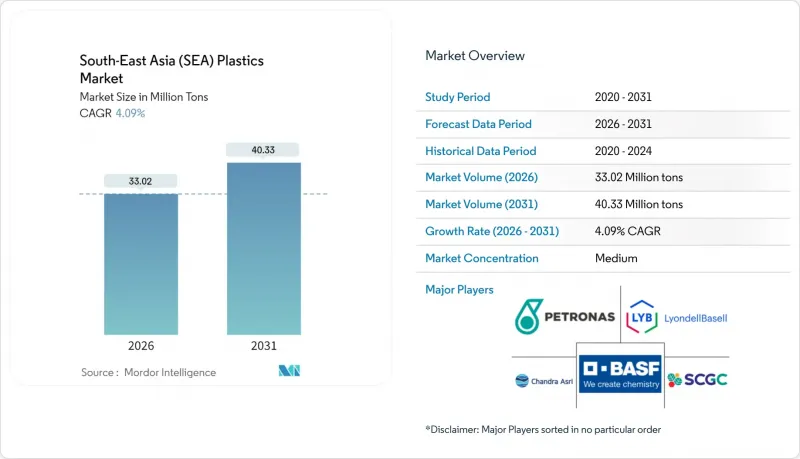
消费支出增加、出口导向製造业扩张以及基础设施运转率持续稳定,推动了加工厂的高速运转,从而促进了产业成长。本地产能的提升有助于降低进口依赖,确保原料供应稳定;同时,监管部门大力推动循环经济,鼓励生产商投资创新和回收。印尼投资的蓬勃发展和越南工厂的快速建设支撑了生产成长,而所有主要东协成员国都在为下游石化产业提供优惠待遇,以确保区域供应链的安全。从即时製程监控到预测性维护,数位化製造倡议也在扩大生产力差距,并增强大型整合商的成本优势。
东南亚塑胶市场趋势与展望
食品和饮料包装行业的需求不断增长
城市生活节奏加快和中产阶级持续壮大,推动了对简便食品和即饮饮料的需求,促使加工商增加多层薄膜和硬质PET容器的产量。自2024年以来,越南包装产业吸引了大量外商直接投资(FDI),全球品牌商纷纷在越南建立面向东协和出口市场的供应基地。监管机构正在收紧食品接触标准,在泰国,所有食品接触包装都必须获得ISO 22000认证。这促使加工商转向使用高性能阻隔树脂和抗菌添加剂。延长保质期的倡议正在零售链中蔓延,推动了对具有更强氧气和防潮性能的聚丙烯和聚乙烯产品的需求。生鲜电商的快速发展,使得相关人员对轻质且抗穿刺包装的需求日益增长,推动了高模量共混材料的快速替代,这种材料能够在不牺牲强度的前提下实现更薄的壁厚。
印尼和越南下游业务快速扩张
2023年至2025年间运作投产的大型裂解装置和聚合物装置将重塑区域贸易格局。越南龙山综合体于2023年底新增165万吨乙烯产能,为越南国内加工商提供稳定的原料供应,此前这些原料主要依赖东北亚地区。在印尼,TPPI正在对其芳烃生产线进行产能优化,而乐天化学预计将于2025年下半年投产一座年产100万吨的裂解装置,届时将运作超过200万吨的单体年产量。这些计划恰逢中国石化产能过剩之际,使东南亚塑胶市场成为寻求关税多元化的全球加工商的替代供应平台。政府的激励措施,例如对超过5亿美元的计划给予税收减免以及简化经济特区内的审批程序,正在缩短建设週期并降低审批门槛,从而鼓励区域加工商签订长期承购协议。
严格的塑胶法规和禁令
泰国的塑胶袋法规(将于2025年3月生效)强制要求使用可生物降解添加剂并设定最低厚度标准,这将使购物袋製造商的原料成本增加15%至20%。新加坡于2025年1月扩大了塑胶废弃物进口禁令,给依赖跨境废弃物流通的本地回收商带来了压力。马来西亚的生产者延伸责任制(EPR)法案计划于2026年生效,该法案将把收集和回收的经济责任转移到製造商身上。这项义务有利于能够承担遵循成本的大型企业。这些措施威胁到一次性产品类型,迫使加工商转向可重复使用和可堆肥的产品以维持货架空间。
细分市场分析
截至2025年,聚乙烯、聚丙烯和聚氯乙烯等传统塑胶将占东南亚塑胶市场63.05%的份额,这主要得益于包装和消费品应用领域的规模经济效益。印尼和越南现有生产线的扩建将提升该地区聚烯的整体名义产能,使树脂价格保持与进口产品的竞争力。
工程塑胶虽然在销售上仍属小众市场,但其战略意义重大,在汽车引擎室零件和电子设备外壳等领域占据重要订单,而耐热性和尺寸稳定性是这些领域的关键指标。本地复合材料生产商正投资研发玻璃纤维增强尼龙和PBT共混物,以帮助原始设备製造商(OEM)实现在地采购目标。为支持电动车的广泛应用而出台的更严格的法规,可能会加速符合UL 94 V-0标准的阻燃等级材料的需求成长。
生质塑胶在东南亚塑胶市场以4.42%的复合年增长率快速成长,但成本溢价和工业堆肥基础设施的缺乏限制了其应用。 SCG Chemicals位于泰国的木薯生物乙烯工厂向加工商供应符合EN 13432堆肥标准的生物聚乙烯(bio-PE),为寻求差异化永续性认证的品牌所有者拓展了材料选择。马来西亚棕榈油创新基金正在支持PHA和PBS,但商业化时间表取决于欧盟森林砍伐法规下的原材料认证标准。
东南亚塑胶市场报告按类型(传统塑胶、工程塑胶、生质塑胶等)、技术(射出成型、吹塑成型等)、应用(包装、电气电子、建筑施工、汽车交通运输等)和地区(印尼、泰国、马来西亚、越南等)进行细分。市场预测以吨为单位。
其他福利:
- Excel格式的市场预测(ME)表
- 3个月的分析师支持
目录
第一章 引言
- 研究假设和市场定义
- 调查范围
第二章调查方法
第三章执行摘要
第四章 市场情势
- 市场概览
- 市场驱动因素
- 食品和饮料包装行业的需求不断增长
- 印尼和越南下游产能快速扩张
- 电子商务主导了对柔性包装的需求激增
- 基础建设促进建筑塑胶的发展
- 政府支持的石化经济特区管道
- 市场限制
- 严格的塑胶法规和禁令
- 原物料价格波动
- 工程塑胶业技术纯熟劳工短缺
- 价值链分析
- 波特五力模型
- 供应商的议价能力
- 买方的议价能力
- 新进入者的威胁
- 替代品的威胁
- 竞争程度
第五章 市场规模与成长预测
- 按类型
- 传统塑料
- 工程塑料
- 生质塑胶
- 透过技术
- 射出成型
- 吹塑成型
- 挤出成型
- 其他技术
- 透过使用
- 包装
- 电气和电子设备
- 建筑/施工
- 汽车和运输设备
- 家居用品
- 家具和床上用品
- 其他用途
- 按地区
- 印尼
- 泰国
- 马来西亚
- 越南
- 菲律宾
- 新加坡
- 东南亚及其他地区
第六章 竞争情势
- 市场集中度
- 策略趋势
- 市占率(%)/排名分析
- 公司简介
- 塑胶树脂製造商
- AGC Chemicals Vietnam Co., Ltd.
- BASF
- Dow
- DuPont
- Indorama Ventures
- JG Summit Petrochemical Corp
- Kaneka(Malaysia)Sdn Bhd
- LyondellBasell
- Nan Ya Plastics(Formosa)
- NPC Alliance Corp
- PETRONAS Chemicals Group Berhad
- Philippine Resins Industries
- PRefChem
- 塑胶製品製造商
- Ampac Holdings
- An Phat Holdings
- An Trung Industries
- Binh Minh Plastic
- Cholon Plastic Co. Ltd.
- City Long(Cambodia)Co., Ltd.
- Dongsung
- Duy Tan Plastics Corporation
- LOTTE Chemical Titan
- Polyplastics Co., Ltd.
- PT Chandra Asri Petrochemical Tbk
- SCG Chemicals PCL
- Thai Formosa Plastic Industry Co., Ltd.
- 塑胶树脂製造商
第七章 市场机会与未来展望
The South-East Asia Plastics market is expected to grow from 31.70 million tons in 2025 to 33.02 million tons in 2026 and is forecast to reach 40.33 million tons by 2031 at 4.09% CAGR over 2026-2031.
Growth rests on rising consumer spending, expanding export-oriented manufacturing, and steady infrastructure outlays that keep processors operating at high utilization rates. Local capacity additions trim import dependence and feedstock security, while regulatory momentum toward circular-economy practices forces producers to upgrade technology and invest in recycling. Indonesia's investment boom and Vietnam's rapid factory build-out underpin volume gains, but all major ASEAN members are channeling incentives into downstream petrochemicals to secure regional supply chains. Digital manufacturing initiatives-from real-time process monitoring to predictive maintenance-are also widening productivity differentials, reinforcing the cost advantages of large, integrated operators.
South-East Asia (SEA) Plastics Market Trends and Insights
Rising Demand from Food and Beverage Packaging
Accelerating urban lifestyles and sustained middle-class growth are intensifying demand for convenience foods and ready-to-drink beverages, prompting converters to raise runs of multi-layer films and rigid PET containers. Vietnam has attracted FDI since 2024 in packaging as global brand owners establish supply hubs to serve ASEAN and export markets. Regulators are tightening food-contact norms-Thailand now requires ISO 22000 certification on all packaging that touches edibles-nudging processors toward higher-spec barrier resins and antimicrobial additives. Shelf-life extension initiatives cascade through retail chains, boosting polypropylene and polyethylene grades engineered for oxygen and moisture resistance. With grocery e-commerce swelling, stakeholder pressure for lightweight yet puncture-resistant formats is spurring rapid material substitution toward high-modulus blends that enable downgauging without compromising integrity.
Rapid Downstream Capacity Additions Across Indonesia and Vietnam
Large-scale crackers and polymer plants coming online between 2023-2025 redraw intraregional trade flows. Vietnam's Long Son complex added 1.65 million t/y of ethylene capacity in late 2023, providing domestic processors with feedstock security previously sourced from Northeast Asia. Indonesia is seeing more than 2 million t/y of extra monomer output as TPPI debottlenecks its aromatics train and Lotte Chemical inaugurates a 1 million t/y cracker in 2H 2025. Coinciding with China's petrochemical overcapacity, these projects position the South-East Asia plastics market as an alternative supply platform for global converters seeking tariff diversification. State incentives-tax holidays on projects exceeding USD 500 million and streamlined permitting inside special economic zones-have shortened build-out schedules and lowered hurdle rates, encouraging regional processors to lock in long-term offtake contracts.
Stringent Anti-Plastic Regulations and Bans
Thailand's plastic bag decree, effective March 2025, mandates biodegradable additives and minimum thickness thresholds, raising input costs for shopping-bag producers by 15-20%. Singapore widened its plastic-waste import ban in January 2025, squeezing regional recyclers that relied on cross-border scrap inflows. Malaysia's forthcoming Extended Producer Responsibility (EPR) law shifts financial responsibility for collection and recycling to manufacturers starting in 2026, an obligation that favors scale players able to absorb compliance spend. These measures threaten single-use categories, forcing converters to pivot toward reusable and compostable options to keep shelf space.
Other drivers and restraints analyzed in the detailed report include:
- Surge in E-Commerce-Led Flexible Packaging Needs
- Infrastructure Push Boosting Construction Plastics
- Feedstock Price Volatility
For complete list of drivers and restraints, kindly check the Table Of Contents.
Segment Analysis
Traditional grades-polyethylene, polypropylene, and PVC-held a 63.05% share of the South-East Asia plastics market in 2025, supported by scale economics in packaging and consumer goods applications. Several brownfield line extensions in Indonesia and Vietnam lift aggregate regional polyolefin nameplate capacity and keep resin pricing competitive versus imports.
Engineering plastics remain niche in volume terms yet strategically important, capturing contracts in automotive under-the-hood parts and electronics housings where heat resistance and dimensional stability drive specification. Local compounders are investing in glass-fiber reinforced nylon and PBT blends to satisfy OEM localization targets. Regulatory push for electric vehicle adoption could accelerate demand for flame-retardant grades compliant with UL 94 V-0 standards.
Bioplastics are climbing at a 4.42% CAGR, the fastest within the South-East Asia plastics market, yet cost premiums and limited infrastructure for industrial composting temper penetration. Thailand's cassava-based bio-ethylene plant, built by SCG Chemicals, supplies converters with bio-PE that meets EN 13432 compostability, widening material choice for brand owners seeking differentiated sustainability credentials. Malaysia's palm oil innovation fund backs PHAs and PBS, though commercialization schedules hinge on feedstock certification thresholds under EU deforestation rules.
The South-East Asia Plastics Market Report is Segmented by Type (Traditional Plastics, Engineering Plastics, and Bioplastics), Technology (Injection Molding, Blow Molding, and More), Application (Packaging, Electrical and Electronics, Building and Construction, Automotive and Transportation, and More), and Geography (Indonesia, Thailand, Malaysia, Vietnam, and More). The Market Forecasts are Provided in Terms of Volume (Tons).
List of Companies Covered in this Report:
- Plastic Resin Manufacturers
- Plastic Product Manufacturers
Additional Benefits:
- The market estimate (ME) sheet in Excel format
- 3 months of analyst support
TABLE OF CONTENTS
1 Introduction
- 1.1 Study Assumptions and Market Definition
- 1.2 Scope of the Study
2 Research Methodology
3 Executive Summary
4 Market Landscape
- 4.1 Market Overview
- 4.2 Market Drivers
- 4.2.1 Rising demand from food and beverage packaging
- 4.2.2 Rapid downstream capacity additions across Indonesia and Vietnam
- 4.2.3 Surge in e-commerce-led flexible packaging needs
- 4.2.4 Infrastructure push boosting construction plastics
- 4.2.5 Government-backed petro-chemical SEZ pipelines
- 4.3 Market Restraints
- 4.3.1 Stringent anti-plastic regulations and bans
- 4.3.2 Feedstock price volatility
- 4.3.3 Shortage of skilled labor in engineering-grade plastics
- 4.4 Value Chain Analysis
- 4.5 Porter's Five Forces
- 4.5.1 Bargaining Power of Suppliers
- 4.5.2 Bargaining Power of Buyers
- 4.5.3 Threat of New Entrants
- 4.5.4 Threat of Substitutes
- 4.5.5 Degree of Competition
5 Market Size and Growth Forecasts (Volume)
- 5.1 By Type
- 5.1.1 Traditional Plastics
- 5.1.2 Engineering Plastics
- 5.1.3 Bioplastics
- 5.2 By Technology
- 5.2.1 Injection Molding
- 5.2.2 Blow Molding
- 5.2.3 Extrusion
- 5.2.4 Other Technologies
- 5.3 By Application
- 5.3.1 Packaging
- 5.3.2 Electrical and Electronics
- 5.3.3 Building and Construction
- 5.3.4 Automotive and Transportation
- 5.3.5 Housewares
- 5.3.6 Furniture and Bedding
- 5.3.7 Other Applications
- 5.4 By Geography
- 5.4.1 Indonesia
- 5.4.2 Thailand
- 5.4.3 Malaysia
- 5.4.4 Vietnam
- 5.4.5 Philippines
- 5.4.6 Singapore
- 5.4.7 Rest of South-East Asia
6 Competitive Landscape
- 6.1 Market Concentration
- 6.2 Strategic Moves
- 6.3 Market Share (%)/Ranking Analysis
- 6.4 Company Profiles (includes Global level Overview, Market level overview, Core Segments, Financials, Strategic Information, Market Rank/Share, Products and Services, Recent Developments)
- 6.4.1 Plastic Resin Manufacturers
- 6.4.1.1 AGC Chemicals Vietnam Co., Ltd.
- 6.4.1.2 BASF
- 6.4.1.3 Dow
- 6.4.1.4 DuPont
- 6.4.1.5 Indorama Ventures
- 6.4.1.6 JG Summit Petrochemical Corp
- 6.4.1.7 Kaneka (Malaysia) Sdn Bhd
- 6.4.1.8 LyondellBasell
- 6.4.1.9 Nan Ya Plastics (Formosa)
- 6.4.1.10 NPC Alliance Corp
- 6.4.1.11 PETRONAS Chemicals Group Berhad
- 6.4.1.12 Philippine Resins Industries
- 6.4.1.13 PRefChem
- 6.4.2 Plastic Product Manufacturers
- 6.4.2.1 Ampac Holdings
- 6.4.2.2 An Phat Holdings
- 6.4.2.3 An Trung Industries
- 6.4.2.4 Binh Minh Plastic
- 6.4.2.5 Cholon Plastic Co. Ltd.
- 6.4.2.6 City Long (Cambodia) Co., Ltd.
- 6.4.2.7 Dongsung
- 6.4.2.8 Duy Tan Plastics Corporation
- 6.4.2.9 LOTTE Chemical Titan
- 6.4.2.10 Polyplastics Co., Ltd.
- 6.4.2.11 PT Chandra Asri Petrochemical Tbk
- 6.4.2.12 SCG Chemicals PCL
- 6.4.2.13 Thai Formosa Plastic Industry Co., Ltd.
- 6.4.1 Plastic Resin Manufacturers
7 Market Opportunities and Future Outlook
- 7.1 White-space and unmet-need assessment

 2026-2030年全球塑胶市场
 塑胶市场:依形状、等级、製造流程、类型、应用和分销管道划分-2026-2032年全球市场预测
 塑胶市场分析及预测(至2035年):类型、产品、应用、材料类型、技术、最终用户、製程、组件、安装类型
 泰国塑胶:市场占有率分析、产业趋势与统计、成长预测(2026-2031)越南塑胶市场:市场占有率分析、产业趋势与统计、成长预测(2026-2031)
 2026-2034年全球塑胶降解细菌市场规模、份额、趋势和成长分析报告2026-2034年全球电气设备塑胶市场规模、份额、趋势和成长分析报告
 2026年全球塑胶和橡胶製品市场报告2026年全球塑胶製品市场报告2026年全球热塑性半成品市场报告