


 |
市场调查报告书
商品编码
1940715
越南纸包装:市场占有率分析、产业趋势与统计、成长预测(2026-2031)Vietnam Paper Packaging - Market Share Analysis, Industry Trends & Statistics, Growth Forecasts (2026 - 2031) |
||||||

※ 本网页内容可能与最新版本有所差异。详细情况请与我们联繫。
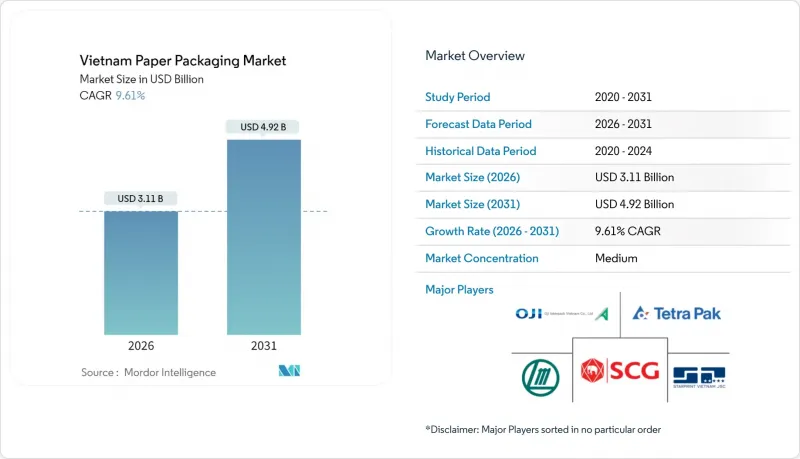
越南纸包装市场在 2025 年的价值为 28.4 亿美元,预计到 2031 年将达到 49.2 亿美元,高于 2026 年的 31.1 亿美元。
预计在预测期(2026-2031 年)内,复合年增长率将达到 9.61%。
这一成长幅度远超全球平均水平,凸显了越南在东南亚不断演变的供应链结构中的战略地位。中产阶级消费的成长、强劲的外国直接投资以及诸如生产者延伸责任制(EPR)等监管激励措施,都在推动对纸质包装的需求。电子商务小包裹量的快速增长、消费品和电子产品生产的转移以及品牌所有者的碳减排承诺,共同促进了越南纸质包装市场的发展。同时,原生纸浆短缺和废纸进口法规的波动造成了供应摩擦,价格和产能扩张仍然是关注的焦点。
越南纸包装市场趋势与洞察
电子商务小包裹量快速成长
2024年,越南国内电子商务销售额达到两位数成长,带动了胡志明市、河内和岘港等城市的小包裹配送量激增。这一增长带动了对专为应对多式联运物流链而设计的瓦楞纸箱的需求。省会城市的微型仓配中心正在调整订单包装,采用较小尺寸的纸箱,以便放入小包裹柜和两轮式配送架。越南政府第221/QD-TTg号决定旨在使物流对GDP的贡献率达到9%至11%,鼓励自动化升级,而这需要标准化的包装尺寸以实现高速分拣。计划在2030年投资50亿美元用于智慧物流基础设施建设,为近期物流量的成长提供了清晰的预期。此次小包裹热潮正迅速提振越南的纸质包装市场。
消费品和电子产品快速境外外包至越南
2025年新增外商直接投资的66%以上将流入加工製造业,刺激南北工业区工厂对运输纸箱的需求。以河南省一家投资9,000万美元的工厂为首的休閒食品製造商,在优先考虑100%永续采购目标的同时,也推动了对箱板纸的稳定需求。从中国迁至越南的电子组装製造商,指定使用符合全球品质标准的防静电衬纸、防潮层和白面牛皮纸衬纸。跨国公司的在地化要求正在推动越南国内纸板生产,以减少进口依赖和范围3排放。因此,越南纸包装市场受益于与外国公司工厂运作计画相关的长期订单。
国内原生纸浆结构性短缺及对进口的依赖
由于缺乏大型永续种植园,越南造纸厂无法满足不断增长的牛皮纸需求。 2023年初,儘管进口量较上季成长9.2%,但包装纸总消费量仍达284,530吨,这一缺口凸显出来。外汇波动和运费成本会直接反映在箱板纸价格上,影响加工业者的利润率。依赖长纤维的高檔箱板纸经常出现短缺,迫使用户缩减生产规模或支付额外费用。因此,纤维短缺是限制越南纸包装市场发展的结构性因素。
细分市场分析
截至2025年,箱板纸将占越南纸包装市场57.18%的份额。这反映了越南以出口为导向的经济结构,其全球运输需要坚固耐用的瓦楞纸板。白面牛皮纸在电子产业丛集中占据了较高的价格地位,而再生瓦楞纸则满足了国内食品饮料物流的需求。兼具成本优势和强度的半化学加工瓦楞纸正吸引买家的目光。儘管纸板的规模仍然较小,但在药品标籤和零售展示需求不断增长的推动下,预计到2031年将实现11.13%的复合年增长率。普通漂白硫酸盐纸浆纸板和折迭纸板为跨国快速消费品公司提供了实现品牌差异化所需的高品质表面。随着环保标籤成为采购标准,对涂布和非涂布再生纸板的需求也不断增长。利乐公司扩大产能后,已将其55%的产量分配给了本地买家,这表明该公司对高端纸盒的需求充满信心。
随着工业园区仓库建设的推进,越南纸包装市场中的箱板纸部分预计将稳步扩张,而纸板市场规模预计将受益于有利于轻型、高再生材料含量产品的监管压力,这使得市场定位从通用衬纸转向专为特定最终用途和小批量印刷而设计的高附加值纸板。
2025年,受电子商务和出口货运量成长的主导,瓦楞纸箱和货柜将占越南纸包装市场50.12%的份额。大型货运公司需要B型和C型瓦楞纸箱进行海运,这两种纸箱兼具抗压性和装载效率。 2030年,越南将投资50亿美元建造智慧物流基础设施,以确保瓦楞纸箱的持续供应。同时,随着医疗保健和个人护理品牌寻求防篡改和商店展示解决方案,折迭纸盒的复合年增长率将达到10.96%。数位印刷补贴鼓励纸盒客製化,并支撑其高端定价。
在纤维供应稳定之前,薄瓦楞纸板的市场机会将十分有限。为此,纸盒采用轻质涂布纸基材,以最大限度地减少材料用量,并符合范围3的排放目标。模塑纸浆嵌件整合到折迭纸盒中,进一步提升了产品的差异化优势。越南的纸包装市场正从散装运输向兼具结构保护和销售点吸引力的混合型SKU不断演变。
其他福利:
- Excel格式的市场预测(ME)表
- 分析师支持(3个月)
目录
第一章 引言
- 研究假设和市场定义
- 调查范围
第二章调查方法
第三章执行摘要
第四章 市场情势
- 市场概览
- 市场驱动因素
- 电子商务小包裹数量快速成长
- 消费品和电子产品快速境外外包至越南
- 塑胶淘汰条例
- 国际品牌所有者的范围 3 碳减排推动了轻质再生纸板的开发
- 区域城市中社交电商和微型仓配的兴起
- 高速数位印刷生产线的税收优惠投资
- 市场限制
- 国内原生纸浆原料结构性短缺;高度依赖进口
- 改变废纸进口政策和品管
- 美国和欧盟针对木材产品的贸易措施收紧了纸浆材料的供应。
- 工业用电价格上涨对中小瓦楞纸箱製造商带来压力
- 产业供应链分析
- 监管环境
- 技术展望
- 波特五力分析
- 供应商的议价能力
- 买方的议价能力
- 新进入者的威胁
- 替代品的威胁
- 竞争对手之间的竞争
第五章 市场规模与成长预测
- 按年级
- 纸板
- 固态漂白硫酸盐纸浆(SBS)
- 未漂白硫酸盐纸浆(SUS)
- 折迭纸盒(FBB)
- 涂布再生纸板(CRB)
- 未涂布再生纸板(URB)
- 其他等级的纸板
- 货柜纸板
- 白色牛皮纸衬垫
- 其他牛皮纸
- 白色顶部测试衬垫
- 其他测试衬垫
- 半化学合成长笛
- 再生公寓
- 其他年级
- 纸板
- 副产品
- 可折迭瓦楞纸箱
- 瓦楞纸箱和容器
- 其他产品
- 按最终用户行业划分
- 食物
- 饮料
- 卫生保健
- 个人护理
- 家居用品
- 电气和电子设备
- 其他终端用户产业
- 按包装类型
- 硬纸板(纸板、厚纸)
- 半硬质(可折迭纸箱,不包括硬纸板箱)
- 柔性纸製品(小袋、包装纸)
- 模塑纤维和纸浆包装产品
第六章 竞争情势
- 市场集中度
- 策略趋势
- 市占率分析
- 公司简介
- SONG LAM Trading & Packaging Production CO., Ltd
- Asia Pulp & Paper Group(APP)
- Tetra Pak International SA
- Oji Interpack Vietnam Co., Ltd
- Khang Thanh Manufacturing CO., LTD
- Hanh Packaging Co. Ltd
- SCG Paper Public Company Limited
- BINH MINH PAT CO.,LTD
- Kraft of Asia Paperboard & Packaging Co., Ltd..
- HC Packaging Vietnam Company Limited
- Starprint Vietnam Joint Stock Company
- Nippon Paper Industries Co., Ltd.
- Box-Pak(Malaysia)Bhd.
- Lee & Man Paper Manufacturing Ltd.
- Sai Gon Paper Corporation
- Dong Hai Ben Tre Joint Stock Company
- Nine Dragons Paper(Holdings)Limited
- Rengo Co., Ltd
第七章 市场机会与未来展望
The Vietnam paper packaging market was valued at USD 2.84 billion in 2025 and estimated to grow from USD 3.11 billion in 2026 to reach USD 4.92 billion by 2031, at a CAGR of 9.61% during the forecast period (2026-2031).
This expansion significantly outpaces the global average, underscoring Vietnam's strategic role in Southeast Asia's evolving supply chain framework. Rising middle-class consumption, robust foreign direct investment, and regulatory incentives such as extended producer responsibility requirements are accelerating demand for paper-based formats. The surge in e-commerce parcel volumes, the relocation of fast-moving consumer goods and electronics production, and brand-owner carbon-cut commitments all converge to bolster the Vietnam paper packaging market.Meanwhile, virgin-fiber shortages and volatile recovered-paper import rules create supply-side friction that keeps prices and capacity expansion in sharp focus.
Vietnam Paper Packaging Market Trends and Insights
Booming e-commerce parcel volumes
National e-commerce turnover rose at a double-digit pace in 2024, driving aggregate parcel flows across Ho Chi Minh City, Hanoi, and Da Nang. The uptick amplifies demand for corrugated shipping containers engineered to survive multimodal logistics chains. Micro-fulfillment centers in tier-2 cities are shifting order profiles toward smaller-format boxes that fit parcel lockers and two-wheeler delivery racks. Vietnam's Decision 221/QD-TTg targets a 9%-11% logistics GDP contribution, prompting automation upgrades that require standardized packaging dimensions for high-speed sortation. Capital spending of USD 5 billion earmarked for smart-logistics infrastructure through 2030 cements near-term volume visibility. The Vietnam paper packaging market gains immediate tailwinds from this parcel boom.
Rapid FMCG and electronics off-shoring into Vietnam
Over 66% of 2025's fresh FDI pledges flowed into processing and manufacturing, catalyzing plant-level demand for transport-worthy cartons in Northern and Southern industrial belts. Snack-food producers, exemplified by the USD 90 million Ha Nam facility, anchor steady containerboard pull-through while prioritizing 100% sustainable sourcing goals. Electronics assemblers relocating from China specify anti-static liners, moisture barriers, and white-top kraftliners that meet global quality codes. Localization mandates by multinational corporations promote in-country board production to cut import reliance and Scope-3 emissions. As a result, the Vietnam paper packaging market secures long-run orders tied to foreign plant commissioning schedules.
Structural shortfall of domestic virgin fiber; import dependence
Vietnam's mills cannot meet surging kraftliner demand because the country lacks large-scale, sustainable forestry plantations. In early 2023, total packaging-paper consumption hit 284,530 tons even as imports rose 9.2% month-on-month, underscoring the gap. Currency swings and freight costs translate quickly into linerboard prices, affecting converter margins. Premium grades that rely on long fiber face periodic shortages, forcing users to down-spec or pay surcharges. The fiber deficit, therefore, acts as a structural drag on the Vietnam paper packaging market.
Other drivers and restraints analyzed in the detailed report include:
- Plastic phase-out regulations (EPR and DRS)
- Foreign brand owners' Scope-3 carbon cuts push lightweight recycled board
- Volatile recovered-paper import policy and quality controls
For complete list of drivers and restraints, kindly check the Table Of Contents.
Segment Analysis
Containerboard held 57.18% of the Vietnam paper packaging market share in 2025, a reflection of Vietnam's export-oriented profile that relies on robust corrugating medium for global shipping. White-top kraftliner commands premium pricing in electronics clusters, whereas recycled fluting satisfies domestic food-and-beverage logistics. Semi-chemical fluting attracts buyers, balancing cost and strength. Cartonboard, although smaller, records an 11.13% CAGR to 2031, propelled by rising pharmaceutical labeling needs and retail-ready displays. Solid bleached sulfate and folding boxboard deliver high-graphics surfaces essential for brand differentiation among multinational FMCG firms. Coated recycled board and uncoated recycled board gain traction as eco-labels become purchasing criteria. Tetra Pak's capacity boost dedicates 55% output to local buyers, signaling confidence in premium carton uptake.
The Vietnam paper packaging market size for containerboard is projected to rise steadily alongside warehouse construction in industrial parks. Meanwhile, the Vietnam paper packaging market size for cartonboard stands to benefit from regulatory pressure favoring lightweight formats with higher recycled content. Market positioning is thus shifting from commodity liner toward value-added board engineered for specific end uses and shorter print runs.
Corrugated Boxes and Containers accounted for 50.12% of the Vietnam paper packaging market size in 2025, as e-commerce and export shipping dominated volume patterns. Large shippers require B- and C-flute cases that strike a balance between crush resistance and stacking efficiency for sea freight. The rollout of USD 5 billion in smart-logistics infrastructure through 2030 ensures continued corrugated throughput. Folding cartons, however, are expanding at an 10.96% CAGR as healthcare and personal-care brands seek tamper-evident, shelf-ready solutions. Digital print subsidies accelerate carton customization, which supports premium pricing.
Down-gauge opportunities in corrugated remain limited until fiber supply stabilizes. In contrast, cartons utilize lightweight coated substrates to minimize material usage and align with Scope 3 emission targets. Molded pulp inserts integrated into folding-carton formats further differentiate offerings. The Vietnam paper packaging market is continuing to evolve from bulk shippers toward hybrid SKUs that combine structural protection with point-of-sale appeal.
The Vietnam Paper Packaging Market Report is Segmented by Grade (Cartonboard, and Containerboard), Product (Folding Cartons, Corrugated Boxes and Containers, and More), End-User Industry (Food, Beverage, Healthcare, Household Care, Electrical and Electronics, and More), Packaging Format (Rigid, Semi-Rigid, Molded Fiber and Pulp Packaging Products, and More). The Market Forecasts are Provided in Terms of Value (USD).
List of Companies Covered in this Report:
- SONG LAM Trading & Packaging Production CO., Ltd
- Asia Pulp & Paper Group (APP)
- Tetra Pak International S.A.
- Oji Interpack Vietnam Co., Ltd
- Khang Thanh Manufacturing CO., LTD
- Hanh Packaging Co. Ltd
- SCG Paper Public Company Limited
- BINH MINH P.A.T CO.,LTD
- Kraft of Asia Paperboard & Packaging Co., Ltd..
- HC Packaging Vietnam Company Limited
- Starprint Vietnam Joint Stock Company
- Nippon Paper Industries Co., Ltd.
- Box-Pak (Malaysia) Bhd.
- Lee & Man Paper Manufacturing Ltd.
- Sai Gon Paper Corporation
- Dong Hai Ben Tre Joint Stock Company
- Nine Dragons Paper (Holdings) Limited
- Rengo Co., Ltd
Additional Benefits:
- The market estimate (ME) sheet in Excel format
- 3 months of analyst support
TABLE OF CONTENTS
1 INTRODUCTION
- 1.1 Study Assumptions and Market Definition
- 1.2 Scope of the Study
2 RESEARCH METHODOLOGY
3 EXECUTIVE SUMMARY
4 MARKET LANDSCAPE
- 4.1 Market Overview
- 4.2 Market Drivers
- 4.2.1 Booming e-commerce parcel volumes
- 4.2.2 Rapid FMCG and electronics off-shoring into Vietnam
- 4.2.3 Plastic phase-out regulations
- 4.2.4 Foreign brand owners' Scope-3 carbon cuts push lightweight recycled board
- 4.2.5 Rise of social-commerce micro-fulfilment in tier-2 cities
- 4.2.6 Tax-incentivised investments in high-speed digital printing lines
- 4.3 Market Restraints
- 4.3.1 Structural shortfall of domestic virgin fibre; import dependence
- 4.3.2 Volatile recovered-paper import policy and quality controls
- 4.3.3 US/EU trade actions on wood products tighten pulpwood feedstock
- 4.3.4 Industrial power-tariff hikes squeeze SME corrugators
- 4.4 Industry Supply-Chain Analysis
- 4.5 Regulatory Landscape
- 4.6 Technological Outlook
- 4.7 Porter's Five Forces Analysis
- 4.7.1 Bargaining Power of Suppliers
- 4.7.2 Bargaining Power of Buyers
- 4.7.3 Threat of New Entrants
- 4.7.4 Threat of Substitutes
- 4.7.5 Intensity of Competitive Rivalry
5 MARKET SIZE AND GROWTH FORECASTS (VALUE)
- 5.1 By Grade
- 5.1.1 Cartonboard
- 5.1.1.1 Solid Bleached Sulphate (SBS)
- 5.1.1.2 Solid Unbleached Sulphate (SUS)
- 5.1.1.3 Folding Boxboard (FBB)
- 5.1.1.4 Coated Recycled Board (CRB)
- 5.1.1.5 Uncoated Recycled Board (URB)
- 5.1.1.6 Other Cartonboard Grades
- 5.1.2 Containerboard
- 5.1.2.1 White-top Kraftliner
- 5.1.2.2 Other Kraftliners
- 5.1.2.3 White-top Testliner
- 5.1.2.4 Other Testliners
- 5.1.2.5 Semi-chemical Fluting
- 5.1.2.6 Recycled Fluting
- 5.1.3 Other Grades
- 5.1.1 Cartonboard
- 5.2 By Product
- 5.2.1 Folding Cartons
- 5.2.2 Corrugated Boxes and Containers
- 5.2.3 Other Products
- 5.3 By End-User Industry
- 5.3.1 Food
- 5.3.2 Beverage
- 5.3.3 Healthcare
- 5.3.4 Personal Care
- 5.3.5 Household Care
- 5.3.6 Electrical and Electronics
- 5.3.7 Other End-User Industries
- 5.4 By Packaging Format
- 5.4.1 Rigid (Corrugated, Solid Board)
- 5.4.2 Semi-rigid (Folding Cartons excluding Solid Board Boxes)
- 5.4.3 Flexible Paper (Sachets, Wraps)
- 5.4.4 Molded Fiber and Pulp Packaging Products
6 COMPETITIVE LANDSCAPE
- 6.1 Market Concentration
- 6.2 Strategic Moves
- 6.3 Market Share Analysis
- 6.4 Company Profiles (includes Global level Overview, Market level overview, Core Segments, Financials as available, Strategic Information, Market Rank/Share for key companies, Products and Services, and Recent Developments)
- 6.4.1 SONG LAM Trading & Packaging Production CO., Ltd
- 6.4.2 Asia Pulp & Paper Group (APP)
- 6.4.3 Tetra Pak International S.A.
- 6.4.4 Oji Interpack Vietnam Co., Ltd
- 6.4.5 Khang Thanh Manufacturing CO., LTD
- 6.4.6 Hanh Packaging Co. Ltd
- 6.4.7 SCG Paper Public Company Limited
- 6.4.8 BINH MINH P.A.T CO.,LTD
- 6.4.9 Kraft of Asia Paperboard & Packaging Co., Ltd..
- 6.4.10 HC Packaging Vietnam Company Limited
- 6.4.11 Starprint Vietnam Joint Stock Company
- 6.4.12 Nippon Paper Industries Co., Ltd.
- 6.4.13 Box-Pak (Malaysia) Bhd.
- 6.4.14 Lee & Man Paper Manufacturing Ltd.
- 6.4.15 Sai Gon Paper Corporation
- 6.4.16 Dong Hai Ben Tre Joint Stock Company
- 6.4.17 Nine Dragons Paper (Holdings) Limited
- 6.4.18 Rengo Co., Ltd
7 MARKET OPPORTUNITIES AND FUTURE OUTLOOK
- 7.1 White-space and Unmet-Need Assessment

 可拉伸纸包装市场:依材料等级、包装形式、应用、终端用户产业及销售管道划分-2026-2032年全球市场预测纸包装材料市场:依产品类型、材料类型、印刷技术和应用划分-2026-2032年全球预测
 纸包装市场规模、份额、趋势和预测:按产品类型、等级、包装等级、最终用途产业和地区划分,2026-2034年
 全球再生纸包装市场规模、份额、趋势和成长分析报告(2026-2034)
 中国纸包装:市场占有率分析、产业趋势与统计、成长预测(2026-2031年)亚太地区纸包装:市场占有率分析、产业趋势与统计、成长预测(2026-2031)欧洲纸包装市场:市场占有率分析、产业趋势与统计、成长预测(2026-2031年)全球纸包装市场规模、份额、趋势和成长分析报告(2026-2034年)全球纸垫製造机械市场规模、份额、趋势和成长分析报告(2026-2034)全球纸瓶市场规模、份额、趋势和成长分析报告(2026-2034年)