


 |
市场调查报告书
商品编码
1940724
咨询服务:市场占有率分析、产业趋势与统计、成长预测(2026-2031)Consulting Service - Market Share Analysis, Industry Trends & Statistics, Growth Forecasts (2026 - 2031) |
||||||

※ 本网页内容可能与最新版本有所差异。详细情况请与我们联繫。
咨询服务市场预计将从 2025 年的 3,710.4 亿美元成长到 2026 年的 3,887.4 亿美元,预计到 2031 年将达到 4906.7 亿美元,2026 年至 2031 年的复合年增长率为 4.77%。
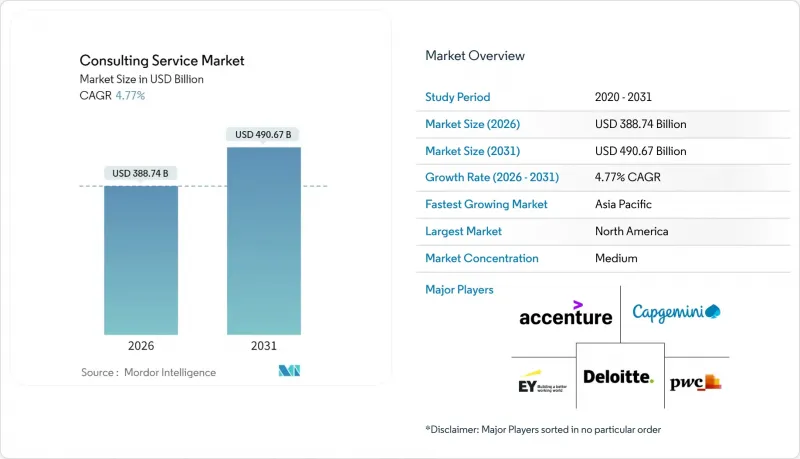
市场的稳定成长反映了咨询服务模式从传统咨询服务转向技术赋能、成果导向模式的重大转变。董事会层级对数位转型的迫切需求、监管机构对环境、社会和管治(ESG) 绩效日益严格的审查以及不断增长的网路风险,正推动企业将支出转向高价值咨询服务。大型公司正透过收购来拓展自身能力,以弥补在人工智慧 (AI)、云端迁移和能源转型等领域的专业知识缺口。同时,专业顾问公司凭藉其深厚的专业知识和敏捷的交付能力赢得了许多专案。结合现场和虚拟交付的混合模式正逐渐成为常态,使企业能够获得全球人才、降低计划成本并减少与差旅相关的碳排放。竞争优势的实现依赖于专有平台、数据驱动的调查方法以及将报酬与可衡量的客户成果挂钩的、可验证的影响指标。
全球咨询服务市场趋势与洞察
加速数位转型
企业正将多年期的现代化专案压缩成更短的周期,这增加了对能够大规模整合云端迁移、资料现代化和大规模分析的咨询顾问的需求。产业专用的云端解决方案支援针对特定产业的客製化服务,迫使咨询顾问将流程重塑与技术实施结合。医疗服务提供者正在部署远端医疗生态系统,製造商正在整合感测器进行预测性维护,金融机构正在推出即时付款基础。顾问公司也积极回应,提供涵盖架构设计、资料迁移和合规性调整的产业专用的云端服务,将自身定位从纯粹的策略顾问转变为执行合作伙伴。这种转变将在初始转型阶段之后,透过託管服务带来长期经常性收入。
疫情后更加重视营运效率
成本控制仍然是董事会的首要任务,因为供给侧通膨和工资压力导致利润率承压。企业要求咨询专案能够提供可量化的投资报酬率,这推动了与产能提升、自动化程度提高和营运资金释放挂钩的绩效付费模式的普及。越来越多的顾问专案围绕着流程挖掘、智慧自动化和混合型员工队伍的精实重组。咨询顾问会引入绩效仪表板,即时追踪关键绩效指标,从而确保透明度并加快决策速度。这种对结果的关注使咨询公司成为价值创造的合作伙伴,而非可有可无的支出项目,从而提升了其在註重成本的客户中的份额。
降低客户成本并提升内部能力
出于经济审慎的考虑,企业将外部支出重新分配到策略缺口,而日常咨询职能则越来越多地被内部专家中心所承担。选择性采购策略强调价值获取,迫使咨询顾问透过专有工具、产业标竿和结果保证来脱颖而出。同时,企业也开始提供协作式采购模式,将顾问顾问嵌入客户团队,加速知识转移和能力成熟,在预算限制下保留业务机会。
细分市场分析
到2025年,营运咨询将占咨询服务市场份额的28.94%,这印证了製造业、零售业和能源产业对流程优化的持续需求。随着企业寻求人工智慧管治、云端转型和网路弹性方面的专业知识,技术咨询正以6.29%的复合年增长率快速成长。市场受益于技术与传统管理咨询的整合,促使企业投资涵盖策略制定、实施和託管服务的端到端能力。技术咨询专案越来越多地将云端迁移蓝图和资料现代化蓝图相结合。企业正在整合专有加速器以缩短时间、降低风险,并透过託管云端营运创造经常性收入。营运咨询透过将数位双胞胎、流程挖掘分析和机器人流程自动化融入其传统的精实工具包,保持了其重要性。营运和技术职能之间的交叉销售正在推动客户总支出份额的成长,这标誌着咨询服务市场正向整合转型解决方案转变。
医疗保健和生命科学领域预计将超越其他垂直产业,以6.63%的复合年增长率成长,这主要得益于数位疗法、远端患者监护和人工智慧辅助药物研发等技术正在改变商业模式。到2025年,银行、金融和保险(BFSI)产业将占咨询服务市场规模的22.10%,反映出对网路安全措施、监理合规和核心银行体系现代化计划的持续需求。能源和公共产业领域的咨询机会主要集中在脱碳策略、电网现代化和氢能生态系统规划方面,凸显了该行业对多学科咨询的日益依赖。
资料隐私法规的加强、以患者为中心的医疗模式以及不断变化的报销机制正在推动医疗保健咨询行业的发展。各公司正将监管方面的专业知识与技术实施方面的支援相结合,指导医疗服务提供者完成电子健康记录升级和基于云端的临床试验平台部署。在金融服务领域,对即时支付系统、数位身分和环境风险压力测试的需求日益增长。 ESG(环境、社会和治理)揭露规则与资料管治标准的整合正在创造跨产业的协同效应,并扩大市场覆盖范围。
区域分析
北美地区预计到2025年将占全球收入的40.62%,这得益于高技术普及率、联邦政府对网路安全的大力投入以及严格的金融服务监管。美国企业正利用咨询服务来制定人工智慧管治框架、零信任架构实施方案以及环境、社会和治理(ESG)合规蓝图。加拿大则凭藉其资源丰富的经济优势,透过试点碳捕获和氢能项目,在能源转型咨询领域中打造自己独特的市场定位。日益严格的气候变迁相关资讯揭露要求将持续支撑两国对咨询服务的长期需求。
亚太地区是成长最快的地区,预计到2031年将以6.92%的复合年增长率成长,这主要得益于大规模数位基础设施计划、电子政府倡议以及可再生能源的扩张。中国在供应链优化和消费银行业务数位化方面对人工智慧的应用将支撑该地区的需求。日本对工业机器人的重视以及新加坡作为金融服务创新中心的地位,为专业顾问公司创造了肥沃的土壤。在印度,医疗数位化、製造自动化和智慧城市规划的整合正在增强该地区咨询服务市场的发展势头。
在能源转型、资料隐私法规和永续性等因素的推动下,欧洲保持稳定成长。 《企业永续性报告指令》(CSRD)要求企业寻找能够满足严格的报告时间表和保证标准的顾问。德国和法国正致力于透过工业4.0提高生产力,而北欧国家则在循环经济战略方面走在前列,推动了对创新营运模式的需求。中东和非洲地区正利用多元化政策和大型基础设施计划来吸引全球咨询专家。同时,南美洲的自然资源生产国需要製定环境、社会和治理(ESG)以及营运效率蓝图,以保持其全球竞争力。
其他福利:
- Excel格式的市场预测(ME)表
- 3个月的分析师支持
目录
第一章 引言
- 研究假设和市场定义
- 调查范围
第二章调查方法
第三章执行摘要
第四章 市场情势
- 市场概览
- 市场驱动因素
- 主流趋势—加速数位转型
- 主流趋势-疫情后更加重视营运效率
- 主流趋势-ESG和风险管理领域监管复杂性的演变
- 主流趋势—云端运算和网路安全的快速普及
- 一个被忽视的领域:对生成式人工智慧管治的咨询需求
- 一个鲜为人知的趋势:董事会层级施压要求对范围 3 价值链进行脱碳
- 市场限制
- 主流-降低客户成本并建立内部能力
- 主流观点-人才短缺和薪资上涨
- 一个鲜为人知的趋势:旅行计划的碳足迹审查力度加大
- 一个鲜为人知的问题:供应商对专有咨询资产的锁定担忧
- 产业价值链分析
- 监管环境
- 技术展望
- 工业4.0和数位转型实践的影响
- 产业生态系分析
- 主要区域的特色
- 管理咨询中常见的经营模式
- 波特五力分析
- 买方的议价能力
- 供应商的议价能力
- 新进入者的威胁
- 替代品的威胁
- 竞争对手之间的竞争
第五章 市场规模与成长预测
- 按服务类型
- 营运咨询
- 策略咨询
- 财务咨询
- 技术咨询
- 人力资本咨询
- 风险与合规咨询
- 其他服务类型
- 按客户产业
- BFSI
- 医疗保健和生命科学
- 能源与公共产业
- 製造业和汽车业
- 资讯与通讯科技与媒体
- 公共部门
- 消费品和零售
- 其他行业
- 按规定表格
- 现场咨询
- 远端/虚拟咨询
- 混合咨询
- 按公司规模
- 大公司
- 小型企业
- 按地区
- 北美洲
- 我们
- 加拿大
- 南美洲
- 巴西
- 欧洲
- 英国
- 德国
- 法国
- 义大利
- 亚太地区
- 中东和非洲
- 中东
- 沙乌地阿拉伯
- 阿拉伯聯合大公国
- 非洲
- 南非
- 中东
- 北美洲
第六章 竞争情势
- 市场集中度
- 策略趋势
- 市占率分析
- 公司简介
- Deloitte Touche Tohmatsu Limited
- Accenture plc
- PricewaterhouseCoopers LLP
- Ernst & Young Global Limited
- KPMG International Cooperative
- Capgemini SE
- McKinsey & Company, Inc.
- Boston Consulting Group, Inc.
- Bain & Company, Inc.
- Roland Berger Holding GmbH & Co. KGaA
- AT Kearney, Inc.
- Simon-Kucher & Partners Strategy & Marketing Consultants GmbH
- OC&C Strategy Consultants LLP
- Gartner, Inc.
- Tata Consultancy Services Limited
- IBM Consulting(International Business Machines Corporation)
- Booz Allen Hamilton Holding Corporation
- CGI Inc.
- Infosys Consulting(Infosys Limited)
- Oliver Wyman Group(Marsh McLennan)
第七章 市场机会与未来展望
The Consulting Service market is expected to grow from USD 371.04 billion in 2025 to USD 388.74 billion in 2026 and is forecast to reach USD 490.67 billion by 2031 at 4.77% CAGR over 2026-2031.
The market's stable expansion reflects a decisive pivot from traditional advisory toward technology-enabled, outcome-oriented engagement models. Board-level urgency around digital transformation, heightened regulatory scrutiny on environmental, social, and governance (ESG) performance, and intensifying cyber risk are funneling enterprise spending toward high-value consulting offerings. Large firms are broadening capability sets through acquisitions that plug expertise gaps in artificial intelligence (AI), cloud migration, and energy transition, while boutique specialists win mandates by offering deep domain knowledge and agile delivery. Hybrid engagement models that combine on-site and virtual delivery are normalizing, allowing firms to access global talent, lower project costs, and reduce travel-related carbon footprints. Competitive differentiation hinges on proprietary platforms, data-driven methodologies, and demonstrable impact metrics that tie fees to measurable client outcomes.
Global Consulting Service Market Trends and Insights
Accelerating Digital-Transformation Mandates
Enterprises are compressing multi-year modernization programs into shorter cycles, driving premium demand for consultants who can orchestrate cloud migration, data modernization, and advanced analytics at scale. Industry-specific cloud solutions allow sector customization, prompting consultants to blend process redesign with technology implementation. Healthcare providers are deploying telehealth ecosystems, manufacturers are embedding sensors for predictive maintenance, and financial institutions are rolling out real-time payment rails. Consulting firms respond with dedicated industry-cloud practices that cover architecture design, data migration, and compliance alignment, repositioning themselves as execution partners rather than purely strategic advisors. The shift elevates long-term annuity revenue from managed services that follow the initial transformation phase.
Heightened Post-Pandemic Operational-Efficiency Focus
Cost containment remains a board priority as supply-side inflation and wage pressure erode margins. Organizations demand quantifiable return-on-investment from consulting engagements, spurring outcome-based fee models tied to throughput gains, automation intensity or working-capital release. Assignments increasingly revolve around process mining, intelligent automation and lean restructuring of hybrid workforces. Consultants embed performance dashboards that track key performance indicators in real time, ensuring transparency and accelerating decision-making. This results-oriented mindset cements consulting firms as value-creation partners rather than discretionary spend items, strengthening wallet share among cost-conscious clients.
Client Cost-Cutting and In-House Capability Build
Economic caution is prompting enterprises to rebalance external spend toward strategic gaps only, while internal centers of excellence absorb routine advisory functions. Selective sourcing strategies emphasize value capture, pushing consultants to differentiate through proprietary tools, industry benchmarks and outcome guarantees. Simultaneously, firms offer co-sourcing models that embed consultants within client teams to transfer knowledge and speed capability maturation, preserving engagement opportunities despite budget restraint.
Other drivers and restraints analyzed in the detailed report include:
- Growing Regulatory Complexity in ESG and Risk
- Demand for Advisory on Gen-AI Governance
- Talent Scarcity and Wage Inflation
For complete list of drivers and restraints, kindly check the Table Of Contents.
Segment Analysis
Operations consulting captured 28.94% of the consulting service market share in 2025, underscoring persistent demand for process optimization across manufacturing, retail, and energy sectors. Technology Advisory is expanding at a 6.29% CAGR as enterprises seek expertise in AI governance, cloud transformation, and cyber-resilience. The market benefits from the convergence of technology and traditional management advisory, prompting firms to invest in end-to-end capabilities spanning strategy, implementation, and managed services.Technology Advisory engagements increasingly bundle cloud-migration road maps with cybersecurity safeguards and data-modernization blueprints. Firms integrate proprietary accelerators to compress timelines and lower risk, creating annuity revenue through managed cloud operations. Operations consulting remains relevant by embedding digital twins, process-mining analytics, and robotic process automation into classic lean toolkits. Cross-selling between Operations and Technology practices deepens wallet share and exemplifies the consulting service market's shift toward integrated transformation solutions.
The Healthcare and Life Sciences segment is forecast to post a 6.63% CAGR, outpacing all other verticals as digital therapeutics, remote patient monitoring, and AI-assisted drug discovery reshape operating models. BFSI retained 22.10% of the consulting service market size in 2025, reflecting sustained cybersecurity, regulatory compliance, and core-bank modernization projects. Consulting opportunities in energy and utilities concentrate on decarbonization strategy, grid modernization, and hydrogen ecosystem planning, reinforcing the sector's reliance on multidisciplinary advisory.
Heightened data-privacy regulation, patient-centric care models, and reimbursement shifts underpin healthcare consulting momentum. Firms combine regulatory know-how with technology enablement, guiding providers through electronic-health-record upgrades and cloud-based clinical trial platforms. In financial services, demand centers on real-time payment rails, digital identity, and environmental risk stress-testing. Cross-vertical synergies emerge as ESG disclosure rules and data-governance standards converge, expanding the market's addressable scope.
The Consulting Service Market Report is Segmented by Service Type (Operations, Strategy, Financial Advisory, Technology Advisory, Human-Capital, Risk and Compliance, Other Service Types), Client Industry (BFSI, Healthcare and Life Sciences, and More), Delivery Model (On-Site, Remote/Virtual, Hybrid), Organisation Size, and Geography. The Market Forecasts are Provided in Terms of Value (USD).
Geography Analysis
North America generated 40.62% of 2025 revenue, buoyed by high technology adoption, federal cybersecurity funding, and stringent financial services regulation. U.S. enterprises engage consultants for AI governance frameworks, zero-trust architecture implementation, and ESG compliance road maps. Canada contributes niche growth in energy-transition consulting, leveraging its resource-rich economy to test carbon-capture and hydrogen pilot schemes. Intensifying climate-related disclosure mandates sustains long-term consulting demand across both countries.
Asia-Pacific is the fastest-growing region, set to expand at a 6.92% CAGR through 2031, propelled by large-scale digital-infrastructure projects, e-government initiatives, and renewables build-out. China anchors regional demand with AI-infused supply-chain optimization and consumer banking digitization. Japan's emphasis on industrial robotics and Singapore's status as a financial-services innovation hub create fertile terrain for specialized consulting shops. India blends healthcare digitalization, manufacturing automation, and smart-city programs, reinforcing the consulting service market's momentum in the subcontinent.
Europe maintains steady growth, driven by energy-transition imperatives, data-privacy regulation and sustainability leadership. The Corporate Sustainability Reporting Directive compels companies to seek advisors who can meet stringent reporting timelines and assurance thresholds. Germany and France focus on Industry 4.0 productivity gains, while the Nordics pioneer circular-economy strategies that elevate demand for innovative operating-model rewiring. Middle East and Africa harness diversification policies and mega-infrastructure projects to attract global consulting expertise, whereas South America's natural-resource producers require ESG and operational-efficiency road maps to remain globally competitive.
- Deloitte Touche Tohmatsu Limited
- Accenture plc
- PricewaterhouseCoopers LLP
- Ernst & Young Global Limited
- KPMG International Cooperative
- Capgemini SE
- McKinsey & Company, Inc.
- Boston Consulting Group, Inc.
- Bain & Company, Inc.
- Roland Berger Holding GmbH & Co. KGaA
- A.T. Kearney, Inc.
- Simon-Kucher & Partners Strategy & Marketing Consultants GmbH
- OC&C Strategy Consultants LLP
- Gartner, Inc.
- Tata Consultancy Services Limited
- IBM Consulting (International Business Machines Corporation)
- Booz Allen Hamilton Holding Corporation
- CGI Inc.
- Infosys Consulting (Infosys Limited)
- Oliver Wyman Group (Marsh McLennan)
Additional Benefits:
- The market estimate (ME) sheet in Excel format
- 3 months of analyst support
TABLE OF CONTENTS
1 INTRODUCTION
- 1.1 Study Assumptions and Market Definition
- 1.2 Scope of the Study
2 RESEARCH METHODOLOGY
3 EXECUTIVE SUMMARY
4 MARKET LANDSCAPE
- 4.1 Market Overview
- 4.2 Market Drivers
- 4.2.1 Mainstream - Accelerating digital-transformation mandates
- 4.2.2 Mainstream - Heightened post-pandemic operational-efficiency focus
- 4.2.3 Mainstream - Growing regulatory complexity in ESG and risk
- 4.2.4 Mainstream - Rapid cloud and cybersecurity adoption
- 4.2.5 Under-the-radar - Demand for advisory on Gen-AI governance
- 4.2.6 Under-the-radar - Board-level pressure for Scope-3 value-chain decarbonisation
- 4.3 Market Restraints
- 4.3.1 Mainstream - Client cost-cutting and in-house capability build
- 4.3.2 Mainstream - Talent scarcity and wage inflation
- 4.3.3 Under-the-radar - Rising carbon-footprint scrutiny of travel-heavy projects
- 4.3.4 Under-the-radar - Vendor-lock-in concerns around proprietary consulting assets
- 4.4 Industry Value-Chain Analysis
- 4.5 Regulatory Landscape
- 4.6 Technological Outlook
- 4.7 Impact of Industry 4.0 and Digital-Transformation Practices
- 4.8 Industry Ecosystem Analysis
- 4.9 Key Regional Hotspots
- 4.10 Prevalent Business Models in Management Consulting
- 4.11 Porter's Five Forces Analysis
- 4.11.1 Bargaining Power of Buyers
- 4.11.2 Bargaining Power of Suppliers
- 4.11.3 Threat of New Entrants
- 4.11.4 Threat of Substitutes
- 4.11.5 Competitive Rivalry
5 MARKET SIZE AND GROWTH FORECASTS
- 5.1 By Service Type (Value)
- 5.1.1 Operations Consulting
- 5.1.2 Strategy Consulting
- 5.1.3 Financial Advisory
- 5.1.4 Technology Advisory
- 5.1.5 Human-Capital Consulting
- 5.1.6 Risk and Compliance Consulting
- 5.1.7 Other Service Types
- 5.2 By Client Industry (Value)
- 5.2.1 BFSI
- 5.2.2 Healthcare and Life Sciences
- 5.2.3 Energy and Utilities
- 5.2.4 Manufacturing and Automotive
- 5.2.5 ICT and Media
- 5.2.6 Public Sector
- 5.2.7 Consumer and Retail
- 5.2.8 Other Industries
- 5.3 By Delivery Model (Value)
- 5.3.1 On-site Consulting
- 5.3.2 Remote / Virtual Consulting
- 5.3.3 Hybrid Consulting
- 5.4 By Organisation Size (Value)
- 5.4.1 Large Enterprises
- 5.4.2 Small and Medium-sized Enterprises
- 5.5 By Geography (Value)
- 5.5.1 North America
- 5.5.1.1 United States
- 5.5.1.2 Canada
- 5.5.2 South America
- 5.5.2.1 Brazil
- 5.5.3 Europe
- 5.5.3.1 United Kingdom
- 5.5.3.2 Germany
- 5.5.3.3 France
- 5.5.3.4 Italy
- 5.5.4 Asia-Pacific (APAC)
- 5.5.5 Middle East and Africa
- 5.5.5.1 Middle East
- 5.5.5.1.1 Saudi Arabia
- 5.5.5.1.2 United Arab Emirates
- 5.5.5.2 Africa
- 5.5.5.2.1 South Africa
- 5.5.5.1 Middle East
- 5.5.1 North America
6 COMPETITIVE LANDSCAPE
- 6.1 Market Concentration
- 6.2 Strategic Moves
- 6.3 Market Share Analysis
- 6.4 Company Profiles (includes Global level Overview, Market level overview, Core Segments, Financials as available, Strategic Information, Market Rank/Share for key companies, Products and Services, and Recent Developments)
- 6.4.1 Deloitte Touche Tohmatsu Limited
- 6.4.2 Accenture plc
- 6.4.3 PricewaterhouseCoopers LLP
- 6.4.4 Ernst & Young Global Limited
- 6.4.5 KPMG International Cooperative
- 6.4.6 Capgemini SE
- 6.4.7 McKinsey & Company, Inc.
- 6.4.8 Boston Consulting Group, Inc.
- 6.4.9 Bain & Company, Inc.
- 6.4.10 Roland Berger Holding GmbH & Co. KGaA
- 6.4.11 A.T. Kearney, Inc.
- 6.4.12 Simon-Kucher & Partners Strategy & Marketing Consultants GmbH
- 6.4.13 OC&C Strategy Consultants LLP
- 6.4.14 Gartner, Inc.
- 6.4.15 Tata Consultancy Services Limited
- 6.4.16 IBM Consulting (International Business Machines Corporation)
- 6.4.17 Booz Allen Hamilton Holding Corporation
- 6.4.18 CGI Inc.
- 6.4.19 Infosys Consulting (Infosys Limited)
- 6.4.20 Oliver Wyman Group (Marsh McLennan)
7 MARKET OPPORTUNITIES AND FUTURE OUTLOOK
- 7.1 White-space and Unmet-Need Assessment

 2026年全球IT咨询市场报告2026年全球企业敏捷转型服务市场报告
 企业敏捷转型服务市场规模、份额、趋势和预测:按方法论、服务类型、组织规模、产业和地区划分,2026-2034 年2026年全球公司秘书服务市场报告2026年全球房地产咨询服务市场报告2026年全球精算咨询服务市场报告2026年全球设计、研究、促销与咨询服务市场报告
 2026-2030年全球行销咨询市场
 东南亚咨询服务:市场占有率分析、产业趋势与统计、成长预测(2026-2031)永续发展咨询服务:市场占有率分析、产业趋势与统计、成长预测(2026-2031)