


 |
市场调查报告书
商品编码
1940816
美国整车货运经纪市场:市场占有率分析、产业趋势与统计、成长预测(2026-2031 年)United States FTL Freight Brokerage - Market Share Analysis, Industry Trends & Statistics, Growth Forecasts (2026 - 2031) |
||||||

※ 本网页内容可能与最新版本有所差异。详细情况请与我们联繫。
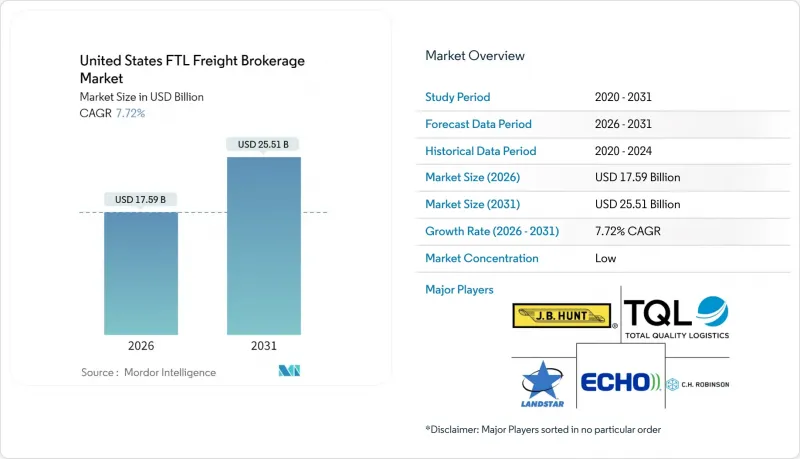
2025 年美国整车货运经纪市场价值 163.3 亿美元,预计到 2031 年将达到 255.1 亿美元,高于 2026 年的 175.9 亿美元。
预计在预测期(2026-2031 年)内,复合年增长率将达到 7.72%。
这种规模和成长轨迹凸显了托运人如何迅速将采购方式转向数位化、第三方整车运输专家,其驱动力在于满足电子商务需求、近岸外包以及基础设施投资。平台主导的仲介业者整合了预测定价、API 连接和自动化合规性检查,以减少人工环节、缩短结算週期并整合货运量。同时,集中的购买力使顶级仲介能够在司机队伍老化、柴油价格波动和信贷紧缩等情况下确保运力。因此,随着供应链数位化、跨境货运量增加以及托运人寻求透过货物整合来降低成本的策略,技术领先、深厚的承运商关係和多元化的设备组合正成为关键优势。
美国整车货运经纪市场趋势与洞察
履约需求爆炸性成长
分散式库存策略需要精细的运力管理,而传统的自有资产承运商难以有效应对。借助人工智慧驱动的整合引擎,仲介透过减少空驶里程和缩短高达 35% 的运输週期,降低了全通路零售商的服务成本。位于人口密集都市区的微型仓配中心促进了频繁的小批量整车运输,使仲介业者能够快速匹配运力,从而获益。快速送达客户仍然是重中之重,这使得货运代理能够为紧急货物的多站路线提供溢价,并巩固了美国整车货运代理市场作为电商网络值得信赖的合作伙伴的地位。
托运人的成本降低策略以及向整车运输方式的转变
透过整合超过 15,000 磅的货物,製造商可以避免码头装卸,减少责任索赔,并缩短运输时间,与同等零担 (LTL) 运输路线相比,可节省 12% 至 18% 的成本。工厂直销是汽车和工业供应链的首选,有助于实现准时制库存控制。能够协调区域整合中心的仲介可以提升美国整车 (FTL) 货运代理市场的流量,随着供应链管理者将速度置于最低单价之上,货运量也会随之增加。
长期存在的司机短缺问题和劳动力老化问题
预计到2024年,非固定薪资卡车驾驶人的就业人数将下降16.3%,这将是自2009年以来最大的降幅。独立承包商的保险和融资成本将上涨20%,迫使部分承包商退出市场。药物和酒精检测违规行为以及2000年以前生产的卡车可能强制安装电子记录设备(ELD)将进一步降低运力。虽然拥有可靠承运商网路的仲介可以提高利润率,但整体运力空间正在萎缩,这减缓了美国整车货运仲介市场的成长潜力。
细分市场分析
到2025年,分销业将占美国整车货运仲介市场份额的30.35%,这反映了全通路零售商、批发商和电子商务平台对全国干货车运输网路的依赖。库存多元化带来的频繁补货需求支撑了该行业的稳定成长。在《基础设施投资与就业法案》的资金支持下,建设业预计在2031年之前实现5.18%的复合年增长率,成为成长最快的行业。平板货车仲介负责协调钢筋、预製墙体和重型设备运送到数千个工地,并在特殊路线上赚取高额运费。在製造业和汽车产业,近岸外包促进了组装厂和供应商园区之间的同步,持续创造跨境运输机会。虽然石油、天然气和矿业的运输量会随商品週期波动,但农业、林业和渔业的运输量具有季节性可预测性,这使得仲介可以透过策略性地将运力分配到收穫走廊来获利。
终端用户组合有助于利润多元化。消费支出放缓可透过基础建设支出抵消,而基础建设支出将持续到2029年预算。利用数据分析的仲介透过根据商品价格波动对托运人进行细分并动态调整定价策略,从而在週期性波动中保持盈利。与联邦紧急事务管理署(FEMA)相关的货运量突然增加带来了额外的商机。这种均衡的终端用户组合有助于美国整车货运仲介市场的长期稳健发展。
其他福利:
- Excel格式的市场预测(ME)表
- 分析师支持(3个月)
目录
第一章 引言
- 研究假设和市场定义
- 调查范围
第二章调查方法
第三章执行摘要
第四章 市场情势
- 市场概览
- 市场驱动因素
- 履约需求爆炸性成长
- 托运人的成本削减计划以及向整车运输 (FTL)的模式转换
- 数位化和API驱动的货物匹配平台
- 美国和墨西哥之间近岸外包走廊的成长
- IIJA基础设施计划增加平板车运输里程
- 由于联邦紧急事务管理局(FEMA)的救灾合同,暂时性激增
- 市场限制
- 长期存在的司机短缺问题和劳动力老化问题
- 柴油价格波动对仲介的利润率带来压力。
- 双重仲介和货物盗窃诈骗导致信贷紧缩
- 主要货运公司将自有车辆纳入公司内部内部资源
- 价值/供应链分析
- 监管环境
- 技术展望
- 波特五力模型
- 新进入者的威胁
- 买方的议价能力
- 供应商的议价能力
- 替代品的威胁
- 竞争对手之间的竞争
- 货运费率趋势分析
- 政府重大政策
- 美国主要FTL经纪公司所在地分析
- 薪资和薪资制度的发展趋势
第五章 市场规模及成长预测(以金额为准,2019-2030 年)
- 最终用户
- 製造业和汽车业
- 石油和天然气、采矿和采石
- 农业、渔业、林业
- 建造
- 分销业
- 其他最终用户
- 透过装置
- 干货车
- 冷藏(冷藏车)
- 平板车/重型货物运输车
- 罐车/散装货物
- 特殊运输/超大货物
- 按货物类型
- 普通货物
- 冷藏货物
- 按美国地区
- 东北
- 中西部
- 南部
- 西
第六章 竞争情势
- 市场集中度
- 策略性倡议和併购
- 市占率分析
- 公司简介
- CH Robinson
- JB Hunt Transport Services
- Total Quality Logistics
- Echo Global Logistics
- Landstar System
- RXO
- Schneider
- WWEX Group(Worldwide Express)
- GlobalTranz
- Arrive Logistics
- Hub Group
- Mode Global
- Armstrong Transport Group
- Nolan Transportation Group
- Trinity Logistics
- PLS Logistics Services
- Allen Lund Company
- Werner Enterprises
- Kag Logistics Inc
- Scotlynn
第七章 市场机会与未来展望
The United States FTL Freight Brokerage Market was valued at USD 16.33 billion in 2025 and estimated to grow from USD 17.59 billion in 2026 to reach USD 25.51 billion by 2031, at a CAGR of 7.72% during the forecast period (2026-2031).
The scale and trajectory underscore how rapidly shippers are migrating procurement toward digital, third-party full-truckload specialists in response to e-commerce fulfillment imperatives, nearshoring, and infrastructure spending. Platform-driven intermediaries are consolidating volumes by integrating predictive pricing, API connectivity, and automated compliance checks that shrink manual touch points and shorten settlement cycles. At the same time, concentrated buying power allows top brokers to secure capacity despite an aging driver workforce, volatile diesel prices, and tightening credit. Technology leadership, deep carrier relationships, and diversified equipment portfolios therefore emerge as decisive advantages as supply chains digitize, cross-border traffic grows, and shippers pursue cost-out strategies through load consolidation.
United States FTL Freight Brokerage Market Trends and Insights
Explosive E-commerce Fulfillment Demand
Distributed inventory strategies require granular capacity management that traditional asset-based carriers cannot meet efficiently. Brokers using AI-driven consolidation engines reduce empty miles and compress transportation cycle times by up to 35%, improving cost-to-serve for omnichannel retailers. Micro-fulfillment hubs in dense urban zones stimulate frequent, small-lot full-truckload moves that reward intermediaries capable of rapid capacity matching. Speed-to-customer remains paramount, enabling premium pricing on expedited multi-stop routes and reinforcing the US FTL freight brokerage market as a go-to partner for e-commerce networks.
Shippers' Cost-Out Agenda and Modal Shift to FTL
Manufacturers consolidating loads above 15,000 lb avoid terminal handling, lower damage claims, and cut transit times, realizing 12-18% savings versus comparable LTL routings. Automotive and industrial supply chains favor direct-to-plant deliveries to sustain just-in-time inventory disciplines. Brokers able to orchestrate regional consolidation hubs draw incremental volume as supply chain managers re-prioritize velocity over lowest unit cost, reinforcing volume flows into the US FTL freight brokerage market.
Chronic Driver Shortage and Aging Workforce
Non-payroll trucking employment shrank 16.3% in 2024, the sharpest retrenchment since 2009. Independent contractors face 20% higher insurance and financing costs, pushing some off the road. Drug and Alcohol Clearinghouse violations and potential ELD mandates on pre-2000 trucks trim further capacity. Brokers with dependable carrier pools can raise margins, yet overall volume headroom narrows, slowing expansion potential for the US FTL freight brokerage market.
Other drivers and restraints analyzed in the detailed report include:
- Digitization and API-Driven Freight-Matching Platforms
- US-Mexico Nearshoring Corridor Growth
- Diesel-Price Volatility Compressing Broker Margins
For complete list of drivers and restraints, kindly check the Table Of Contents.
Segment Analysis
Distributive trade accounted for 30.35% of the US FTL freight brokerage market share in 2025, reflecting omnichannel retailers, wholesalers, and e-commerce marketplaces that depend on nationwide dry-van networks. Growth remains stable as inventory decentralization favors frequent replenishment. Construction, accelerated by Infrastructure Investment and Jobs Act funding, registers the fastest 5.18% CAGR to 2031. Flatbed brokers coordinate rebar, prefabricated walls, and heavy equipment to thousands of work sites, capturing premium rates for specialized routings. Manufacturing and automotive continue to present cross-border opportunities as nearshoring drives synchronized flows between assembly plants and supplier parks. Oil, gas, and mining volumes fluctuate with commodity cycles, while agriculture, fishing, and forestry shipments retain seasonal predictability that brokers monetize through strategic positioning of capacity in harvest corridors.
The end-user mix supports margin diversification. A slowdown in consumer spending can be offset by infrastructure outlays that extend through 2029 appropriations. Brokers leveraging data analytics segment shippers by commodity volatility and adjust pricing strategies dynamically, sustaining profitability across cycles. FEMA-related episodic volume spikes provide additional upside. The balanced portfolio across end-users therefore underpins the long-run resilience of the US FTL freight brokerage market.
The US FTL Freight Brokerage Market Report is Segmented by End-User (Manufacturing and Automotive, Oil and Gas Mining and Quarrying, Agriculture Fishing and Forestry, Construction, Distributive Trade, and More), Equipment Type (Dry-Van, Refrigerated Reefer, Flatbed Heavy-Haul, Tanker Bulk, and More), Freight Type (General Freight, Refrigerated Freight), and Geography. The Market Forecasts are Provided in Terms of Value (USD).
List of Companies Covered in this Report:
- C.H. Robinson
- J.B. Hunt Transport Services
- Total Quality Logistics
- Echo Global Logistics
- Landstar System
- RXO
- Schneider
- WWEX Group (Worldwide Express)
- GlobalTranz
- Arrive Logistics
- Hub Group
- Mode Global
- Armstrong Transport Group
- Nolan Transportation Group
- Trinity Logistics
- PLS Logistics Services
- Allen Lund Company
- Werner Enterprises
- Kag Logistics Inc
- Scotlynn
Additional Benefits:
- The market estimate (ME) sheet in Excel format
- 3 months of analyst support
TABLE OF CONTENTS
1 Introduction
- 1.1 Study Assumptions and Market Definition
- 1.2 Scope of the Study
2 Research Methodology
3 Executive Summary
4 Market Landscape
- 4.1 Market Overview
- 4.2 Market Drivers
- 4.2.1 Explosive e-commerce fulfilment demand
- 4.2.2 Shippers' cost-out agenda and modal shift to FTL
- 4.2.3 Digitisation and API-driven freight-matching platforms
- 4.2.4 US-Mexico nearshoring corridor growth
- 4.2.5 IIJA infrastructure projects boosting flatbed miles
- 4.2.6 FEMA disaster-relief contracts creating episodic spikes
- 4.3 Market Restraints
- 4.3.1 Chronic driver shortage and ageing workforce
- 4.3.2 Diesel-price volatility compressing broker margins
- 4.3.3 Double-brokering and cargo-theft fraud tightening credit
- 4.3.4 Private-fleet insourcing by big shippers
- 4.4 Value / Supply-Chain Analysis
- 4.5 Regulatory Landscape
- 4.6 Technological Outlook
- 4.7 Porter's Five Forces
- 4.7.1 Threat of New Entrants
- 4.7.2 Bargaining Power of Buyers
- 4.7.3 Bargaining Power of Suppliers
- 4.7.4 Threat of Substitutes
- 4.7.5 Competitive Rivalry
- 4.8 Insights into Freight Rates
- 4.9 Key Government Initiatives
- 4.10 Insights on the FTL Brokerage Hotspots in the United states
- 4.11 Wage and Pay-structure Trends
5 Market Size and Growth Forecasts (Value, 2019-2030)
- 5.1 By End-User
- 5.1.1 Manufacturing And Automotive
- 5.1.2 Oil And Gas, Mining, And Quarrying
- 5.1.3 Agriculture, Fishing, And Forestry
- 5.1.4 Construction
- 5.1.5 Distributive Trade
- 5.1.6 Other End Users
- 5.2 By Equipment Type
- 5.2.1 Dry-Van
- 5.2.2 Refrigerated (Reefer)
- 5.2.3 Flatbed / Heavy-haul
- 5.2.4 Tanker / Bulk
- 5.2.5 Specialized / Over-dimension
- 5.3 By Freight Type
- 5.3.1 General Freight
- 5.3.2 Refrigerated Freight
- 5.4 By U.S. Region
- 5.4.1 Northeast
- 5.4.2 Midwest
- 5.4.3 South
- 5.4.4 West
6 Competitive Landscape
- 6.1 Market Concentration
- 6.2 Strategic Moves and MandA
- 6.3 Market Share Analysis
- 6.4 Company Profiles (includes Global level Overview, Market level overview, Core Segments, Financials as available, Strategic Information, Market Rank/Share for key companies, Products and Services, and Recent Developments)
- 6.4.1 C.H. Robinson
- 6.4.2 J.B. Hunt Transport Services
- 6.4.3 Total Quality Logistics
- 6.4.4 Echo Global Logistics
- 6.4.5 Landstar System
- 6.4.6 RXO
- 6.4.7 Schneider
- 6.4.8 WWEX Group (Worldwide Express)
- 6.4.9 GlobalTranz
- 6.4.10 Arrive Logistics
- 6.4.11 Hub Group
- 6.4.12 Mode Global
- 6.4.13 Armstrong Transport Group
- 6.4.14 Nolan Transportation Group
- 6.4.15 Trinity Logistics
- 6.4.16 PLS Logistics Services
- 6.4.17 Allen Lund Company
- 6.4.18 Werner Enterprises
- 6.4.19 Kag Logistics Inc
- 6.4.20 Scotlynn
7 Market Opportunities and Future Outlook
- 7.1 White-space and Unmet-Need Assessment

 货运代理服务市场:依服务类型、运输方式、客户规模、货物类型、技术应用及最终用户产业划分-2026-2032年全球市场预测
 全球货运仲介市场规模、份额、趋势和成长分析报告(2026-2034)
 2026-2030年全球货运仲介市场
 2026-2030年全球数位货运经纪市场
 数位货运经纪市场机会、成长驱动因素、产业趋势分析及预测(2026-2035年)
 2032 年数位货运经纪市场预测:按平台类型、运输方式、服务类型、部署模式、最终用户和地区进行的全球分析
 2025年数位货运经纪全球市场报告
 美国货运经纪:市场份额分析、行业趋势、统计数据和成长预测(2025-2030 年)全球数位货运经纪市场-以运输方式、垂直产业、区域范围、预测分類的市场规模
 全球数位货运经纪市场规模、份额、趋势分析报告(依客户类型、运输方式、服务类型、最终用户产业、地区、展望与预测,2025 年至 2032 年)