


 |
市场调查报告书
商品编码
1940836
特种肥料:市场占有率分析、产业趋势与统计、成长预测(2026-2031)Specialty Fertilizer - Market Share Analysis, Industry Trends & Statistics, Growth Forecasts (2026 - 2031) |
||||||

※ 本网页内容可能与最新版本有所差异。详细情况请与我们联繫。
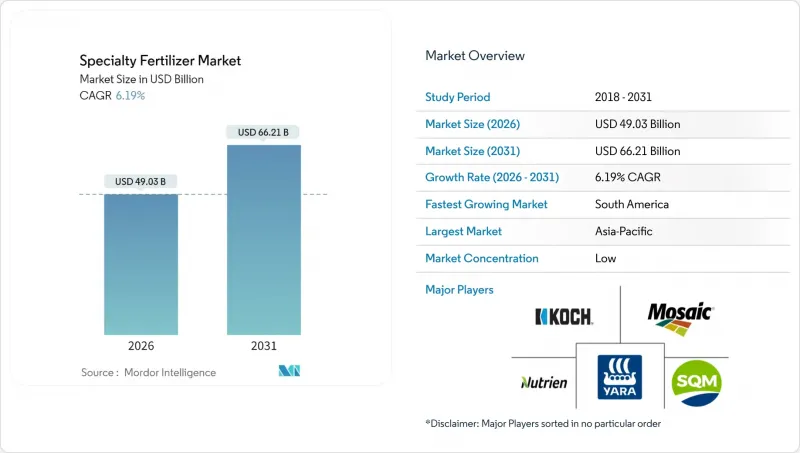
2025年特种肥料市场价值为461.7亿美元,预计到2031年将达到662.1亿美元,高于2026年的490.3亿美元。
预计在预测期(2026-2031 年)内,复合年增长率将达到 6.19%。
精密农业工具的普及应用正在推动市场成长,这主要得益于高效配方产品的快速发展以及将养分管理与环境指标挂钩的政策支持。液态产品占据主导地位,因为其完全溶解性符合灌溉施肥的需求,而缓释包衣技术的进步则确保养分输送与作物需求同步。数位化农业平台提供即时田间数据,从而提高养分利用效率,促进合规性,并实现排碳权货币化。推广保护性耕作方式、提高滴灌技术的普及率以及为提高氮肥利用效率提供奖励,将增强各类作物的需求韧性。日益激烈的市场竞争依赖于整合分析、硬体和客製化养分解决方案的综合服务模式,从而提高特种肥料市场的农场盈利。
全球特种肥料市场趋势与洞察
精密农业简介
卫星影像、土壤感测器和GPS导航施肥机正在提高养分施用的精准度。 2024年,大多数玉米和大豆种植者采用了变数施肥技术,与2023年相比,每英亩特种肥料用量增加,同时减少了大面积施肥。即时氮肥额度允许在作物生长阶段按需混合施肥,从而减少损失并提高产量。设备製造商目前正与养分供应商合作设计多仓施肥机,让农民无需停机即可更换肥料配方。支援性的保护项目正在承担部分硬体成本,加速了高效能精密农业产品的推广应用。
水资源短缺与灌溉效率
与漫灌系统相比,滴灌和施肥相结合可显着减少用水量,这在农业淡水资源份额日益减少的今天尤其重要。到2024年,全球滴灌管网的面积不断扩大,透过这些管网施用特殊肥料的量是传统田间施肥方式的两倍。以色列和约旦强制规定10公顷以上的新农场必须采用压力灌溉,从而锁定了对完全水溶性营养混合物的需求。因此,必须使用不易堵塞、低盐指数的线上pH值和电导率探头。与用水目标挂钩的补贴计画鼓励施肥灌溉,从而促进了特种肥料市场的成长。
原物料和能源价格波动
2024年,地缘政治紧张局势导致天然气、钾肥和磷矿石价格波动,对生产商的利润率带来压力。聚合物涂层占复合树脂(CRF)成本的25%之多,其价格与原油价格挂钩,因此原油价格上涨会直接导致产品价格上涨。俄罗斯和白俄罗斯钾肥供应中断导致现货价格暂时上涨50%,促使企业寻找替代货源。依赖单一供应商供应特殊添加剂会加剧风险,而外汇波动则进一步增加了依赖进口製造商的不确定性。采购週期短,几乎没有避险的空间,因此难以维持价格稳定。
细分市场分析
预计到2025年,液体肥料将占据特种肥料市场53.38%的份额。这一地位主要得益于其与肥料灌溉(混施)无与伦比的兼容性以及均匀的养分分布。液体肥料溶解迅速、易于混合,使其适用于需要精确均质性的变数施肥系统。亚太和南美洲大规模灌溉农田的普及将使液体肥料的消费量保持在高位,而室内种植因其盐分积累风险低而备受青睐。不断完善的分销基础设施,使得散装运输和农场现场混施成为可能,也促进了这一领域的成长。
预计缓释特种肥料市场将以7.81%的复合年增长率成长,成为所有特种肥料类型中成长最快的。包膜技术的进步使得养分释放曲线能够与植物吸收相匹配,从而减少径流和人工需求。聚合物硫基产品在缺硫地区越来越受欢迎,而可生物降解薄膜则有助于应对即将出台的微塑胶法规。精密农业工具能提升价值,并支持单次施肥即可满足作物多个生长阶段的需求,进而提高投资报酬率。
特种肥料市场按特种肥料类型(控释肥、液体肥料、缓释肥、水溶性肥料)、施用方法(滴灌施肥、叶面喷布、土壤施用)、作物类型(田间作物、园艺作物、草坪和观赏植物)以及地区(亚太地区、欧洲、中东和非洲、北美、南美)进行细分。市场预测以价值(美元)和销售量(公吨)为单位。
区域分析
到2025年,亚太地区将占全球收入的65.20%,这主要得益于中国的土壤检测补贴和印度针对小规模农户的专项养分激励措施。日本和韩国的集约化土地利用推高了每公顷的投入,而澳洲的干旱管理法规则则鼓励使用液态混合肥料的灌溉系统。东南亚的棕榈油和大米生产商正在采用高效投入品以满足永续性认证的要求,这进一步推动了产量成长。
南美洲将成为成长最快的地区,到2031年复合年增长率将达到8.55%。巴西已开始投资精密农业技术以提高养分利用效率,大型农场将控制释放肥料(CRF)的使用与犁地技术结合,以保护土壤健康。阿根廷也朝着类似的方向发展,利用控释肥料种植大豆和玉米,以在日益严格的环境监管下保持出口竞争力。
南美洲特种肥料市场的特征是规模化农业生产和现代农业技术的扩张。该地区以巴西和阿根廷为首,拥有广阔的农地和丰富的作物种类,因此蕴藏着巨大的市场潜力。巴西凭藉其庞大的农业规模和对农业创新的高度重视,已成为该地区最大的市场。阿根廷则凭藉精密农业技术的推广和对出口导向农业的重视,成为成长最快的市场。该地区市场的特点是人们对永续农业实践的认识不断提高,对农业技术的投资也不断增加。
其他福利:
- Excel格式的市场预测(ME)表
- 3个月的分析师支持
目录
第一章 引言
- 研究假设和市场定义
- 调查范围
- 调查方法
第二章 报告
第三章执行摘要和主要发现
第四章 主要产业趋势
- 主要农作物种植面积
- 田间作物
- 园艺作物
- 平均施肥量
- 微量营养素
- 田间作物
- 园艺作物
- 宏量营养素
- 田间作物
- 园艺作物
- 次要必需营养素
- 田间作物
- 园艺作物
- 微量营养素
- 具有灌溉设施的农田
- 法律规范
- 价值炼和通路分析
- 市场驱动因素
- 精密农业简介
- 水资源短缺与灌溉效率
- 温室和垂直农业的扩张
- NUE投入的排碳权奖励
- 利用 CRISPR 技术培育营养作物
- 透过数位化可追溯性实现高端化
- 市场限制
- 原物料和能源价格波动
- 化学肥料灌溉设备的高额资本投资成本
- 禁止微塑胶涂层的趋势
- 碳计量数据标准存在差距
第五章 市场规模及成长预测(数量与价值)
- 专业类型
- 控释肥料(CRF)
- 聚合物涂层
- 聚合物和硫涂层
- 其他的
- 液体肥料
- 缓效性肥料(SRF)
- 水溶性
- 控释肥料(CRF)
- 应用模式
- 施肥灌溉
- 叶面喷布
- 土壤
- 作物类型
- 田间作物
- 园艺作物
- 草坪和观赏植物
- 地区
- 亚太地区
- 澳洲
- 孟加拉
- 中国
- 印度
- 印尼
- 日本
- 巴基斯坦
- 菲律宾
- 泰国
- 越南
- 亚太其他地区
- 欧洲
- 法国
- 德国
- 义大利
- 荷兰
- 俄罗斯
- 西班牙
- 乌克兰
- 英国
- 其他欧洲地区
- 中东和非洲
- 奈及利亚
- 沙乌地阿拉伯
- 南非
- 土耳其
- 其他中东和非洲地区
- 北美洲
- 加拿大
- 墨西哥
- 我们
- 北美其他地区
- 南美洲
- 阿根廷
- 巴西
- 南美洲其他地区
- 亚太地区
第六章 竞争情势
- 关键策略倡议
- 市占率分析
- 公司简介
- 公司简介
- Coromandel International Limited
- EuroChem Group AG
- COMPO EXPERT GmbH
- Haifa Group
- Kingenta Ecological Engineering Group Co., Ltd.
- Koch Fertilizer LLC
- Nutrien Ltd.
- Sociedad Quimica y Minera de Chile SA
- The Mosaic Company
- Yara International ASA
- ICL Group Ltd.
- K+S Aktiengesellschaft
- Indian Farmers Fertiliser Cooperative Ltd.
- Omex Agriculture Ltd.
- Agro-Culture Liquid Fertilizers LLC
第七章:CEO们需要思考的关键策略问题
The specialty fertilizers market was valued at USD 46.17 billion in 2025 and estimated to grow from USD 49.03 billion in 2026 to reach USD 66.21 billion by 2031, at a CAGR of 6.19% during the forecast period (2026-2031).
The adoption of precision farming tools propels market growth, driven by the rapid shift toward enhanced-efficiency formulations and policy support that links nutrient management with environmental metrics. Liquid products dominate because their full solubility matches fertigation needs, while technology improvements in controlled-release coatings keep nutrient availability synchronized with crop demand. Digital agriculture platforms provide real-time field data that enhances nutrient use efficiency, promotes regulatory compliance, and facilitates carbon-credit monetization. Expanding protected cultivation, increasing drip irrigation coverage, and offering incentives for nitrogen use efficiency enhance demand resiliency across crop categories. Competitive intensity hinges on integrated service models that bundle analytics, hardware, and tailored nutrient solutions to raise farm profitability in the specialty fertilizers market.
Global Specialty Fertilizer Market Trends and Insights
Precision-Agriculture Adoption
Satellite imagery, soil sensors, and GPS-guided spreaders are enhancing the accuracy of nutrient placement. In 2024, the majority of corn and soybean growers adopted variable-rate application, compared to 2023, and specialty fertilizer use per acre increased as the broadcast practice declined. Real-time nitrogen crediting triggers on-demand blended inputs that match crop stages, cutting losses and bolstering yields. Equipment firms now co-design multi-bin applicators with nutrient suppliers, letting farmers switch formulations without downtime. Supportive conservation programs cover part of the hardware cost, thereby accelerating the penetration of precision-ready, enhanced-efficiency products.
Water Scarcity and Irrigation Efficiency
Drip irrigation, paired with fertigation, reduces water use compared to flood systems, a critical benefit as agriculture's share of freshwater resources contracts. Global acreage under drip lines reached a higher level in 2024, and specialty fertilizer volumes through these networks doubled those of conventional field methods. Israel and Jordan mandate pressurized irrigation for new farms larger than 10 ha, creating locked-in demand for fully soluble nutrient blends. Online pH and conductivity probes require low-salt index products that remain clog-free. Subsidies linked to water use targets favor fertigation and support the growth of the specialty fertilizers market.
Raw-Material and Energy Price Volatility
Natural gas, potash, and phosphate rock prices fluctuated in 2024 amid geopolitical tensions, compressing producer margins. Polymer coatings, which account for up to 25% of CRF costs, track crude oil, so oil spikes translate quickly into higher finished product prices. Potash supply disruptions from Russia and Belarus led to spot costs increasing by 50% at times, prompting alternative sourcing. Single-supplier dependence for specialty additives magnifies risk, and currency shifts add further uncertainty for import-reliant manufacturers. Short procurement cycles leave little room for hedging, making price stability elusive.
Other drivers and restraints analyzed in the detailed report include:
- Greenhouse and Vertical-Farm Expansion
- Digital Traceability Premiums
- Emerging Micro-Plastic Coating Bans
For complete list of drivers and restraints, kindly check the Table Of Contents.
Segment Analysis
Liquid fertilizers accounted for 53.38% of the specialty fertilizers market share in 2025, a position built on their unmatched compatibility with fertigation and uniform nutrient distribution. Their rapid dissolution and ease of blending suit variable-rate rigs that demand precise homogeneity. Adoption of large irrigated acreage across the Asia Pacific and South America keeps volumes high, while indoor farming values its low salt risk. The segment also benefits from an expanded distribution infrastructure that supports bulk shipments and on-farm blending.
The specialty fertilizers market size for controlled-release products is projected to expand at a 7.81% CAGR, the fastest among specialty types. Coating advances offer predictable nutrient release curves that align with crop uptake, thereby curbing leaching and reducing labor requirements. Polymer-sulfur variants gain traction in sulfur-deficient regions, and biodegradable films help satisfy looming microplastic laws. Precision agriculture tools amplify value, as one application now feeds a crop across multiple growth stages, improving return on investment.
The Specialty Fertilizer Market is Segmented by Specialty Type (CRF, Liquid Fertilizer, SRF, Water Soluble), by Application Mode (Fertigation, Foliar, Soil), by Crop Type (Field Crops, Horticultural Crops, Turf and Ornamental), and by Region (Asia-Pacific, Europe, Middle East and Africa, North America, and South America). The Market Forecasts are Provided in Terms of Value (USD) and Volume (Metric Tons).
Geography Analysis
Asia Pacific commanded 65.20% of global revenue in 2025, supported by China's soil testing subsidies and India's specialty nutrient incentives for smallholders. Intensive land use in Japan and South Korea further propels per-hectare spending, while Australia's drought management rules promote the use of fertigation systems with liquid blends. Southeast Asian palm and rice producers adopt enhanced-efficiency inputs to comply with sustainability certifications, adding incremental volume.
South America represents the fastest-growing region with an 8.55% CAGR to 2031. Brazil has initiated investments in precision agriculture technologies that enhance nutrient efficiency, and large farms are aligning CRF usage with no-till practices to safeguard soil health. Argentina mirrors this trajectory, utilizing controlled-release solutions for soy and corn to maintain export competitiveness amid growing environmental scrutiny.
The South American specialty fertilizer market is characterized by large-scale agricultural operations and growing adoption of modern farming practices. The region, primarily represented by Brazil and Argentina, shows significant market potential driven by extensive agricultural lands and diverse crop portfolios. Brazil emerges as the largest market in the region, supported by its vast agricultural operations and strong focus on technological advancement in farming. Argentina stands as the fastest-growing market, driven by increasing adoption of precision farming techniques and a focus on export-oriented agriculture. The region's market is characterized by growing awareness about sustainable farming practices and increasing investments in agricultural technology.
- Coromandel International Limited
- EuroChem Group AG
- COMPO EXPERT GmbH
- Haifa Group
- Kingenta Ecological Engineering Group Co., Ltd.
- Koch Fertilizer LLC
- Nutrien Ltd.
- Sociedad Quimica y Minera de Chile S.A.
- The Mosaic Company
- Yara International ASA
- ICL Group Ltd.
- K+S Aktiengesellschaft
- Indian Farmers Fertiliser Cooperative Ltd.
- Omex Agriculture Ltd.
- Agro-Culture Liquid Fertilizers LLC
Additional Benefits:
- The market estimate (ME) sheet in Excel format
- 3 months of analyst support
TABLE OF CONTENTS
1 INTRODUCTION
- 1.1 Study Assumptions and Market Definition
- 1.2 Scope of the Study
- 1.3 Research Methodology
2 REPORT OFFERS
3 EXECUTIVE SUMMARY AND KEY FINDINGS
4 KEY INDUSTRY TRENDS
- 4.1 Acreage of Major Crop Types
- 4.1.1 Field Crops
- 4.1.2 Horticultural Crops
- 4.2 Average Nutrient Application Rates
- 4.2.1 Micronutrients
- 4.2.1.1 Field Crops
- 4.2.1.2 Horticultural Crops
- 4.2.2 Primary Nutrients
- 4.2.2.1 Field Crops
- 4.2.2.2 Horticultural Crops
- 4.2.3 Secondary Macronutrients
- 4.2.3.1 Field Crops
- 4.2.3.2 Horticultural Crops
- 4.2.1 Micronutrients
- 4.3 Agricultural Land Equipped for Irrigation
- 4.4 Regulatory Framework
- 4.5 Value Chain and Distribution Channel Analysis
- 4.6 Market Drivers
- 4.6.1 Precision-agriculture adoption
- 4.6.2 Water scarcity and irrigation efficiency
- 4.6.3 Greenhouse and vertical-farm expansion
- 4.6.4 Carbon-credit incentives for NUE inputs
- 4.6.5 CRISPR-enabled nutrient-dense crops
- 4.6.6 Digital traceability premiums
- 4.7 Market Restraints
- 4.7.1 Raw-material and energy price volatility
- 4.7.2 High capex of fertigation hardware
- 4.7.3 Emerging micro-plastic coating bans
- 4.7.4 Data-standard gaps for carbon accounting
5 MARKET SIZE AND GROWTH FORECASTS (VALUE AND VOLUME)
- 5.1 Specialty Type
- 5.1.1 Controlled-Release Fertilizer (CRF)
- 5.1.1.1 Polymer Coated
- 5.1.1.2 Polymer-Sulfur Coated
- 5.1.1.3 Others
- 5.1.2 Liquid Fertilizer
- 5.1.3 Slow-Release Fertilizer (SRF)
- 5.1.4 Water-Soluble
- 5.1.1 Controlled-Release Fertilizer (CRF)
- 5.2 Application Mode
- 5.2.1 Fertigation
- 5.2.2 Foliar
- 5.2.3 Soil
- 5.3 Crop Type
- 5.3.1 Field Crops
- 5.3.2 Horticultural Crops
- 5.3.3 Turf and Ornamental
- 5.4 Region
- 5.4.1 Asia-Pacific
- 5.4.1.1 Australia
- 5.4.1.2 Bangladesh
- 5.4.1.3 China
- 5.4.1.4 India
- 5.4.1.5 Indonesia
- 5.4.1.6 Japan
- 5.4.1.7 Pakistan
- 5.4.1.8 Philippines
- 5.4.1.9 Thailand
- 5.4.1.10 Vietnam
- 5.4.1.11 Rest of Asia-Pacific
- 5.4.2 Europe
- 5.4.2.1 France
- 5.4.2.2 Germany
- 5.4.2.3 Italy
- 5.4.2.4 Netherlands
- 5.4.2.5 Russia
- 5.4.2.6 Spain
- 5.4.2.7 Ukraine
- 5.4.2.8 United Kingdom
- 5.4.2.9 Rest of Europe
- 5.4.3 Middle East and Africa
- 5.4.3.1 Nigeria
- 5.4.3.2 Saudi Arabia
- 5.4.3.3 South Africa
- 5.4.3.4 Turkey
- 5.4.3.5 Rest of Middle East and Africa
- 5.4.4 North America
- 5.4.4.1 Canada
- 5.4.4.2 Mexico
- 5.4.4.3 United States
- 5.4.4.4 Rest of North America
- 5.4.5 South America
- 5.4.5.1 Argentina
- 5.4.5.2 Brazil
- 5.4.5.3 Rest of South America
- 5.4.1 Asia-Pacific
6 COMPETITIVE LANDSCAPE
- 6.1 Key Strategic Moves
- 6.2 Market Share Analysis
- 6.3 Company Landscape
- 6.4 Company Profiles (includes Global Overview, Market Overview, Core Segments, Financials, Strategic Information, Market Rank/Share, Products and Services, Recent Developments)
- 6.4.1 Coromandel International Limited
- 6.4.2 EuroChem Group AG
- 6.4.3 COMPO EXPERT GmbH
- 6.4.4 Haifa Group
- 6.4.5 Kingenta Ecological Engineering Group Co., Ltd.
- 6.4.6 Koch Fertilizer LLC
- 6.4.7 Nutrien Ltd.
- 6.4.8 Sociedad Quimica y Minera de Chile S.A.
- 6.4.9 The Mosaic Company
- 6.4.10 Yara International ASA
- 6.4.11 ICL Group Ltd.
- 6.4.12 K+S Aktiengesellschaft
- 6.4.13 Indian Farmers Fertiliser Cooperative Ltd.
- 6.4.14 Omex Agriculture Ltd.
- 6.4.15 Agro-Culture Liquid Fertilizers LLC
7 KEY STRATEGIC QUESTIONS FOR FERTILIZER CEOS

 晶体肥料市场:2026-2032年全球市场预测(依养分类型、应用、形态、作物类型、作用机制与销售管道)特种肥料市场:2026-2032年全球市场预测(依产品形式、作物类型、养分类型、施用方法、通路和最终用途划分)
 特种肥料市场规模、份额和趋势分析报告:按技术、作物、类型、应用、地区和细分市场预测(2026-2033 年)
 全球特种肥料市场规模、份额、趋势和成长分析报告(2026-2034)
 2026年全球特种肥料市场报告
 特种肥料市场规模、份额和成长分析(按类型、技术、形态、作物类型、应用方法和地区划分)-2026-2033年产业预测全球特种肥料市场规模(依特种肥料类型、作物类型、施用方法、区域范围及预测)
 特种肥料市场 - 全球产业规模、份额、趋势、机会和预测,按作物类型、形式、应用方式、技术、地区和竞争细分,2020-2030 年
 中东和非洲特种肥料:市场占有率分析、行业趋势和统计数据、成长预测(2025-2030 年)中国特种肥料市场占有率分析、产业趋势与统计、成长预测(2025-2030年)