


 |
市场调查报告书
商品编码
1871065
长时储能(LDES)概述:技术、材料、专案、公司和研究进展(2025-2026 年)、替代方案和市场趋势(2026-2046 年)Long Duration Energy Storage (LDES) Overview: Technologies, Materials, Projects, Companies, Research Advances in 2025-2026, Escape Routes, Markets 2026-2046 |
||||||

长时储能(LDES)对于弥补风能和太阳能发电的间歇性至关重要。它还能在停电期间与其他绿色能源方案形成互补。一些支持者认为,LDES 需要数兆美元的投资,但是否有替代方案、投资回报期以及合理的延期时间?
本报告透过提供23条详细的预测线和3条路线图(涵盖2026年至2046年)来解答这个问题。尤其重要的是,报告对2025年至2026年的研发和公司发展趋势进行了详细分析。结果表明,未来20年内,透过低排放电力系统(LDES)实现低成本绿色电力供应大约需要1兆美元,而其他替代方案,例如扩展输电和互联网络以覆盖更广泛的气候条件和时间段,将逐渐得到更广泛的应用。
目录
第一章:摘要整理与结论
- 本报告的目标和独特范围
- 研究方法
- 关于电气化和低压储能系统 (LDES) 定义、需求和候选方案的主要结论
- 关于低压储能系统 (LDES) 参数和计算的主要结论
- 主要结论:电网、微电网和替代方案的低压储能系统 (LDES)
- 实际和建议的低压储能系统 (LDES) 类型及黄金标准
- 19 种柱式和 10 种技术的潜在低压储能系统 (LDES) 性能
- 目前和潜在安装范例
- 三种低压储能系统 (LDES) 尺寸分类及其2026 年至 2046 年的技术优势
- 依技术划分的可用站点数量(2026-2046 年)
- 依技术划分的 LDES 需求计算及其影响
- 当前和未来 LDES 的持续时间和供电能力
- 2026-2046 年九项关键 LDES 技术的 SWOT 分析
- 特色公司、依公司和技术划分的投资趋势以及重点区域
- 长时储能 (LDES) 路线图
- 2026-2046 年市场预测(23 条预测线、图表和评论)
第二章:LDES 的需求与设计原则
- 能源基础知识
- 向再生能源的快速转型和成本的快速下降(2025 年统计和)趋势)
- 太阳能发电的主导与间歇性挑战
- 随着风能/太阳能占有率增加和成本下降,长时储能系统 (LDES) 的应用日益普及
- LDES 的定义与需求
- LDES 指标
- 2025-2026 年 LDES 计画(关键技术子集)
- LDES 的障碍、替代方案与投资环境
- LDES 工具包
- 最新技术性能独立评估
- 电池在长时应用(8 小时以上)表现不佳
- 离网 LDES 的详细分析
第三章:LDES 的替代方案
- 概述
- 资讯图表:13 个解决方案(2026-2046 年)
- 全球案例:丹麦、新加坡、中国和美国各州
- 风能、太阳能和可选低排放系统 (LDES) 的容量係数
- 2025 年低排放系统 (LDES) 替代方案的广泛研究
- 2025 年家庭能源管理系统 (HEMS) 间歇性供电研究
第四章:抽水蓄能:传统抽水蓄能系统 (PHES)
- 摘要
- 2025 年前的研究进展与潜在展望
- 全球专案与计划
- 经济效益
- 政策建议
- 传统抽水蓄能系统的参数评估
- 传统抽水蓄能系统的 SWOT 分析
第五章:先进抽水蓄能系统 (APHES)
- 摘要
- 利用废弃矿场
- 地下加压系统:Quidnet Energy美国
- 利用山坡进行重流体储能:英国 RheEnergise 公司
- 海水和盐水利用
- 义大利 Sizeable Energy 公司、德国 StEnSea 公司、荷兰 Ocean Grazer 公司
- 混合技术:2024 年和 2025 年的研究进展
- 2024 年与 2025 年的研究进展
- APHES SWOT 评估
第六章 压缩空气储能 (CAES)
- 概述(包括 2025 年的研究进展)
- 由于供应短缺,新进入者激增
- CAES 市场定位
- CAES SWOT 评估及 LDES 参数比较
- CAES 技术选择
- CAES 专案、子系统製造商和研究(2025 年及以后)
- 公司进展概况以及 Zhar Research 的评估
- ALCAES 瑞士
- APEX CAES 美国
- Augwind Energy 以色列
- Keep Energy Systems 英国(原 Cheesecake)
- Corre Energy 荷兰
- 华能集团 中国
- Hydrostor 加拿大
- LiGE Pty 南非
- Storelectric 英国
- Terrastor Energy Corporation 美国
第七章 液流电瓶 (RFB)
- 概述
- 研究转向低压配电系统 (LDES)
- 液流电池在低压配电系统的成功应用(2026-2046 年)
- 液流电池在低压配电系统的 SWOT 分析与参数比较
- 基于 8 项标准(名称、品牌、技术、成熟度、非併网应用、低压配电应用)对 45 家液流电池公司进行比较评论)
- RFB 技术(包括 2025 年的研究)
- 依材料划分的具体设计:钒、铁及其变体、其他金属配体、卤素基、有机、锰、2025 年研究、三项 SWOT 分析
- RFB 製造商简介
第八章:固体重力储能 (SGES)
- 概述(包括 2025 年研究)
- 美国 ARES 公司
- 瑞士、美国、中国和印度的 Energy Vault 授权商
- Gravitricity 公司
- 澳洲 Green Gravity 公司
- 法国 SinkFloatSolutions 公司
第九章:先进常规结构电池 (ACCB)
- 概述
- 八家 ACCB 製造商的八项比较标准
- 参数评估与SWOT分析(LDES的ACCB)
- 金属空气电池
- 高温电池
- 金属离子电池,包括Inlyte、Altris、HiNa、Tiamat、Natron和Faradion
- 镍氢电池:EnerVenue USA SWOT分析
第十章 液化气体储能(LGES):液态空气(LAES)或二氧化碳
- 概述
- 液态空气储能系统(LAES LDES)
- 液态与压缩二氧化碳储能系统(LDES)
第十一章 用于延迟供电的热能储存(ETES)
- 2025年概述与研究进展
- 2025年研究进展及2024
- 经验教训:西门子歌美飒、Azelio、Steisdal、Lumenion
- 热机方法的进展:Echogen USA
- 利用极端温度和光伏转换
- 从单一工厂销售延迟热能和电力
第十二章:氢和其他化学中间体(LDES)
- 2025年至2026年研究进展总结
- LDES中氢气储存参数评估
- LDES中氢气、甲烷和氨的SWOT分析
- 部分实际项目
- 计算表明,H2ES最适合季节性储存(未来需求)
- 由于缺乏数据,一些研究得出不同的结论
- LDES系统中氢气储存的候选技术
Summary
A new report gives the reality about LDES, presenting detailed opportunities in materials and systems without the usual exaggeration. It is Zhar Research 602-page, "Long Duration Energy Storage Grand Overview: Technologies, Materials, Projects, Companies, Research Advances in 2025-6, Escape Routes, Markets 2026-2046".
Essential
Long Duration Energy Storage LDES is increasingly essential to cover intermittency of wind and solar power. It is also useful to cover down time of all other green options. Enthusiasts push for trillions of dollars to be spent on it but what is the reality after considering escape routes, paybacks and real-world delays? The new Zhar Research report has the answers with detailed forecasts in 23 lines and roadmaps in three lines for 2026-2046. Importantly, that includes a very close look at research and company advances 2025-6. The result is that over the next 20 years around one trillion dollars will be needed to deliver the lower cost of green electricity resulting from LDES while escape routes are also increasingly activated such as grids and their interconnectors widening across more weather and time zones. See 12 other groupings.
Latest in-depth information
The report has 12 chapters, 17 parameters compared, 22 SWOT appraisals, 23 forecast lines and PhD level analysis throughout, with over 104 companies covered. That includes consideration of units and companies with technologies capable of LDES but currently only used for short-duration storage.
The Executive Summary and Conclusions uses 50 pages to present 23 key conclusions, most of the SWOT appraisals and new infograms, tables and graphs for easy assimilation of the essentials including roadmaps. See all forecasts as tables and graphs with explanation.
Escape routes
Chapter 2. LDES need and design principles (30 pages) explains the context of green electricity then introduces LDES definitions, needs, toolkit, metrics and more. Chapter 3. LDES escape routes (13 pages) presents the large number of escape routes, deliberate and otherwise, that are arriving to reduce the need for LDES by reducing the need for electricity, reducing the intermittency of green production of electricity and permitting us to viably live with intermittency. Together, they may later reduce demand for the band aid of LDES by at least 50%, something largely ignored by suppliers and their trade association.
Latest technology thoroughly examined
Technology chapters then follow, each with new parameter tables, SWOT appraisals and how research advances 2025-6 change the situation. The authors find that Pumped Hydro is the gold standard of LDES on a host of criteria and that it has much further to go including in forms called Advanced Pumped Hydro. These are covered in Chapter 4. Pumped Hydro: conventional PHES (30 pages) and Chapter 5. Advanced Pumped Hydro APHES with 42 pages covering many seawater forms, plus using loaded heavier water on mere hills and other options. Some make pumped hydro useful for large microgrids such as AI datacenters and flat terrain using old mines and underground sprung rock. One conclusion is that APHES widens the scope of PHES rather than competing with it.
Chapter 6. Compressed Air CAES ( 64 pages) shows how this option can have lower capital expenditure that PHES by using existing salt caverns and may approach the Levelised Cost of Storage LCOS of PHES and be located where PHES is not practicable. The activities of 12 companies, various regions, technology options and many latest research advances are appraised.
Chapter 7. Redox Flow Batteries RFB (154 pages) involve the most suppliers with 45 of them compared by many parameters. These may never have the lowest LDES LCOS but they have advantages such as economy of scale of increasing size (like PHES, APHES and few others) to follow the market trend to units with more capacity and smaller footprint being safely stackable. Indeed, they may win for microgrids if named problems are fixed. Large RFB in China used for short duration grid storage can be operated as LDES when the need arises. Understand the RFB progression from using valuable metal and incurring recycling to ones using everyday materials and some hybrids of RFB with Advanced Conventional Construction Batteries ACCB for smaller size but with some named disadvantages.
Chapter 8. Solid Gravity Energy Storage SGES (37 pages) involves lifting blocks but there is also an option using sand. The high capital cost of assembling what looks like a large array of dock cranes in a huge building can be reduced for smaller capacities when it is done in mines. Beyond China, where six monsters are being erected above ground, the chapter examines the activities of five companies across the world taking different approaches all capable of longest duration with no self-leakage or fade but some named challenges.
Chapter 9. Advanced Conventional Construction Batteries ACCB (49 pages) spans many chemistries and fortunes from bankruptcies to Form Energy iron-air batteries raising more money than anyone by promising viable 100-hour grid LDES. It is erecting several commercial facilities to prove it but there are issues for this option and others presented in this chapter. See then all compared by parameter, SWOT and latest research advances.
Chapter 10. Liquefied gas energy storage LGES: Liquid Air LAES or CO2 (44 pages) examines these options in China and by companies elsewhere gaining traction. They have economy of scaling in size but also advantages for large microgrids. They have strong competition in their sweet spot of LDES duration but they use proven subsystems. What trials are being prepared? Will LCOS be an issue? Latest research? It is all here.
Chapter 11. Thermal Energy Storage for delayed electricity ETES (23 pages) reveals the lessons from several bankruptcies and exits in this sector that is not to be confused with the mature, successful business of delayed heat. Understand a new approach in Alaska using heat pumps instead of a steam cycle and the many pros, cons and research studies.
Chapter 12. Hydrogen and Other Chemical Intermediary LDES (42 pages) explains why most agree that the best chemical intermediary for delayed electricity should be hydrogen. However, it is the smallest molecule, leaking easily and, indirectly, it is a potent greenhouse gas. Full cycle efficiency for LDES is poor. It attracts as a possibility in existing salt caverns for extremely high capacity and longest duration but why no major trials? What about two projects with above ground tanks and the work in China with hydrogen storage not offering LDES as a priority?
Your most thorough, up-to-date, truly independent source book on all of this is the Zhar Research report, "Long Duration Energy Storage Grand Overview: Technologies, Materials, Projects, Companies, Research Advances in 2025-6, Escape Routes, Markets 2026-2046".
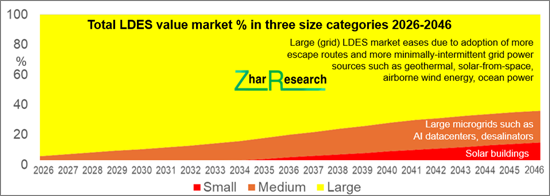
CAPTION: Total LDES value market % in three size categories 2026-2046. Source Zhar Research report, "Long Duration Energy Storage Grand Overview: Technologies, Materials, Projects, Companies, Research Advances in 2025-6, Escape Routes, Markets 2026-2046".
Table of Contents
1. Executive summary and conclusions
- 1.1. Purpose and unique scope of this report
- 1.2. Methodology of this analysis
- 1.3. Key conclusions concerning electrification and LDES definition, needs, candidates
- 1.4. Key conclusions concerning LDES parameters and calculations
- 1.5. Key conclusions: LDES for grid, microgrid and escape routes
- 1.5.1. Different LDES needs and technologies for grid and microgrid
- 1.5.2. Escape routes from LDES with infogram
- 1.5.3. Grids have more options reducing the need for LDES
- 1.6. Actual and proposed types of LDES and the gold standard
- 1.7. Potential LDES performance by ten technologies in 19 columns
- 1.8. Examples of current installations and potential
- 1.9. Three LDES sizes, with different technology winners 2026-2046 on current evidence
- 1.10. Acceptable sites: numbers by technology 2026-2046
- 1.11. Calculations of LDES need by technology with implications
- 1.12. Current and emerging LDES duration vs power deliverable
- 1.12.1. Current LDES situation in green and trend in grid need in blue: simplified version
- 1.12.2. Duration hours vs power delivered by project and 12 technologies in 2026
- 1.13. SWOT appraisals of nine important LDES technologies for 2026-2046
- 1.14. Companies to watch, investment trends by company and technology, important regions
- 1.15. Long Duration Energy Storage LDES roadmap 2026-2046
- 1.16. Market forecasts in 23 lines 2026-2046 with graphs and explanation
- 1.16.1. LDES total value market showing beyond-grid gaining share 2024-2046
- 1.16.2. Number of LDES actual and putative manufacturers: RFB vs Other showing shakeout 2026-2046
- 1.16.3. Total LDES value market % in three size categories 2026-2046 table, graph, explanation
- 1.16.4. Regional share of LDES value market % in four regions 2026-2046 table, graph, explanation
- 1.16.5. LDES market in 9 technology categories $ billion 2026-2046 table, graphs, explanation
- 1.16.6. Vanadium vs iron vs other RFB LDES market % value sales with technology strategies 2026-2046
2. LDES need and design principles
- 2.1. Energy fundamentals
- 2.2. Racing into renewables with rapid cost reduction: 2025 statistics and trends
- 2.3. Solar winning and the intermittency challenge
- 2.4. Adoption of LDES of increasing duration driven by increased wind/solar percentage and cost reduction
- 2.5. LDES definitions and needs
- 2.5.1. General
- 2.5.2. Integrated energy storage systems for grids
- 2.5.3. Example of urgent need for grid LDES - UK government report
- 2.5.4. Very different needs for grid vs beyond-grid LDES 2026-2046
- 2.5.5. Duration vs power showing three size sectors needing different technologies
- 2.6. LDES metrics
- 2.7. LDES projects in 2025-6 showing leading technology subsets
- 2.7.1. Current LDES zones of duration vs power and trend in need
- 2.7.2. Leading projects in 2025-6 showing detail and leading technology subsets, trend
- 2.8. LDES impediments, alternatives and investment climate
- 2.9. LDES toolkit
- 2.9.1. Overview
- 2.9.2. LDES choices compared
- 2.9.3. Electrochemical LDES options explained
- 2.10. Latest independent assessments of performance by technology
- 2.11. Batteries that struggle above 8-hour duration
- 2.12. Drill down report on beyond-grid LDES
3. LDES escape routes
- 3.1. General situation
- 3.2. Infogram: 13 escape routes from LDES 2026-2046
- 3.3. Examples across the world: Denmark, Singapore, China, USA
- 3.4. Capacity factor of wind, solar and options that need little or no LDES
- 3.5. Extensive 2025 research on LDES escape routes
- 3.6. Research in 2025 on Home Energy Management Systems coping with intermittent supply
4. Pumped hydro: conventional PHES
- 4.1. Overview
- 4.1.1. Three options
- 4.1.2. History, environmental, timescales, potential sites, DOE appraisal
- 4.1.3. Site-limited primarily due environmental concerns not number of appropriate topologies
- 4.1.4. Problem analysis, actions to reduce PHES emissions, ugliness, water use, cost
- 4.2. Research advances and view of potential through 2025
- 4.3. Projects and intentions across the world
- 4.3.1. Geographical
- 4.3.2. Large pumped hydro schemes worldwide
- 4.4. Economics
- 4.5. Policy recommendations
- 4.6. Parameter appraisal of conventional pumped hydro PHES
- 4.7. SWOT appraisal of conventional pumped hydro PHES
5. Advanced pumped hydro APHES
- 5.1. Overview
- 5.2. Using mining sites
- 5.2.1. Potential
- 5.2.2. Research advances in 2025
- 5.3. Pressurised underground: Quidnet Energy USA
- 5.4. Using heavier water up mere hills: RheEnergise UK
- 5.4.1. General
- 5.4.2. RheEnergise installation progress 2025-6
- 5.4.3. Power for mines and other targets with appraisal of prospects
- 5.5. Using seawater or other brine
- 5.5.1. General
- 5.5.2. Brine in salt caverns Cavern Energy USA
- 5.5.3. SWOT appraisal of seawater pumped hydro on land
- 5.6. Sizeable Energy Italy, StEnSea Germany, Ocean Grazer Netherlands
- 5.6.1. General
- 5.6.2. Sizable Energy Itay
- 5.6.3. StEnSea Germany
- 5.6.4. Ocean Grazer Netherlands
- 5.6.5. SWOT appraisal of underwater energy storage for LDES
- 5.7. Hybrid technologies: research advances in 2024 and 2025
- 5.8. Research advances in 2024 and 2025
- 5.9. SWOT appraisal of APHES
6. Compressed air CAES
- 6.1. Overview including research advances announced in 2025
- 6.1.1. Basics
- 6.1.2. Research advances in 2025
- 6.2. Undersupply attracts clones
- 6.3. Market positioning of CAES
- 6.4. SWOT appraisal and parameter comparison of CAES for LDES
- 6.5. CAES technology options
- 6.5.1. Thermodynamic
- 6.4.2. Isochoric or isobaric storage
- 6.4.3. Adiabatic choice of cooling is winning
- 6.6. CAES projects, subsystem manufacturers, objectives, research 2025 onwards
- 6.6.1. Overview
- 6.6.2. Siemens Energy Germany
- 6.6.3. MAN Energy Solutions Germany
- 6.6.4. Increasing the CAES storage time and discharge duration
- 6.6.5. Research in UK and European Union 2025 onwards
- 6.7. Profiles of CAES company progress with Zhar Research appraisals
- 6.7.1. ALCAES Switzerland
- 6.7.2. APEX CAES USA
- 6.7.3. Augwind Energy Israel
- 6.7.4. Keep Energy Systems UK formerly Cheesecake
- 6.7.5. Corre Energy Netherlands
- 6.7.6. Huaneng Group China
- 6.7.7. Hydrostor Canada
- 6.7.8. LiGE Pty South Africa
- 6.7.9. Storelectric UK
- 6.7.10. Terrastor Energy Corporation USA
7. Redox flow batteries RFB
- 7.1. Overview
- 7.2. RFB research pivoting to LDES
- 7.2.1. Overview of RFB and its potential for LDES
- 7.2.2. Infogram: RFB achievements and aspirations 2026-2046
- 7.2.3. 72 RFB research advances in 2025
- 7.2.4. 18 examples of RFB research advances in 2024
- 7.3. Winning LDES redox flow battery technologies 2026-2046
- 7.4. SWOT appraisal and parameter comparison of RFB for LDES
- 7.5 45 RFB companies compared in 8 columns: name, brand, technology, tech. readiness, beyond grid focus, LDES focus, comment
- 7.6. RFB technologies with research advances through 2025
- 7.6.1. Regular or hybrid, their chemistries and the main ones being commercialised
- 7.6.2. SWOT appraisals of regular vs hybrid options
- 7.7. Specific designs by material: vanadium, iron and variants, other metal ligand, halogen-based, organic, manganese with 2025 research, three SWOT appraisals
- 7.7.1. Vanadium RFB design and SWOT appraisal
- 7.7.2. All-iron and variants RFB design and SWOT appraisal
- 7.8. RFB manufacturer profiles
8. Solid gravity energy storage SGES
- 8.1. Overview including research in 2025
- 8.1.1. General
- 8.1.2. Three stages of operation
- 8.1.3. Three geometries
- 8.1.4. Pumped hydro gravity storage compared to the three SGES options
- 8.1.5. Basics
- 8.1.6. SWOT appraisal of solid gravity storage SGES for LDES
- 8.1.7. Parameter appraisal of solid gravity energy storage SGES for LDES
- 8.1.8. CAPEX challenge
- 8.1.9. Challenge of ongoing expenses
- 8.1.10. Possibility of pumping sand
- 8.1.11. Hydraulic piston lift instead of cable: 2025 modelling
- 8.1.12. Appraisal of other SGES research through 2025 and 2024
- 8.2. ARES USA
- 8.3. Energy Vault Switzerland, USA and China, India licensees
- 8.4. Gravitricity
- 8.5. Green Gravity Australia
- 8.6. SinkFloatSolutions France
9. Advanced conventional construction batteries ACCB
- 9.1. Overview
- 9.2. Eight ACCB manufacturers compared: 8 columns: name, brand, technology, tech. readiness, beyond-grid focus, LDES focus, comment
- 9.3. Parameter appraisal and SWOT appraisal of ACCB for LDES
- 9.3.1. Parameter appraisal
- 9.3.2. SWOT appraisal of ACCB for LDES
- 9.3.3. Research appraisal published in 2025
- 9.4. Metal-air batteries
- 9.4.1. Iron-air with SWOT and 2025 research: Form Energy USA
- 9.4.2. Aluminium-air : Phinergy Israel
- 9.4.3. Zinc-air with SWOT: E-Zinc, AZA battery, Zinc8 (Abound)
- 9.5. High temperature batteries
- 9.5.1. Molten calcium antimony: Ambri USA out of business, SWOT
- 9.5.2. Sodium or lithium sulfur: NGK/ BASF Japan/ Germany, others, research in 2025, SWOT
- 9.6. Metal-ion batteries including Inlyte, Altris, HiNa, Tiamat, Natron, Faradion
- 9.6.1. Sodium-ion with SWOT
- 9.6.2. Zinc halide Eos Energy Enterprises USA with SWOT
- 9.6.3. Zinc-ion Enerpoly, Urban Electric Power USA, NextEra USA
- 9.7. Nickel hydrogen batteries: EnerVenue USA with SWOT
10. Liquefied gas energy storage LGES: Liquid air LAES or CO2
- 10.1. Overview
- 10.2. Liquid air LAES LDES
- 10.2.1. Technology and research advances through 2025
- 10.2.2. Parameter comparison of LAES for LDES
- 10.2.3. SWOT appraisal of LAES for LDES
- 10.2.4. Indicative LAES systems, footprints and operating parameters
- 10.2.5. Research advances in 2025 and 2024
- 10.2.6. CGDG, Zhongli Zhongke Energy Storage Technology Co China
- 10.2.7. Highview Energy UK and partners Sumitomo, Centrica, Rio Tinto and others
- 10.2.8. MIT study of LAES viability in USA
- 10.2.9. Phelas Germany
- 10.3. Liquid and compressed carbon dioxide LDES
- 10.3.1. Overview
- 10.3.2. Parameter comparison of CO2 for LDES
- 10.3.3. SWOT appraisal of liquid CO2 for LDES
- 10.3.4. Research advances in 2025
- 10.3.5. Energy Dome Italy
- 10.3.6. China and Kazakhstan
11. Thermal energy storage for delayed electricity ETES
- 11.1. Overview and research advances in 2025
- 11.2. Research advances in 2025 and 2024
- 11.3. Lessons of failure: Siemens Gamesa, Azelio, Steisdal, Lumenion
- 11.4. The heat engine approach proceeds: Echogen USA
- 11.5. Use of extreme temperatures and photovoltaic conversion
- 11.5.1. Antora USA
- 11.5.2. Fourth Power USA
- 11.6. Marketing delayed heat and electricity from one plant
- 11.6.1. Overview
- 11.6.2. MGA Thermal Australia
- 11.6.3. Malta Inc Germany
12. Hydrogen and other chemical intermediary LDES
- 12.1. Overview with research progress in 2025-6
- 12.1.1. Overview
- 12.1.2. Sweet spot for chemical intermediary LDES but safety issues
- 12.1.3. Mainstream research through 2025-6
- 12.1.4. Research dreaming of niches through 2025-6
- 12.1.5. Research on complex mechanisms for hydrogen loss
- 12.1.6. Research on hydrogen leakage causing global warming
- 12.1.7. Examples of hydrogen storage advances 2025-6
- 12.2. Parameter appraisal of hydrogen storage for LDES
- 12.3. SWOT appraisal of hydrogen, methane, ammonia for LDES
- 12.4. The small number of actual projects
- 12.4.1. Calistoga Resiliency Centre USA 48-hour microgrid
- 12.4.2. Ulm University microgrid trial Germany 2025-2027
- 12.4.3. China plans in 2025 and 2026
- 12.5. Calculations showing H2ES best only for seasonal storage, needed later
- 12.6. Calculations with other conclusions partly due to lack of operating data
- 12.7. Candidate technologies for hydrogen storage within LDES systems

 2026-2030年全球长期储能(LDES)市场
 全球长期储能市场:市场规模、份额和趋势分析(按技术、储存週期、应用和地区划分),基于细分市场的预测(2026-2033 年)
 长期储能市场机会、成长要素、产业趋势分析及2026-2035年预测。
 2026年全球长期储能市场报告
 长时储能市场-2026-2031年预测
 资料中心、微电网和住宅应用的长期储能(LDES):技术趋势和市场展望(2026-2036)
 全球长期储能(LDES)市场:预测至2032年-按时间段、能源容量、技术、应用、最终用户和地区进行分析长期储能市场规模、占有率、成长及全球产业分析:依类型、应用和地区划分的洞察与预测(2024-2032 年)
 长时储能市场-全球产业规模、份额、趋势、机会及预测(按类型、应用、地区、竞争细分,2020-2030 年)
 用于长期储能的氧化还原液流电池 (RFB):电网、微电网、市场和技术(2025-2045)