


 |
市场调查报告书
商品编码
1871246
有机食品市场机会、成长驱动因素、产业趋势分析及预测(2025-2034年)Organic Food Market Opportunity, Growth Drivers, Industry Trend Analysis, and Forecast 2025 - 2034 |
||||||

2024年全球有机食品市场价值为1,543亿美元,预计到2034年将以9%的复合年增长率成长至3,644亿美元。
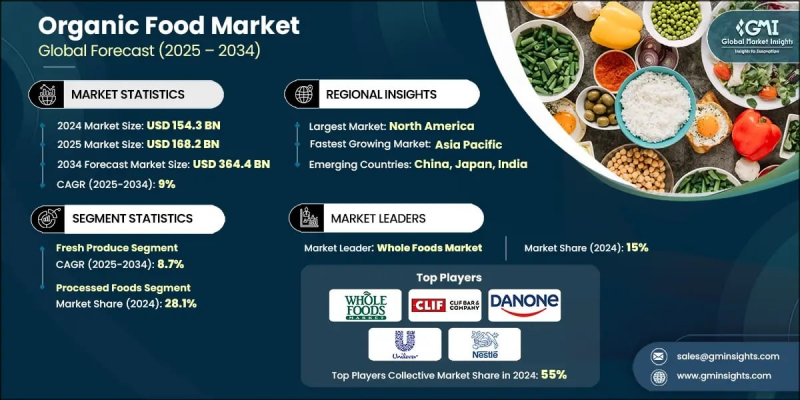
日益增强的环保意识和不断变化的消费习惯正深刻影响着人们对有机和永续来源食品的需求。人们对土壤健康退化、气候变迁和碳排放的认识不断提高,促使他们更倾向于选择能够促进生物多样性、节约用水并最大限度地减少污染的有机耕作方式。这种转变激励农民采用永续的农业方法,同时也推动了市场的持续扩张。政府政策和认证系统透过确保产品真实性和增强消费者信心,进一步加速了这一趋势。近一半的产业成长都得益于支持环保生产的公共计画和认证。植物性和纯素食潮流与有机产品的融合,正在扩大饮料、功能性食品和富含蛋白质产品的消费群体,重新定义着现代注重健康的消费者消费有机食品的方式。
| 市场范围 | |
|---|---|
| 起始年份 | 2024 |
| 预测年份 | 2025-2034 |
| 起始值 | 1543亿美元 |
| 预测值 | 3644亿美元 |
| 复合年增长率 | 9% |
2024年,新鲜农产品市占率达37%。此细分市场受益于较高的购买频率以及消费者对其健康益处的认知度。包装有机食品因其便利性、保质期和来源透明度而持续吸引消费者。饮料仍然是最具创新性的细分市场,不断涌现以功能性成分和天然香料为特色的新产品。成熟品牌强调品质、可追溯性和感官吸引力以维持品牌忠诚度,而自有品牌产品则在零售连锁店中拓展市场份额。
2024年,高度加工的有机产品市占率为4.7%,预计到2034年将以9.3%的复合年增长率成长,这主要得益于膳食补充剂、蛋白粉和其他功能性产品在小众健康通路中日益增长的人气。这些品类的消费者更愿意为产品的完整性、来源和最低加工标准支付溢价,增强了专卖店和电商平台的需求。
2024年,欧洲有机食品市占率达到40.2%,预计2034年将维持7.8%的复合年增长率。成长的主要驱动力来自德国、法国和英国强有力的有机政策以及消费者的信任。欧盟在第三个有机农业行动计画下的支持,持续提升了有机产品的生产能力,并增强了认证标籤的公信力。德国凭藉着完善的零售基础设施,引领区域有机食品消费,而英国和法国则在有机产品类别上呈现多元化发展趋势。
全球有机食品市场的主要参与者包括雀巢、联合利华、Amy's Kitchen、Clif Bar & Company、Organic Valley、Whole Foods Market、通用磨坊、达能、克罗格、Stonyfield Farm、Earthbound Farm、Eden Foods 和 Nature's Path Foods。为了巩固市场地位,有机食品产业的公司正推行以创新、永续性和透明度为核心的策略。他们透过在食品和饮料产品线中推出植物性和清洁标章产品,不断拓展有机产品组合。各大品牌正投资于认证采购项目和本地合作伙伴关係,以确保供应链的可追溯性和环保性。持续的产品创新,尤其是在功能性食品和即食食品领域,正帮助企业吸引更年轻、更注重健康的消费者。
目录
第一章:方法论与范围
第二章:执行概要
第三章:行业洞察
- 产业生态系分析
- 供应商格局
- 利润率
- 每个阶段的价值增加
- 影响价值链的因素
- 中断
- 产业影响因素
- 成长驱动因素
- 产业陷阱与挑战
- 市场机会
- 成长潜力分析
- 监管环境
- 波特的分析
- PESTEL 分析
- 价格趋势
- 按地区
- 未来市场趋势
- 技术与创新格局
- 当前技术趋势
- 新兴技术
- 专利格局
- 贸易统计(HS编码)(註:仅提供重点国家的贸易统计资料)
- 主要进口国
- 主要出口国
- 永续性和环境方面
- 永续实践
- 减少废弃物策略
- 生产中的能源效率
- 环保倡议
- 碳足迹考量
第四章:竞争格局
- 介绍
- 公司市占率分析
- 按地区
- 公司矩阵分析
- 主要市场参与者的竞争分析
- 竞争定位矩阵
- 关键进展
- 併购
- 合作伙伴关係与合作
- 新产品发布
- 扩张计划
第五章:市场规模及预测:依产品类别划分,2021-2034年
- 主要趋势
- 新鲜农产品
- 有机水果
- 有机蔬菜
- 有机香草和香料
- 乳製品和鸡蛋
- 有机乳製品
- 有机起起司及发酵乳製品
- 有机蛋製品
- 替代乳製品
- 肉类、家禽和海鲜
- 有机牛肉和猪肉
- 有机家禽
- 有机海鲜和水产养殖
- 包装食品/杂货
- 有机罐装腌製食品
- 有机干货和厨房必备品
- 有机零食和方便食品
- 有机油和醋
- 饮料
- 有机果汁和冰沙
- 有机咖啡和茶
- 有机酒精饮料
- 功能性及健康饮料
- 冷冻食品
- 有机冷冻蔬菜和水果
- 有机冷冻餐食和主菜
- 有机冷冻甜点
- 烘焙食品和糖果
- 有机烘焙食品
- 有机糖果和甜点
- 手工及特色商品
第六章:市场规模及预测:依加工等级划分,2021-2034年
- 主要趋势
- 新鲜/极少加工
- 加工食品
- 高度加工
第七章:市场规模及预测:依配销通路划分,2021-2034年
- 主要趋势
- 超市和杂货店
- 特色食品店
- 餐饮服务管道
- 直接面向消费者的管道
- 批发分销
第八章:市场规模及预测:依最终用途产业划分,2021-2034年
- 食品零售业
- 食品服务业
- 食品加工业
- 机构部门
- 其他的
第九章:市场规模及预测:依地区划分,2021-2034年
- 主要趋势
- 北美洲
- 我们
- 加拿大
- 欧洲
- 英国
- 德国
- 法国
- 义大利
- 西班牙
- 欧洲其他地区
- 亚太地区
- 中国
- 印度
- 日本
- 韩国
- 澳洲
- 亚太其他地区
- 拉丁美洲
- 巴西
- 墨西哥
- 阿根廷
- 拉丁美洲其他地区
- 中东和非洲
- 南非
- 沙乌地阿拉伯
- 阿联酋
- 中东和非洲其他地区
第十章:公司简介
- Whole Foods Market
- General Mills
- The Kroger
- Danone
- Unilever
- Nestle
- Organic Valley
- Amy's Kitchen
- Clif Bar & Company
- Eden Foods
- Nature's Path Foods
- Stonyfield Farm
- Earthbound Farm
The Global Organic Food Market was valued at USD 154.3 Billion in 2024 and is estimated to grow at a CAGR of 9% to reach USD 364.4 Billion by 2034.
Growing environmental consciousness and changing consumer habits are strongly influencing the demand for organic and sustainably sourced food. Awareness about soil health degradation, climate change, and carbon emissions is leading people to prefer organic farming practices that promote biodiversity, conserve water, and minimize pollution. This transition is motivating farmers to adopt sustainable agricultural methods while fueling consistent market expansion. Government policies and certification frameworks have further accelerated this trend by ensuring product authenticity and building consumer confidence. Nearly half of the industry's growth is driven by public programs and certifications that support environmentally friendly production. The blending of plant-based and vegan trends with organic offerings is expanding the consumer base for beverages, functional foods, and protein-rich products, redefining how the modern health-conscious population consumes organic foods.
| Market Scope | |
|---|---|
| Start Year | 2024 |
| Forecast Year | 2025-2034 |
| Start Value | $154.3 Billion |
| Forecast Value | $364.4 Billion |
| CAGR | 9% |
The fresh produce segment held 37% share in 2024. This segment benefits from high purchase frequency and consumer familiarity with its health benefits. Packaged organic foods continue to attract buyers for their convenience, shelf life, and transparency in sourcing. Beverages remain the most innovative segment, witnessing fast-paced product launches featuring functional ingredients and natural flavors. Established brands emphasize quality, traceability, and sensory appeal to maintain brand loyalty, while private-label products expand their footprint across retail chains.
The highly processed organic formats held a 4.7% share in 2024 and are projected to grow at a CAGR of 9.3% through 2034, propelled by the rising popularity of supplements, protein powders, and other functional products in niche health channels. Consumers in these categories demonstrate a higher willingness to pay premiums when product integrity, provenance, and minimal processing are evident, which strengthens demand across specialty stores and e-commerce platforms.
Europe Organic Food Market held a 40.2% share in 2024 and is expected to maintain a CAGR of 7.8% through 2034. Growth is primarily driven by strong organic policies and consumer trust within Germany, France, and the United Kingdom. EU support under the Third Action Plan for Organic Farming continues to enhance production capabilities and reinforce credibility in certified labeling. Germany leads regional consumption, supported by a well-established retail infrastructure, while the UK and France are experiencing diversification across organic categories.
Prominent players operating in the Global Organic Food Market include Nestle, Unilever, Amy's Kitchen, Clif Bar & Company, Organic Valley, Whole Foods Market, General Mills, Danone, The Kroger, Stonyfield Farm, Earthbound Farm, Eden Foods, and Nature's Path Foods. To strengthen their foothold, companies in the organic food industry are pursuing strategies centered on innovation, sustainability, and transparency. They are expanding their organic product portfolios by introducing plant-based and clean-label variants across food and beverage lines. Major brands are investing in certified sourcing programs and local partnerships to ensure traceable and eco-friendly supply chains. Continuous product innovation, especially in functional foods and ready-to-eat options, is helping companies appeal to younger and health-conscious consumers.
Table of Contents
Chapter 1 Methodology & Scope
- 1.1 Market scope and definition
- 1.2 Research design
- 1.2.1 Research approach
- 1.2.2 Data collection methods
- 1.3 Data mining sources
- 1.3.1 Global
- 1.3.2 Regional/Country
- 1.4 Base estimates and calculations
- 1.4.1 Base year calculation
- 1.4.2 Key trends for market estimation
- 1.5 Primary research and validation
- 1.5.1 Primary sources
- 1.6 Forecast model
- 1.7 Research assumptions and limitations
Chapter 2 Executive Summary
- 2.1 Industry 360° synopsis
- 2.2 Key market trends
- 2.2.1 Product category
- 2.2.2 Processing level
- 2.2.3 Distribution channel
- 2.2.4 End use industry
- 2.3 TAM analysis, 2025-2034
- 2.4 CXO perspectives: Strategic imperatives
- 2.4.1 Executive decision points
- 2.4.2 Critical success factors
- 2.5 Outlook and strategic recommendations
Chapter 3 Industry Insights
- 3.1 Industry ecosystem analysis
- 3.1.1 Supplier landscape
- 3.1.2 Profit margin
- 3.1.3 Value addition at each stage
- 3.1.4 Factor affecting the value chain
- 3.1.5 Disruptions
- 3.2 Industry impact forces
- 3.2.1 Growth drivers
- 3.2.2 Industry pitfalls and challenges
- 3.2.3 Market opportunities
- 3.3 Growth potential analysis
- 3.4 Regulatory landscape
- 3.4.1 North America
- 3.4.2 Europe
- 3.4.3 Asia Pacific
- 3.4.4 Latin America
- 3.4.5 Middle East & Africa
- 3.5 Porter's analysis
- 3.6 PESTEL analysis
- 3.7 Price trends
- 3.7.1 By region
- 3.8 Future market trends
- 3.9 Technology and innovation landscape
- 3.9.1 Current technological trends
- 3.9.2 Emerging technologies
- 3.10 Patent landscape
- 3.11 Trade statistics (HS code) (Note: the trade statistics will be provided for key countries only)
- 3.11.1 Major importing countries
- 3.11.2 Major exporting countries
- 3.12 Sustainability and environmental aspects
- 3.12.1 Sustainable practices
- 3.12.2 Waste reduction strategies
- 3.12.3 Energy efficiency in production
- 3.12.4 Eco-friendly initiatives
- 3.13 Carbon footprint considerations
Chapter 4 Competitive Landscape, 2024
- 4.1 Introduction
- 4.2 Company market share analysis
- 4.2.1 By region
- 4.2.1.1 North America
- 4.2.1.2 Europe
- 4.2.1.3 Asia Pacific
- 4.2.1.4 Latin America
- 4.2.1.5 Middle East & Africa
- 4.2.1 By region
- 4.3 Company matrix analysis
- 4.4 Competitive analysis of major market players
- 4.5 Competitive positioning matrix
- 4.6 Key developments
- 4.6.1 Mergers & acquisitions
- 4.6.2 Partnerships & collaborations
- 4.6.3 New product launches
- 4.6.4 Expansion plans
Chapter 5 Market Size and Forecast, By Product Category, 2021-2034 (USD Billion, Kilo Tons)
- 5.1 Key trends
- 5.2 Fresh produce
- 5.2.1 Organic fruits
- 5.2.2 Organic vegetables
- 5.2.3 Organic herbs & spices
- 5.3 Dairy & eggs
- 5.3.1 Organic milk products
- 5.3.2 Organic cheese & fermented dairy
- 5.3.3 Organic egg products
- 5.3.4 Alternative dairy products
- 5.4 Meat, poultry & seafood
- 5.4.1 Organic beef & pork
- 5.4.2 Organic poultry
- 5.4.3 Organic seafood & aquaculture
- 5.5 Packaged/grocery foods
- 5.5.1 Organic canned & preserved foods
- 5.5.2 Organic dry goods & pantry staples
- 5.5.3 Organic snacks & convenience foods
- 5.5.4 Organic oils & vinegars
- 5.6 Beverages
- 5.6.1 Organic juices & smoothies
- 5.6.2 Organic coffee & tea
- 5.6.3 Organic alcoholic beverages
- 5.6.4 Functional & health beverages
- 5.7 Frozen foods
- 5.7.1 Organic frozen vegetables & fruits
- 5.7.2 Organic frozen meals & entrees
- 5.7.3 Organic frozen desserts
- 5.8 Bakery & confectionery
- 5.8.1 Organic baked goods
- 5.8.2 Organic confectionery & sweets
- 5.8.3 Artisanal & specialty products
Chapter 6 Market Size and Forecast, By Processing Level, 2021-2034 (USD Billion, Kilo Tons)
- 6.1 Key trends
- 6.2 Fresh/minimally processed
- 6.3 Processed foods
- 6.4 Highly processed
Chapter 7 Market Size and Forecast, By Distribution Channel, 2021-2034 (USD Billion, Kilo Tons)
- 7.1 Key trends
- 7.2 Supermarkets & grocery stores
- 7.3 Specialty food stores
- 7.4 Food service channel
- 7.5 Direct-to-consumer channel
- 7.6 Wholesale distribution
Chapter 8 Market Size and Forecast, By End Use Industry, 2021-2034 (USD Billion, Kilo Tons)
- 8.1 Food retail industry
- 8.2 Food service industry
- 8.3 Food processing industry
- 8.4 Institutional sector
- 8.5 Others
Chapter 9 Market Size and Forecast, By Region, 2021-2034 (USD Billion, Kilo Tons)
- 9.1 Key trends
- 9.2 North America
- 9.2.1 U.S.
- 9.2.2 Canada
- 9.3 Europe
- 9.3.1 UK
- 9.3.2 Germany
- 9.3.3 France
- 9.3.4 Italy
- 9.3.5 Spain
- 9.3.6 Rest of Europe
- 9.4 Asia Pacific
- 9.4.1 China
- 9.4.2 India
- 9.4.3 Japan
- 9.4.4 South Korea
- 9.4.5 Australia
- 9.4.6 Rest of Asia Pacific
- 9.5 Latin America
- 9.5.1 Brazil
- 9.5.2 Mexico
- 9.5.3 Argentina
- 9.5.4 Rest of Latin America
- 9.6 Middle East & Africa
- 9.6.1 South Africa
- 9.6.2 Saudi Arabia
- 9.6.3 UAE
- 9.6.4 Rest of Middle East & Africa
Chapter 10 Company Profiles
- 10.1 Whole Foods Market
- 10.2 General Mills
- 10.3 The Kroger
- 10.4 Danone
- 10.5 Unilever
- 10.6 Nestle
- 10.7 Organic Valley
- 10.8 Amy's Kitchen
- 10.9 Clif Bar & Company
- 10.10 Eden Foods
- 10.11 Nature's Path Foods
- 10.12 Stonyfield Farm
- 10.13 Earthbound Farm

 有机食品市场-全球产业规模、份额、趋势、机会和预测:按类别、工艺、销售管道、地区和竞争格局划分,2021-2031年有机食品香精市场-全球产业规模、份额、趋势、机会和预测(按类型、应用、形式、地区和竞争格局划分),2021-2031年
 全球有机农产品市场:预测(至2032年)-按产品类型、形式、通路、最终用户和地区分類的分析
 义大利食品市场规模、占有率、成长及全球产业分析:依类型、应用和地区划分的洞察与预测(2024-2032)2032 年有机食品市场预测:按产品、工艺类别、包装类型、分销管道、应用和地区进行全球分析2032 年有机和天然食品市场预测:按产品类型、认证、分销管道和地区进行的全球分析
 按类别、产品类型、分销通路和地区分類的有机食品市场有机食品和饮料市场-全球产业规模、份额、趋势、机会和预测(按产品类型、配销通路、地区和竞争情况,2020-2030 年)
 有机食品和饮料市场规模、份额、成长分析、按产品类型、按加工、按分销管道、按地区 - 行业预测,2024-2031 年
 有机食品市场规模、占有率、预测、趋势分析:按类型、分销管道、工艺、包装类型 - 到 2031 年的全球预测