


 |
市场调查报告书
商品编码
1876632
智慧工业照明灯具市场机会、成长驱动因素、产业趋势分析及预测(2025-2034年)Smart Industrial Lighting Fixtures Market Opportunity, Growth Drivers, Industry Trend Analysis, and Forecast 2025 - 2034 |
||||||

2024 年全球智慧工业照明灯具市场价值为 32 亿美元,预计到 2034 年将以 14.8% 的复合年增长率成长至 122 亿美元。
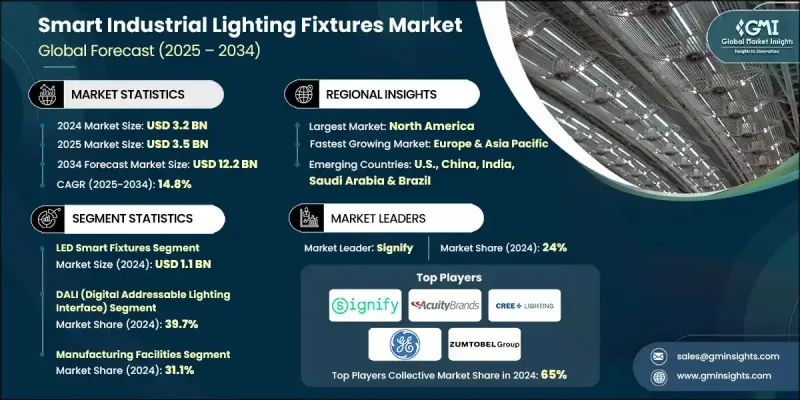
工业领域对节能、经济且环保的照明解决方案的需求日益增长,推动了智慧照明的普及。工业设施面临越来越大的营运成本削减和碳排放减少的压力,而智慧LED照明系统提供了有效的解决方案。这些系统融合了运动侦测、自动调光和日光采集等先进技术,可显着节省能源并带来营运效益。不断上涨的能源成本和永续发展措施进一步推动了智慧照明的普及,因为企业希望在实现长期节能的同时,也能达到环保目标。世界各国政府正在实施更严格的能源效率标准,逐步淘汰低效照明,并提供奖励措施鼓励采用智慧照明。这些政策在工业环境中尤其重要,因为遵守能源法规对于确保业务的持续运作至关重要。
| 市场范围 | |
|---|---|
| 起始年份 | 2024 |
| 预测年份 | 2025-2034 |
| 起始值 | 32亿美元 |
| 预测值 | 122亿美元 |
| 复合年增长率 | 14.8% |
2024年,LED智慧灯具市场规模达到11亿美元,预计2025年至2034年将以15.1%的复合年增长率成长。与传统照明相比,LED技术的成熟使其拥有更高的流明输出、更低的发热量和更少的维护需求。与感测器和智慧控制器的日益集成,使得运动感应、日光采集和自动调光等功能得以实现,从而显着提升了能源效率和运作效率。 LED组件和生产成本的下降,也让包括小型企业在内的更多工业用户能够轻鬆使用LED产品。
製造设施领域占31.1%的市场份额,预计到2034年将以15.5%的复合年增长率成长。工业製造环境需要能够承受恶劣条件、持续运作并能根据工作流程需求动态调整的照明系统。整合感测器的智慧照明解决方案能够根据人员占用情况、特定任务需求和环境光照自动调节照明,从而在确保为工人提供持续、最佳照明的同时,降低能耗并提高生产效率和安全性。
2024年美国智慧工业照明灯具市场规模达10亿美元,预计2025年至2034年将以15.3%的复合年增长率成长。製造商和工业运营商正越来越多地采用智慧照明系统,以提高能源效率、降低营运成本并遵守严格的环境法规。国家永续发展倡议和减碳目标正在推动从传统照明向物联网赋能的智慧LED解决方案转型。主要市场参与者的存在、强大的研发实力以及政府对节能升级的激励措施,为市场扩张创造了有利条件。
全球智慧工业照明灯具市场的主要企业包括Cima Lighting、Zumtobel Group、Holophane、Acuity Brands、Luminis Lighting、Eaton、Cree Lighting、AGC Lighting、LSI Industries、GE Current、Panasonic Lighting、Dialight、Osram (ams OSRAM)、PureLid、effient、CureLiHub、BientsLED、TureLis OSRAM.、PureLiHub、effienting、HureLid、TybyTLED、TureLi、Hurek、TureLiT、TureSTJ、T这些企业积极追求技术创新和产品差异化,以增强其竞争优势。他们大力投资研发,致力于推出节能、物联网赋能的智慧照明解决方案,以满足不断变化的产业需求。与工业运营商、系统整合商和政府机构的策略合作,有助于企业加速市场渗透并确保合规性。拓展区域製造和分销网络,增强了企业高效满足不断增长的需求的能力。此外,企业还利用永续发展行销、产品客製化和智慧照明服务来吸引企业客户。
目录
第一章:方法论与范围
第二章:执行概要
第三章:行业洞察
- 产业生态系分析
- 供应商格局
- 利润率
- 每个阶段的价值增加
- 影响价值链的因素
- 产业影响因素
- 成长驱动因素
- 能源效率和成本节约
- 智慧城市与都市化计划
- 政府法规和永续发展指令
- 改造趋势与基础建设现代化
- 产业陷阱与挑战
- 复杂的安装与改造挑战
- 高昂的前期成本和投资报酬率问题
- 成长驱动因素
- 成长潜力分析
- 未来市场趋势
- 技术与创新格局
- 当前技术趋势
- 新兴技术
- 价格趋势
- 按地区
- 副产品
- 监管环境
- 标准和合规要求
- 区域监理框架
- 认证标准
- 贸易统计
- 主要进口国
- 主要出口国
- 波特的分析
- PESTEL 分析
第四章:竞争格局
- 介绍
- 公司市占率分析
- 按地区
- 北美洲
- 欧洲
- 亚太地区
- 拉丁美洲
- 中东和非洲
- 按地区
- 公司矩阵分析
- 主要市场参与者的竞争分析
- 竞争定位矩阵
- 关键进展
- 併购
- 合作伙伴关係与合作
- 新产品发布
- 扩张计划
第五章:市场估算与预测:依产品划分,2021-2034年
- 主要趋势
- LED智慧灯具
- 物联网系统
- 人工智慧/机器学习赋能的灯具
- 以人为中心的照明系统
- 支援LiFi技术的灯具
第六章:市场估算与预测:依控制协议与连结方式划分,2021-2034年
- 主要趋势
- DALI(数位可寻址照明介面)
- 无线协定
- 乙太网路供电(PoE)
- 物质/线通用标准
第七章:市场估算与预测:依智慧功能与效能划分,2021-2034年
- 主要趋势
- 占用感知和运动侦测
- 日光采集系统
- 能源监控与分析
- 预测性维护能力
- 应急与安全整合
第八章:市场估算与预测:依应用领域划分,2021-2034年
- 主要趋势
- 製造工厂
- 仓储和配送中心
- 食品加工厂
- 製药生产
- 汽车工厂
- 重工业应用
- 危险场所
第九章:市场估算与预测:依配销通路划分,2021-2034年
- 主要趋势
- 直销
- 间接销售
第十章:市场估计与预测:依地区划分,2021-2034年
- 主要趋势
- 北美洲
- 我们
- 加拿大
- 欧洲
- 德国
- 英国
- 法国
- 义大利
- 西班牙
- 亚太地区
- 中国
- 印度
- 日本
- 韩国
- 澳洲
- 印尼
- 马来西亚
- 拉丁美洲
- 巴西
- 墨西哥
- 阿根廷
- MEA
- 沙乌地阿拉伯
- 阿联酋
- 南非
第十一章:公司简介
- Acuity Brands
- AGC Lighting
- Cima Lighting
- Cree Lighting
- Dialight
- Eaton
- GE Current
- Holophane
- Hubbell Lighting
.11.10. LSI 工业
- 高效率发光
- 鲁米尼斯照明
- 欧司朗(ams OSRAM)
- 松下照明
.11.15. PureLiFi
- 表示
- 超亮LED灯
- Zumtobel集团
The Global Smart Industrial Lighting Fixtures Market was valued at USD 3.2 billion in 2024 and is estimated to grow at a CAGR of 14.8% to reach USD 12.2 billion by 2034.
The surge is fueled by the growing demand for energy-efficient, cost-effective, and environmentally responsible lighting solutions in industrial settings. Industrial facilities face increasing pressure to cut operational expenses and reduce carbon emissions, and smart LED lighting systems provide an effective solution. These systems incorporate advanced technologies such as motion detection, automated dimming, and daylight harvesting, offering substantial energy savings and operational benefits. Rising energy costs and sustainability initiatives further drive adoption, as businesses aim to achieve long-term savings while meeting environmental targets. Governments worldwide are enforcing stricter energy efficiency standards, phasing out inefficient lighting, and offering incentives to encourage smart lighting adoption. These policies are especially impactful in industrial environments where compliance with energy regulations is critical for uninterrupted operations.
| Market Scope | |
|---|---|
| Start Year | 2024 |
| Forecast Year | 2025-2034 |
| Start Value | $3.2 Billion |
| Forecast Value | $12.2 Billion |
| CAGR | 14.8% |
The LED smart fixtures segment accounted for USD 1.1 billion in 2024 and is forecasted to grow at a CAGR of 15.1% from 2025 to 2034. The maturity of LED technology has enabled higher lumen output, reduced heat production, and lower maintenance demands compared to traditional lighting. Increasing integration with sensors and intelligent controllers allows features like motion sensing, daylight harvesting, and automated dimming, which together drive notable energy savings and operational efficiency. Falling costs of LED components and production have expanded accessibility to a wider range of industrial users, including smaller enterprises.
The manufacturing facilities segment held a 31.1% share and is expected to grow at a CAGR of 15.5% through 2034. Industrial manufacturing environments demand lighting systems that can endure harsh conditions, provide continuous operation, and adjust dynamically to workflow requirements. Smart lighting solutions with sensor integration enable automated adjustments based on occupancy, task-specific needs, and ambient lighting, reducing energy consumption while improving productivity and safety by ensuring consistent, optimal illumination for workers.
U.S. Smart Industrial Lighting Fixtures Market was valued at USD 1 billion in 2024 and is anticipated to grow at a CAGR of 15.3% from 2025 to 2034. Manufacturers and industrial operators are increasingly adopting intelligent lighting systems to enhance energy efficiency, cut operational costs, and comply with strict environmental regulations. National sustainability initiatives and carbon reduction goals are driving the transition from conventional lighting to IoT-enabled and smart LED solutions. The presence of major market players, robust research and development, and government incentives for energy-efficient upgrades have created favorable conditions for market expansion.
Key companies in the Global Smart Industrial Lighting Fixtures Market include Cima Lighting, Zumtobel Group, Holophane, Acuity Brands, Luminis Lighting, Eaton, Cree Lighting, AGC Lighting, LSI Industries, GE Current, Panasonic Lighting, Dialight, Osram (ams OSRAM), PureLiFi, Hubbell Lighting, Signify, SuperBrightLEDs, and Lumefficient. Companies in the Smart Industrial Lighting Fixtures Market are actively pursuing technology innovation and product differentiation to strengthen their competitive position. They are investing heavily in research and development to introduce energy-efficient, IoT-enabled, and intelligent lighting solutions that meet evolving industrial requirements. Strategic collaborations with industrial operators, system integrators, and government initiatives allow companies to accelerate market penetration and ensure regulatory compliance. Expanding regional manufacturing and distribution networks enhances their ability to meet rising demand efficiently. Firms are also leveraging sustainability-driven marketing, product customization, and smart lighting service offerings to attract enterprise clients.
Table of Contents
Chapter 1 Methodology & Scope
- 1.1 Market scope and definition
- 1.2 Research design
- 1.2.1 Research approach
- 1.2.2 Data collection methods
- 1.3 Data mining sources
- 1.3.1 Global
- 1.3.2 Regional/Country
- 1.4 Base estimates and calculations
- 1.4.1 Base year calculation
- 1.4.2 Key trends for market estimation
- 1.5 Primary research and validation
- 1.5.1 Primary sources
- 1.6 Forecast model
- 1.7 Research assumptions and limitations
Chapter 2 Executive Summary
- 2.1 Industry 360° synopsis
- 2.2 Key market trends
- 2.2.1 Regional
- 2.2.2 Product
- 2.2.3 Control protocol & connectivity
- 2.2.4 Smart features & capabilities
- 2.2.5 Application
- 2.3 CXO perspectives: Strategic imperatives
- 2.3.1 Key decision points for industry executives
- 2.3.2 Critical success factors for market players
- 2.4 Future outlook and strategic recommendations
Chapter 3 Industry Insights
- 3.1 Industry ecosystem analysis
- 3.1.1 Supplier landscape
- 3.1.2 Profit margin
- 3.1.3 Value addition at each stage
- 3.1.4 Factor affecting the value chain
- 3.2 Industry impact forces
- 3.2.1 Growth drivers
- 3.2.1.1 Energy efficiency & cost savings
- 3.2.1.2 Smart city & urbanization initiatives
- 3.2.1.3 Government regulations & sustainability mandates
- 3.2.1.4 Retrofit trends & infrastructure modernization
- 3.2.2 Industry pitfalls & challenges
- 3.2.2.1 Complex installation & retrofit challenges
- 3.2.2.2 High upfront costs & ROI concerns
- 3.2.1 Growth drivers
- 3.3 Growth potential analysis
- 3.4 Future market trends
- 3.5 Technology and innovation landscape
- 3.5.1 Current technological trends
- 3.5.2 Emerging technologies
- 3.6 Price trends
- 3.6.1 By region
- 3.6.2 By product
- 3.7 Regulatory landscape
- 3.7.1 Standards and compliance requirements
- 3.7.2 Regional regulatory frameworks
- 3.7.3 Certification standards
- 3.8 Trade statistics
- 3.8.1 Major importing countries
- 3.8.2 Major exporting countries
- 3.9 Porter's analysis
- 3.10 PESTEL analysis
Chapter 4 Competitive Landscape, 2024
- 4.1 Introduction
- 4.2 Company market share analysis
- 4.2.1 By Region
- 4.2.1.1 North America
- 4.2.1.2 Europe
- 4.2.1.3 Asia Pacific
- 4.2.1.4 Latin America
- 4.2.1.5 Middle East & Africa
- 4.2.1 By Region
- 4.3 Company matrix analysis
- 4.4 Competitive analysis of major market players
- 4.5 Competitive positioning matrix
- 4.6 Key developments
- 4.6.1 Mergers & acquisitions
- 4.6.2 Partnerships & collaborations
- 4.6.3 New product launches
- 4.6.4 Expansion plans
Chapter 5 Market Estimates & Forecast, By Product, 2021 - 2034, (USD Billion) (Million Units)
- 5.1 Key trends
- 5.2 LED smart fixtures
- 5.3 IoT-enabled systems
- 5.4 AI/ML-enabled fixtures
- 5.5 Human-centric lighting systems
- 5.6 LiFi-enabled fixtures
Chapter 6 Market Estimates & Forecast, By Control Protocol & Connectivity, 2021 - 2034, (USD Billion) (Thousand Units)
- 6.1 Key trends
- 6.2 DALI (Digital addressable lighting interface)
- 6.3 Wireless protocol
- 6.4 Power over Ethernet (PoE)
- 6.5 Matter/thread universal standard
Chapter 7 Market Estimates & Forecast, By Smart Features & Capabilities, 2021 - 2034, (USD Billion) (Thousand Units)
- 7.1 Key trends
- 7.2 Occupancy sensing & motion detection
- 7.3 Daylight harvesting systems
- 7.4 Energy monitoring & analytics
- 7.5 Predictive maintenance capabilities
- 7.6 Emergency & safety integration
Chapter 8 Market Estimates & Forecast, By Application, 2021 - 2034, (USD Billion) (Thousand Units)
- 8.1 Key trends
- 8.2 Manufacturing facilities
- 8.3 Warehousing & distribution centers
- 8.4 Food processing plants
- 8.5 Pharmaceutical manufacturing
- 8.6 Automotive plants
- 8.7 Heavy industrial applications
- 8.8 Hazardous location
Chapter 9 Market Estimates & Forecast, By Distribution Channel, 2021 - 2034, (USD Billion) (Thousand Units)
- 9.1 Key trends
- 9.2 Direct sales
- 9.3 Indirect sales
Chapter 10 Market Estimates & Forecast, By Region, 2021 - 2034, (USD Billion) (Thousand Units)
- 10.1 Key trends
- 10.2 North America
- 10.2.1 U.S.
- 10.2.2 Canada
- 10.3 Europe
- 10.3.1 Germany
- 10.3.2 UK
- 10.3.3 France
- 10.3.4 Italy
- 10.3.5 Spain
- 10.4 Asia Pacific
- 10.4.1 China
- 10.4.2 India
- 10.4.3 Japan
- 10.4.4 South Korea
- 10.4.5 Australia
- 10.4.6 Indonesia
- 10.4.7 Malaysia
- 10.5 Latin America
- 10.5.1 Brazil
- 10.5.2 Mexico
- 10.5.3 Argentina
- 10.6 MEA
- 10.6.1 Saudi Arabia
- 10.6.2 UAE
- 10.6.3 South Africa
Chapter 11 Company Profiles
- 11.1 Acuity Brands
- 11.2 AGC Lighting
- 11.3 Cima Lighting
- 11.4 Cree Lighting
- 11.5 Dialight
- 11.6 Eaton
- 11.7 GE Current
- 11.8 Holophane
- 11.9 Hubbell Lighting
.11.10. LSI Industries
- 11.11 Lumefficient
- 11.12 Luminis Lighting
- 11.13 Osram (ams OSRAM)
- 11.14 Panasonic Lighting
.11.15. PureLiFi
- 11.16 Signify
- 11.17 SuperBrightLEDs
- 11.18 Zumtobel Group

 半导体工厂自动化:技术问题与市场预测
 工厂自动化感测器市场 - 全球产业规模、份额、趋势、机会和预测,按感测器类型、应用、地区和竞争格局划分,2020-2030 年预测
 2025年全球药局处方笺采集机器人市场报告
 工厂自动化市场预测至2032年:按组件、解决方案、最终用户和区域分類的全球分析2025年全球微型工厂市场报告
 工厂自动化平台即服务市场:按组件、部署模式、组织规模、最终用户产业和应用程式划分 - 全球预测(2025-2032 年)电脑整合製造市场(按组件、技术和最终用户划分)—2025-2032年全球预测2025年工厂自动化全球市场报告
 工厂自动化感测器市场(按组件、按技术、按最终用途、按国家和地区)-2025 年至 2032 年全球产业分析、市场规模、市场份额及预测2025年工厂自动化感测器全球市场报告