


 |
市场调查报告书
商品编码
1885884
细胞农业原料市场机会、成长驱动因素、产业趋势分析及预测(2025-2034年)Cellular Agriculture Ingredients Market Opportunity, Growth Drivers, Industry Trend Analysis, and Forecast 2025 - 2034 |
||||||

2024 年全球细胞农业原料市场价值为 8.9 亿美元,预计到 2034 年将以 29.5% 的复合年增长率成长至 118 亿美元。
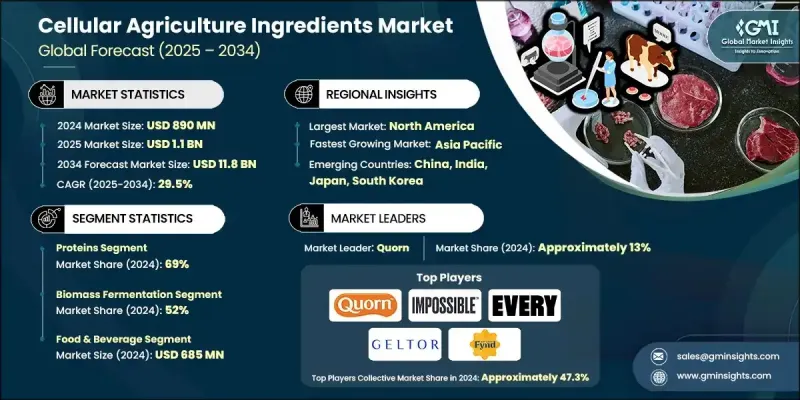
细胞农业原料正逐渐成为未来食品生产的核心要素,它利用精准发酵、生物质发酵和细胞培养等方法,无需依赖传统畜牧系统即可生产与动物来源相同的蛋白质、脂肪、酵素和生物活性成分。这些生物製造方法利用微生物宿主和培养细胞,生产高纯度原料,例如乳蛋白和蛋蛋白、胶原蛋白、血红素化合物和特殊脂质,其功能可与传统动物源性原料媲美甚至超越。随着全球食品产业面临气候相关压力和对永续采购日益增长的需求,製造商正在加速采用细胞农业解决方案,这些方案能够提供营养等效性、可靠的性能并减少环境足迹。向再生和低影响生产模式的转变,正在提升人们对发酵衍生材料的兴趣,这些材料涵盖替代蛋白、强化食品和主流消费品类别。高纯度精准发酵蛋白具有更高的溶解度、纯净的感官特性和生物活性,可提供稳定的供应选择,从而支持大规模的原料创新。
| 市场范围 | |
|---|---|
| 起始年份 | 2024 |
| 预测年份 | 2025-2034 |
| 起始值 | 8.9亿美元 |
| 预测值 | 118亿美元 |
| 复合年增长率 | 29.5% |
蛋白质板块在2024年创造了6.1亿美元的市场规模,占市场份额的69%,预计2025年至2034年将以29.1%的复合年增长率成长。其主导地位源自于蛋白质在多种产品配方中发挥的关键功能作用以及其营养全面的胺基酸结构。以发酵为基础的蛋白质平台能够生产出分子结构相同的蛋白质成分,并增强其溶解性、耐热性和乳化性能,这得益于精准控制的发酵和细胞培养技术。
2024年,生物质发酵领域创造了4.62亿美元的收入。该领域之所以领先,是因为其基础设施成熟,且具备大规模蛋白质生产的可扩展性。由真菌和微生物系统产生的全细胞生物质具有全面的营养成分、天然的结构和具有竞争力的生产成本,能够实现高产量,适用于各种食品应用。
预计到2034年,北美细胞农业原料市场将以30.6%的复合年增长率成长。对永续原料开发的日益重视、对替代农业系统的兴趣不断增长,以及发酵衍生成分越来越多地应用于乳製品替代品、肉类替代品和功能性营养产品中,是推动区域市场扩张的关键因素。此外,对气候适应能力的日益关注以及对传统畜牧业依赖程度的降低也促进了市场成长。
活跃于细胞农业配料市场的主要公司包括 Quorn、Impossible Foods、EVERY 公司、Geltor、Nature's Fynd、Bored Cow、Onego Bio、TurtleTree、Planetary Group、Modern Kitchen、WNWN Food Labs 和 GOOD Meat。这些公司正透过扩大发酵产能、优化生物製程效率以及拓展食品製造和生物技术网路中的合作生态系统来增强其竞争优势。许多公司正在开发专有的微生物菌株和细胞系,以提高产量、降低生产成本并增强配料的功能性。与全球食品品牌建立策略合作伙伴关係有助于加速配方推广并确保长期供应协议。对监管准备、安全验证和清洁标籤配料开发的投资进一步支持了该公司在多个地区的市场准入。此外,各公司正在透过开发特殊蛋白质、脂质和生物活性化合物来丰富产品组合,以服务高价值应用并开拓新的收入管道。
目录
第一章:方法论与范围
第二章:执行概要
第三章:行业洞察
- 产业生态系分析
- 供应商格局
- 利润率
- 每个阶段的价值增加
- 影响价值链的因素
- 中断
- 产业影响因素
- 司机
- 陷阱与挑战
- 机会
- 成长潜力分析
- 监管环境
- 北美洲
- 欧洲
- 亚太地区
- 拉丁美洲
- 中东和非洲
- 波特的分析
- PESTEL 分析
- 价格趋势
- 按地区
- 依产品类型
- 未来市场趋势
- 技术与创新格局
- 当前技术趋势
- 新兴技术
- 专利格局
- 贸易统计(HS编码)(註:仅提供重点国家的贸易统计资料)
- 主要进口国
- 主要出口国
- 永续性和环境方面
- 永续实践
- 减少废弃物策略
- 生产中的能源效率
- 环保倡议
- 碳足迹考量
第四章:竞争格局
- 介绍
- 公司市占率分析
- 按地区
- 北美洲
- 欧洲
- 亚太地区
- 拉丁美洲
- MEA
- 按地区
- 公司矩阵分析
- 主要市场参与者的竞争分析
- 竞争定位矩阵
- 关键进展
- 併购
- 合作伙伴关係与合作
- 新产品发布
- 扩张计划
第五章:市场估算与预测:依成分类型划分,2021-2034年
- 主要趋势
- 蛋白质
- 脂肪和脂质
- 酵素
- 香料和调味料
- 细胞培养基成分
- 支架和基质
第六章:市场估计与预测:依技术划分,2021-2034年
- 主要趋势
- 生物质发酵
- 精准发酵
- 栽培/培育产品
第七章:市场估计与预测:依应用领域划分,2021-2034年
- 主要趋势
- 餐饮
- 宠物食品
- 营养保健品和膳食补充剂
- 化妆品及个人护理
- 生物加工和细胞培养投入
第八章:市场估算与预测:依地区划分,2021-2034年
- 主要趋势
- 北美洲
- 我们
- 加拿大
- 欧洲
- 德国
- 英国
- 法国
- 西班牙
- 义大利
- 欧洲其他地区
- 亚太地区
- 中国
- 印度
- 日本
- 澳洲
- 韩国
- 亚太其他地区
- 拉丁美洲
- 巴西
- 墨西哥
- 阿根廷
- 拉丁美洲其他地区
- 中东和非洲
- 沙乌地阿拉伯
- 南非
- 阿联酋
- 中东和非洲其他地区
第九章:公司简介
- Quorn
- Impossible Foods
- The EVERY Company
- Geltor
- Nature's Fynd
- Bored Cow
- Onego Bio
- TurtleTree
- Planetary Group
- Modern Kitchen
- WNWN Food Labs
- GOOD Meat
The Global Cellular Agriculture Ingredients Market was valued at USD 890 million in 2024 and is estimated to grow at a CAGR of 29.5% to reach USD 11.8 billion by 2034.
Cellular agriculture ingredients are emerging as a core element of future food production, utilizing precision fermentation, biomass fermentation, and cell cultivation methods to generate animal-identical proteins, fats, enzymes, and bioactive components without relying on conventional livestock systems. These bio-manufacturing approaches use microbial hosts and cultured cells to create high-purity ingredients such as dairy and egg proteins, collagen, heme-based compounds, and specialized lipids that match or exceed the functionality of traditional animal-derived inputs. As the global food sector confronts climate-related pressures and increasing demand for sustainable sourcing, manufacturers are accelerating the adoption of cellular agriculture solutions that deliver nutritional equivalence, reliable performance, and reduced environmental footprints. The shift toward regenerative and low-impact production models is amplifying interest in fermentation-derived materials across alternative proteins, fortified foods, and mainstream consumer categories. High-purity precision-fermented proteins with improved solubility, clean sensory profiles, and bioactive potential offer a consistent supply option that supports large-scale ingredient innovation.
| Market Scope | |
|---|---|
| Start Year | 2024 |
| Forecast Year | 2025-2034 |
| Start Value | $890 Million |
| Forecast Value | $11.8 Billion |
| CAGR | 29.5% |
The proteins segment generated USD 610 million in 2024, representing 69% share, and is projected to grow at a CAGR of 29.1% from 2025 to 2034. Their predominance comes from their essential functional roles in multiple product formulations and their nutritionally complete amino acid structures. Fermentation-based protein platforms produce molecularly identical protein ingredients with enhanced solubility, heat tolerance, and emulsification attributes, supported by precision-controlled fermentation and cell cultivation technologies.
The biomass fermentation segment generated USD 462 million in 2024. This segment leads due to its mature infrastructure and scalability for mass protein production. Whole-cell biomass generated from fungal and microbial systems delivers comprehensive nutritional content, natural structure, and competitive production economics, enabling high-volume output suitable for diverse food applications.
North America Cellular Agriculture Ingredients Market is projected to grow at a CAGR of 30.6% through 2034. Increasing commitments to sustainable ingredient development, expanding interest in alternative agricultural systems, and the rising integration of fermentation-derived components into dairy replacements, meat alternatives, and functional nutrition products are key factors driving regional expansion. Heightened focus on climate resilience and reduced dependence on traditional livestock-based sourcing also contributes to market growth.
Major companies active in the Cellular Agriculture Ingredients Market include Quorn, Impossible Foods, The EVERY Company, Geltor, Nature's Fynd, Bored Cow, Onego Bio, TurtleTree, Planetary Group, Modern Kitchen, WNWN Food Labs, and GOOD Meat. Companies operating in Cellular Agriculture Ingredients Market are strengthening their competitive positioning by scaling fermentation capacity, optimizing bioprocess efficiency, and expanding collaborative ecosystems across food manufacturing and biotechnology networks. Many firms are developing proprietary microbial strains and cell lines to improve yield, reduce production costs, and enhance ingredient functionality. Strategic partnerships with global food brands are helping accelerate formulation adoption and secure long-term supply agreements. Investments in regulatory readiness, safety validation, and clean-label ingredient development are further supporting market entry across multiple regions. Additionally, companies are diversifying product portfolios with specialized proteins, lipids, and bioactive compounds to serve high-value applications and unlock new revenue channels.
Table of Contents
Chapter 1 Methodology & Scope
- 1.1 Market scope and definition
- 1.2 Research design
- 1.2.1 Research approach
- 1.2.2 Data collection methods
- 1.3 Data mining sources
- 1.3.1 Global
- 1.3.2 Regional/Country
- 1.4 Base estimates and calculations
- 1.4.1 Base year calculation
- 1.4.2 Key trends for market estimation
- 1.5 Primary research and validation
- 1.5.1 Primary sources
- 1.6 Forecast model
- 1.7 Research assumptions and limitations
Chapter 2 Executive Summary
- 2.1 Industry 3600 synopsis
- 2.2 Key market trends
- 2.2.1 Ingredient type trends
- 2.2.2 Technology trends
- 2.2.3 Application trends
- 2.2.4 Regional trends
- 2.3 TAM Analysis, 2025-2034
- 2.4 CXO perspectives: Strategic imperatives
- 2.4.1 Executive decision points
- 2.4.2 Critical success factors
- 2.5 Future Outlook and Strategic Recommendations
Chapter 3 Industry Insights
- 3.1 Industry ecosystem analysis
- 3.1.1 Supplier landscape
- 3.1.2 Profit margin
- 3.1.3 Value addition at each stage
- 3.1.4 Factor affecting the value chain
- 3.1.5 Disruptions
- 3.2 Industry impact forces
- 3.2.1 Drivers
- 3.2.2 Pitfalls & Challenges
- 3.2.3 Opportunities
- 3.3 Growth potential analysis
- 3.4 Regulatory landscape
- 3.4.1 North America
- 3.4.2 Europe
- 3.4.3 Asia Pacific
- 3.4.4 Latin America
- 3.4.5 Middle East & Africa
- 3.5 Porter's analysis
- 3.6 PESTEL analysis
- 3.7 Price trends
- 3.7.1 By region
- 3.7.2 By product type
- 3.8 Future market trends
- 3.9 Technology and Innovation landscape
- 3.9.1 Current technological trends
- 3.9.2 Emerging technologies
- 3.10 Patent Landscape
- 3.11 Trade statistics (HS code) ( Note: the trade statistics will be provided for key countries only)
- 3.11.1 Major importing countries
- 3.11.2 Major exporting countries
- 3.12 Sustainability and environmental aspects
- 3.12.1 Sustainable practices
- 3.12.2 Waste reduction strategies
- 3.12.3 Energy efficiency in production
- 3.12.4 Eco-friendly initiatives
- 3.13 Carbon footprint consideration
Chapter 4 Competitive Landscape, 2024
- 4.1 Introduction
- 4.2 Company market share analysis
- 4.2.1 By region
- 4.2.1.1 North America
- 4.2.1.2 Europe
- 4.2.1.3 Asia Pacific
- 4.2.1.4 LATAM
- 4.2.1.5 MEA
- 4.2.1 By region
- 4.3 Company matrix analysis
- 4.4 Competitive analysis of major market players
- 4.5 Competitive positioning matrix
- 4.6 Key developments
- 4.6.1 Mergers & acquisitions
- 4.6.2 Partnerships & collaborations
- 4.6.3 New Product Launches
- 4.6.4 Expansion Plans
Chapter 5 Market Estimates and Forecast, By Ingredient Type, 2021-2034 (USD Million & Kilo Tons)
- 5.1 Key trends
- 5.2 Proteins
- 5.3 Fats & lipids
- 5.4 Enzymes
- 5.5 Flavors & aromatics
- 5.6 Cell culture media components
- 5.7 Scaffolds & matrices
Chapter 6 Market Estimates and Forecast, By Technology, 2021-2034 (USD Million & Kilo Tons)
- 6.1 Key trends
- 6.2 Biomass fermentation
- 6.3 Precision fermentation
- 6.4 Cultivated/cultured products
Chapter 7 Market Estimates and Forecast, By Application, 2021-2034 (USD Million & Kilo Tons)
- 7.1 Key trends
- 7.2 Food & beverage
- 7.3 Pet food
- 7.4 Nutraceuticals & dietary supplements
- 7.5 Cosmetics & personal care
- 7.6 Bioprocessing & cell culture inputs
Chapter 8 Market Estimates and Forecast, By Region, 2021-2034 (USD Million & Kilo Tons)
- 8.1 Key trends
- 8.2 North America
- 8.2.1 U.S.
- 8.2.2 Canada
- 8.3 Europe
- 8.3.1 Germany
- 8.3.2 UK
- 8.3.3 France
- 8.3.4 Spain
- 8.3.5 Italy
- 8.3.6 Rest of Europe
- 8.4 Asia Pacific
- 8.4.1 China
- 8.4.2 India
- 8.4.3 Japan
- 8.4.4 Australia
- 8.4.5 South Korea
- 8.4.6 Rest of Asia Pacific
- 8.5 Latin America
- 8.5.1 Brazil
- 8.5.2 Mexico
- 8.5.3 Argentina
- 8.5.4 Rest of Latin America
- 8.6 Middle East and Africa
- 8.6.1 Saudi Arabia
- 8.6.2 South Africa
- 8.6.3 UAE
- 8.6.4 Rest of Middle East and Africa
Chapter 9 Company Profiles
- 9.1 Quorn
- 9.2 Impossible Foods
- 9.3 The EVERY Company
- 9.4 Geltor
- 9.5 Nature's Fynd
- 9.6 Bored Cow
- 9.7 Onego Bio
- 9.8 TurtleTree
- 9.9 Planetary Group
- 9.10 Modern Kitchen
- 9.11 WNWN Food Labs
- 9.12 GOOD Meat

 细胞农业市场分析及预测(至2035年):类型、产品类型、技术、应用、材料类型、製程、最终用户、组件、阶段
 全球细胞农业市场规模、份额、趋势和成长分析报告(2026-2034年)细胞农业的成长机会:全球培养肉生产发展趋势(2025-2030 年)全球食品与农业技术市场-2025-2030年预测
 细胞农业支架材料市场机会、成长驱动因素、产业趋势分析及预测(2025-2034年)
 全球细胞农业市场
 2032 年细胞农业市场预测:按产品类型、来源、分销管道、技术、应用和地区进行的全球分析
 蜂窝农业市场 - 全球产业规模、份额、趋势、机会和预测,按技术、应用、最终用户产业、地区和竞争细分,2020-2030 年预测
 细胞农业市场报告:趋势、预测和竞争分析(至 2030 年)