


 |
市场调查报告书
商品编码
1892716
永续建筑化学品市场机会、成长驱动因素、产业趋势分析及预测(2025-2034年)Sustainable Construction Chemicals Market Opportunity, Growth Drivers, Industry Trend Analysis, and Forecast 2025 - 2034 |
||||||

2024 年全球永续建筑化学品市场价值为 721 亿美元,预计到 2034 年将以 6.3% 的复合年增长率增长至 1,322 亿美元。
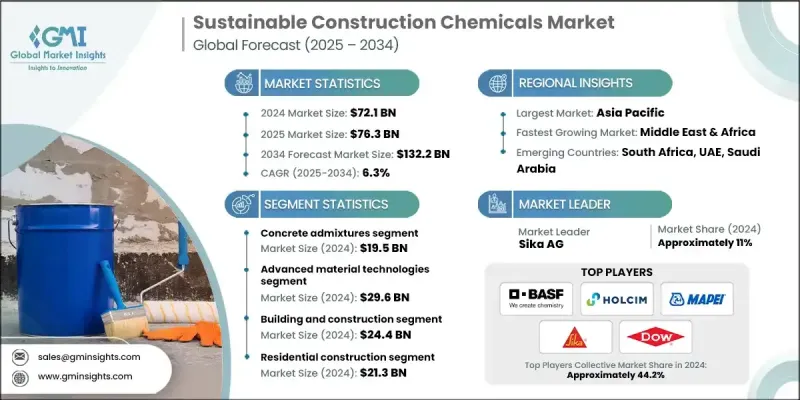
该市场涵盖种类繁多的产品,例如生物基防水涂料、环保型黏合剂和密封剂、保温材料以及旨在提高耐久性并减少环境影响的特种化学品。这些产品正在帮助建筑业降低碳足迹并延长材料使用寿命。更严格的环境法规、对节能建筑日益增长的需求以及人们对永续建筑实践的认识不断提高,都推动了该市场的成长。在欧洲,监管框架正促使建筑业采用低碳、可回收材料和创新化学解决方案。政策驱动的需求与技术进步的结合,使建筑业能够提供具有韧性和环保意识的基础设施,同时满足消费者不断变化的对永续性的期望。
| 市场范围 | |
|---|---|
| 起始年份 | 2024 |
| 预测年份 | 2025-2034 |
| 起始值 | 721亿美元 |
| 预测值 | 1322亿美元 |
| 复合年增长率 | 6.3% |
到2024年,混凝土外加剂市场份额将达到27%。这些外加剂能够提升混凝土的机械性能、耐久性和环保性能。许多产品都添加了生物基或回收成分,有效降低了基础设施和商业建筑项目中使用的混凝土的碳足迹。
2024年,先进材料技术领域的市场规模达到296亿美元,预计2025年至2034年将以2.2%的复合年增长率成长。奈米材料、自修復涂层和高性能添加剂的创新正在提升建筑的强度、韧性和永续性。这些技术使建筑业能够建造维护成本低的建筑,同时满足现代环境性能和耐久性标准。
2024年,欧洲永续建筑化学品市场规模达175亿美元。诸如《建筑能源法案》(GEG)等法规以及《2050年气候行动计画》中的各项倡议,正推动製造商采用低影响原料和节能配方进行创新。各公司正在推出一系列产品,从再生材料添加剂到无溶剂涂料,这些产品在确保长期性能的同时,也符合生态标准。此类监管框架正在塑造市场对产品生命週期可持续性和室内环境品质的预期,从而鼓励对更环保的解决方案进行投资。
目录
第一章:方法论
第二章:执行概要
第三章:行业洞察
- 产业生态系分析
- 供应商格局
- 利润率
- 每个阶段的价值增加
- 影响价值链的因素
- 中断
- 产业影响因素
- 成长驱动因素
- 产业陷阱与挑战
- 市场机会
- 成长潜力分析
- 监管环境
- 北美洲
- 欧洲
- 亚太地区
- 拉丁美洲
- 中东和非洲
- 波特的分析
- PESTEL 分析
- 价格趋势
- 按地区
- 副产品
- 未来市场趋势
- 技术与创新格局
- 当前技术趋势
- 新兴技术
- 专利格局
- 贸易统计(註:仅提供重点国家的贸易统计)
- 主要进口国
- 主要出口国
- 永续性和环境方面
- 永续实践
- 减少废弃物策略
- 生产中的能源效率
- 环保倡议
- 碳足迹考量
第四章:竞争格局
- 介绍
- 公司市占率分析
- 按地区
- 北美洲
- 欧洲
- 亚太地区
- 拉丁美洲
- MEA
- 按地区
- 公司矩阵分析
- 主要市场参与者的竞争分析
- 竞争定位矩阵
- 关键进展
- 併购
- 合作伙伴关係与合作
- 新产品发布
- 扩张计划
第五章:市场估算与预测:依产品类型划分,2021-2034年
- 混凝土外加剂
- 高效减水剂和减水剂
- 引气剂
- 加速剂和减速剂
- 特种外加剂
- 防水和防护涂层
- 膜系统
- 液态涂料
- 结晶防水
- 生物基防护解决方案
- 黏合剂和密封剂
- 结构胶合剂
- 建筑密封剂
- 生物基黏合剂系统
- 低挥发性有机化合物配方
- 绝缘材料
- 生物基绝缘材料
- 再生材料隔热材料
- 相变材料
- 气凝胶技术
- 特种建筑化学品
- 自癒材料
- 碳负排放混凝土
- 地聚合物系统
- 智慧建筑材料
第六章:市场估计与预测:依技术划分,2021-2034年
- 生物基技术
- 植物性原料
- 微生物生产系统
- 酶促过程
- 生物技术应用
- 再生材料技术
- 消费后回收材料
- 工业后废弃物的利用
- 循环经济解决方案
- 废弃物製化学品工艺
- 低碳技术
- 碳捕获与利用
- 再生能源併网
- 节能生产
- 碳中和配方
- 先进材料技术
- 奈米科技应用
- 智慧材料系统
- 自癒技术
- 相变材料
第七章:市场估计与预测:依应用领域划分,2021-2034年
- 住宅建筑
- 独栋住宅
- 多户住宅
- 经济适用房项目
- 绿色住宅开发
- 商业建筑
- 办公大楼
- 零售空间
- 医疗机构
- 教育建筑
- 基础设施建设
- 交通基础设施
- 供水和污水系统
- 能源基础设施
- 智慧城市项目
- 工业建筑
- 製造工厂
- 仓库和配送中心
- 资料中心
- 清洁能源设施
第八章:市场估算与预测:依最终用途产业划分,2021-2034年
- 建筑施工
- 基础设施建设
- 工业应用
- 交通运输部门
- 能源和公用事业
- 海洋和近海
- 采矿和矿产
- 农业和食品加工
第九章:市场估计与预测:依地区划分,2021-2034年
- 北美洲
- 我们
- 加拿大
- 欧洲
- 德国
- 英国
- 法国
- 义大利
- 西班牙
- 欧洲其他地区
- 亚太地区
- 中国
- 印度
- 日本
- 澳洲
- 韩国
- 亚太其他地区
- 拉丁美洲
- 巴西
- 墨西哥
- 阿根廷
- 拉丁美洲其他地区
- 中东和非洲
- 沙乌地阿拉伯
- 南非
- 阿联酋
- 中东和非洲其他地区
第十章:公司简介
- BASF SE (Master Builders Solutions)
- Sika AG
- Ashland
- Holcim
- Cemex
- 3M Company
- Arkema SA
- Clariant AG
- Evonik Industries AG
- MAPEI SpA
- The Dow Chemical Company
The Global Sustainable Construction Chemicals Market was valued at USD 72.1 billion in 2024 and is estimated to grow at a CAGR of 6.3% to reach USD 132.2 billion by 2034.
The market includes a wide array of products such as bio-based waterproofing coatings, eco-friendly adhesives and sealants, insulation materials, and specialty chemicals designed to enhance durability while reducing environmental impact. These products are helping the construction industry lower carbon footprints and extend material lifespans. Growth in this market is being fueled by stricter environmental regulations, rising demand for energy-efficient buildings, and greater awareness of sustainable construction practices. Across Europe, regulatory frameworks are compelling the industry to adopt low-carbon, recyclable materials and innovative chemical solutions. This combination of policy-driven demand and technological advancement is enabling the construction sector to deliver resilient, eco-conscious infrastructure while meeting evolving consumer expectations for sustainability.
| Market Scope | |
|---|---|
| Start Year | 2024 |
| Forecast Year | 2025-2034 |
| Start Value | $72.1 Billion |
| Forecast Value | $132.2 Billion |
| CAGR | 6.3% |
The concrete admixture segment held a 27% share in 2024. These admixtures enhance mechanical properties, durability, and environmental performance. Many products incorporate biobased or recycled components, effectively lowering the carbon footprint of concrete used in both infrastructure and commercial construction projects.
The advanced material technologies segment was valued at USD 29.6 billion in 2024 and is expected to grow at a CAGR of 2.2% from 2025 to 2034. Innovations in nanomaterials, self-healing coatings, and high-performance additives are improving building strength, resilience, and sustainability. These technologies allow the construction industry to develop low-maintenance structures while meeting modern standards for environmental performance and durability.
Europe Sustainable Construction Chemicals Market reached USD 17.5 billion in 2024. Regulations such as the Building Energy Act (GEG) and initiatives under the Climate Action Plan 2050 are driving manufacturers to innovate with low-impact raw materials and energy-efficient formulations. Companies are introducing products ranging from recycled-content admixtures to solvent-free coatings that deliver long-term performance without compromising ecological standards. Such regulatory frameworks are shaping market expectations regarding lifecycle sustainability and indoor environmental quality, encouraging investment in greener solutions.
Key players in the Global Sustainable Construction Chemicals Market include Sika AG, BASF SE, Holcim Ltd, MAPEI S.p.A., The Dow Chemical Company, and others. Companies in the Sustainable Construction Chemicals Market are employing several strategies to strengthen their presence. Many are investing in research and development to create eco-friendly, high-performance products, including recycled-content materials and solvent-free coatings. Strategic partnerships with distributors and construction firms expand market reach, while mergers and acquisitions help consolidate portfolios and enter new regions. Firms are also emphasizing sustainability certifications and eco-labels to meet regulatory requirements and attract environmentally conscious buyers.
Table of Contents
Chapter 1 Methodology
- 1.1 Market scope and definition
- 1.2 Research design
- 1.2.1 Research approach
- 1.2.2 Data collection methods
- 1.3 Data mining sources
- 1.3.1 Global
- 1.3.2 Regional/Country
- 1.4 Base estimates and calculations
- 1.4.1 Base year calculation
- 1.4.2 Key trends for market estimation
- 1.5 Primary research and validation
- 1.5.1 Primary sources
- 1.6 Forecast model
- 1.7 Research assumptions and limitations
Chapter 2 Executive Summary
- 2.1 Industry 360° synopsis
- 2.2 Key market trends
- 2.2.1 Regional
- 2.2.2 Product Type
- 2.2.3 Technology
- 2.2.4 Application
- 2.2.5 End use Industry
- 2.3 TAM Analysis, 2025-2034
- 2.4 CXO perspectives: Strategic imperatives
- 2.4.1 Executive decision points
- 2.4.2 Critical success factors
- 2.5 Future Outlook and Strategic Recommendations
Chapter 3 Industry Insights
- 3.1 Industry ecosystem analysis
- 3.1.1 Supplier Landscape
- 3.1.2 Profit Margin
- 3.1.3 Value addition at each stage
- 3.1.4 Factor affecting the value chain
- 3.1.5 Disruptions
- 3.2 Industry impact forces
- 3.2.1 Growth drivers
- 3.2.2 Industry pitfalls and challenges
- 3.2.3 Market opportunities
- 3.3 Growth potential analysis
- 3.4 Regulatory landscape
- 3.4.1 North America
- 3.4.2 Europe
- 3.4.3 Asia Pacific
- 3.4.4 Latin America
- 3.4.5 Middle East & Africa
- 3.5 Porter's analysis
- 3.6 PESTEL analysis
- 3.7 Price trends
- 3.7.1 By region
- 3.7.2 By product
- 3.8 Future market trends
- 3.9 Technology and Innovation landscape
- 3.9.1 Current technological trends
- 3.9.2 Emerging technologies
- 3.10 Patent Landscape
- 3.11 Trade statistics (Note: the trade statistics will be provided for key countries only)
- 3.11.1 Major importing countries
- 3.11.2 Major exporting countries
- 3.12 Sustainability and Environmental Aspects
- 3.12.1 Sustainable Practices
- 3.12.2 Waste Reduction Strategies
- 3.12.3 Energy Efficiency in Production
- 3.12.4 Eco-friendly Initiatives
- 3.13 Carbon Footprint Considerations
Chapter 4 Competitive Landscape, 2024
- 4.1 Introduction
- 4.2 Company market share analysis
- 4.2.1 By region
- 4.2.1.1 North America
- 4.2.1.2 Europe
- 4.2.1.3 Asia Pacific
- 4.2.1.4 LATAM
- 4.2.1.5 MEA
- 4.2.1 By region
- 4.3 Company matrix analysis
- 4.4 Competitive analysis of major market players
- 4.5 Competitive positioning matrix
- 4.6 Key developments
- 4.6.1 Mergers & acquisitions
- 4.6.2 Partnerships & collaborations
- 4.6.3 New Product Launches
- 4.6.4 Expansion Plans
Chapter 5 Market Estimates and Forecast, By Product Type, 2021- 2034 (USD Billion, Kilo Tons)
- 5.1 Key trends
- 5.2 Concrete admixtures
- 5.2.1 Superplasticizers and water reducers
- 5.2.2 Air-entraining agents
- 5.2.3 Accelerating and retarding agents
- 5.2.4 Specialty admixtures
- 5.3 Waterproofing and protective coatings
- 5.3.1 Membrane systems
- 5.3.2 Liquid applied coatings
- 5.3.3 Crystalline waterproofing
- 5.3.4 Bio-based protective solutions
- 5.4 Adhesives and sealants
- 5.4.1 Structural adhesives
- 5.4.2 Construction sealants
- 5.4.3 Bio-based adhesive systems
- 5.4.4 Low-voc formulations
- 5.5 Insulation materials
- 5.5.1 Bio-based insulation
- 5.5.2 Recycled content insulation
- 5.5.3 Phase change materials
- 5.5.4 Aerogel technologies
- 5.6 Specialty construction chemicals
- 5.6.1 Self-healing materials
- 5.6.2 Carbon-negative concrete
- 5.6.3 Geopolymer systems
- 5.6.4 Smart construction materials
Chapter 6 Market Estimates and Forecast, By Technology, 2021 - 2034 (USD Billion, Kilo Tons)
- 6.1 Key trends
- 6.2 Bio-based technologies
- 6.2.1 Plant-based raw materials
- 6.2.2 Microbial production systems
- 6.2.3 Enzymatic processes
- 6.2.4 Biotechnology applications
- 6.3 Recycled content technologies
- 6.3.1 Post-consumer recycled materials
- 6.3.2 Post-industrial waste utilization
- 6.3.3 Circular economy solutions
- 6.3.4 Waste-to-chemical processes
- 6.4 Low-carbon technologies
- 6.4.1 Carbon capture and utilization
- 6.4.2 Renewable energy integration
- 6.4.3 Energy-efficient production
- 6.4.4 Carbon-neutral formulations
- 6.5 Advanced material technologies
- 6.5.1 Nanotechnology applications
- 6.5.2 Smart material systems
- 6.5.3 Self-healing technologies
- 6.5.4 Phase change materials
Chapter 7 Market Estimates and Forecast, By Application, 2021 - 2034 (USD Billion, Kilo Tons)
- 7.1 Key trends
- 7.2 Residential construction
- 7.2.1 Single-family homes
- 7.2.2 Multi-family housing
- 7.2.3 Affordable housing projects
- 7.2.4 Green residential developments
- 7.3 Commercial construction
- 7.3.1 Office buildings
- 7.3.2 Retail spaces
- 7.3.3 Healthcare facilities
- 7.3.4 Educational buildings
- 7.4 Infrastructure development
- 7.4.1 Transportation infrastructure
- 7.4.2 Water and wastewater systems
- 7.4.3 Energy infrastructure
- 7.4.4 Smart city projects
- 7.5 Industrial construction
- 7.5.1 Manufacturing facilities
- 7.5.2 Warehouses and distribution centers
- 7.5.3 Data centers
- 7.5.4 Clean energy facilities
Chapter 8 Market Estimates and Forecast, By End use Industry, 2021 - 2034 (USD Billion, Kilo Tons)
- 8.1 Key trends
- 8.2 Building and construction
- 8.3 Infrastructure development
- 8.4 Industrial applications
- 8.5 Transportation sector
- 8.6 Energy and utilities
- 8.7 Marine and offshore
- 8.8 Mining and minerals
- 8.9 Agriculture and food processing
Chapter 9 Market Estimates and Forecast, By Region, 2021 - 2034 (USD Billion, Kilo Tons)
- 9.1 Key trends
- 9.2 North America
- 9.2.1 U.S.
- 9.2.2 Canada
- 9.3 Europe
- 9.3.1 Germany
- 9.3.2 UK
- 9.3.3 France
- 9.3.4 Italy
- 9.3.5 Spain
- 9.3.6 Rest of Europe
- 9.4 Asia Pacific
- 9.4.1 China
- 9.4.2 India
- 9.4.3 Japan
- 9.4.4 Australia
- 9.4.5 South Korea
- 9.4.6 Rest of Asia Pacific
- 9.5 Latin America
- 9.5.1 Brazil
- 9.5.2 Mexico
- 9.5.3 Argentina
- 9.5.4 Rest of Latin America
- 9.6 Middle East & Africa
- 9.6.1 Saudi Arabia
- 9.6.2 South Africa
- 9.6.3 UAE
- 9.6.4 Rest of Middle East & Africa
Chapter 10 Company Profiles
- 10.1 BASF SE (Master Builders Solutions)
- 10.2 Sika AG
- 10.3 Ashland
- 10.4 Holcim
- 10.5 Cemex
- 10.6 3M Company
- 10.7 Arkema S.A
- 10.8 Clariant AG
- 10.9 Evonik Industries AG
- 10.10 MAPEI S.p.A.
- 10.11 The Dow Chemical Company

 环保建设化学品市场预测至2034年:按产品类型、技术、应用和地区分類的全球分析全球可再生原料化学品市场预测(至2034年):依原料类型、化学品类型、最终用户及地区划分全球永续特种化学品市场预测(至2032年):依产品种类、原料、应用及地区划分
 永续化学品市场-全球产业规模、份额、趋势、机会和预测,依产品、应用、地区和竞争格局划分,2020-2030年预测
 再生原料化学品市场机会、成长驱动因素、产业趋势分析及预测(2025-2034年)全球生物基和永续性原料市场:预测(至2032年)-按产品类型、原料类型、技术、应用和地区分類的分析永续造纸化学品市场机会、成长动力、产业趋势分析及 2025 - 2034 年预测
 下一代永续化学品原料市场:按产品、应用、地区和国家进行分析和预测(2025-2034 年)
 永续的化学原料的全球市场(2025年~2035年)
 全球永续化学品市场(2025-2035)