


 |
市场调查报告书
商品编码
1892845
膳食纤维市场机会、成长驱动因素、产业趋势分析及预测(2026-2035年)Dietary Fibers Market Opportunity, Growth Drivers, Industry Trend Analysis, and Forecast 2026 - 2035 |
||||||

2025 年全球膳食纤维市场价值为 105 亿美元,预计到 2035 年将以 7.9% 的复合年增长率增长至 221 亿美元。
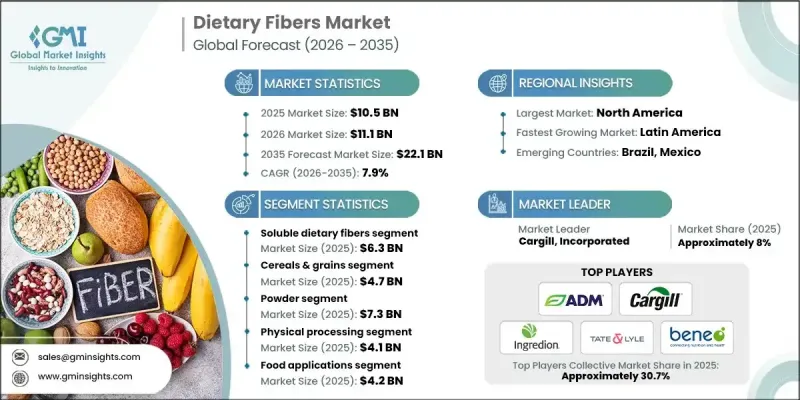
市场成长的驱动力在于消费者健康意识的不断提高,尤其是对肠道健康和整体健康重要性的日益重视。消费者积极寻求改善消化功能、预防肥胖、糖尿病和心血管疾病等生活型态相关慢性病的方法。这种对预防性营养的重视促使食品饮料生产商不断创新,生产富含膳食纤维的产品,以满足注重健康的消费者的需求。消费者对富含膳食纤维的功能性食品、补充剂和饮料的兴趣日益浓厚,也推动了市场的快速扩张,因为他们越来越多地选择富含膳食纤维的饮食来控制体重、血糖并降低患慢性病的风险。
| 市场范围 | |
|---|---|
| 起始年份 | 2025 |
| 预测年份 | 2026-2035 |
| 起始值 | 105亿美元 |
| 预测值 | 221亿美元 |
| 复合年增长率 | 7.9% |
2025年,可溶性膳食纤维市场规模达63亿美元,预计2026年至2035年将以8.2%的复合年增长率成长。可溶性膳食纤维因其在消化健康、胆固醇管理和血糖控制方面的益处而备受关注。随着消费者对预防性营养的日益重视,功能性食品、饮料和膳食补充剂中可溶性膳食纤维的添加量也不断增加。
2025年,谷物市场规模达到47亿美元,预计2026年至2035年间将以8.1%的复合年增长率成长。谷物中的膳食纤维广泛应用于烘焙食品、休閒食品和饮料领域,使生产商能够开发出各种满足功能性营养需求的强化食品。谷物加工的多样性也促进了多个产品类别的创新。
预计2025年,北美膳食纤维市场规模将达31亿美元。人们对肠道健康、体重管理和预防性营养的日益关注,推动了该地区对富含膳食纤维的功能性食品、饮料和膳食补充剂的需求。完善的零售体系和消费者较高的健康意识,也为市场的稳定成长提供了支撑。
目录
第一章:方法论
第二章:执行概要
第三章:行业洞察
- 产业生态系分析
- 供应商格局
- 利润率
- 每个阶段的价值增加
- 影响价值链的因素
- 中断
- 产业影响因素
- 成长驱动因素
- 产业陷阱与挑战
- 市场机会
- 成长潜力分析
- 监管环境
- 北美洲
- 欧洲
- 亚太地区
- 拉丁美洲
- 中东和非洲
- 波特的分析
- PESTEL 分析
- 价格趋势
- 按地区
- 副产品
- 未来市场趋势
- 技术与创新格局
- 当前技术趋势
- 新兴技术
- 专利格局
- 贸易统计(註:仅提供重点国家的贸易统计)
- 主要进口国
- 主要出口国
- 永续性和环境方面
- 永续实践
- 减少废弃物策略
- 生产中的能源效率
- 环保倡议
- 碳足迹考量
第四章:竞争格局
- 介绍
- 公司市占率分析
- 按地区
- 北美洲
- 欧洲
- 亚太地区
- 拉丁美洲
- MEA
- 按地区
- 公司矩阵分析
- 主要市场参与者的竞争分析
- 竞争定位矩阵
- 关键进展
- 併购
- 合作伙伴关係与合作
- 新产品发布
- 扩张计划
第五章:市场估算与预测:依产品类型划分,2022-2035年
- 可溶性膳食纤维
- β-葡聚醣
- 燕麦β-葡聚醣
- 大麦β-葡聚醣
- 酵母β-葡聚醣
- 蘑菇β-葡聚醣
- 车前子壳
- 菊糖和菊糖型果聚醣
- 菊苣根菊粉
- 菊芋菊粉
- 龙舌兰菊粉
- 果胶
- 高甲氧基果胶
- 低甲氧基果胶
- 聚葡萄糖
- 低聚果糖(FOS)
- 低聚半乳糖(GOS)
- 抗性麦芽糊精/糊精
- 可溶性玉米纤维
- 瓜尔胶
- 刺槐豆胶
- 阿拉伯胶(阿拉伯树胶)
- 海藻酸盐
- 阿拉伯木聚醣
- 葡甘露聚醣
- β-葡聚醣
- 不溶性膳食纤维
- 纤维素
- 微晶纤维素(MCC)
- 粉状纤维素
- 半纤维素
- 木质素
- 抗性淀粉
- RS1(物理上无法存取)
- RS2(颗粒状淀粉)
- RS3(回生淀粉)
- RS4(化学改质)
- RS5(直链淀粉-脂质复合物)
- 几丁质和壳聚醣
- 小麦麸皮/谷物麸皮
- 玉米麸皮
- 羟丙基甲基纤维素(HPMC)
- 混合植物细胞壁纤维
- 甘蔗纤维
- 苹果纤维
- 柑橘纤维
- 纤维素
第六章:市场估算与预测:依来源划分,2022-2035年
- 谷物和谷类
- 小麦
- 燕麦
- 大麦
- 玉米
- 米
- 黑麦
- 水果和蔬菜
- 柑橘
- 苹果
- 香蕉
- 根茎类蔬菜(菊苣、马铃薯)
- 其他水果(莓果、番石榴)
- 豆类
- 豆子
- 豌豆
- 扁豆
- 大豆
- 坚果和种子
- 奇亚籽
- 亚麻籽
- 车前子
- 杏仁
- 其他来源
- 海藻/藻类
- 真菌/蘑菇
- 酵母菌
- 微生物/发酵衍生的
第七章:市场估计与预测:依形式划分,2022-2035年
- 粉末
- 细/超细粉末
- 粗粉
- 调味粉
- 无味粉末
- 液体/凝胶
- 液体浓缩物
- 糖浆
- 固体剂型
- 胶囊
- 胶囊/片剂
- 软糖
- 晶圆
- 便捷格式
- 单份包装
- 便携式格式
第八章:市场估算与预测:依加工方式划分,2022-2035年
- 物理处理
- 机械铣削/研磨
- 蒸气爆炸
- 挤压
- 单螺桿挤出
- 双螺桿挤出
- 喷砂挤压
- 高静水压(HHP)
- 微波辅助萃取
- 超细/极细研磨
- 高压均质化(HPH)
- 化学加工
- 酸萃取
- 碱萃取
- 氧化
- 化学改性
- 酵素法加工
- 纤维素酶处理
- 半纤维素酶/木聚醣酶处理
- 果胶酶处理
- 淀粉酶/蛋白酶处理
- 生物/发酵加工
- 乳酸菌发酵
- 真菌发酵
- 酵母发酵
- 固态发酵(SSF)
- 混合/联合方法
- 发酵 + 微流体化
- 酵素法+超音波
- 挤压成型+碱处理
- 其他的
第九章:市场估算与预测:依应用领域划分,2022-2035年
- 食品应用
- 麵包店
- 麵包和捲饼
- 饼干和曲奇
- 蛋糕和鬆饼
- 糕点
- 早餐谷物和零食
- 即食谷物
- 热麦片
- 谷物棒
- 营养棒
- 零食饼干
- 糖果
- 巧克力
- 糖果和软糖
- 无糖糖果
- 乳製品及乳製品替代品
- 优格
- 冰淇淋和冷冻甜点
- 起司及起司替代品
- 液态奶及乳製品替代品
- 植物基乳製品替代品
- 肉类及肉类替代品
- 香肠
- 加工肉製品
- 植物肉替代品
- 婴幼儿营养
- 婴儿配方奶粉
- 婴儿食品
- 幼儿营养产品
- 其他食品应用
- 义大利麵和麵条
- 汤和酱料
- 调味品和佐料
- 即食餐
- 麵包店
- 饮料应用
- 功能性饮料
- 营养奶昔
- 冰沙
- 碳酸饮料
- 果汁及果汁饮料
- 粉状饮料混合物
- 药物应用
- 泻药
- 胆固醇管理
- 糖尿病管理
- 医学营养(肠内/肠外)
- 膳食补充剂
- 消化系统健康补充剂
- 体重管理补充剂
- 益生元补充剂
- 运动营养
- 动物营养
- 伴侣动物(宠物食品)
- 牲畜饲料
- 水产养殖
- 其他应用
- 个人护理及化妆品
- 可生物降解包装材料
第十章:市场估计与预测:依地区划分,2022-2035年
- 北美洲
- 我们
- 加拿大
- 欧洲
- 德国
- 英国
- 法国
- 义大利
- 西班牙
- 欧洲其他地区
- 亚太地区
- 中国
- 印度
- 日本
- 澳洲
- 韩国
- 亚太其他地区
- 拉丁美洲
- 巴西
- 墨西哥
- 阿根廷
- 拉丁美洲其他地区
- 中东和非洲
- 沙乌地阿拉伯
- 南非
- 阿联酋
- 中东和非洲其他地区
第十一章:公司简介
- Archer Daniels Midland Company (ADM)
- Cargill, Incorporated
- Ingredion Incorporated
- Tate & Lyle PLC
- BENEO GmbH
- Sudzucker Group
- Roquette Freres
- Kerry Group
- J. Rettenmaier & Sohne GmbH & Co. KG
- SunOpta, Inc.
- Taiyo Kagaku Co., Ltd.
- Nexira
- Fiberstar, Inc.
- Emsland Group
- AGT Food and Ingredients
- Shandong Minqiang Biotechnology Co., Ltd.
- Grain Processing Corporation
- Tereos Syral
- Farbest-Tallman Foods Corporation
- Cosucra Groupe Warcoing SA
The Global Dietary Fibers Market was valued at USD 10.5 billion in 2025 and is estimated to grow at a CAGR of 7.9% to reach USD 22.1 billion by 2035.
The market growth is fueled by increasing consumer awareness about health and wellness, particularly the importance of gut health and overall well-being. Consumers are actively seeking ways to improve digestive function and prevent lifestyle-related and chronic diseases such as obesity, diabetes, and cardiovascular disorders. This shift toward preventive nutrition is driving food and beverage manufacturers to innovate and produce fiber-enriched products that meet the demands of health-conscious buyers. The rising interest in functional foods, supplements, and beverages fortified with dietary fibers is also contributing to the market's rapid expansion, as consumers increasingly adopt fiber-rich diets to manage weight, control blood sugar, and reduce the risk of chronic illnesses.
| Market Scope | |
|---|---|
| Start Year | 2025 |
| Forecast Year | 2026-2035 |
| Start Value | $10.5 Billion |
| Forecast Value | $22.1 Billion |
| CAGR | 7.9% |
The soluble dietary fibers segment was valued at USD 6.3 billion in 2025 and is expected to grow at a CAGR of 8.2% from 2026 to 2035. Soluble fibers are gaining traction due to their benefits in digestive health, cholesterol management, and glycemic control. Functional foods, beverages, and dietary supplements are increasingly incorporating soluble fibers as consumer interest in preventive nutrition grows.
The cereals and grains segment reached USD 4.7 billion in 2025 and is projected to grow at a CAGR of 8.1% during 2026-2035. Fibers from cereals and grains are widely used in bakery, snack, and beverage applications, allowing manufacturers to develop a variety of fortified foods that address functional nutrition needs. Their versatility in processing enables innovation across multiple product categories.
North America Dietary Fibers Market accounted for USD 3.1 billion in 2025. Increasing awareness of gut health, weight management, and preventive nutrition is driving the region's demand for fiber-enriched functional foods, beverages, and dietary supplements. A well-established retail infrastructure and high consumer health awareness are supporting steady market growth.
Key players in the Global Dietary Fibers Market include Tate & Lyle PLC, Archer Daniels Midland Company (ADM), Ingredion Incorporated, BENEO GmbH, and Cargill, Incorporated. Companies in the Global Dietary Fibers Market are employing strategies such as investing in research and development to create novel fiber types with enhanced functional properties and health benefits. They are expanding product portfolios to include ready-to-use functional ingredients for food and beverage applications. Strategic partnerships with food manufacturers and ingredient suppliers help broaden market reach, while acquisitions and collaborations strengthen regional presence. Companies are also focusing on consumer education campaigns, marketing fiber-rich solutions for weight management, digestive health, and chronic disease prevention.
Table of Contents
Chapter 1 Methodology
- 1.1 Market scope and definition
- 1.2 Research design
- 1.2.1 Research approach
- 1.2.2 Data collection methods
- 1.3 Data mining sources
- 1.3.1 Global
- 1.3.2 Regional/Country
- 1.4 Base estimates and calculations
- 1.4.1 Base year calculation
- 1.4.2 Key trends for market estimation
- 1.5 Primary research and validation
- 1.5.1 Primary sources
- 1.6 Forecast model
- 1.7 Research assumptions and limitations
Chapter 2 Executive Summary
- 2.1 Industry 360° synopsis
- 2.2 Key market trends
- 2.2.1 Regional
- 2.2.2 Product Type
- 2.2.3 Source
- 2.2.4 Form
- 2.2.5 Processing Method
- 2.2.6 Application
- 2.3 TAM Analysis, 2026-2035
- 2.4 CXO perspectives: Strategic imperatives
- 2.4.1 Executive decision points
- 2.4.2 Critical success factors
- 2.5 Future Outlook and Strategic Recommendations
Chapter 3 Industry Insights
- 3.1 Industry ecosystem analysis
- 3.1.1 Supplier Landscape
- 3.1.2 Profit Margin
- 3.1.3 Value addition at each stage
- 3.1.4 Factor affecting the value chain
- 3.1.5 Disruptions
- 3.2 Industry impact forces
- 3.2.1 Growth drivers
- 3.2.2 Industry pitfalls and challenges
- 3.2.3 Market opportunities
- 3.3 Growth potential analysis
- 3.4 Regulatory landscape
- 3.4.1 North America
- 3.4.2 Europe
- 3.4.3 Asia Pacific
- 3.4.4 Latin America
- 3.4.5 Middle East & Africa
- 3.5 Porter's analysis
- 3.6 PESTEL analysis
- 3.7 Price trends
- 3.7.1 By region
- 3.7.2 By product
- 3.8 Future market trends
- 3.9 Technology and Innovation landscape
- 3.9.1 Current technological trends
- 3.9.2 Emerging technologies
- 3.10 Patent Landscape
- 3.11 Trade statistics (Note: the trade statistics will be provided for key countries only)
- 3.11.1 Major importing countries
- 3.11.2 Major exporting countries
- 3.12 Sustainability and Environmental Aspects
- 3.12.1 Sustainable Practices
- 3.12.2 Waste Reduction Strategies
- 3.12.3 Energy Efficiency in Production
- 3.12.4 Eco-friendly Initiatives
- 3.13 Carbon Footprint Considerations
Chapter 4 Competitive Landscape, 2025
- 4.1 Introduction
- 4.2 Company market share analysis
- 4.2.1 By region
- 4.2.1.1 North America
- 4.2.1.2 Europe
- 4.2.1.3 Asia Pacific
- 4.2.1.4 LATAM
- 4.2.1.5 MEA
- 4.2.1 By region
- 4.3 Company matrix analysis
- 4.4 Competitive analysis of major market players
- 4.5 Competitive positioning matrix
- 4.6 Key developments
- 4.6.1 Mergers & acquisitions
- 4.6.2 Partnerships & collaborations
- 4.6.3 New Product Launches
- 4.6.4 Expansion Plans
Chapter 5 Market Estimates and Forecast, By Product Type, 2022 - 2035 (USD Billion, Kilo Tons)
- 5.1 Key trends
- 5.2 Soluble Dietary Fibers
- 5.2.1 Beta-Glucan
- 5.2.1.1 Oat Beta-Glucan
- 5.2.1.2 Barley Beta-Glucan
- 5.2.1.3 Yeast Beta-Glucan
- 5.2.1.4 Mushroom Beta-Glucan
- 5.2.2 Psyllium Husk
- 5.2.3 Inulin & Inulin-Type Fructans
- 5.2.3.1 Chicory Root Inulin
- 5.2.3.2 Jerusalem Artichoke Inulin
- 5.2.3.3 Agave Inulin
- 5.2.4 Pectin
- 5.2.4.1 High-Methoxyl Pectin
- 5.2.4.2 Low-Methoxyl Pectin
- 5.2.5 Polydextrose
- 5.2.6 Fructooligosaccharides (FOS)
- 5.2.7 Galactooligosaccharides (GOS)
- 5.2.8 Resistant Maltodextrin/Dextrin
- 5.2.9 Soluble Corn Fiber
- 5.2.10 Guar Gum
- 5.2.11 Locust Bean Gum
- 5.2.12 Acacia (Gum Arabic)
- 5.2.13 Alginate
- 5.2.14 Arabinoxylan
- 5.2.15 Glucomannan
- 5.2.1 Beta-Glucan
- 5.3 Insoluble Dietary Fibers
- 5.3.1 Cellulose
- 5.3.1.1 Microcrystalline Cellulose (MCC)
- 5.3.1.2 Powdered Cellulose
- 5.3.2 Hemicellulose
- 5.3.3 Lignin
- 5.3.4 Resistant Starch
- 5.3.4.1 RS1 (Physically Inaccessible)
- 5.3.4.2 RS2 (Granular Starch)
- 5.3.4.3 RS3 (Retrograded Starch)
- 5.3.4.4 RS4 (Chemically Modified)
- 5.3.4.5 RS5 (Amylose-Lipid Complex)
- 5.3.5 Chitin & Chitosan
- 5.3.6 Wheat Bran/Cereal Bran
- 5.3.7 Corn Bran
- 5.3.8 Hydroxypropylmethylcellulose (HPMC)
- 5.3.9 Mixed Plant Cell Wall Fibers
- 5.3.9.1 Sugar Cane Fiber
- 5.3.9.2 Apple Fiber
- 5.3.9.3 Citrus Fiber
- 5.3.1 Cellulose
Chapter 6 Market Estimates and Forecast, By Source, 2022 - 2035 (USD Billion, Kilo Tons)
- 6.1 Key trends
- 6.2 Cereals & Grains
- 6.2.1 Wheat
- 6.2.2 Oats
- 6.2.3 Barley
- 6.2.4 Corn
- 6.2.5 Rice
- 6.2.6 Rye
- 6.3 Fruits & Vegetables
- 6.3.1 Citrus
- 6.3.2 Apple
- 6.3.3 Banana
- 6.3.4 Root Vegetables (Chicory, Potato)
- 6.3.5 Other Fruits (Berries, Guava)
- 6.4 Legumes
- 6.4.1 Beans
- 6.4.2 Peas
- 6.4.3 Lentils
- 6.4.4 Soybeans
- 6.5 Nuts & Seeds
- 6.5.1 Chia Seeds
- 6.5.2 Flaxseed
- 6.5.3 Psyllium
- 6.5.4 Almonds
- 6.6 Other Sources
- 6.6.1 Seaweed/Algae
- 6.6.2 Fungi/Mushrooms
- 6.6.3 Yeast
- 6.6.4 Microbial/Fermentation-Derived
Chapter 7 Market Estimates and Forecast, By Form, 2022 - 2035 (USD Billion, Kilo Tons)
- 7.1 Key trends
- 7.2 Powder
- 7.2.1 Fine/Ultrafine Powder
- 7.2.2 Coarse Powder
- 7.2.3 Flavored Powder
- 7.2.4 Unflavored Powder
- 7.3 Liquid/Gel
- 7.3.1 Liquid Concentrate
- 7.3.2 Syrup
- 7.4 Solid Dosage Forms
- 7.4.1 Capsules
- 7.4.2 Caplets/Tablets
- 7.4.3 Gummies
- 7.4.4 Wafers
- 7.5 Convenience Formats
- 7.5.1 Single-Serve Packets
- 7.5.2 On-the-Go Formats
Chapter 8 Market Estimates and Forecast, By Processing Method, 2022 - 2035 (USD Billion, Kilo Tons)
- 8.1 Key trends
- 8.2 Physical Processing
- 8.2.1 Mechanical Milling/Grinding
- 8.2.2 Steam Explosion
- 8.2.3 Extrusion
- 8.2.3.1 Single-Screw Extrusion
- 8.2.3.2 Twin-Screw Extrusion
- 8.2.3.3 Blasting Extrusion
- 8.2.4 High Hydrostatic Pressure (HHP)
- 8.2.5 Microwave-Assisted Extraction
- 8.2.6 Ultrafine/Superfine Grinding
- 8.2.7 High-Pressure Homogenization (HPH)
- 8.3 Chemical Processing
- 8.3.1 Acid Extraction
- 8.3.2 Alkaline Extraction
- 8.3.3 Oxidation
- 8.3.4 Chemical Modification
- 8.4 Enzymatic Processing
- 8.4.1 Cellulase Treatment
- 8.4.2 Hemicellulase/Xylanase Treatment
- 8.4.3 Pectinase Treatment
- 8.4.4 Amylase/Protease Treatment
- 8.5 Biological/Fermentation Processing
- 8.5.1 Lactic Acid Bacteria Fermentation
- 8.5.2 Fungal Fermentation
- 8.5.3 Yeast Fermentation
- 8.5.4 Solid-State Fermentation (SSF)
- 8.6 Hybrid/Combined Methods
- 8.6.1 Fermentation + Microfluidization
- 8.6.2 Enzymatic + Ultrasound
- 8.6.3 Extrusion + Alkaline Treatment
- 8.7 Others
Chapter 9 Market Estimates and Forecast, By Application, 2022 - 2035 (USD Billion, Kilo Tons)
- 9.1 Key trends
- 9.2 Food Applications
- 9.2.1 Bakery
- 9.2.1.1 Bread & Rolls
- 9.2.1.2 Biscuits & Cookies
- 9.2.1.3 Cakes & Muffins
- 9.2.1.4 Pastries
- 9.2.2 Breakfast Cereals & Snacks
- 9.2.2.1 Ready-to-Eat Cereals
- 9.2.2.2 Hot Cereals
- 9.2.2.3 Cereal Bars
- 9.2.2.4 Nutrition Bars
- 9.2.2.5 Snack Crackers
- 9.2.3 Confectionery
- 9.2.3.1 Chocolate
- 9.2.3.2 Candies & Gummies
- 9.2.3.3 Sugar-Free Confectionery
- 9.2.4 Dairy & Dairy Alternatives
- 9.2.4.1 Yogurt
- 9.2.4.2 Ice Cream & Frozen Desserts
- 9.2.4.3 Cheese & Cheese Alternatives
- 9.2.4.4 Fluid Milk & Milk Alternatives
- 9.2.4.5 Plant-Based Dairy Alternatives
- 9.2.5 Meat & Meat Alternatives
- 9.2.5.1 Sausages
- 9.2.5.2 Processed Meat Products
- 9.2.5.3 Plant-Based Meat Alternatives
- 9.2.6 Infant & Toddler Nutrition
- 9.2.6.1 Infant Formula
- 9.2.6.2 Baby Food
- 9.2.6.3 Toddler Nutrition Products
- 9.2.7 Other Food Applications
- 9.2.7.1 Pasta & Noodles
- 9.2.7.2 Soups & Sauces
- 9.2.7.3 Dressings & Condiments
- 9.2.7.4 Ready Meals
- 9.2.1 Bakery
- 9.3 Beverage Applications
- 9.3.1 Functional Beverages
- 9.3.2 Nutrition Shakes
- 9.3.3 Smoothies
- 9.3.4 Carbonated Beverages
- 9.3.5 Juice & Juice Drinks
- 9.3.6 Powdered Beverage Mixes
- 9.4 Pharmaceutical Applications
- 9.4.1 Laxatives
- 9.4.2 Cholesterol Management
- 9.4.3 Diabetes Management
- 9.4.4 Medical Nutrition (Enteral/Parenteral)
- 9.5 Dietary Supplements
- 9.5.1 Digestive Health Supplements
- 9.5.2 Weight Management Supplements
- 9.5.3 Prebiotic Supplements
- 9.5.4 Sports Nutrition
- 9.6 Animal Nutrition
- 9.6.1 Companion Animal (Pet Food)
- 9.6.2 Livestock Feed
- 9.6.3 Aquaculture
- 9.7 Other Applications
- 9.7.1 Personal Care & Cosmetics
- 9.7.2 Biodegradable Packaging Materials
Chapter 10 Market Estimates and Forecast, By Region, 2022 - 2035 (USD Billion, Kilo Tons)
- 10.1 Key trends
- 10.2 North America
- 10.2.1 U.S.
- 10.2.2 Canada
- 10.3 Europe
- 10.3.1 Germany
- 10.3.2 UK
- 10.3.3 France
- 10.3.4 Italy
- 10.3.5 Spain
- 10.3.6 Rest of Europe
- 10.4 Asia Pacific
- 10.4.1 China
- 10.4.2 India
- 10.4.3 Japan
- 10.4.4 Australia
- 10.4.5 South Korea
- 10.4.6 Rest of Asia Pacific
- 10.5 Latin America
- 10.5.1 Brazil
- 10.5.2 Mexico
- 10.5.3 Argentina
- 10.5.4 Rest of Latin America
- 10.6 Middle East & Africa
- 10.6.1 Saudi Arabia
- 10.6.2 South Africa
- 10.6.3 UAE
- 10.6.4 Rest of Middle East & Africa
Chapter 11 Company Profiles
- 11.1 Archer Daniels Midland Company (ADM)
- 11.2 Cargill, Incorporated
- 11.3 Ingredion Incorporated
- 11.4 Tate & Lyle PLC
- 11.5 BENEO GmbH
- 11.6 Sudzucker Group
- 11.7 Roquette Freres
- 11.8 Kerry Group
- 11.9 J. Rettenmaier & Sohne GmbH & Co. KG
- 11.10 SunOpta, Inc.
- 11.11 Taiyo Kagaku Co., Ltd.
- 11.12 Nexira
- 11.13 Fiberstar, Inc.
- 11.14 Emsland Group
- 11.15 AGT Food and Ingredients
- 11.16 Shandong Minqiang Biotechnology Co., Ltd.
- 11.17 Grain Processing Corporation
- 11.18 Tereos Syral
- 11.19 Farbest-Tallman Foods Corporation
- 11.20 Cosucra Groupe Warcoing SA

 膳食纤维市场报告:趋势、预测与竞争分析(至2035年)
 可溶性膳食纤维市场-全球产业规模、份额、趋势、机会及预测(按类型、来源、应用、地区和竞争格局划分,2021-2031年)
 膳食纤维市场规模、份额和成长分析(按成分、类型、应用和地区划分)—产业预测(2026-2033 年)
 膳食纤维饮料市场预测(至2032年):按产品类型、来源、包装、应用、最终用户和地区进行的全球分析
 膳食纤维市场:按来源、类型、应用和地区划分
 胡萝卜纤维市场:成长,未来展望,竞争分析,2024~2032年
 胡萝卜纤维市场机会、成长动力、产业趋势分析与预测 2024 - 2032马铃薯纤维市场、机会、成长动力、产业趋势分析与预测,2024-2032