


 |
市场调查报告书
商品编码
1892875
威士忌市场机会、成长驱动因素、产业趋势分析及预测(2026-2035年)Whiskey Market Opportunity, Growth Drivers, Industry Trend Analysis, and Forecast 2026 - 2035 |
||||||

2025年全球威士忌市场价值1,080亿美元,预计到2035年将以5.5%的复合年增长率成长至1,850亿美元。
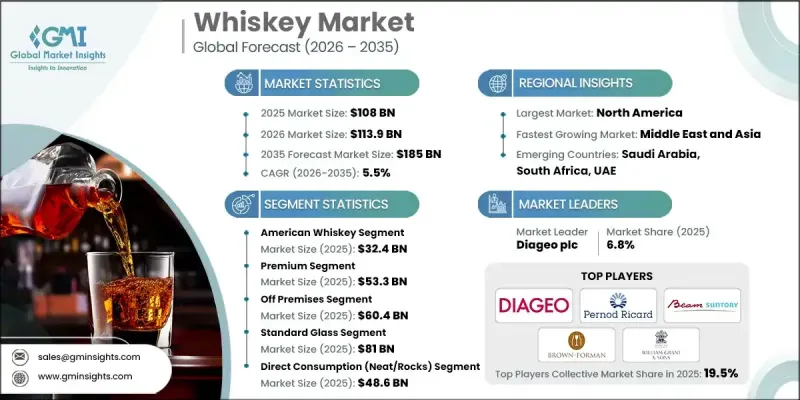
市场成长主要受高端化趋势、全球消费扩张以及消费者对正宗、陈年和手工威士忌产品日益增长的兴趣所驱动。此外,餐饮通路和零售通路的拓展、数位化管道的普及以及鸡尾酒文化在年轻族群中的流行也进一步推动了成长。全球分销网络的增强和新兴市场高端化趋势的持续推动着所有威士忌品类的强劲需求。威士忌的文化共鸣、传承品牌以及产品创新(例如桶陈和限量版)正在提升消费者的参与。生产商正加大对现代化、小批量生产和永续蒸馏技术的投资,以提高营运效率并维持产品的真实性。电子商务平台和订阅式品鑑体验的普及也加强了品牌与消费者之间的联繫,使酿酒商能够触及国际市场的新客户群。
| 市场范围 | |
|---|---|
| 起始年份 | 2025 |
| 预测年份 | 2026-2035 |
| 起始值 | 1080亿美元 |
| 预测值 | 1850亿美元 |
| 复合年增长率 | 5.5% |
预计到2025年,高端威士忌市场规模将达到533亿美元。其持续成长得益于品质与价格的平衡,使其对一般威士忌消费者极具吸引力。同时,超高端威士忌市场正经历更快的扩张,越来越多的消费者愿意为独特的风味、别緻的口感和知名品牌支付更高的价格。年轻和中等收入消费者可支配收入的成长推动了他们从普通威士忌转向高端和超高端威士忌的趋势,这反映了消费者口味的转变以及对更高品质饮酒体验的追求。
预计到2025年,非现场销售市场规模将达604亿美元。随着越来越多的消费者选择购买威士忌在家享用,零售店、超市和线上平台均呈现强劲成长动能。电子商务的兴起使消费者能够轻鬆比较价格、探索新品牌并方便地订购高端威士忌。酒吧、餐厅和俱乐部等场所的现场销售也在稳步復苏,受益于社交活动和夜生活场所的日益丰富,同时这些场所对于推广威士忌品牌和高端产品仍然至关重要。
2025年,美国威士忌市场价值将达到343亿美元。北美地区的需求主要由美国和加拿大驱动,这得益于波本威士忌、黑麦威士忌和加拿大威士忌的高消费量和出口量。波本威士忌在国内外市场持续占据主导地位,这得益于高端化趋势和精酿酒厂的兴起。在加拿大,人们对口感顺滑的美国威士忌的兴趣日益浓厚,这种威士忌既吸引了普通饮酒者,也吸引了鸡尾酒爱好者。该地区强大的分销网络和深厚的威士忌文化进一步促进了创新和市场扩张。
目录
第一章:方法论与范围
第二章:执行概要
第三章:行业洞察
- 产业生态系分析
- 供应商格局
- 利润率
- 每个阶段的价值增加
- 影响价值链的因素
- 中断
- 产业影响因素
- 成长驱动因素
- 高端威士忌的需求不断增长
- 对陈年烈酒和特色烈酒的兴趣
- 透过电子商务进行扩张
- 产业陷阱与挑战
- 高昂的生产成本和老化成本
- 日益激烈的市场竞争
- 市场机会
- 拓展新兴市场
- 口味和技术创新
- 采取可持续的做法
- 成长驱动因素
- 成长潜力分析
- 监管环境
- 北美洲
- 欧洲
- 亚太地区
- 拉丁美洲
- 中东和非洲
- 波特的分析
- PESTEL 分析
- 技术与创新格局
- 当前技术趋势
- 新兴技术
- 价格趋势
- 按地区
- 依产品类型
- 未来市场趋势
- 技术与创新格局
- 当前技术趋势
- 新兴技术
- 专利格局
- 贸易统计(HS编码)(註:仅提供重点国家的贸易统计资料)
- 主要进口国
- 主要出口国
- 永续性和环境方面
- 永续实践
- 减少废弃物策略
- 生产中的能源效率
- 环保倡议
- 碳足迹考量
第四章:竞争格局
- 介绍
- 公司市占率分析
- 按地区
- 北美洲
- 欧洲
- 亚太地区
- 拉丁美洲
- MEA
- 按地区
- 公司矩阵分析
- 主要市场参与者的竞争分析
- 竞争定位矩阵
- 关键进展
- 併购
- 合作伙伴关係与合作
- 新产品发布
- 扩张计划
第五章:市场估算与预测:依产品类型划分,2021-2034年
- 美国威士忌
- 波本威士忌
- 纯波本威士忌
- 田纳西威士忌
- 其他的
- 苏格兰威士忌
- 单一麦芽苏格兰威士忌
- 单一谷物苏格兰威士忌
- 调和苏格兰威士忌
- 混合麦芽苏格兰威士忌
- 混合谷物苏格兰威士忌
- 爱尔兰威士忌
- 单一壶式蒸馏爱尔兰威士忌
- 单一麦芽爱尔兰威士忌
- 单一谷物爱尔兰威士忌
- 混合爱尔兰威士忌
- 加拿大威士忌
- 加拿大调和威士忌
- 加拿大黑麦威士忌
- 日本威士忌
- 日本单一麦芽威士忌
- 日本调和威士忌
- 日本单谷
- 风味威士忌
- 蜂蜜风味威士忌
- 苹果风味威士忌
- 肉桂威士忌
- 其他口味变体
- 即饮型(RTD)威士忌
- 威士忌可乐即饮
- 威士忌姜汁汽水即饮
- 威士忌鸡尾酒即饮
第六章:市场估计与预测:依价格层级划分,2021-2034年
- 高阶市场
- 超高端市场
- 奢侈品/超高端市场(零售价100美元以上)
第七章:市场估计与预测:依配销通路划分,2021-2034年
- 本地部署
- 非现场
- 旅游零售/免税店
- 机构/批发
第八章:市场估价与预测:依包装材料划分,2021-2034年
- 标准玻璃
- 永续材料
- 高级包装
第九章:市场估计与预测:依应用领域划分,2021-2034年
- 直接饮用(纯饮、加冰、加水)
- 鸡尾酒和混合饮料
- 烹饪与美食
- 赠送
- 其他的
第十章:市场估计与预测:依地区划分,2021-2034年
- 北美洲
- 我们
- 加拿大
- 墨西哥
- 欧洲
- 德国
- 英国
- 法国
- 西班牙
- 义大利
- 欧洲其他地区
- 亚太地区
- 中国
- 印度
- 日本
- 澳洲
- 韩国
- 亚太其他地区
- 拉丁美洲
- 巴西
- 墨西哥
- 阿根廷
- 拉丁美洲其他地区
- 中东和非洲
- 沙乌地阿拉伯
- 南非
- 阿联酋
- 中东和非洲其他地区
第十一章:公司简介
- Bacardi Limited
- Balcones Distilling
- Beam Suntory
- Brown-Forman Corporation
- Campari Group
- Diageo plc
- Edrington Group
- Heaven Hill Brands
- Kings County Distillery
- Pernod Ricard
- Remy Cointreau
- Sazerac Company
- Starward Whisky
- Stranahan's Colorado Whiskey
- Teeling Whiskey Company
- Westland Distillery
- William Grant & Sons
The Global Whiskey Market was valued at USD 108 billion in 2025 and is estimated to grow at a CAGR of 5.5% to reach USD 185 billion by 2035.
Market growth is driven by rising premiumization, expanding global consumption, and increasing consumer interest in authentic, aged, and craft whiskey products. Growth is further supported by the expansion of on-trade and off-trade retail channels, greater digital accessibility, and the rising popularity of cocktail culture among younger demographics. Enhanced global distribution networks and the premium shift in emerging markets continue to create robust demand across all whiskey categories. Whiskey's cultural resonance, heritage-driven branding, and product innovation, such as cask finishes and limited-edition releases, are boosting consumer engagement. Producers are increasingly investing in modernization, small-batch production, and sustainable distilling technologies to improve operational efficiency while preserving product authenticity. The proliferation of e-commerce platforms and subscription-based tasting experiences has also strengthened brand-consumer relationships, allowing distillers to access new audiences across international markets.
| Market Scope | |
|---|---|
| Start Year | 2025 |
| Forecast Year | 2026-2035 |
| Start Value | $108 Billion |
| Forecast Value | $185 Billion |
| CAGR | 5.5% |
The premium segment generated USD 53.3 billion in 2025. Its continued growth is driven by the balance of quality and affordability, making it attractive to regular whiskey consumers. Super-premium whiskey, meanwhile, is witnessing faster expansion as more consumers are willing to spend extra for distinctive flavors, unique finishes, and reputable brands. Rising disposable incomes among younger and middle-income consumers have fueled a shift from standard whiskies to premium and super-premium varieties, reflecting evolving tastes and a desire for elevated drinking experiences.
The off-premises sales segment reached USD 60.4 billion in 2025. Retail outlets, supermarkets, and online platforms are seeing strong growth as more consumers prefer purchasing whiskey for home consumption. The rise of e-commerce allows buyers to easily compare prices, explore new brands, and order premium bottles conveniently. On-premises sales through bars, restaurants, and clubs are also recovering steadily, benefiting from increased social activities and nightlife, while remaining crucial for promoting whiskey brands and premium offerings.
U.S. Whiskey Market was valued at USD 34.3 billion in 2025. North America's demand is largely driven by the U.S. and Canada, supported by high consumption and exports of bourbon, rye, and Canadian whiskies. Bourbon continues to dominate domestically and internationally, bolstered by premiumization trends and the rise of craft distilleries. Interest in smooth, easy-to-drink American whiskies is growing in Canada, appealing to both casual drinkers and cocktail enthusiasts. The region's strong distribution networks and rich whiskey culture further support innovation and market expansion.
Key players in the Global Whiskey Market include Diageo, Pernod Ricard, Beam Suntory, William Grant & Sons, Brown-Forman, and Whyte & Mackay, all of which continue to invest in product innovation, global expansion, and premiumization strategies to maintain competitive strength in the evolving whiskey landscape. Companies operating in the Whiskey Market increasingly rely on premiumization, launching aged, limited-edition, and cask-finished expressions to attract enthusiasts willing to pay higher prices. Major players also emphasize innovation, experimenting with unique maturation techniques, regional ingredients, and collaborative releases to differentiate their portfolios. Global expansion remains a priority, with firms strengthening distribution networks in high-growth regions such as Asia Pacific through partnerships and localized marketing campaigns. Many brands are investing heavily in digital engagement, using e-commerce, virtual tastings, and storytelling-driven social media campaigns to reach younger consumers.
Table of Contents
Chapter 1 Methodology & Scope
- 1.1 Market scope and definition
- 1.2 Research design
- 1.2.1 Research approach
- 1.2.2 Data collection methods
- 1.3 Data mining sources
- 1.3.1 Global
- 1.3.2 Regional/Country
- 1.4 Base estimates and calculations
- 1.4.1 Base year calculation
- 1.4.2 Key trends for market estimation
- 1.5 Primary research and validation
- 1.5.1 Primary sources
- 1.6 Forecast model
- 1.7 Research assumptions and limitations
Chapter 2 Executive Summary
- 2.1 Industry 360° synopsis
- 2.2 Key market trends
- 2.2.1 Product type
- 2.2.2 Price tier
- 2.2.3 Distribution channel
- 2.2.4 Packaging material
- 2.2.5 Application
- 2.2.6 Regional
- 2.3 TAM Analysis, 2025-2034
- 2.4 CXO perspectives: Strategic imperatives
- 2.4.1 Executive decision points
- 2.4.2 Critical success factors
- 2.5 Future outlook and strategic recommendations
Chapter 3 Industry Insights
- 3.1 Industry ecosystem analysis
- 3.1.1 Supplier landscape
- 3.1.2 Profit margin
- 3.1.3 Value addition at each stage
- 3.1.4 Factor affecting the value chain
- 3.1.5 Disruptions
- 3.2 Industry impact forces
- 3.2.1 Growth drivers
- 3.2.1.1 Rising demand for premium whiskey
- 3.2.1.2 Interest in aged and specialty spirits
- 3.2.1.3 Expansion through e-commerce
- 3.2.2 Industry pitfalls and challenges
- 3.2.2.1 High production and aging costs
- 3.2.2.2 Increasing market competition
- 3.2.3 Market opportunities
- 3.2.3.1 Expansion into emerging markets
- 3.2.3.2 Innovation in flavors and techniques
- 3.2.3.3 Adoption of sustainable practices
- 3.2.1 Growth drivers
- 3.3 Growth potential analysis
- 3.4 Regulatory landscape
- 3.4.1 North America
- 3.4.2 Europe
- 3.4.3 Asia Pacific
- 3.4.4 Latin America
- 3.4.5 Middle East & Africa
- 3.5 Porter's analysis
- 3.6 PESTEL analysis
- 3.7 Technology and innovation landscape
- 3.7.1 Current technological trends
- 3.7.2 Emerging technologies
- 3.8 Price trends
- 3.8.1 By region
- 3.8.2 By product type
- 3.9 Future market trends
- 3.10 Technology and innovation landscape
- 3.10.1 Current technological trends
- 3.10.2 Emerging technologies
- 3.11 Patent landscape
- 3.12 Trade statistics (HS code) (Note: the trade statistics will be provided for key countries only)
- 3.12.1 Major importing countries
- 3.12.2 Major exporting countries
- 3.13 Sustainability and environmental aspects
- 3.13.1 Sustainable practices
- 3.13.2 Waste reduction strategies
- 3.13.3 Energy efficiency in production
- 3.13.4 Eco-friendly initiatives
- 3.14 Carbon footprint consideration
Chapter 4 Competitive Landscape, 2025
- 4.1 Introduction
- 4.2 Company market share analysis
- 4.2.1 By region
- 4.2.1.1 North America
- 4.2.1.2 Europe
- 4.2.1.3 Asia Pacific
- 4.2.1.4 LATAM
- 4.2.1.5 MEA
- 4.2.1 By region
- 4.3 Company matrix analysis
- 4.4 Competitive analysis of major market players
- 4.5 Competitive positioning matrix
- 4.6 Key developments
- 4.6.1 Mergers & acquisitions
- 4.6.2 Partnerships & collaborations
- 4.6.3 New product launches
- 4.6.4 Expansion plans
Chapter 5 Market Estimates and Forecast, By Product Type, 2021-2034 (USD Billion) (Million Liters)
- 5.1 Key trends
- 5.2 American whiskey
- 5.2.1 Bourbon whiskey
- 5.2.2 Straight bourbon
- 5.2.3 Tennessee whiskey
- 5.2.4 Others
- 5.3 Scotch whisky
- 5.3.1 Single malt scotch
- 5.3.2 Single grain scotch
- 5.3.3 Blended scotch whisky
- 5.3.4 Blended malt scotch
- 5.3.5 Blended grain scotch
- 5.4 Irish whiskey
- 5.4.1 Single pot still Irish whiskey
- 5.4.2 Single malt Irish whiskey
- 5.4.3 Single grain Irish whiskey
- 5.4.4 Blended Irish whiskey
- 5.5 Canadian whisky
- 5.5.1 Canadian blended whisky
- 5.5.2 Canadian rye whisky
- 5.6 Japanese whisky
- 5.6.1 Japanese single malt
- 5.6.2 Japanese blended whisky
- 5.6.3 Japanese single grain
- 5.7 Flavored whiskey
- 5.7.1 Honey-flavored whiskey
- 5.7.2 Apple-flavored whiskey
- 5.7.3 Cinnamon-flavored whiskey
- 5.7.4 Other flavored variants
- 5.8 Ready-to-drink (RTD) whiskey
- 5.8.1 Whiskey & cola RTD
- 5.8.2 Whiskey & ginger ale RTD
- 5.8.3 Whiskey cocktail RTD
Chapter 6 Market Estimates and Forecast, By Price Tier, 2021-2034 (USD Billion) (Million Liters)
- 6.1 Key trends
- 6.2 Premium segment
- 6.3 Super-premium segment
- 6.4 Luxury/ultra-premium segment ($100+ retail)
Chapter 7 Market Estimates and Forecast, By Distribution Channel, 2021-2034 (USD Billion) (Million Liters)
- 7.1 Key trends
- 7.2 On-premise
- 7.3 Off-premise
- 7.4 Travel retail/duty-free
- 7.5 Institutional/wholesale
Chapter 8 Market Estimates and Forecast, By Packaging Material, 2021-2034 (USD Billion) (Million Liters)
- 8.1 Key trends
- 8.2 Standard glass
- 8.3 Sustainable material
- 8.4 Premium packaging
Chapter 9 Market Estimates and Forecast, By Application, 2021-2034 (USD Billion) (Million Liters)
- 9.1 Key trends
- 9.2 Direct consumption (neat, on the rocks, with water)
- 9.3 Cocktails & mixed drinks
- 9.4 Cooking & culinary
- 9.5 Gifting
- 9.6 Others
Chapter 10 Market Estimates and Forecast, By Region, 2021-2034 (USD Billion) (Million Liters)
- 10.1 Key trends
- 10.2 North America
- 10.2.1 U.S.
- 10.2.2 Canada
- 10.2.3 Mexico
- 10.3 Europe
- 10.3.1 Germany
- 10.3.2 UK
- 10.3.3 France
- 10.3.4 Spain
- 10.3.5 Italy
- 10.3.6 Rest of Europe
- 10.4 Asia Pacific
- 10.4.1 China
- 10.4.2 India
- 10.4.3 Japan
- 10.4.4 Australia
- 10.4.5 South Korea
- 10.4.6 Rest of Asia Pacific
- 10.5 Latin America
- 10.5.1 Brazil
- 10.5.2 Mexico
- 10.5.3 Argentina
- 10.5.4 Rest of Latin America
- 10.6 Middle East and Africa
- 10.6.1 Saudi Arabia
- 10.6.2 South Africa
- 10.6.3 UAE
- 10.6.4 Rest of Middle East and Africa
Chapter 11 Company Profiles
- 11.1 Bacardi Limited
- 11.2 Balcones Distilling
- 11.3 Beam Suntory
- 11.4 Brown-Forman Corporation
- 11.5 Campari Group
- 11.6 Diageo plc
- 11.7 Edrington Group
- 11.8 Heaven Hill Brands
- 11.9 Kings County Distillery
- 11.10 Pernod Ricard
- 11.11 Remy Cointreau
- 11.12 Sazerac Company
- 11.13 Starward Whisky
- 11.14 Stranahan's Colorado Whiskey
- 11.15 Teeling Whiskey Company
- 11.16 Westland Distillery
- 11.17 William Grant & Sons

 威士忌市场报告:趋势、预测和竞争分析(至2035年)
 威士忌市场规模、份额及成长分析(按饮料类型、产品类型、口味、最终用户、销售管道和地区划分)-2026-2033年产业预测
 美国威士忌市场规模、份额和成长分析(按产品、应用、分销通路、年龄层和地区划分)-2026-2033年产业预测
 风味威士忌市场-全球产业规模、份额、趋势、机会和预测,按类型、应用、配销通路、地区和竞争格局划分,2020-2030年预测
 单一麦芽苏格兰威士忌市场规模、占有率、成长及全球产业分析:按类型、应用和地区划分的洞察与预测(2024-2032)全球单一麦芽威士忌市场 - 2025 年至 2030 年预测全球单一麦芽威士忌市场规模:按产品、应用、地区、范围和预测
 全球单一麦芽威士忌市场世界威士忌市场