


 |
市场调查报告书
商品编码
2019152
健康零食市场机会、成长要素、产业趋势分析及2026-2035年预测Healthy Snacks Market Opportunity, Growth Drivers, Industry Trend Analysis, and Forecast 2026 - 2035 |
||||||

预计到 2025 年,全球健康零食市场价值将达到 1,073 亿美元,年复合成长率为 6.5%,到 2035 年将达到 2,005 亿美元。
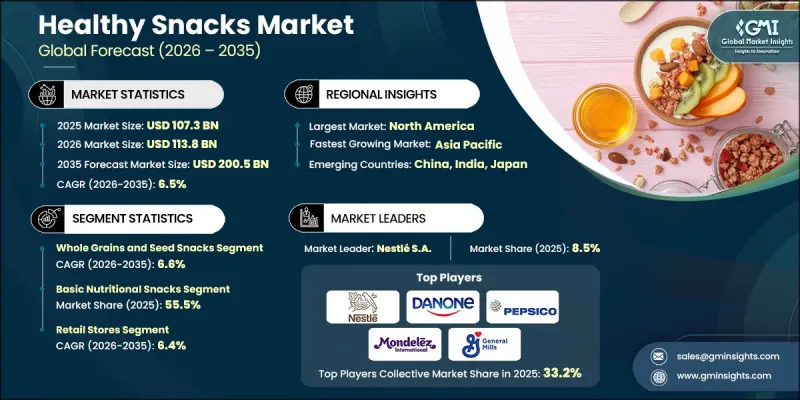
消费者健康意识的提升以及对便利营养食品的偏好推动了这个市场的扩张。注重健康的消费者正在寻找能够提供必需营养素、帮助控制体重并减少加工食品和高糖食品摄取量的零食。健康零食能够提供能量、必需维生素和矿物质,同时促进整体健康。这些产品满足特定的饮食需求,例如纯素、无麸质和生酮友善型,且不含人工防腐剂。市场涵盖多个管道,零售商透过超级市场、健康食品商店和电商平台销售产品,而餐饮服务业则在咖啡馆、自动贩卖机和便利商店提供健康食品选择。坚果、干果、蛋白棒和蔬菜片等便携式零食的创新产品,满足了生活方式活跃、追求便利营养食品的消费者的需求。
| 市场范围 | |
|---|---|
| 开始年份 | 2025 |
| 预测期 | 2026-2035 |
| 上市时的市场规模 | 1073亿美元 |
| 预测金额 | 2005亿美元 |
| 复合年增长率 | 6.5% |
全谷谷物和种子零食市场预计到2025年将占据20%的市场份额,到2035年将以6.6%的复合年增长率成长。消费者对天然营养点心的需求是推动市场成长的主要动力,因为这些产品富含膳食纤维,并具有许多健康益处。水果类零食因其甜美、富含维生素且不含过多醣分的替代品而日益受到欢迎。坚果和种子类产品因其蛋白质含量、健康脂肪以及能够为注重健康的消费者提供持久能量而继续保持强劲势头。
预计到2025年,基础营养零食市占率将达到55.5%,并在2026年至2035年间以6.2%的复合年增长率成长。消费者依然偏好提供必需营养素的简单健康食品。富含维生素、矿物质和超级食物的零食越来越受欢迎,因为它们能够解决免疫力、能量和认知功能等特定健康问题。随着消费者越来越重视预防医学和健康养生,有助于消化、心臟健康和体重管理的健康功能性零食也日益受到关注。
北美健康零食市场正快速成长,预计到2025年将占据36.2%的市场。消费者对洁净标示和有机产品的兴趣日益浓厚,以及文明病的增加,都推动了该市场的发展。千禧世代和Z世代正在推动对功能性零食的需求,这些零食能够强化蛋白质、改善肠道健康和增强免疫力。超级市场、便利商店和线上通路提供的便利、易携带和易食用的产品形式,进一步促进了市场成长。
目录
第一章:调查方法和范围
第二章执行摘要
第三章业界考察
- 生态系分析
- 供应商情况
- 利润率
- 每个阶段增加的价值
- 影响价值链的因素
- 中断
- 影响产业的因素
- 促进因素
- 产业潜在风险与挑战
- 市场机会
- 成长潜力分析
- 监理情势
- 北美洲
- 欧洲
- 亚太地区
- 拉丁美洲
- 中东和非洲
- 波特五力分析
- PESTEL 分析
- 价格趋势
- 按地区
- 按类型
- 未来市场趋势
- 科技与创新趋势
- 当前技术趋势
- 新兴技术
- 专利趋势
- 贸易统计(HS编码)
- 主要进口国
- 主要出口国
- 永续性和环境方面
- 永续倡议
- 减少废弃物策略
- 生产中的能源效率
- 具有环保意识的倡议
- 考虑碳足迹
第四章 竞争情势
- 介绍
- 企业市占率分析
- 按地区
- 北美洲
- 欧洲
- 亚太地区
- 拉丁美洲
- 中东和非洲
- 按地区
- 企业矩阵分析
- 主要市场公司的竞争分析
- 竞争定位矩阵
- 主要进展
- 併购
- 伙伴关係与合作
- 新产品发布
- 业务拓展计划
第五章 市场估价与预测:依产品划分,2022-2035年
- 全谷谷物种子零食
- 水果零食
- 坚果和种子零食
- 优格和乳製品零食
- 蔬菜零食
- 蛋白质棒和零食
- 无麸质和纯素零食
- 其他的
第六章 市场估计与预测:依功能划分,2022-2035年
- 基础营养零食
- 营养强化型功能性零食
- 功能性健康零食
- 运动表现
第七章 市场估价与预测:依通路划分,2022-2035年
- 实体店面
- 线上零售
- 自动贩卖机
- 直接向消费者销售
第八章 市场估计与预测:依地区划分,2022-2035年
- 北美洲
- 我们
- 加拿大
- 欧洲
- 德国
- 英国
- 法国
- 西班牙
- 义大利
- 其他欧洲地区
- 亚太地区
- 中国
- 印度
- 日本
- 澳洲
- 韩国
- 亚太其他地区
- 拉丁美洲
- 巴西
- 墨西哥
- 阿根廷
- 其他拉丁美洲地区
- 中东和非洲
- 沙乌地阿拉伯
- 南非
- 阿拉伯聯合大公国
- 其他中东和非洲地区
第九章:公司简介
- Danone SA
- General Mills, Inc.
- Glanbia PLC
- Hain Celestial Group, Inc.
- Hippeas
- Hormel Foods Corporation
- Kellanova Company
- Mondelez International, Inc.
- Nestle SA
- PepsiCo, Inc.
- Simply Good Foods Company
The Global Healthy Snacks Market was valued at USD 107.3 billion in 2025 and is estimated to grow at a CAGR of 6.5% to reach USD 200.5 billion by 2035.
The expansion of this market is driven by consumers' increasing awareness of health and wellness and their preference for convenient, nutrient-rich foods. Health-conscious buyers are seeking snacks that provide essential nutrients, support weight management, and reduce the intake of processed and high-sugar foods. Healthy snacks deliver energy, essential vitamins, and minerals while promoting overall well-being. These products cater to specific dietary requirements, including vegan, gluten-free, and keto-friendly options, while avoiding artificial preservatives. The market serves multiple channels, with retailers offering products through supermarkets, health food stores, and e-commerce platforms, while the foodservice sector provides healthy options in cafes, vending machines, and convenience outlets. Innovations in portable snacks, including nuts, dried fruits, protein bars, and vegetable chips, are meeting the needs of consumers leading active lifestyles and seeking quick, nutritious options.
| Market Scope | |
|---|---|
| Start Year | 2025 |
| Forecast Year | 2026-2035 |
| Start Value | $107.3 Billion |
| Forecast Value | $200.5 Billion |
| CAGR | 6.5% |
The whole grain and seed snacks segment held a 20% share in 2025 and is expected to grow at a CAGR of 6.6% by 2035. The demand for natural, nutrient-dense snacks is driving this segment, as these products are rich in fiber and offer multiple health benefits. Fruit-based snacks are growing in popularity because consumers want sweet, vitamin-packed alternatives without excessive sugar. Nut and seed-based products remain strong performers due to their protein content, healthy fats, and ability to provide sustained energy for health-focused individuals.
The basic nutritional snacks segment accounted for 55.5% share in 2025 and is expected to grow at a CAGR of 6.2% from 2026 to 2035. Consumers continue to prefer simple, wholesome options that deliver essential nutrition. Snacks fortified with vitamins, minerals, and superfoods are increasingly popular as they address specific health concerns such as immunity, energy, and cognitive function. Functional health snacks that support digestive health, heart health, and weight management are gaining traction as consumers prioritize preventive care and wellness.
North America Healthy Snacks Market held a 36.2% share in 2025 and is growing rapidly. The region's healthy snacks market benefits from increasing consumer focus on clean-label and organic products, along with a rising prevalence of lifestyle-related health issues. Millennials and Gen Z are driving demand for functional snacks that provide protein enrichment, gut health benefits, and immune support. Convenience, portability, and easy-to-consume formats offered through supermarkets, convenience stores, and online channels are further fueling market growth.
Key players in the Global Healthy Snacks Market include PepsiCo, Inc., Nestle S.A., Danone S.A., Glanbia PLC, Hain Celestial Group, Inc., Mondelez
International, Inc., Hippeas, Simply Good Foods Company, Hormel Foods Corporation, and Kellanova Company. Companies in the Global Healthy Snacks Market are adopting multiple strategies to strengthen their market position and expand their footprint. They are investing in research and development to create innovative, functional products that meet evolving consumer demands for wellness and nutrition. Strategic partnerships with retailers and e-commerce platforms enhance distribution and accessibility, while targeted marketing campaigns highlight health benefits, sustainability, and clean-label credentials. Firms are also exploring acquisitions and collaborations to expand product portfolios and enter new geographic markets. Emphasis on packaging innovation, including eco-friendly and convenient designs, reinforces brand value. Companies are leveraging consumer insights and data analytics to anticipate trends, refine product offerings, and build long-term loyalty in competitive markets.
Table of Contents
Chapter 1 Methodology & Scope
- 1.1 Market scope and definition
- 1.2 Research design
- 1.2.1 Research approach
- 1.2.2 Data collection methods
- 1.3 Data mining sources
- 1.3.1 Global
- 1.3.2 Regional/Country
- 1.4 Base estimates and calculations
- 1.4.1 Base year calculation
- 1.4.2 Key trends for market estimation
- 1.5 Primary research and validation
- 1.5.1 Primary sources
- 1.6 Forecast model
- 1.7 Research assumptions and limitations
Chapter 2 Executive Summary
- 2.1 Industry 360° synopsis
- 2.2 Key market trends
- 2.2.1 Regional
- 2.2.2 Product
- 2.2.3 Function
- 2.2.4 Distribution channel
- 2.3 TAM Analysis, 2026-2035
- 2.4 CXO perspectives: Strategic imperatives
- 2.4.1 Executive decision points
Chapter 3 Industry Insights
- 3.1 Industry ecosystem analysis
- 3.1.1 Supplier landscape
- 3.1.2 Profit margin
- 3.1.3 Value addition at each stage
- 3.1.4 Factor affecting the value chain
- 3.1.5 Disruptions
- 3.2 Industry impact forces
- 3.2.1 Growth drivers
- 3.2.2 Industry pitfalls and challenges
- 3.2.3 Market opportunities
- 3.3 Growth potential analysis
- 3.4 Regulatory landscape
- 3.4.1 North America
- 3.4.2 Europe
- 3.4.3 Asia Pacific
- 3.4.4 Latin America
- 3.4.5 Middle East & Africa
- 3.5 Porter's analysis
- 3.6 PESTEL analysis
- 3.7 Price trends
- 3.7.1 By region
- 3.7.2 By type
- 3.8 Future market trends
- 3.9 Technology and Innovation landscape
- 3.9.1 Current technological trends
- 3.9.2 Emerging technologies
- 3.10 Patent Landscape
- 3.11 Trade statistics (HS code)
- 3.11.1 Major importing countries
- 3.11.2 Major exporting countries
- 3.12 Sustainability and environmental aspects
- 3.12.1 Sustainable practices
- 3.12.2 Waste reduction strategies
- 3.12.3 Energy efficiency in production
- 3.12.4 Eco-friendly initiatives
- 3.13 Carbon footprint consideration
Chapter 4 Competitive Landscape, 2025
- 4.1 Introduction
- 4.2 Company market share analysis
- 4.2.1 By region
- 4.2.1.1 North America
- 4.2.1.2 Europe
- 4.2.1.3 Asia Pacific
- 4.2.1.4 LATAM
- 4.2.1.5 MEA
- 4.2.1 By region
- 4.3 Company matrix analysis
- 4.4 Competitive analysis of major market players
- 4.5 Competitive positioning matrix
- 4.6 Key developments
- 4.6.1 Mergers & acquisitions
- 4.6.2 Partnerships & collaborations
- 4.6.3 New Product Launches
- 4.6.4 Expansion Plans
Chapter 5 Market Estimates and Forecast, By Product, 2022-2035 (USD Billion) (Kilo Tons)
- 5.1 Key trends
- 5.2 Whole grains and seeds snacks
- 5.3 Fruit-based snacks
- 5.4 Nut and seed-based snacks
- 5.5 Yogurt and dairy snacks
- 5.6 Vegetable snacks
- 5.7 Protein bars and snacks
- 5.8 Gluten-free and vegan snacks
- 5.9 Others
Chapter 6 Market Estimates and Forecast, By Function, 2022-2035 (USD Billion) (Kilo Tons)
- 6.1 Key trends
- 6.2 Basic nutritional snacks
- 6.3 Fortified/enhanced snacks
- 6.4 Functional health snacks
- 6.5 Sports & performance
Chapter 7 Market Estimates and Forecast, By Distribution Channel, 2022-2035 (USD Billion) (Kilo Tons)
- 7.1 Key trends
- 7.2 Retail stores
- 7.3 Online retail
- 7.4 Vending machines
- 7.5 Direct-to-consumer
Chapter 8 Market Estimates and Forecast, By Region, 2022-2035 (USD Billion) (Kilo Tons)
- 8.1 Key trends
- 8.2 North America
- 8.2.1 U.S.
- 8.2.2 Canada
- 8.3 Europe
- 8.3.1 Germany
- 8.3.2 UK
- 8.3.3 France
- 8.3.4 Spain
- 8.3.5 Italy
- 8.3.6 Rest of Europe
- 8.4 Asia Pacific
- 8.4.1 China
- 8.4.2 India
- 8.4.3 Japan
- 8.4.4 Australia
- 8.4.5 South Korea
- 8.4.6 Rest of Asia Pacific
- 8.5 Latin America
- 8.5.1 Brazil
- 8.5.2 Mexico
- 8.5.3 Argentina
- 8.5.4 Rest of Latin America
- 8.6 Middle East and Africa
- 8.6.1 Saudi Arabia
- 8.6.2 South Africa
- 8.6.3 UAE
- 8.6.4 Rest of Middle East and Africa
Chapter 9 Company Profiles
- 9.1 Danone S.A.
- 9.2 General Mills, Inc.
- 9.3 Glanbia PLC
- 9.4 Hain Celestial Group, Inc.
- 9.5 Hippeas
- 9.6 Hormel Foods Corporation
- 9.7 Kellanova Company
- 9.8 Mondelez International, Inc.
- 9.9 Nestle S.A.
- 9.10 PepsiCo, Inc.
- 9.11 Simply Good Foods Company

 健康零食市场-全球产业规模、份额、趋势、机会及预测(依产品、包装、销售管道、地区及竞争格局划分,2021-2031年)
 健康零食和高蛋白食品市场预测至2032年:按产品、成分、分销管道、最终用户和地区分類的全球分析健康零食市场预测至2032年:按产品、形式、分销管道、最终用户和地区分類的全球分析
 健康零食市场规模、份额和成长分析(依产品、效能宣称、包装、通路和地区划分)-2026-2033年产业预测2032 年正念零食解决方案市场预测:按零食类型、成分、包装、分销管道、最终用户和地区进行的全球分析
 中国的健康零食市场:各产品类型,主张,各包装形式,各流通管道,各地区,机会,预测,2018年~2032年健康零食市场:依产品类型、主张、包装类型、通路、地区、机会、预测,2018-2032年印度健康零食市场依产品类型、主张、包装类型、通路、地区、机会和预测,2018-2032年日本健康零食市场:依产品类型、主张、包装类型、通路、地区、机会和预测,2018-2032年美国健康零食市场:依产品类型、主张、包装类型、通路、地区、机会、预测,2018-2032年