


 |
市场调查报告书
商品编码
2019156
环保食品包装市场机会、成长要素、产业趋势分析及2026-2035年预测Eco-friendly Food Packaging Market Opportunity, Growth Drivers, Industry Trend Analysis, and Forecast 2026 - 2035 |
||||||

预计到 2025 年,全球环保食品包装市场价值将达到 2,117 亿美元,并预计以 8% 的复合年增长率成长,到 2035 年达到 4,512 亿美元。
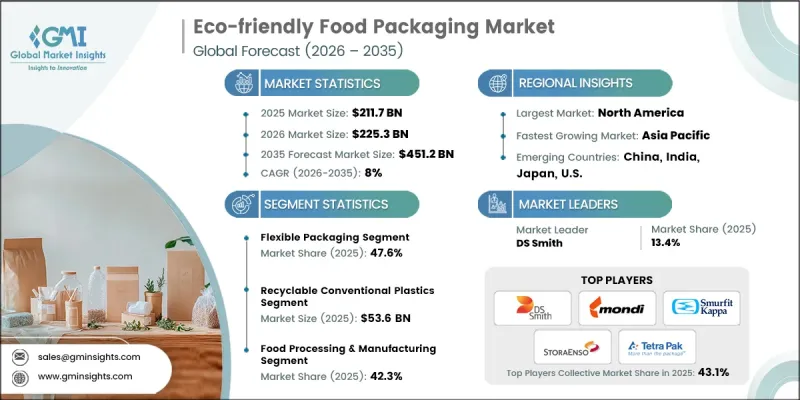
市场成长的驱动力来自于旨在减少塑胶废弃物的法规结构的强化,以及食品饮料产业对永续包装解决方案的日益普及。对环保替代品的需求不断增长,加上食品配送服务的快速扩张,正在加速向可回收和可堆肥的材料转变。生物基包装技术的持续创新也有助于提升产品性能和永续性。製造商致力于在保持包装效率和耐用性的同时,减少对环境的影响。随着循环经济实践的日益重视,企业正在推广可有效重复使用或回收的材料。此外,向永续消费模式的转变正在推动对环保包装的需求,使环保食品包装成为全球供应链的关键关注领域。
| 市场范围 | |
|---|---|
| 开始年份 | 2025 |
| 预测期 | 2026-2035 |
| 初始市场规模 | 2117亿美元 |
| 预测金额 | 4512亿美元 |
| 复合年增长率 | 8% |
由于主要经济体针对一次性塑胶製品推出了更严格的法规,环保意识强的食品包装产业正展现出强劲的发展势头。监管机构正在执行更严格的合规标准,以最大限度地减少对环境的影响,迫使企业转向永续的替代方案。同时,食品和饮料製造商正努力透过采用可回收和可堆肥材料来实现更高的永续性目标。随着企业致力于取代传统的塑胶包装,向纺织品和纸质包装解决方案的转变正在加速。产业相关人员正日益将包装策略与循环经济原则相契合,并专注于材料的回收和再利用。这种转变正在重塑产品开发和供应链策略,并刺激永续材料应用的创新。
预计到2025年,软包装市占率将达到47.6%,主要得益于其轻量化结构、材料用量减少和成本效益。这种包装形式有助于延长产品保质期并优化物流,从而促进其在食品供应链中的广泛应用。可回收单一材料结构和永续复合解决方案的不断进步进一步提升了其吸引力。兼顾性能与环保因素的能力持续推动市场对软包装解决方案的强劲需求。
预计到2025年,可回收传统塑胶市场规模将达536亿美元。该市场之所以依然重要,是因为其兼具永续性和功能性。完善的回收基础设施、成本优势以及与现有生产系统的兼容性,都为其持续应用提供了支撑。此类材料能够有效保护产品、延长保质期,符合监管要求,并有助于循环经济的发展。
受监管压力和企业日益重视永续发展的推动,预计到2025年,北美环保食品包装市场份额将达到46.2%。可回收、可堆肥和纤维基包装形式在该地区食品相关产业中已广泛应用。对先进材料和包装技术的投资正在增强创新能力。食品零售、包装商品和配送服务的需求不断增长,推动了市场扩张,预计到2035年,该地区将在永续包装的采用方面发挥主导作用。
目录
第一章:调查方法和范围
第二章执行摘要
第三章业界考察
- 生态系分析
- 供应商情况
- 利润率
- 成本结构
- 每个阶段增加的价值
- 影响价值链的因素
- 中断
- 影响产业的因素
- 促进因素
- 欧盟、印度和北美严格禁止使用一次性塑胶製品
- 制定目标,推出可回收和可堆肥包装的快速消费品品牌。
- 电子商务驱动的食品配送正在推动可生物降解包装材料的需求。
- 企业ESG措施正在加速包装材料的转型。
- 生物基聚合物的进步提高了阻隔性能
- 产业潜在风险与挑战
- 新兴国家缺乏工业堆肥基础设施
- 水分和氧气阻隔性能的限制
- 市场机会
- 模塑纤维包装在速食店的推广
- 都市区食品配送可重复使用包装系统的发展
- 促进因素
- 成长潜力分析
- 监理情势
- 波特五力分析
- PESTEL 分析
- 科技与创新趋势
- 当前技术趋势
- 新兴技术
- 价格趋势
- 按地区
- 副产品
- 定价策略
- 新兴经营模式
- 合规要求
- 专利和智慧财产权分析
第四章 竞争情势
- 介绍
- 企业市占率分析
- 按地区
- 市场集中度分析
- 主要企业的竞争标竿分析
- 财务绩效比较
- 销售量
- 利润率
- 研究与发展(R&D)
- 产品系列比较
- 产品线宽度
- 科技
- 创新
- 区域扩张比较
- 全球扩张分析
- 服务网路覆盖
- 按地区分類的市场渗透率
- 竞争定位矩阵
- 领导者
- 挑战者
- 追踪者
- 小众玩家
- 战略展望矩阵
- 财务绩效比较
- 主要进展
- 併购
- 伙伴关係与合作
- 技术进步
- 业务拓展与投资策略
- 数位转型计划
- 新兴/Start-Ups竞争对手的发展趋势
第五章 市场估算与预测:依材料类型划分,2022-2035年
- 纸张和纸板
- 可再生传统塑料
- 再生塑胶
- 生物基和生物分解性塑胶
- 金属
- 玻璃
- 其他的
第六章 市场估价与预测:依包装类型划分,2022-2035年
- 硬包装
- 软包装
- 半刚性包装
第七章 市场估计与预测:依应用领域划分,2022-2035年
- 生鲜食品
- 乳製品
- 冷冻食品(包括冷冻甜点)
- 加工食品
- 饮料
- 酱汁、调味料和佐料
- 其他的
第八章 市场估算与预测:依最终使用者划分,2022-2035年
- 食品加工/製造
- 餐厅经营者
- 零售及自有品牌包装
第九章 市场估计与预测:依地区划分,2022-2035年
- 北美洲
- 我们
- 加拿大
- 欧洲
- 德国
- 英国
- 法国
- 西班牙
- 义大利
- 荷兰
- 亚太地区
- 中国
- 印度
- 日本
- 澳洲
- 韩国
- 拉丁美洲
- 巴西
- 墨西哥
- 阿根廷
- 中东和非洲
- 南非
- 沙乌地阿拉伯
- 阿拉伯聯合大公国
第十章:公司简介
- 主要企业
- Amcor
- DS Smith
- Mondi
- Smurfit Kappa
- Stora Enso
- Tetra Pak
- Huhtamaki
- Sonoco Products
- WestRock
- International Paper
- 按地区分類的主要企业
- 北美洲
- Genpak
- 亚太地区
- Biopak
- 欧洲
- Elopak
- Karl Knauer
- Nordic Paper
- 北美洲
- 小众公司/颠覆者
- Biomass Packaging
- PacknWood
- 苏帕克
- TIPA
- Vegware
The Global Eco-friendly Food Packaging Market was valued at USD 211.7 billion in 2025 and is estimated to grow at a CAGR of 8% to reach USD 451.2 billion by 2035.
Market growth is driven by stricter regulatory frameworks aimed at reducing plastic waste, along with the rising adoption of sustainable packaging solutions across the food and beverage sector. Increasing demand for environmentally responsible alternatives, combined with rapid expansion in food delivery services, is accelerating the transition toward recyclable and compostable materials. Continuous innovation in bio-based packaging technologies is also enhancing product performance and sustainability credentials. Manufacturers are focusing on reducing environmental impact while maintaining packaging efficiency and durability. The growing emphasis on circular economy practices is encouraging companies to adopt materials that can be reused or recycled efficiently. In addition, the shift toward sustainable consumption patterns is reinforcing demand for eco-conscious packaging formats, making eco-friendly food packaging a key focus area across global supply chains.
| Market Scope | |
|---|---|
| Start Year | 2025 |
| Forecast Year | 2026-2035 |
| Start Value | $211.7 Billion |
| Forecast Value | $451.2 Billion |
| CAGR | 8% |
The eco-friendly food packaging industry is experiencing strong momentum due to tightening regulations targeting single-use plastics across major economies. Regulatory bodies are enforcing stricter compliance standards to minimize environmental impact, prompting companies to transition toward sustainable alternatives. At the same time, food and beverage manufacturers are committing to higher sustainability targets by adopting recyclable and compostable materials. The shift toward fiber-based and paper-based packaging solutions is gaining traction as businesses aim to replace traditional plastic formats. Industry participants are increasingly aligning their packaging strategies with circular economy principles, focusing on material recovery and reuse. This transition is reshaping product development and supply chain strategies, encouraging innovation in sustainable material applications.
The flexible packaging segment accounted for 47.6% share in 2025 owing to its lightweight structure, reduced material usage, and cost efficiency. This packaging format supports improved product preservation and optimized logistics, contributing to its widespread adoption across the food supply chain. Ongoing advancements in recyclable mono-material structures and sustainable laminate solutions are further enhancing its appeal. The ability to balance performance with environmental considerations continues to drive strong demand for flexible packaging solutions.
The recyclable conventional plastics segment generated USD 53.6 billion in 2025. This segment remains prominent as it offers a practical balance between sustainability and functionality. Established recycling infrastructure, cost advantages, and compatibility with existing production systems support its continued use. Materials within this category provide effective product protection, extend shelf life, and comply with regulatory requirements while contributing to circular economy initiatives.
North America Eco-friendly Food Packaging Market held a 46.2% share in 2025, supported by regulatory pressure and increasing corporate focus on sustainability. The region is witnessing the broad adoption of recyclable, compostable, and fiber-based packaging formats across food-related industries. Investments in advanced materials and packaging technologies are strengthening innovation capabilities. Growing demand from food retail, packaged goods, and delivery services is sustaining market expansion, positioning the region as a leader in sustainable packaging adoption through 2035.
Key companies operating in the Global Eco-friendly Food Packaging Market include Amcor, Biomass Packaging, Biopak, DS Smith, Elopak, Genpak, Huhtamaki, International Paper, Karl Knauer, Mondi, Nordic Paper, PacknWood, Smurfit Kappa, Sonoco Products, Stora Enso, Sulapac, Tetra Pak, TIPA, Vegware, and WestRock. Companies in the Global Eco-friendly Food Packaging Market are strengthening their competitive position through innovation, strategic partnerships, and sustainability-driven initiatives. Many firms are investing in research and development to create advanced bio-based and recyclable materials that meet performance and regulatory standards. Businesses are forming collaborations across the value chain to enhance recycling infrastructure and support circular economy models. Expansion of product portfolios with sustainable alternatives is helping companies address evolving consumer preferences. In addition, organizations are leveraging digital technologies to improve supply chain transparency and operational efficiency. Companies are also focusing on sustainable sourcing, eco-friendly manufacturing processes, and compliance with global environmental regulations to reinforce brand positioning and long-term market growth.
Table of Contents
Chapter 1 Methodology and Scope
- 1.1 Market scope and definition
- 1.2 Research design
- 1.2.1 Research approach
- 1.2.2 Data collection methods
- 1.3 Data mining sources
- 1.3.1 Global
- 1.3.2 Regional/Country
- 1.4 Base estimates and calculations
- 1.4.1 Base year calculation
- 1.4.2 Key trends for market estimation
- 1.5 Primary research and validation
- 1.5.1 Primary sources
- 1.6 Forecast model
- 1.7 Research assumptions and limitations
Chapter 2 Executive Summary
- 2.1 Industry 360° synopsis, 2022 - 2035
- 2.2 Key market trends
- 2.2.1 Material type trends
- 2.2.2 Packaging format trends
- 2.2.3 Application trends
- 2.2.4 End-user trends
- 2.2.5 Regional trends
- 2.3 TAM Analysis, 2026-2035
- 2.4 CXO perspectives: Strategic imperatives
Chapter 3 Industry Insights
- 3.1 Industry ecosystem analysis
- 3.1.1 Supplier Landscape
- 3.1.2 Profit Margin
- 3.1.3 Cost structure
- 3.1.4 Value addition at each stage
- 3.1.5 Factor affecting the value chain
- 3.1.6 Disruptions
- 3.2 Industry impact forces
- 3.2.1 Growth drivers
- 3.2.1.1 Stringent single-use plastic bans across EU, India, North America
- 3.2.1.2 FMCG brands adopting recyclable and compostable packaging targets
- 3.2.1.3 E-commerce food delivery driving need for biodegradable packaging
- 3.2.1.4 Corporate ESG commitments accelerating packaging material transitions
- 3.2.1.5 Advancements in bio-based polymers improving barrier performance
- 3.2.2 Industry pitfalls and challenges
- 3.2.2.1 Limited industrial composting infrastructure in emerging economies
- 3.2.2.2 Performance limitations in moisture and oxygen barrier properties
- 3.2.3 Market opportunities
- 3.2.3.1 Expansion of molded fiber packaging in quick-service restaurants
- 3.2.3.2 Growth in reusable packaging systems for urban food delivery
- 3.2.1 Growth drivers
- 3.3 Growth potential analysis
- 3.4 Regulatory landscape
- 3.4.1 North America
- 3.4.2 Europe
- 3.4.3 Asia Pacific
- 3.4.4 Latin America
- 3.4.5 Middle East & Africa
- 3.5 Porter's analysis
- 3.6 PESTEL analysis
- 3.7 Technology and Innovation landscape
- 3.7.1 Current technological trends
- 3.7.2 Emerging technologies
- 3.8 Price trends
- 3.8.1 By region
- 3.8.2 By product
- 3.9 Pricing Strategies
- 3.10 Emerging Business Models
- 3.11 Compliance Requirements
- 3.12 Patent and IP analysis
Chapter 4 Competitive Landscape, 2025
- 4.1 Introduction
- 4.2 Company market share analysis
- 4.2.1 By region
- 4.2.1.1 North America
- 4.2.1.2 Europe
- 4.2.1.3 Asia Pacific
- 4.2.1.4 Latin America
- 4.2.1.5 Middle East & Africa
- 4.2.2 Market concentration analysis
- 4.2.1 By region
- 4.3 Competitive benchmarking of key players
- 4.3.1 Financial performance comparison
- 4.3.1.1 Revenue
- 4.3.1.2 Profit margin
- 4.3.1.3 R&D
- 4.3.2 Product portfolio comparison
- 4.3.2.1 Product range breadth
- 4.3.2.2 Technology
- 4.3.2.3 Innovation
- 4.3.3 Geographic presence comparison
- 4.3.3.1 Global footprint analysis
- 4.3.3.2 Service network coverage
- 4.3.3.3 Market penetration by region
- 4.3.4 Competitive positioning matrix
- 4.3.4.1 Leaders
- 4.3.4.2 Challengers
- 4.3.4.3 Followers
- 4.3.4.4 Niche players
- 4.3.5 Strategic outlook matrix
- 4.3.1 Financial performance comparison
- 4.4 Key developments
- 4.4.1 Mergers and acquisitions
- 4.4.2 Partnerships and collaborations
- 4.4.3 Technological advancements
- 4.4.4 Expansion and investment strategies
- 4.4.5 Digital transformation initiatives
- 4.5 Emerging/ startup competitors landscape
Chapter 5 Market Estimates and Forecast, By Material Type, 2022 - 2035 (USD Million)
- 5.1 Key trends
- 5.2 Paper & paperboard
- 5.3 Recyclable conventional plastics
- 5.4 Recycled plastics
- 5.5 Bio-based & biodegradable plastics
- 5.6 Metal
- 5.7 Glass
- 5.8 Others
Chapter 6 Market Estimates and Forecast, By Packaging Format, 2022 - 2035 (USD Million)
- 6.1 Key trends
- 6.2 Rigid packaging
- 6.3 Flexible packaging
- 6.4 Semi-rigid packaging
Chapter 7 Market Estimates and Forecast, By Application, 2022 - 2035 (USD Million)
- 7.1 Key trends
- 7.2 Fresh food
- 7.3 Dairy products
- 7.4 Frozen food (including frozen desserts)
- 7.5 Processed food
- 7.6 Beverages
- 7.7 Sauces, dressings & condiments
- 7.8 Others
Chapter 8 Market Estimates and Forecast, By End-User, 2022 - 2035 (USD Million)
- 8.1 Key trends
- 8.2 Food processing & manufacturing
- 8.3 Foodservice operators
- 8.4 Retail & private label packaging
Chapter 9 Market Estimates and Forecast, By Region, 2022 - 2035 (USD Million)
- 9.1 Key trends
- 9.2 North America
- 9.2.1 U.S.
- 9.2.2 Canada
- 9.3 Europe
- 9.3.1 Germany
- 9.3.2 UK
- 9.3.3 France
- 9.3.4 Spain
- 9.3.5 Italy
- 9.3.6 Netherlands
- 9.4 Asia Pacific
- 9.4.1 China
- 9.4.2 India
- 9.4.3 Japan
- 9.4.4 Australia
- 9.4.5 South Korea
- 9.5 Latin America
- 9.5.1 Brazil
- 9.5.2 Mexico
- 9.5.3 Argentina
- 9.6 Middle East and Africa
- 9.6.1 South Africa
- 9.6.2 Saudi Arabia
- 9.6.3 UAE
Chapter 10 Company Profiles
- 10.1 Global Key Players
- 10.1.1 Amcor
- 10.1.2 DS Smith
- 10.1.3 Mondi
- 10.1.4 Smurfit Kappa
- 10.1.5 Stora Enso
- 10.1.6 Tetra Pak
- 10.1.7 Huhtamaki
- 10.1.8 Sonoco Products
- 10.1.9 WestRock
- 10.1.10 International Paper
- 10.2 Regional key players
- 10.2.1 North America
- 10.2.1.1 Genpak
- 10.2.2 Asia Pacific
- 10.2.2.1 Biopak
- 10.2.3 Europe
- 10.2.3.1 Elopak
- 10.2.3.2 Karl Knauer
- 10.2.3.3 Nordic Paper
- 10.2.1 North America
- 10.3 Niche Players/Disruptors
- 10.3.1 Biomass Packaging
- 10.3.2 PacknWood
- 10.3.3 Sulapac
- 10.3.4 TIPA
- 10.3.5 Vegware

 环保食品包装市场规模(至 2035 年):依材料类型、包装类型、产品类型、技术、策略细分、应用领域、最终用户、公司、地区、产业趋势和预测
 环保食品包装市场分析及预测(至2035年):类型、产品类型、材料类型、应用、技术、最终用户、组件、製程、实施方案、解决方案
 全球甘蔗容器市场规模、份额、趋势和成长分析报告(2026-2034年)环保食品包装市场规模、份额、成长及全球产业分析:按类型和应用划分,区域洞察及2026-2034年预测
 2026年全球环保食品包装市场报告
 永续包装和环保食品解决方案市场预测至2032年:按包装材料、产品类型、技术、分销管道、最终用户和地区分類的全球分析环保包装材料市场预测至2032年:按包装类型、材料、形式、工艺、应用和地区分類的全球分析
 甘蔗餐具市场机会、成长驱动因素、产业趋势分析及预测(2025-2034年)可生物降解和可堆肥包装市场预测至2032年:按产品类型、材料类型、技术、应用、最终用户和地区分類的全球分析
 生物分解性食品包装薄膜市场(按材料类型、厚度、包装类型、最终用户产业、应用和分销管道)—2025-2030 年全球预测