


 |
市场调查报告书
商品编码
1972228
全球云端IT服务管理市场:市场规模-按产品/服务、解决方案类型、部署模式、组织规模、产业和地区划分-预测至2031年Cloud ITSM Market Size by Solution Type (IT Service Desk, IT Asset Management, IT Operations Management, Change & Release Management, Enterprise Service Management), Deployment Mode (Public Cloud, Private Cloud, Hybrid Cloud) - Global Forecast to 2031 |
||||||


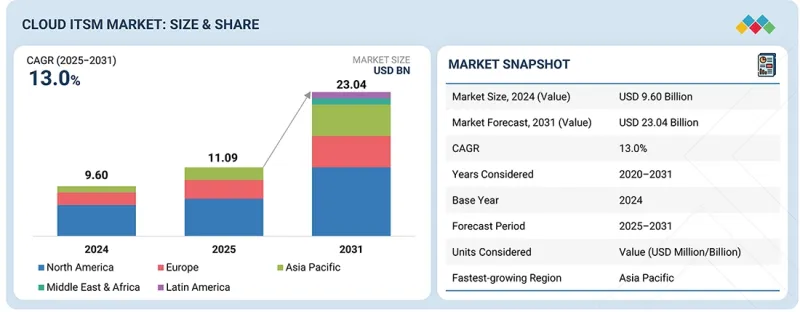
全球云端 ITSM 市场正在快速扩张,预计市场规模将从 2025 年的约 110.9 亿美元成长到 2031 年的 230.4 亿美元,复合年增长率为 13.0%。
全球云端IT服务管理(ITSM)市场持续稳定成长,这主要得益于企业对IT流程自动化、混合办公模式的日益重视以及对标准化和可配置服务管理框架的需求。各组织正在采用云端原生ITSM平台来实现事件管理、问题管理和变更管理的自动化,同时确保在分散式环境中提供集中式且始终在线的服务。
| 调查范围 | |
|---|---|
| 调查期 | 2020-2031 |
| 基准年 | 2024 |
| 预测期 | 2025-2031 |
| 目标单元 | 金额(100万/10亿美元) |
| 部分 | 依产品/服务、解决方案类型、部署模式、组织规模、产业、地区 |
| 目标区域 | 北美洲、欧洲、亚太地区、中东和非洲、拉丁美洲 |
随着服务台日益复杂,数位生态系统不断扩展,对人工智慧驱动的工单路由、工作流程编配和整合配置管理的需求日益增长,旨在提升服务等级协定 (SLA) 合规性和营运效率。然而,受监管产业的资料管治问题阻碍了这一成长,安全性和资料居住要求也延缓了云端采用进程。此外,传统基础设施的整合挑战进一步限制了大规模部署,增加了互通性和迁移成本的压力。儘管存在这些限制,但对自动化、弹性以及统一IT管理的持续关注凸显了云端 ITSM 平台在实现可扩展和标准化数位服务营运方面发挥的关键作用。
IT 和 ITeS 组织在快节奏、以服务等级协定 (SLA)主导的环境中运营,服务可靠性、客户应对力和营运透明度直接影响收入和合约续约。与传统企业不同,IT 和 ITeS 供应商通常管理多客户基础架构、分散式交付中心和复杂的支援模式,因此需要一个标准化且高度可设定的云端 ITSM 平台。基于云端的 IT 服务管理使这些组织能够集中处理跨客户环境的事件回应,全面追踪 SLA,自动化重复性服务工作流程,并为内部团队和外部客户提供即时效能仪表板。 SaaS 交付模式的扩充性使 IT服务供应商能够在保持管治一致性和营运可见度的同时,快速接纳新客户。 2025 年 2 月,Freshworks 与 Unisys 建立了策略合作伙伴关係,旨在透过向中大型企业的 IT 服务团队提供包括 Freshservice 在内的基于云端的 IT 服务管理解决方案,扩大其在託管服务环境中的市场覆盖范围。此次合作显示了云端 ITSM 日益重要的作用,它使 IT服务供应商能够实现支援营运的现代化和高效扩展。对于面向 IT 和 ITeS 组织的供应商和解决方案供应商而言,强调多租户功能、SLA 驱动的自动化和快速客户入职框架,为在服务密集型、效能驱动领域创造持续收入提供了强有力的机会。
实施和整合服务透过将平台功能转化为完全可运行且与企业策略一致的服务环境,为云端 ITSM 部署奠定了基础。这些服务涵盖解决方案架构设计、工作流程配置、服务目录建置、CMDB 建模、从传统 ITSM 工具迁移数据,以及与 ERP、DevOps、身分管理、监控和云端平台的 API 驱动整合。有效的部署可确保与 ITIL 实践、内部管治策略和安全框架保持一致,从而降低部署风险并加快实现可衡量价值的速度。对于在混合云和多重云端环境中运作的公司而言,结构化整合可以消除资料孤岛,提高服务可见性,并实现跨业务功能的统一报告。随着企业对其分散的服务管理环境进行现代化改造,对专业整合技术的需求持续成长。 2024 年 5 月,ServiceNow 扩展了其全球合作伙伴计划,以增强其在企业工作流程部署方面的实施和整合能力,这再次印证了认证交付生态系统在大规模转型中的战略重要性。对于供应商和解决方案供应商,开发产业专用的整合模板、自动化加速器和认证咨询人才,为他们提供了一个在竞争激烈的企业竞标中脱颖而出的明确机会,同时还能建立长期的咨询关係和经常性的业务收益来源。
“北美凭藉其广泛的企业级SaaS应用、先进的AI驱动型服务台自动化以及ITSM平台与DevOps和多重云端管治框架的紧密整合,在云端ITSM市场中处于领先地位。与此同时,亚太地区预计将成为增长最快的地区。”
北美云端IT服务管理(ITSM)市场的发展主要得益于SaaS的高采用率、成熟的IT管理架构以及混合云和多重云端营运模式的普及。美国和加拿大的企业正在管理复杂的数位化环境,这些环境需要符合ITIL标准的流程、严格的服务等级协定(SLA)遵守以及持续的审核准备,从而推动了对具备内建自动化和分析功能的云端原生ITSM平台的需求。为了因应日益复杂的服务以及跨职能依赖关係,各组织正在将ITSM与DevOps、保全行动、终端管理和组态管理资料库(CMDB)系统整合。该地区已建立起一个强大的企业软体供应商、超大规模资料中心业者云端服务商和系统整合商生态系统,以支援大规模部署。主要企业、金融机构、医疗保健机构和公共部门组织的聚集,进一步推动了对标准化服务管治和人工智慧驱动的集中式服务台的需求。这些趋势使北美成为一个成熟的云端ITSM市场,自动化和营运弹性是其核心策略重点。
本报告对云端ITSM市场的主要参与企业进行了调查,并对云端ITSM市场的领先供应商进行了概况介绍。主要市场参与企业包括ServiceNow(美国)、BMC Software(美国)、Broadcom(美国)、ManageEngine(美国)、Ivanti(美国)、Zendesk(美国)、Freshworks(美国)、Atlassian(澳洲)、SolarWinds(美国)、OpenText(加拿大)、NinjaOne(美国)、SymphonyOne(美国) Summit(美国)、Microsoft(美国)、EasyVista(美国)、IFS(瑞典)、GoTo (美国)、Aisera(美国)、Sysaid Technologies(加拿大)、InvGate(美国)、Wolken Software(美国)、AtomicWork(美国)、Mindarray Systems(印度)、IssueTrak(美国)、Viverio(美国)、Evant IMST(美国) Technologies(印度)、Proactivenet(西班牙)、义大利(美国)、Alloy Software(美国)、Provance(加拿大)、ServiceAide(美国)、TeamDynamix(美国)、 Hornbill(英国)、IBM(美国)、Giva (美国)和阿伦巴(苏格兰)。
调查范围
本研究报告从产品/服务、解决方案类型、部署模式、组织规模、产业和地区等维度对云端ITSM市场进行细分。报告详细阐述了影响云端ITSM市场成长的关键因素,包括驱动因素、限制因素、挑战和机会。该报告对主要产业参与企业进行了深入分析,涵盖其业务概况、解决方案、服务、关键策略、协议、合作关係、新产品和服务发布、併购以及与云端ITSM市场相关的最新发展动态。此外,报告也对云端ITSM市场生态系统中新兴的新创Start-Ups进行了竞争分析。
购买本报告的理由
本报告为市场领导和新参与企业提供最准确的云端IT服务管理(ITSM)市场及其细分市场整体收入规模估计值。这有助于相关人员了解竞争格局,更好地定位自身业务,并制定合适的打入市场策略。报告中还深入分析了市场趋势、关键驱动因素和挑战。
本报告深入分析了以下几点:
- 对关键驱动因素(企业对 IT 流程自动化的关注加速了云端 ITSM 的采用;混合工作环境需要阻碍因素式、始终在线的服务管理平台;标准化的 IT 工作流程推动了对可配置云原生 ITSM 解决方案的需求;管治复杂的服务台需要对所有 IT 运营进行智能编配的全面采用)、机会(AI 驱动的事件预测在企业 IT 环境中仍未得到充分利用;集成的 IT 运营数据支持高级分析主导的服务优化;从独立 ITSM 逐步扩展到集成的多域 IT 运营平台;API 优先的 ITSM 平台通过生态系统集成和扩展创造了货币化机会)和挑战(碎片化的内部生态系统阻碍了内部生态系统阻碍了 IT 主动性采用对 ITSM 的内部规划更具支持性;流程的速度)的分析。
- 产品开发/创新:对云端 ITSM 市场的未来技术趋势、研发活动和新产品/服务发布进行详细分析。
- 市场发展:盈利市场的全面资讯-本报告分析了各地区的云端ITSM市场。
- 市场多元化:提供有关云端 ITSM 市场的新产品和服务、未开发的市场、最新趋势和投资的全面资讯。
- 竞争评估 - 主要参与企业: ServiceNow(美国)、BMC Software(美国)、Broadcom(美国)、ManageEngine(美国)、Ivanti(美国)、Zendesk(美国)、Freshworks(美国)、Atlassian(澳洲)、SolarWinds(美国)、OpenText(加拿大)、NinjaOneOne(美国)、澳洲)、SolarWinds(美国)、OpenText(加拿大)、NinjaOneOne(美国)、Syistay) (瑞典)、GoTo(美国)、Aisera(美国)、Sysaid Technologies(加拿大)、InvGate(美国)、Wolken Software(美国)、AtomicWork(美国)、Mindarray Systems(印度)、IssueTrak(美国)、Vivantio(美国)、Everest IMS Technologies Software Software(印度)、IssueTrak(美国)、Vivantio(美国)、Everest IMS Technologies Software Software Software(印度)、Proactive(西班牙)、AProoyance) (美国)、TeamDynamix(美国)、Hornbill(英国)、IBM本报告由美国Giva公司和苏格兰Alemba公司共同撰写,旨在帮助相关人员了解云端IT服务管理(ITSM)市场的趋势,并提供关键市场驱动因素、限制因素、挑战和机会的资讯。
目录
第一章:引言
第二章执行摘要
第三章重要考察
第四章 市场概览
- 市场动态
- 促进因素
- 抑制因子
- 机会
- 任务
- 未满足的需求和差距
- 相互关联的市场与跨产业机会
- 新的经营模式和生态系统的变化
- 参与企业一级/二级/三级市场的策略性倡议
第五章 产业趋势
- 波特五力分析
- 总体经济指标
- 供应链分析
- 生态系分析
- 价格分析
- 2026年重大会议和活动
- 影响客户业务的趋势/颠覆性因素
- 投资和资金筹措场景
- 案例研究分析
- 2025年美国关税的影响 - 云端IT服务管理市场
第六章:透过采用技术、专利、数位化和人工智慧实现策略颠覆
- 技术分析
- 技术/产品蓝图
- 专利分析
- 未来应用
- 人工智慧/生成式人工智慧对云端IT服务管理市场的影响
- 成功案例及其在现实世界中的应用
第七章 监理情势
- 监理情势
- 监管机构、政府机构和其他组织
- 区域产业标准
第八章:顾客趋势与购买行为
- 决策流程
- 买方相关人员和采购评估标准
- 招募障碍和内部挑战
- 各个终端用户产业中尚未满足的需求
- 市场盈利
第九章:云端ITSM市场(依产品/服务分类)
- 解决方案
- 服务
第十章:云端ITSM市场(依解决方案类型划分)
- IT服务台(核心事件/请求处理)
- IT资产管理(ITAM)
- 变更和发布管理
- IT维运管理(ITOM)
- 企业服务管理(ESM)
第十一章:云端ITSM市场(依部署模式划分)
- 公共云端
- 私有云端
- 混合云端
第十二章:云端ITSM市场(依组织规模划分)
- 大公司
- 中型公司
- 小型企业
第十三章:云端ITSM市场(依产业划分)
- BFSI
- 零售和消费品
- 医疗保健和生命科学
- 电讯
- 资讯科技/资讯科技服务
- 媒体与娱乐
- 製造业
- 政府/公共部门
- 能源与公共产业
- 教育
- 其他的
第十四章:云端ITSM市场(依地区划分)
- 北美洲
- 我们
- 加拿大
- 欧洲
- 英国
- 德国
- 法国
- 义大利
- 其他的
- 亚太地区
- 中国
- 印度
- 日本
- 其他的
- 中东和非洲
- 海湾合作委员会国家
- 南非
- 其他的
- 拉丁美洲
- 巴西
- 墨西哥
- 其他的
第十五章 竞争格局
- 主要参与企业的策略/优势,2023-2025年
- 2020-2024年收入分析
- 2024年市占率分析
- 产品对比
- 企业估值矩阵:主要参与企业,2025 年
- 公司估值矩阵:Start-Ups/中小企业,2025 年
- 企业估值和财务指标
- 竞争格局
第十六章:公司简介
- 主要参与企业
- SERVICENOW
- BMC SOFTWARE
- BROADCOM
- MANAGEENGINE
- IVANTI
- ZENDESK
- FRESHWORKS
- ATLASSIAN
- SOLARWINDS
- OPENTEXT
- 其他公司
- NINJAONE
- SYMPHONYAI SUMMIT
- MICROSOFT
- EASYVISTA
- IFS
- GOTO
- AISERA
- SYSAID TECHNOLOGIES
- INVGATE
- WOLKEN SOFTWARE
- ATOMICWORK
- MINDARRAY SYSTEMS
- ISSUETRAK
- VIVANTIO
- EVEREST IMS TECHNOLOGIES
- PROACTIVENET
- ITARIAN
- ALLOY SOFTWARE
- PROVANCE
- SERVICEAIDE
- TEAMDYNAMIX
- HORNBILL
- IBM
- GIVA
- ALEMBA
第十七章调查方法
第十八章附录
The global cloud ITSM market is expanding rapidly, with a projected market size rising from about USD 11.09 billion in 2025 to USD 23.04 billion by 2031, for a CAGR of 13.0%. The global cloud ITSM market is expanding steadily, driven by enterprise focus on IT process automation, hybrid workforce enablement, and the need for standardized, configurable service management frameworks. Organizations are adopting cloud-native ITSM platforms to automate incident, problem, and change management while ensuring centralized, always-accessible service delivery across distributed environments.
| Scope of the Report | |
|---|---|
| Years Considered for the Study | 2020-2031 |
| Base Year | 2024 |
| Forecast Period | 2025-2031 |
| Units Considered | Value (USD Million/Billion) |
| Segments | Offering, Solution Type, Deployment Mode, Organization Size, Vertical |
| Regions covered | North America, Europe, Asia Pacific, Middle East & Africa, Latin America |
Rising service desk complexity and expanding digital ecosystems are accelerating demand for AI-driven ticket routing, workflow orchestration, and integrated configuration management to improve SLA adherence and operational efficiency. However, growth is restrained by data governance concerns in regulated industries, where security and residency requirements slow cloud adoption. Legacy infrastructure integration challenges further limit full-scale deployment, creating pressures on interoperability and transition costs. Despite these restraints, the continued emphasis on automation, resilience, and unified IT governance underscores the critical role of cloud ITSM platforms in enabling scalable, standardized digital service operations.
"By vertical, IT & ITeS is estimated to witness the fastest growth rate during the forecast period."
IT and ITeS organizations operate in high-velocity, SLA driven environments where service reliability, client responsiveness, and operational transparency directly influence revenue and contract retention. Unlike traditional enterprises, IT and ITeS providers often manage multi-client infrastructures, distributed delivery centers, and complex support models that require standardized yet highly configurable cloud ITSM platforms. Cloud-based IT Service Management enables these organizations to centralize incident handling across client environments, enforce SLA tracking, automate repetitive service workflows, and provide real-time performance dashboards to both internal teams and external customers. The scalability of SaaS delivery models allows IT service providers to onboard new clients rapidly while maintaining governance consistency and operational visibility. In February 2025, Freshworks entered a strategic relationship with Unisys to deliver cloud-based IT service management solutions, including Freshservice, to mid-market and enterprise IT service teams, strengthening go-to-market reach within managed service environments. This collaboration highlights the growing role of cloud ITSM in enabling IT service providers to modernize support operations and scale efficiently. For vendors and solution providers targeting IT and ITeS organizations, emphasizing multi-tenant capabilities, SLA driven automation, and rapid client onboarding frameworks presents a strong opportunity to capture recurring revenue in a services-intensive, performance-driven vertical.
"By professional services, implementation & integration services to hold the largest market share during the forecast period."
Implementation and integration services form the execution backbone of cloud ITSM deployments by converting platform capabilities into fully operational, enterprise-aligned service environments. These services cover solution architecture design, workflow configuration, service catalog structuring, CMDB modeling, data migration from legacy ITSM tools, and API driven integrations with ERP, DevOps, identity management, monitoring, and cloud platforms. Effective implementation ensures alignment with Information Technology Infrastructure Library (ITIL) practices, internal governance policies, and security frameworks, reducing deployment risk and accelerating measurable time-to-value. For enterprises operating across hybrid and multi-cloud ecosystems, structured integration eliminates data silos, improves service visibility, and enables unified reporting across business functions. Demand for specialized integration expertise continues to expand as organizations modernize fragmented service management estates. In May 2024, ServiceNow expanded its global partner program to strengthen implementation and integration capabilities for enterprise workflow deployments, reinforcing the strategic importance of certified delivery ecosystems in large-scale transformations. For vendors and solution providers, developing industry-specific integration templates, automation accelerators, and certified consulting talent presents a clear opportunity to differentiate in competitive enterprise bids while establishing long-term advisory relationships and recurring services revenue streams.
"North America leads the cloud ITSM market with widespread enterprise SaaS adoption, advanced AI-driven service desk automation, and strong integration of ITSM platforms with DevOps and multi-cloud governance frameworks, while Asia Pacific is set to be the fastest-growing region."
The cloud ITSM market in North America is driven by high SaaS adoption, mature IT governance frameworks, and widespread use of hybrid and multi-cloud operating models. Enterprises across the United States and Canada manage complex digital environments that require ITIL-aligned workflows, strict SLA compliance, and continuous audit-readiness, driving demand for cloud-native ITSM platforms with embedded automation and analytics. Organizations are integrating ITSM with DevOps, security operations, endpoint management, and CMDB systems to address rising service complexity and cross-functional dependencies. The region benefits from a strong ecosystem of enterprise software vendors, hyperscalers, and system integrators that support large-scale deployments. Concentration of major enterprises, financial institutions, healthcare providers, and public sector agencies further drives demand for standardized service governance and centralized, AI-enabled service desks. These dynamics position North America as a mature cloud ITSM market where automation and operational resilience are core strategic priorities.
Breakdown of Primaries
In-depth interviews were conducted with Chief Executive Officers (CEOs), innovation and technology directors, system integrators, and executives from various key organizations operating in the cloud ITSM market.
- By Company: Tier 1 - 35%, Tier 2 - 45%, and Tier 3 - 20%
- By Designation: Directors - 35%, Managers - 25%, and others - 40%
- By Region: North America - 35%, Europe - 15%, Asia Pacific - 40%, Middle East & Africa - 5%, and Latin America - 5%
The report includes a study of key players in the cloud ITSM market. It profiles major vendors in the cloud ITSM market. The major market players include ServiceNow (US), BMC Software (US), Broadcom (US), ManageEngine (US), Ivanti (US), Zendesk (US), Freshworks (US), Atlassian (Australia), SolarWinds (US), OpenText (Canada), NinjaOne (US), SymphonyAI Summit (US), Microsoft (US), EasyVista (US), IFS (Sweden), GoTo (US), Aisera (US), Sysaid Technologies (Canada), InvGate (US), Wolken Software (US), AtomicWork (US), Mindarray Systems (India), IssueTrak (US), Vivantio (US), Everest IMS Technologies (India), Proactivenet (Spain), Itarian (US), Alloy Software (US), Provance (Canada), ServiceAide (US), TeamDynamix (US), Hornbill (UK), IBM (US), Giva (US), and Alemba (Scotland).
Research Coverage
This research report categorizes the cloud ITSM market based on offering (solutions, services [professional services (implementation & integration, training & consultation, support & maintenance), managed services]), solution type (IT service desk, IT Asset Management, Change & Release Management, IT Operations Management, Enterprise Service Management), deployment mode (public cloud, private cloud, hybrid cloud), organization size (large enterprises, mid enterprises, small enterprises), vertical (BFSI, Retail & Consumer Goods, Healthcare & life sciences, Telecommunications, It & ITeS, Media & Entertainment, Manufacturing, Government & Public Sector, Energy & Utilities, Education, other verticals [travel & hospitality, and transportation & logistics]) and Region (North America, Europe, Asia Pacific, Middle East & Africa, and Latin America). The report's scope covers detailed information regarding the major factors, such as drivers, restraints, challenges, and opportunities, influencing the growth of the cloud ITSM market. A detailed analysis of the key industry players was done to provide insights into their business overview, solutions, and services; key strategies; contracts, partnerships, agreements, new product & service launches, and mergers and acquisitions; and recent developments associated with the cloud ITSM market. This report also covers the competitive analysis of upcoming startups in the cloud ITSM market ecosystem.
Reason to buy this report
The report would provide market leaders and new entrants with information on the closest approximations of the revenue numbers for the overall cloud ITSM market and its subsegments. It would help stakeholders understand the competitive landscape and gain more insights to better position their businesses and plan suitable go-to-market strategies. It also helps stakeholders understand the market's pulse and provides them with information on key market drivers, restraints, challenges, and opportunities.
The report provides insights into the following pointers:
- Analysis of key drivers (enterprise focus on IT process automation accelerates cloud ITSM adoption, hybrid work environments require centralized, always-accessible service management platforms, standardized IT workflows drive demand for configurable cloud-native ITSM solutions, increasing service desk complexity necessitates intelligent orchestration across IT operations), restraints (data governance concerns slow cloud ITSM adoption in regulated industries, legacy infrastructure integration complexity limits full cloud ITSM deployment), opportunities (AI-driven incident prediction remains underutilized across enterprise IT environments, unified IT operations data enables advanced analytics-led service optimization, progressive expansion from standalone ITSM into integrated, multi-domain IT operations platforms, API-first ITSM platforms create monetization opportunities through ecosystem integrations and extensions), and challenges (fragmented tooling ecosystems hinder end-to-end IT service visibility, change management resistance delays organizational adoption of automated ITSM processes)
- Product Development/Innovation: Detailed insights on upcoming technologies, research & development activities, and new product & service launches in the cloud ITSM market
- Market Development: Comprehensive information about lucrative markets - the report analyses the cloud ITSM market across varied regions
- Market Diversification: Exhaustive information about new products & services, untapped geographies, recent developments, and investments in the cloud ITSM market
- Competitive Assessment: In-depth assessment of market shares, growth strategies and service offerings of leading players such as ServiceNow (US), BMC Software (US), Broadcom (US), ManageEngine (US), Ivanti (US), Zendesk (US), Freshworks (US), Atlassian (Australia), SolarWinds (US), OpenText (Canada), NinjaOne (US), SymphonyAI Summit (US), Microsoft (US), EasyVista (US), IFS (Sweden), GoTo (US), Aisera (US), Sysaid Technologies (Canada), InvGate (US), Wolken Software (US), AtomicWork (US), Mindarray Systems (India), IssueTrak (US), Vivantio (US), Everest IMS Technologies (India), Proactivenet (Spain), Itarian (US), Alloy Software (US), Provance (Canada), ServiceAide (US), TeamDynamix (US), Hornbill (UK), IBM (US), Giva (US), Alemba (Scotland). The report also helps stakeholders understand the cloud ITSM market's pulse and provides information on key market drivers, restraints, challenges, and opportunities
TABLE OF CONTENTS
1 INTRODUCTION
- 1.1 STUDY OBJECTIVES
- 1.2 MARKET DEFINITION
- 1.3 MARKET SCOPE
- 1.3.1 MARKET SEGMENTATION AND REGIONAL SCOPE
- 1.3.2 INCLUSIONS AND EXCLUSIONS
- 1.3.3 YEARS CONSIDERED
- 1.4 CURRENCY CONSIDERED
- 1.5 LIMITATIONS
- 1.6 STAKEHOLDERS
- 1.7 SUMMARY OF CHANGES
2 EXECUTIVE SUMMARY
- 2.1 MARKET HIGHLIGHTS AND KEY INSIGHTS
- 2.2 KEY MARKET PARTICIPANTS: MAPPING OF STRATEGIC DEVELOPMENTS
- 2.3 DISRUPTIVE TRENDS IN CLOUD ITSM MARKET
- 2.4 HIGH-GROWTH SEGMENTS
- 2.5 REGIONAL SNAPSHOT: MARKET SIZE, GROWTH RATE, AND FORECAST
3 PREMIUM INSIGHTS
- 3.1 ATTRACTIVE OPPORTUNITIES FOR PLAYERS IN CLOUD ITSM MARKET
- 3.2 CLOUD ITSM MARKET, BY OFFERING
- 3.3 CLOUD ITSM MARKET, BY SOLUTION TYPE
- 3.4 CLOUD ITSM MARKET, BY DEPLOYMENT MODE
- 3.5 CLOUD ITSM MARKET, BY ORGANIZATION SIZE
- 3.6 CLOUD ITSM MARKET, BY VERTICAL
- 3.7 CLOUD ITSM MARKET, BY REGION
4 MARKET OVERVIEW
- 4.1 INTRODUCTION
- 4.2 MARKET DYNAMICS
- 4.2.1 DRIVERS
- 4.2.1.1 Enterprise focus on IT process automation accelerates cloud ITSM adoption
- 4.2.1.2 Hybrid work environments require centralized, always-accessible service management platforms
- 4.2.1.3 Standardized IT workflows drive demand for configurable cloud-native ITSM solutions
- 4.2.1.4 Increasing service desk complexity necessitates intelligent orchestration across IT operations
- 4.2.2 RESTRAINTS
- 4.2.2.1 Data governance concerns slow cloud ITSM adoption in regulated industries
- 4.2.2.2 Legacy infrastructure integration complexity limits full cloud ITSM deployment
- 4.2.3 OPPORTUNITIES
- 4.2.3.1 AI-driven incident prediction remains underutilized across enterprise IT environments
- 4.2.3.2 Unified IT operations data enables advanced analytics-led service optimization
- 4.2.3.3 Progressive expansion from standalone ITSM into integrated, multi-domain IT operations platforms
- 4.2.3.4 API-first ITSM platforms create monetization opportunities through ecosystem integrations and extensions
- 4.2.4 CHALLENGES
- 4.2.4.1 Fragmented tooling ecosystems hinder end-to-end IT service visibility
- 4.2.4.2 Change management resistance delays organizational adoption of automated ITSM processes
- 4.2.1 DRIVERS
- 4.3 UNMET NEEDS AND WHITE SPACES
- 4.3.1 UNMET NEEDS IN CLOUD ITSM MARKET
- 4.3.2 WHITE SPACE OPPORTUNITIES
- 4.4 INTERCONNECTED MARKETS AND CROSS-SECTOR OPPORTUNITIES
- 4.4.1 INTERCONNECTED MARKETS
- 4.4.2 CROSS-SECTOR OPPORTUNITIES
- 4.5 EMERGING BUSINESS MODELS AND ECOSYSTEM SHIFTS
- 4.5.1 EMERGING BUSINESS MODELS
- 4.5.1.1 Cloud ITSM business models
- 4.5.2 ECOSYSTEM SHIFTS
- 4.5.1 EMERGING BUSINESS MODELS
- 4.6 STRATEGIC MOVES BY TIER-1/2/3 PLAYERS
- 4.6.1 KEY MOVES AND STRATEGIC FOCUS
5 INDUSTRY TRENDS
- 5.1 PORTER'S FIVE FORCES ANALYSIS
- 5.1.1 THREAT OF NEW ENTRANTS
- 5.1.2 THREAT OF SUBSTITUTES
- 5.1.3 BARGAINING POWER OF SUPPLIERS
- 5.1.4 BARGAINING POWER OF BUYERS
- 5.1.5 INTENSITY OF COMPETITIVE RIVALRY
- 5.2 MACROECONOMIC INDICATORS
- 5.2.1 INTRODUCTION
- 5.2.2 GDP TRENDS & FORECASTS
- 5.2.3 TRENDS IN GLOBAL ICT INDUSTRY
- 5.2.4 TRENDS IN GLOBAL CLOUD PROFESSIONAL INDUSTRY
- 5.3 SUPPLY CHAIN ANALYSIS
- 5.4 ECOSYSTEM ANALYSIS
- 5.5 PRICING ANALYSIS
- 5.5.1 AVERAGE SELLING PRICE, BY SOLUTION TYPE, 2025 (USD)
- 5.5.2 INDICATIVE PRICING ANALYSIS OF PRODUCTS, BY VENDOR, 2025
- 5.6 KEY CONFERENCES AND EVENTS, 2026
- 5.7 TRENDS/DISRUPTIONS IMPACTING CUSTOMER BUSINESS
- 5.8 INVESTMENT AND FUNDING SCENARIO
- 5.9 CASE STUDY ANALYSIS
- 5.9.1 ALGAR TECH IMPROVED ITS IT SERVICE MANAGEMENT USING BROADCOM SOLUTIONS
- 5.9.2 GRUPO MOURA USED BMC HELIX TO DRIVE OPTIMAL USER EXPERIENCES
- 5.9.3 DEUTSCHE TELEKOM MEETS DEMAND FOR IT EFFICIENCY WITH SERVICENOW ITSM
- 5.9.4 OPENTEXT'S SMAX SAAS CREATED ROBUST & SCALABLE ITSM SOLUTION, IMPROVING USER EFFICIENCY FOR ZURICH AIRPORT
- 5.9.5 FRESHWORKS' STREAMLINED, CLOUD-BASED SUPPORT PLATFORM TRANSFORMED USERS' RELATIONSHIP TO IT FOR ELSEVIER
- 5.10 IMPACT OF 2025 US TARIFF - CLOUD ITSM MARKET
- 5.10.1 INTRODUCTION
- 5.10.2 KEY TARIFF RATES
- 5.10.3 PRICE IMPACT ANALYSIS
- 5.10.4 IMPACT ON COUNTRY/REGION
- 5.10.4.1 US
- 5.10.4.2 Europe
- 5.10.4.3 Asia Pacific
- 5.10.5 IMPACT ON VERTICALS
- 5.10.5.1 BFSI
- 5.10.5.2 Telecommunications
- 5.10.5.3 Energy & utilities
- 5.10.5.4 IT & ITeS
- 5.10.5.5 Media & entertainment
- 5.10.5.6 Manufacturing
- 5.10.5.7 Government & public sector
- 5.10.5.8 Retail & consumer goods
- 5.10.5.9 Healthcare & life sciences
6 STRATEGIC DISRUPTION THROUGH TECHNOLOGY, PATENTS, DIGITAL, AND AI ADOPTION
- 6.1 TECHNOLOGY ANALYSIS
- 6.1.1 KEY EMERGING TECHNOLOGIES
- 6.1.1.1 Intelligent automation and event correlation
- 6.1.1.2 Cloud-native microservices architecture
- 6.1.1.3 Low-code workflow orchestration engines
- 6.1.2 COMPLEMENTARY TECHNOLOGIES
- 6.1.2.1 Cloud discovery and dynamic CMDB synchronization
- 6.1.2.2 iPaaS and API integration frameworks
- 6.1.2.3 FinOps platforms and cloud cost governance
- 6.1.3 ADJACENT TECHNOLOGIES
- 6.1.3.1 Digital experience monitoring systems
- 6.1.3.2 DevOps and SRE toolchains
- 6.1.1 KEY EMERGING TECHNOLOGIES
- 6.2 TECHNOLOGY/PRODUCT ROADMAP
- 6.2.1 SHORT-TERM (2026-2028) | MODULARIZATION, AUTOMATION & INTEGRATION
- 6.2.2 MID-TERM (2028-2031) | ORCHESTRATION, COST GOVERNANCE, EXTENDED OPERATIONS
- 6.2.3 LONG-TERM (2031-2035+) | INTELLIGENT OPERATIONS, AUTONOMY & ENTERPRISE CONTROL PLANE
- 6.3 PATENT ANALYSIS
- 6.4 FUTURE APPLICATIONS
- 6.4.1 AUTONOMOUS SERVICE ORCHESTRATION AND SELF-HEALING CLOUD OPERATIONS
- 6.4.2 ITSM-LED UNIFIED OBSERVABILITY AND INCIDENT INTELLIGENCE
- 6.4.3 EXPERIENCE-DRIVEN DIGITAL EMPLOYEE SERVICE MANAGEMENT
- 6.4.4 ENTERPRISE SERVICE MANAGEMENT AS CLOUD WORKFLOW BACKBONE
- 6.4.5 FINOPS-INTEGRATED CLOUD ITSM AND ITAM GOVERNANCE
- 6.5 IMPACT OF AI/GENERATIVE AI ON CLOUD ITSM MARKET
- 6.5.1 TOP USE CASES AND MARKET POTENTIAL
- 6.5.2 BEST PRACTICES IN CLOUD ITSM
- 6.5.3 CASE STUDY OF AI IMPLEMENTATION IN CLOUD ITSM MARKET
- 6.5.3.1 Mears Group and ServiceNow revolutionize employee experience with GenAI-powered Now Assist platform
- 6.5.4 INTERCONNECTED ADJACENCY ECOSYSTEM AND IMPACT ON MARKET PLAYERS
- 6.5.5 CLIENT READINESS TO ADOPT GENERATIVE AI IN CLOUD ITSM MARKET
- 6.6 SUCCESS STORIES AND REAL-WORLD APPLICATIONS
- 6.6.1 SERVICENOW: NOW ASSIST FOR ITSM
- 6.6.2 BMC SOFTWARE: HELIXGPT FOR ITSM
7 REGULATORY LANDSCAPE
- 7.1 REGULATORY LANDSCAPE
- 7.1.1 REGULATORY BODIES, GOVERNMENT AGENCIES, AND OTHER ORGANIZATIONS
- 7.1.2 INDUSTRY STANDARDS, BY REGION
- 7.1.2.1 North America
- 7.1.2.2 Europe
- 7.1.2.3 Asia Pacific
- 7.1.2.4 Middle East & South Africa
- 7.1.2.5 Latin America
8 CUSTOMER LANDSCAPE AND BUYER BEHAVIOR
- 8.1 DECISION-MAKING PROCESS
- 8.2 BUYER STAKEHOLDERS AND BUYING EVALUATION CRITERIA
- 8.2.1 KEY STAKEHOLDERS IN BUYING PROCESS
- 8.2.2 BUYING CRITERIA
- 8.3 ADOPTION BARRIERS AND INTERNAL CHALLENGES
- 8.4 UNMET NEEDS IN VARIOUS END-USER INDUSTRIES
- 8.5 MARKET PROFITABILITY
- 8.5.1 REVENUE POTENTIAL
- 8.5.2 COST DYNAMICS
- 8.5.3 MARGIN OPPORTUNITIES IN KEY APPLICATIONS
9 CLOUD ITSM MARKET, BY OFFERING
- 9.1 INTRODUCTION
- 9.1.1 OFFERING: CLOUD ITSM MARKET DRIVERS
- 9.2 SOLUTIONS
- 9.2.1 ENABLING AUTOMATED SERVICE DELIVERY, OPERATIONAL GOVERNANCE, AND ENTERPRISE-WIDE DIGITAL WORKFLOW STANDARDIZATION
- 9.3 SERVICES
- 9.3.1 EMERGING AS STRATEGIC ENABLERS OF PLATFORM OPTIMIZATION, GOVERNED DEPLOYMENT, AND RECURRING VALUE REALIZATION
- 9.3.2 PROFESSIONAL SERVICES
- 9.3.2.1 Driving structured implementation, process maturity, and long-term platform value optimization
- 9.3.2.2 Implementation & integration services
- 9.3.2.3 Training & consultation
- 9.3.2.4 Support & maintenance
- 9.3.3 MANAGED SERVICES
- 9.3.3.1 Transforming cloud ITSM through continuous governance, automation optimization, and outcome-based operational ownership
10 CLOUD ITSM MARKET, BY SOLUTION TYPE
- 10.1 INTRODUCTION
- 10.1.1 SOLUTION TYPE: CLOUD ITSM MARKET DRIVERS
- 10.2 IT SERVICE DESK (CORE INCIDENT/REQUEST HANDLING)
- 10.2.1 REDEFINING ENTERPRISE SUPPORT THROUGH AUTOMATION, UNIFIED WORKFLOWS, AND EXPERIENCE-DRIVEN INCIDENT MANAGEMENT
- 10.2.2 INCIDENT & PROBLEM MANAGEMENT
- 10.2.3 SELF-SERVICE PORTALS AND KNOWLEDGE BASE
- 10.2.4 OMNICHANNEL TICKETING (EMAIL, CHAT, MOBILE)
- 10.3 IT ASSET MANAGEMENT (ITAM)
- 10.3.1 STRENGTHENING COST GOVERNANCE, LIFECYCLE VISIBILITY, AND COMPLIANCE CONTROL ACROSS CLOUD-DRIVEN ENTERPRISES
- 10.3.2 CMBD & CONFIGURATION TACKING
- 10.3.3 LIFECYCLE & LICENSE OPTIMIZATION
- 10.3.4 HARDWARE/SOFTWARE DISCOVERY
- 10.4 CHANGE & RELEASE MANAGEMENT
- 10.4.1 STRENGTHENING GOVERNED DEPLOYMENT, COMPLIANCE ASSURANCE, AND DEVOPS-ALIGNED SERVICE RESILIENCE
- 10.4.2 WORKFLOW AUTOMATION & APPROVALS
- 10.4.3 RISK ASSESSMENT & ROLLBACK
- 10.4.4 COMPLIANCE REPORTING
- 10.5 IT OPERATIONS MANAGEMENT (ITOM)
- 10.5.1 ADVANCING AI-DRIVEN OBSERVABILITY, PROACTIVE REMEDIATION, AND RESILIENT HYBRID CLOUD PERFORMANCE MANAGEMENT
- 10.5.2 MONITORING & ALERTING
- 10.5.3 EVENT CORRELATION & ANALYTICS
- 10.5.4 PREDICTIVE MAINTENANCE
- 10.6 ENTERPRISE SERVICE MANAGEMENT (ESM)
- 10.6.1 WORKLOAD OPTIMIZATION AND MANAGEMENT ALIGN CLOUD PERFORMANCE REQUIREMENTS WITH CONTINUOUS COST EFFICIENCY
- 10.6.2 HR SERVICE DELIVERY
- 10.6.3 FACILITIES & FINANCE WORKFLOWS
- 10.6.4 CUSTOM DEPARTMENTAL APPS
11 CLOUD ITSM MARKET, BY DEPLOYMENT MODE
- 11.1 INTRODUCTION
- 11.1.1 DEPLOYMENT MODE: CLOUD ITSM MARKET DRIVERS
- 11.2 PUBLIC CLOUD
- 11.2.1 ACCELERATING SCALABLE SAAS-BASED CLOUD ITSM ADOPTION THROUGH HYPERSCALER PARTNERSHIPS AND CLOUD NATIVE INNOVATION
- 11.3 PRIVATE CLOUD
- 11.3.1 ENABLING GOVERNANCE-DRIVEN CLOUD ITSM ADOPTION THROUGH CONTROLLED INFRASTRUCTURE AND COMPLIANCE-ALIGNED ARCHITECTURES
- 11.4 HYBRID CLOUD
- 11.4.1 ENABLING UNIFIED GOVERNANCE AND WORKLOAD PORTABILITY ACROSS DISTRIBUTED CLOUD ITSM ENVIRONMENTS
12 CLOUD ITSM MARKET, BY ORGANIZATION SIZE
- 12.1 INTRODUCTION
- 12.1.1 ORGANIZATION SIZE: CLOUD ITSM MARKET DRIVERS
- 12.2 LARGE ENTERPRISES
- 12.2.1 DRIVING ADOPTION THROUGH SCALE, GOVERNANCE COMPLEXITY, AND AI-ENABLED ENTERPRISE-WIDE SERVICE ORCHESTRATION
- 12.3 MID-SIZED ENTERPRISES
- 12.3.1 ACCELERATING CLOUD ITSM ADOPTION THROUGH SCALABLE AUTOMATION AND GROWTH-ALIGNED SERVICE GOVERNANCE
- 12.4 SMALL ENTERPRISES
- 12.4.1 FUELING ADOPTION THROUGH RAPID SAAS DEPLOYMENT, LOW-CODE AUTOMATION, AND AI-ENABLED SERVICE OPTIMIZATION
13 CLOUD ITSM MARKET, BY VERTICAL
- 13.1 INTRODUCTION
- 13.1.1 VERTICAL: CLOUD ITSM MARKET DRIVERS
- 13.2 BFSI
- 13.2.1 ADVANCING SECURE, COMPLIANCE-DRIVEN CLOUD ITSM ADOPTION TO STRENGTHEN OPERATIONAL RESILIENCE AND DIGITAL BANKING CONTINUITY
- 13.3 RETAIL & CONSUMER GOODS
- 13.3.1 LEVERAGING CLOUD ITSM TO PROTECT REVENUE, STANDARDIZE STORE OPERATIONS, AND ENABLE RESILIENT OMNICHANNEL SERVICE DELIVERY
- 13.4 HEALTHCARE & LIFE SCIENCES
- 13.4.1 ADOPTING SECURE, COMPLIANCE-DRIVEN CLOUD ITSM TO SAFEGUARD CLINICAL CONTINUITY AND PROTECT PATIENT DATA
- 13.5 TELECOMMUNICATIONS
- 13.5.1 LEVERAGING CLOUD ITSM TO STRENGTHEN NETWORK RESILIENCE, AUTOMATE SERVICE OPERATIONS, AND MEET STRINGENT SLA DEMANDS
- 13.6 IT & ITES
- 13.6.1 ADOPTING CLOUD ITSM TO ENABLE SCALABLE CLIENT DELIVERY, SLA DRIVEN AUTOMATION, AND MULTI-TENANT SERVICE GOVERNANCE
- 13.7 MEDIA & ENTERTAINMENT
- 13.7.1 LEVERAGING CLOUD ITSM TO ENHANCE CONTENT DELIVERY RESILIENCE AND OPTIMIZE HIGH VOLUME DIGITAL SERVICE OPERATIONS
- 13.8 MANUFACTURING
- 13.8.1 ADOPTING CLOUD ITSM TO SAFEGUARD PRODUCTION UPTIME AND UNIFY IT AND OPERATIONAL SERVICE WORKFLOWS
- 13.9 GOVERNMENT & PUBLIC SECTOR
- 13.9.1 DRIVING CLOUD ITSM ADOPTION TO MODERNIZE CITIZEN SERVICES AND STRENGTHEN COMPLIANCE-DRIVEN DIGITAL GOVERNANCE
- 13.10 ENERGY & UTILITIES
- 13.10.1 LEVERAGING CLOUD ITSM TO STRENGTHEN GRID RESILIENCE AND MODERNIZE OUTAGE AND ASSET GOVERNANCE WORKFLOWS
- 13.11 EDUCATION
- 13.11.1 USING CLOUD ITSM TO MODERNIZE CAMPUS OPERATIONS AND ENHANCE STUDENT-CENTRIC DIGITAL SERVICE DELIVERY
- 13.12 OTHER VERTICALS
14 CLOUD ITSM MARKET, BY REGION
- 14.1 INTRODUCTION
- 14.2 NORTH AMERICA
- 14.2.1 US
- 14.2.1.1 Accelerating enterprise and federal cloud ITSM adoption through AI-driven automation and compliance-ready platforms in US
- 14.2.2 CANADA
- 14.2.2.1 Strengthening secure and compliant cloud ITSM adoption through carrier-led transformation and public sector modernization in Canada
- 14.2.1 US
- 14.3 EUROPE
- 14.3.1 UK
- 14.3.1.1 Advancing AI-enabled and compliance-ready cloud ITSM adoption across regulated and public sector enterprises in UK
- 14.3.2 GERMANY
- 14.3.2.1 Enabling sovereign and industry integrated cloud ITSM adoption across manufacturing-led enterprises in Germany
- 14.3.3 FRANCE
- 14.3.3.1 Driving secure and AI-enabled cloud ITSM adoption aligned with GDPR and sovereign cloud priorities in France
- 14.3.4 ITALY
- 14.3.4.1 Strengthening cyber resilience and OT integrated cloud ITSM adoption across manufacturing-driven enterprises in Italy
- 14.3.5 REST OF EUROPE
- 14.3.1 UK
- 14.4 ASIA PACIFIC
- 14.4.1 CHINA
- 14.4.1.1 Advancing localized and automation-driven cloud ITSM adoption across large-scale enterprise environments in China
- 14.4.2 INDIA
- 14.4.2.1 Accelerating AI-enabled and scalable cloud ITSM adoption across enterprise and public sector digital transformation in India
- 14.4.3 JAPAN
- 14.4.3.1 Strengthening automation-driven and governance-focused cloud ITSM adoption across enterprise IT environments in Japan
- 14.4.4 REST OF ASIA PACIFIC
- 14.4.1 CHINA
- 14.5 MIDDLE EAST & AFRICA
- 14.5.1 GCC COUNTRIES
- 14.5.1.1 Saudi Arabia
- 14.5.1.1.1 Accelerating sovereign and automation-driven cloud ITSM adoption across government and enterprise digital transformation in Saudi Arabia
- 14.5.1.2 UAE
- 14.5.1.2.1 Scaling secure and automation-driven cloud ITSM adoption across government and enterprise digital transformation in UAE
- 14.5.1.3 Other GCC countries
- 14.5.1.1 Saudi Arabia
- 14.5.2 SOUTH AFRICA
- 14.5.2.1 South Africa workforce management market advancing through HR digitalization compliance alignment and data-driven workforce analytics
- 14.5.3 REST OF MIDDLE EAST & AFRICA
- 14.5.1 GCC COUNTRIES
- 14.6 LATIN AMERICA
- 14.6.1 BRAZIL
- 14.6.1.1 Cloud ITSM adoption in Brazil shaped by data residency requirements, enterprise scale, and partner-led digital transformation
- 14.6.2 MEXICO
- 14.6.2.1 Cloud ITSM adoption in Mexico shaped by enterprise digitalization, bilingual service delivery, and partner-led cloud enablement
- 14.6.3 REST OF LATIN AMERICA
- 14.6.1 BRAZIL
15 COMPETITIVE LANDSCAPE
- 15.1 INTRODUCTION
- 15.2 KEY PLAYER STRATEGIES/RIGHT TO WIN, 2023-2025
- 15.3 REVENUE ANALYSIS, 2020-2024
- 15.4 MARKET SHARE ANALYSIS, 2024
- 15.5 PRODUCT COMPARISON
- 15.5.1 SERVICENOW
- 15.5.2 BMC SOFTWARE
- 15.5.3 BROADCOM
- 15.5.4 MANAGEENGINE
- 15.5.5 IVANTI
- 15.6 COMPANY EVALUATION MATRIX: KEY PLAYERS, 2025
- 15.6.1 STARS
- 15.6.2 EMERGING LEADERS
- 15.6.3 PERVASIVE PLAYERS
- 15.6.4 PARTICIPANTS
- 15.6.5 COMPANY FOOTPRINT: KEY PLAYERS, 2025
- 15.6.5.1 Company footprint
- 15.6.5.2 Regional footprint
- 15.6.5.3 Solution type footprint
- 15.6.5.4 Vertical footprint
- 15.7 COMPANY EVALUATION MATRIX: STARTUPS/SMES, 2025
- 15.7.1 PROGRESSIVE COMPANIES
- 15.7.2 RESPONSIVE COMPANIES
- 15.7.3 DYNAMIC COMPANIES
- 15.7.4 STARTING BLOCKS
- 15.7.5 COMPETITIVE BENCHMARKING: STARTUP/SMES, 2025
- 15.7.5.1 Detailed list of key startups/SMEs
- 15.7.5.2 Competitive benchmarking of key startups/SMEs
- 15.8 COMPANY VALUATION AND FINANCIAL METRICS
- 15.8.1 COMPANY VALUATION OF KEY VENDORS
- 15.8.2 FINANCIAL METRICS OF KEY VENDORS
- 15.9 COMPETITIVE SCENARIO
- 15.9.1 PRODUCT LAUNCHES/ENHANCEMENTS
- 15.9.2 DEALS
16 COMPANY PROFILES
- 16.1 INTRODUCTION
- 16.2 MAJOR PLAYERS
- 16.2.1 SERVICENOW
- 16.2.1.1 Business overview
- 16.2.1.2 Products/Solutions/Services offered
- 16.2.1.3 Recent developments
- 16.2.1.3.1 Product launches and enhancements
- 16.2.1.3.2 Deals
- 16.2.1.4 MnM view
- 16.2.1.4.1 Right to win
- 16.2.1.4.2 Strategic choices
- 16.2.1.4.3 Weaknesses and competitive threats
- 16.2.2 BMC SOFTWARE
- 16.2.2.1 Business overview
- 16.2.2.2 Products/Solutions/Services offered
- 16.2.2.3 Recent developments
- 16.2.2.3.1 Product launches and enhancements
- 16.2.2.3.2 Deals
- 16.2.2.4 MnM view
- 16.2.2.4.1 Right to win
- 16.2.2.4.2 Strategic choices
- 16.2.2.4.3 Weaknesses and competitive threats
- 16.2.3 BROADCOM
- 16.2.3.1 Business overview
- 16.2.3.2 Products/Solutions/Services offered
- 16.2.3.3 Recent developments
- 16.2.3.3.1 Product launches and enhancements
- 16.2.3.4 MnM view
- 16.2.3.4.1 Right to win
- 16.2.3.4.2 Strategic choices
- 16.2.3.4.3 Weaknesses and competitive threats
- 16.2.4 MANAGEENGINE
- 16.2.4.1 Business overview
- 16.2.4.2 Products/Solutions/Services offered
- 16.2.4.3 Recent developments
- 16.2.4.3.1 Product launches and enhancements
- 16.2.4.3.2 Deals
- 16.2.4.4 MnM view
- 16.2.4.4.1 Right to win
- 16.2.4.4.2 Strategic choices
- 16.2.4.4.3 Weaknesses and competitive threats
- 16.2.5 IVANTI
- 16.2.5.1 Business overview
- 16.2.5.2 Products/Solutions/Services offered
- 16.2.5.3 Recent developments
- 16.2.5.3.1 Recent developments
- 16.2.5.3.2 Deals
- 16.2.5.4 MnM view
- 16.2.5.4.1 Right to win
- 16.2.5.4.2 Strategic choices
- 16.2.5.4.3 Weaknesses and competitive threats
- 16.2.6 ZENDESK
- 16.2.6.1 Business overview
- 16.2.6.2 Products/Solutions/Services offered
- 16.2.6.3 Recent developments
- 16.2.6.3.1 Deals
- 16.2.7 FRESHWORKS
- 16.2.7.1 Business overview
- 16.2.7.2 Products/Solutions/Services offered
- 16.2.7.3 Recent developments
- 16.2.7.3.1 Product launches and enhancements
- 16.2.8 ATLASSIAN
- 16.2.8.1 Business overview
- 16.2.8.2 Products/Solutions/Services offered
- 16.2.8.3 Recent developments
- 16.2.8.3.1 Product launches and enhancements
- 16.2.8.3.2 Deals
- 16.2.9 SOLARWINDS
- 16.2.9.1 Business overview
- 16.2.9.2 Products/Solutions/Services offered
- 16.2.9.3 Recent developments
- 16.2.9.3.1 Product launches and enhancements
- 16.2.9.3.2 Deals
- 16.2.10 OPENTEXT
- 16.2.10.1 Business overview
- 16.2.10.2 Products/Solutions/Services offered
- 16.2.10.3 Recent developments
- 16.2.10.3.1 Deals
- 16.2.1 SERVICENOW
- 16.3 OTHER PLAYERS
- 16.3.1 NINJAONE
- 16.3.2 SYMPHONYAI SUMMIT
- 16.3.3 MICROSOFT
- 16.3.4 EASYVISTA
- 16.3.5 IFS
- 16.3.6 GOTO
- 16.3.7 AISERA
- 16.3.8 SYSAID TECHNOLOGIES
- 16.3.9 INVGATE
- 16.3.10 WOLKEN SOFTWARE
- 16.3.11 ATOMICWORK
- 16.3.12 MINDARRAY SYSTEMS
- 16.3.13 ISSUETRAK
- 16.3.14 VIVANTIO
- 16.3.15 EVEREST IMS TECHNOLOGIES
- 16.3.16 PROACTIVENET
- 16.3.17 ITARIAN
- 16.3.18 ALLOY SOFTWARE
- 16.3.19 PROVANCE
- 16.3.20 SERVICEAIDE
- 16.3.21 TEAMDYNAMIX
- 16.3.22 HORNBILL
- 16.3.23 IBM
- 16.3.24 GIVA
- 16.3.25 ALEMBA
17 RESEARCH METHODOLOGY
- 17.1 RESEARCH DATA
- 17.1.1 SECONDARY DATA
- 17.1.2 PRIMARY DATA
- 17.1.3 MARKET SIZE ESTIMATION
- 17.1.4 DATA TRIANGULATION
- 17.1.5 FACTOR ANALYSIS
- 17.1.6 RESEARCH ASSUMPTIONS
18 APPENDIX
- 18.1 DISCUSSION GUIDE
- 18.2 KNOWLEDGESTORE: MARKETSANDMARKETS' SUBSCRIPTION PORTAL
- 18.3 CUSTOMIZATION OPTIONS
- 18.4 RELATED REPORTS
- 18.5 AUTHOR DETAILS
List of Tables
- TABLE 1 INCLUSIONS AND EXCLUSIONS
- TABLE 2 USD EXCHANGE RATES, 2020-2025
- TABLE 3 IMPACT OF PORTER'S FIVE FORCES ON CLOUD ITSM MARKET
- TABLE 4 GDP PERCENTAGE CHANGE, BY KEY COUNTRY, 2021-2029
- TABLE 5 CLOUD ITSM MARKET: ROLE OF COMPANIES IN ECOSYSTEM
- TABLE 6 AVERAGE SELLING PRICE, BY SOLUTION TYPE, 2025 (USD)
- TABLE 7 INDICATIVE PRICING ANALYSIS OF PRODUCTS, BY VENDOR, 2025
- TABLE 8 CLOUD ITSM MARKET: LIST OF KEY CONFERENCES AND EVENTS, 2026
- TABLE 9 US ADJUSTED RECIPROCAL TARIFF RATES
- TABLE 10 LIST OF GRANTED PATENTS IN CLOUD ITSM MARKET, 2022-2021
- TABLE 11 TOP USE CASES AND MARKET POTENTIAL
- TABLE 12 BEST PRACTICES: COMPANIES IMPLEMENTING USE CASES
- TABLE 13 INTERCONNECTED ADJACENT ECOSYSTEM AND IMPLICATIONS FOR MARKET PLAYERS
- TABLE 14 NORTH AMERICA: REGULATORY BODIES, GOVERNMENT AGENCIES, AND OTHER ORGANIZATIONS
- TABLE 15 EUROPE: REGULATORY BODIES, GOVERNMENT AGENCIES, AND OTHER ORGANIZATIONS
- TABLE 16 ASIA PACIFIC: REGULATORY BODIES, GOVERNMENT AGENCIES, AND OTHER ORGANIZATIONS
- TABLE 17 OTHERS: REGULATORY BODIES, GOVERNMENT AGENCIES, AND OTHER ORGANIZATIONS
- TABLE 18 INFLUENCE OF STAKEHOLDERS ON BUYING PROCESS FOR TOP THREE VERTICALS
- TABLE 19 KEY BUYING CRITERIA FOR TOP THREE VERTICALS
- TABLE 20 CLOUD ITSM MARKET: UNMET NEEDS IN KEY END-USER INDUSTRIES
- TABLE 21 CLOUD ITSM MARKET, BY OFFERING, 2020-2024 (USD MILLION)
- TABLE 22 CLOUD ITSM MARKET, BY OFFERING, 2025-2031 (USD MILLION)
- TABLE 23 CLOUD ITSM SOLUTIONS MARKET, BY REGION, 2020-2024 (USD MILLION)
- TABLE 24 CLOUD ITSM SOLUTIONS MARKET, BY REGION, 2025-2031 (USD MILLION)
- TABLE 25 CLOUD ITSM MARKET, BY SERVICE, 2020-2024 (USD MILLION)
- TABLE 26 CLOUD ITSM MARKET, BY SERVICE, 2025-2031 (USD MILLION)
- TABLE 27 CLOUD ITSM SERVICES MARKET, BY REGION, 2020-2024 (USD MILLION)
- TABLE 28 CLOUD ITSM SERVICES MARKET, BY REGION, 2025-2031 (USD MILLION)
- TABLE 29 CLOUD ITSM MARKET, BY PROFESSIONAL SERVICE, 2020-2024 (USD MILLION)
- TABLE 30 CLOUD ITSM MARKET, BY PROFESSIONAL SERVICE, 2025-2031 (USD MILLION)
- TABLE 31 CLOUD ITSM PROFESSIONAL SERVICES MARKET, BY REGION, 2020-2024 (USD MILLION)
- TABLE 32 CLOUD ITSM PROFESSIONAL SERVICES MARKET, BY REGION, 2025-2031 (USD MILLION)
- TABLE 33 CLOUD ITSM IMPLEMENTATION & INTEGRATION SERVICES MARKET, BY REGION, 2020-2024 (USD MILLION)
- TABLE 34 CLOUD ITSM IMPLEMENTATION & INTEGRATION SERVICES MARKET, BY REGION, 2025-2031 (USD MILLION)
- TABLE 35 CLOUD ITSM TRAINING & CONSULTATION SERVICES MARKET, BY REGION, 2020-2024 (USD MILLION)
- TABLE 36 CLOUD ITSM TRAINING & CONSULTATION SERVICES MARKET, BY REGION, 2025-2031 (USD MILLION)
- TABLE 37 CLOUD ITSM SUPPORT & MAINTENANCE SERVICES MARKET, BY REGION, 2020-2024 (USD MILLION)
- TABLE 38 CLOUD ITSM SUPPORT & MAINTENANCE SERVICES MARKET, BY REGION, 2025-2031 (USD MILLION)
- TABLE 39 CLOUD ITSM MANAGED SERVICES MARKET, BY REGION, 2020-2024 (USD MILLION)
- TABLE 40 CLOUD ITSM MANAGED SERVICES MARKET, BY REGION, 2025-2031 (USD MILLION)
- TABLE 41 CLOUD ITSM MARKET, BY SOLUTION TYPE, 2020-2024 (USD MILLION)
- TABLE 42 CLOUD ITSM MARKET, BY SOLUTION TYPE, 2025-2031 (USD MILLION)
- TABLE 43 CLOUD IT SERVICE DESK MARKET, BY REGION, 2020-2024 (USD MILLION)
- TABLE 44 CLOUD IT SERVICE DESK MARKET, BY REGION, 2025-2031 (USD MILLION)
- TABLE 45 CLOUD IT ASSET MANAGEMENT (ITAM) MARKET, BY REGION, 2020-2024 (USD MILLION)
- TABLE 46 CLOUD IT ASSET MANAGEMENT (ITAM) MARKET, BY REGION, 2025-2031 (USD MILLION)
- TABLE 47 CLOUD CHANGE & RELEASE MANAGEMENT MARKET, BY REGION, 2020-2024 (USD MILLION)
- TABLE 48 CLOUD CHANGE & RELEASE MANAGEMENT MARKET, BY REGION, 2025-2031 (USD MILLION)
- TABLE 49 CLOUD IT OPERATIONS MANAGEMENT (ITOM) MARKET, BY REGION, 2020-2024 (USD MILLION)
- TABLE 50 CLOUD IT OPERATIONS MANAGEMENT (ITOM) MARKET, BY REGION, 2025-2031 (USD MILLION)
- TABLE 51 CLOUD ENTERPRISE SERVICE MANAGEMENT (ESM) MARKET, BY REGION, 2020-2024 (USD MILLION)
- TABLE 52 CLOUD ENTERPRISE SERVICE MANAGEMENT (ESM) MARKET, BY REGION, 2025-2031 (USD MILLION)
- TABLE 53 CLOUD ITSM MARKET, BY DEPLOYMENT MODE, 2020-2024 (USD MILLION)
- TABLE 54 CLOUD ITSM MARKET, BY DEPLOYMENT MODE, 2025-2031 (USD MILLION)
- TABLE 55 PUBLIC CLOUD ITSM MARKET, BY REGION, 2020-2024 (USD MILLION)
- TABLE 56 PUBLIC CLOUD ITSM MARKET, BY REGION, 2025-2031 (USD MILLION)
- TABLE 57 PRIVATE CLOUD ITSM MARKET, BY REGION, 2020-2024 (USD MILLION)
- TABLE 58 PRIVATE CLOUD ITSM MARKET, BY REGION, 2025-2031 (USD MILLION)
- TABLE 59 HYBRID CLOUD ITSM MARKET, BY REGION, 2020-2024 (USD MILLION)
- TABLE 60 HYBRID CLOUD ITSM MARKET, BY REGION, 2025-2031 (USD MILLION)
- TABLE 61 CLOUD ITSM MARKET, BY ORGANIZATION SIZE, 2020-2024 (USD MILLION)
- TABLE 62 CLOUD ITSM MARKET, BY ORGANIZATION SIZE, 2025-2031 (USD MILLION)
- TABLE 63 CLOUD ITSM MARKET FOR LARGE ENTERPRISES, BY REGION, 2020-2024 (USD MILLION)
- TABLE 64 CLOUD ITSM MARKET FOR LARGE ENTERPRISES, BY REGION, 2025-2031 (USD MILLION)
- TABLE 65 CLOUD ITSM MARKET FOR MID-SIZED ENTERPRISES, BY REGION, 2020-2024 (USD MILLION)
- TABLE 66 CLOUD ITSM MARKET FOR MID-SIZED ENTERPRISES, BY REGION, 2025-2031 (USD MILLION)
- TABLE 67 CLOUD ITSM MARKET FOR SMALL ENTERPRISES, BY REGION, 2020-2024 (USD MILLION)
- TABLE 68 CLOUD ITSM MARKET FOR SMALL ENTERPRISES, BY REGION, 2025-2031 (USD MILLION)
- TABLE 69 CLOUD ITSM MARKET, BY VERTICAL, 2020-2024 (USD MILLION)
- TABLE 70 CLOUD ITSM MARKET, BY VERTICAL, 2025-2031 (USD MILLION)
- TABLE 71 CLOUD ITSM MARKET IN BFSI, BY REGION, 2020-2024 (USD MILLION)
- TABLE 72 BFSI: CLOUD ITSM MARKET, BY REGION, 2025-2031 (USD MILLION)
- TABLE 73 CLOUD ITSM MARKET IN RETAIL & CONSUMER GOODS, BY REGION, 2020-2024 (USD MILLION)
- TABLE 74 CLOUD ITSM MARKET IN RETAIL & CONSUMER GOODS, BY REGION, 2025-2031 (USD MILLION)
- TABLE 75 CLOUD ITSM MARKET IN HEALTHCARE & LIFE SCIENCES, BY REGION, 2020-2024 (USD MILLION)
- TABLE 76 CLOUD ITSM MARKET IN HEALTHCARE & LIFE SCIENCES, BY REGION, 2025-2031 (USD MILLION)
- TABLE 77 CLOUD ITSM MARKET IN TELECOMMUNICATIONS, BY REGION, 2020-2024 (USD MILLION)
- TABLE 78 CLOUD ITSM MARKET IN TELECOMMUNICATIONS, BY REGION, 2025-2031 (USD MILLION)
- TABLE 79 CLOUD ITSM MARKET IN IT & ITES, BY REGION, 2020-2024 (USD MILLION)
- TABLE 80 CLOUD ITSM MARKET IN IT & ITES, BY REGION, 2025-2031 (USD MILLION)
- TABLE 81 CLOUD ITSM MARKET IN MEDIA & ENTERTAINMENT, BY REGION, 2020-2024 (USD MILLION)
- TABLE 82 CLOUD ITSM MARKET IN MEDIA & ENTERTAINMENT, BY REGION, 2025-2031 (USD MILLION)
- TABLE 83 CLOUD ITSM MARKET IN MANUFACTURING, BY REGION, 2020-2024 (USD MILLION)
- TABLE 84 CLOUD ITSM MARKET IN MANUFACTURING, BY REGION, 2025-2031 (USD MILLION)
- TABLE 85 CLOUD ITSM MARKET IN GOVERNMENT & PUBLIC SECTOR, BY REGION, 2020-2024 (USD MILLION)
- TABLE 86 CLOUD ITSM MARKET IN GOVERNMENT & PUBLIC SECTOR, BY REGION, 2025-2031 (USD MILLION)
- TABLE 87 CLOUD ITSM MARKET IN ENERGY & UTILITIES, BY REGION, 2020-2024 (USD MILLION)
- TABLE 88 CLOUD ITSM MARKET IN ENERGY & UTILITIES, BY REGION, 2025-2031 (USD MILLION)
- TABLE 89 CLOUD ITSM MARKET IN EDUCATION, BY REGION, 2020-2024 (USD MILLION)
- TABLE 90 CLOUD ITSM MARKET IN EDUCATION, BY REGION, 2025-2031 (USD MILLION)
- TABLE 91 CLOUD ITSM MARKET IN OTHER VERTICALS, BY REGION, 2020-2024 (USD MILLION)
- TABLE 92 OTHER VERTICALS: CLOUD ITSM MARKET, BY REGION, 2025-2031 (USD MILLION)
- TABLE 93 CLOUD ITSM MARKET, BY REGION, 2020-2024 (USD MILLION)
- TABLE 94 CLOUD ITSM MARKET, BY REGION, 2025-2031 (USD MILLION)
- TABLE 95 NORTH AMERICA: CLOUD ITSM MARKET, BY OFFERING, 2020-2024 (USD MILLION)
- TABLE 96 NORTH AMERICA: CLOUD ITSM MARKET, BY OFFERING, 2025-2031 (USD MILLION)
- TABLE 97 NORTH AMERICA: CLOUD ITSM MARKET, BY SOLUTION TYPE, 2020-2024 (USD MILLION)
- TABLE 98 NORTH AMERICA: CLOUD ITSM MARKET, BY SOLUTION TYPE, 2025-2031 (USD MILLION)
- TABLE 99 NORTH AMERICA: CLOUD ITSM MARKET, BY SERVICE, 2020-2024 (USD MILLION)
- TABLE 100 NORTH AMERICA: CLOUD ITSM MARKET, BY SERVICE, 2025-2031 (USD MILLION)
- TABLE 101 NORTH AMERICA: CLOUD ITSM MARKET, BY PROFESSIONAL SERVICE, 2020-2024 (USD MILLION)
- TABLE 102 NORTH AMERICA: CLOUD ITSM MARKET, BY PROFESSIONAL SERVICE, 2025-2031 (USD MILLION)
- TABLE 103 NORTH AMERICA: CLOUD ITSM MARKET, BY DEPLOYMENT MODE, 2020-2024 (USD MILLION)
- TABLE 104 NORTH AMERICA: CLOUD ITSM MARKET, BY DEPLOYMENT MODE, 2025-2031 (USD MILLION)
- TABLE 105 NORTH AMERICA: CLOUD ITSM MARKET, BY ORGANIZATION SIZE, 2020-2024 (USD MILLION)
- TABLE 106 NORTH AMERICA: CLOUD ITSM MARKET, BY ORGANIZATION SIZE, 2025-2031 (USD MILLION)
- TABLE 107 NORTH AMERICA: CLOUD ITSM MARKET, BY VERTICAL, 2020-2024 (USD MILLION)
- TABLE 108 NORTH AMERICA: CLOUD ITSM MARKET, BY VERTICAL, 2025-2031 (USD MILLION)
- TABLE 109 NORTH AMERICA: CLOUD ITSM MARKET, BY COUNTRY, 2020-2024 (USD MILLION)
- TABLE 110 NORTH AMERICA: CLOUD ITSM MARKET, BY COUNTRY, 2025-2031 (USD MILLION)
- TABLE 111 US: CLOUD ITSM MARKET, BY OFFERING, 2020-2024 (USD MILLION)
- TABLE 112 US: CLOUD ITSM MARKET, BY OFFERING, 2025-2031 (USD MILLION)
- TABLE 113 CANADA: CLOUD ITSM MARKET, BY OFFERING, 2020-2024 (USD MILLION)
- TABLE 114 CANADA: CLOUD ITSM MARKET, BY OFFERING, 2025-2031 (USD MILLION)
- TABLE 115 EUROPE: CLOUD ITSM MARKET, BY OFFERING, 2020-2024 (USD MILLION)
- TABLE 116 EUROPE: CLOUD ITSM MARKET, BY OFFERING, 2025-2031 (USD MILLION)
- TABLE 117 EUROPE: CLOUD ITSM MARKET, BY SOLUTION TYPE, 2020-2024 (USD MILLION)
- TABLE 118 EUROPE: CLOUD ITSM MARKET, BY SOLUTION TYPE, 2025-2031 (USD MILLION)
- TABLE 119 EUROPE: CLOUD ITSM MARKET, BY SERVICE, 2020-2024 (USD MILLION)
- TABLE 120 EUROPE: CLOUD ITSM MARKET, BY SERVICE, 2025-2031 (USD MILLION)
- TABLE 121 EUROPE: CLOUD ITSM MARKET, BY PROFESSIONAL SERVICE, 2020-2024 (USD MILLION)
- TABLE 122 EUROPE: CLOUD ITSM MARKET, BY PROFESSIONAL SERVICE, 2025-2031 (USD MILLION)
- TABLE 123 EUROPE: CLOUD ITSM MARKET, BY DEPLOYMENT MODE, 2020-2024 (USD MILLION)
- TABLE 124 EUROPE: CLOUD ITSM MARKET, BY DEPLOYMENT MODE, 2025-2031 (USD MILLION)
- TABLE 125 EUROPE: CLOUD ITSM MARKET, BY ORGANIZATION SIZE, 2020-2024 (USD MILLION)
- TABLE 126 EUROPE: CLOUD ITSM MARKET, BY ORGANIZATION SIZE, 2025-2031 (USD MILLION)
- TABLE 127 EUROPE: CLOUD ITSM MARKET, BY VERTICAL, 2020-2024 (USD MILLION)
- TABLE 128 EUROPE: CLOUD ITSM MARKET, BY VERTICAL, 2025-2031 (USD MILLION)
- TABLE 129 EUROPE: CLOUD ITSM MARKET, BY COUNTRY, 2020-2024 (USD MILLION)
- TABLE 130 EUROPE: CLOUD ITSM MARKET, BY COUNTRY, 2025-2031 (USD MILLION)
- TABLE 131 UK: CLOUD ITSM MARKET, BY OFFERING, 2020-2024 (USD MILLION)
- TABLE 132 UK: CLOUD ITSM MARKET, BY OFFERING, 2025-2031 (USD MILLION)
- TABLE 133 GERMANY: CLOUD ITSM MARKET, BY OFFERING, 2020-2024 (USD MILLION)
- TABLE 134 GERMANY: CLOUD ITSM MARKET, BY OFFERING, 2025-2031 (USD MILLION)
- TABLE 135 FRANCE: CLOUD ITSM MARKET, BY OFFERING, 2020-2024 (USD MILLION)
- TABLE 136 FRANCE: CLOUD ITSM MARKET, BY OFFERING, 2025-2031 (USD MILLION)
- TABLE 137 ITALY: CLOUD ITSM MARKET, BY OFFERING, 2020-2024 (USD MILLION)
- TABLE 138 ITALY: CLOUD ITSM MARKET, BY OFFERING, 2025-2031 (USD MILLION)
- TABLE 139 REST OF EUROPE: CLOUD ITSM MARKET, BY OFFERING, 2020-2024 (USD MILLION)
- TABLE 140 REST OF EUROPE: CLOUD ITSM MARKET, BY OFFERING, 2025-2031 (USD MILLION)
- TABLE 141 ASIA PACIFIC: CLOUD ITSM MARKET, BY OFFERING, 2020-2024 (USD MILLION)
- TABLE 142 ASIA PACIFIC: CLOUD ITSM MARKET, BY OFFERING, 2025-2031 (USD MILLION)
- TABLE 143 ASIA PACIFIC: CLOUD ITSM MARKET, BY SOLUTION TYPE, 2020-2024 (USD MILLION)
- TABLE 144 ASIA PACIFIC: CLOUD ITSM MARKET, BY SOLUTION TYPE, 2025-2031 (USD MILLION)
- TABLE 145 ASIA PACIFIC: CLOUD ITSM MARKET, BY SERVICE, 2020-2024 (USD MILLION)
- TABLE 146 ASIA PACIFIC: CLOUD ITSM MARKET, BY SERVICE, 2025-2031 (USD MILLION)
- TABLE 147 ASIA PACIFIC: CLOUD ITSM MARKET, BY PROFESSIONAL SERVICE, 2020-2024 (USD MILLION)
- TABLE 148 ASIA PACIFIC: CLOUD ITSM MARKET, BY PROFESSIONAL SERVICE, 2025-2031 (USD MILLION)
- TABLE 149 ASIA PACIFIC: CLOUD ITSM MARKET, BY DEPLOYMENT MODE, 2020-2024 (USD MILLION)
- TABLE 150 ASIA PACIFIC: CLOUD ITSM MARKET, BY DEPLOYMENT MODE, 2025-2031 (USD MILLION)
- TABLE 151 ASIA PACIFIC: CLOUD ITSM MARKET, BY ORGANIZATION SIZE, 2020-2024 (USD MILLION)
- TABLE 152 ASIA PACIFIC: CLOUD ITSM MARKET, BY ORGANIZATION SIZE, 2025-2031 (USD MILLION)
- TABLE 153 ASIA PACIFIC: CLOUD ITSM MARKET, BY VERTICAL, 2020-2024 (USD MILLION)
- TABLE 154 ASIA PACIFIC: CLOUD ITSM MARKET, BY VERTICAL, 2025-2031 (USD MILLION)
- TABLE 155 ASIA PACIFIC: CLOUD ITSM MARKET, BY COUNTRY, 2020-2024 (USD MILLION)
- TABLE 156 ASIA PACIFIC: CLOUD ITSM MARKET, BY COUNTRY, 2025-2031 (USD MILLION)
- TABLE 157 CHINA: CLOUD ITSM MARKET, BY OFFERING, 2020-2024 (USD MILLION)
- TABLE 158 CHINA: CLOUD ITSM MARKET, BY OFFERING, 2025-2031 (USD MILLION)
- TABLE 159 INDIA: CLOUD ITSM MARKET, BY OFFERING, 2020-2024 (USD MILLION)
- TABLE 160 INDIA: CLOUD ITSM MARKET, BY OFFERING, 2025-2031 (USD MILLION)
- TABLE 161 JAPAN: CLOUD ITSM MARKET, BY OFFERING, 2020-2024 (USD MILLION)
- TABLE 162 JAPAN: CLOUD ITSM MARKET, BY OFFERING, 2025-2031 (USD MILLION)
- TABLE 163 REST OF ASIA PACIFIC: CLOUD ITSM MARKET, BY OFFERING, 2020-2024 (USD MILLION)
- TABLE 164 REST OF ASIA PACIFIC: CLOUD ITSM MARKET, BY OFFERING, 2025-2031 (USD MILLION)
- TABLE 165 MIDDLE EAST & AFRICA: CLOUD ITSM MARKET, BY OFFERING, 2020-2024 (USD MILLION)
- TABLE 166 MIDDLE EAST & AFRICA: CLOUD ITSM MARKET, BY OFFERING, 2025-2031 (USD MILLION)
- TABLE 167 MIDDLE EAST & AFRICA: CLOUD ITSM MARKET, BY SOLUTION TYPE, 2020-2024 (USD MILLION)
- TABLE 168 MIDDLE EAST & AFRICA: CLOUD ITSM MARKET, BY SOLUTION TYPE, 2025-2031 (USD MILLION)
- TABLE 169 MIDDLE EAST & AFRICA: CLOUD ITSM MARKET, BY SERVICE, 2020-2024 (USD MILLION)
- TABLE 170 MIDDLE EAST & AFRICA: CLOUD ITSM MARKET, BY SERVICE, 2025-2031 (USD MILLION)
- TABLE 171 MIDDLE EAST & AFRICA: CLOUD ITSM MARKET, BY PROFESSIONAL SERVICE, 2020-2024 (USD MILLION)
- TABLE 172 MIDDLE EAST & AFRICA: CLOUD ITSM MARKET, BY PROFESSIONAL SERVICE, 2025-2031 (USD MILLION)
- TABLE 173 MIDDLE EAST & AFRICA: CLOUD ITSM MARKET, BY DEPLOYMENT MODE, 2020-2024 (USD MILLION)
- TABLE 174 MIDDLE EAST & AFRICA: CLOUD ITSM MARKET, BY DEPLOYMENT MODE, 2025-2031 (USD MILLION)
- TABLE 175 MIDDLE EAST & AFRICA: CLOUD ITSM MARKET, BY ORGANIZATION SIZE, 2020-2024 (USD MILLION)
- TABLE 176 MIDDLE EAST & AFRICA: CLOUD ITSM MARKET, BY ORGANIZATION SIZE, 2025-2031 (USD MILLION)
- TABLE 177 MIDDLE EAST & AFRICA: CLOUD ITSM MARKET, BY VERTICAL, 2020-2024 (USD MILLION)
- TABLE 178 MIDDLE EAST & AFRICA: CLOUD ITSM MARKET, BY VERTICAL, 2025-2031 (USD MILLION)
- TABLE 179 MIDDLE EAST & AFRICA: CLOUD ITSM MARKET, BY COUNTRY, 2020-2024 (USD MILLION)
- TABLE 180 MIDDLE EAST & AFRICA: CLOUD ITSM MARKET, BY COUNTRY, 2025-2031 (USD MILLION)
- TABLE 181 GCC COUNTRIES: CLOUD ITSM MARKET, BY COUNTRY, 2020-2024 (USD MILLION)
- TABLE 182 GCC COUNTRIES: CLOUD ITSM MARKET, BY COUNTRY, 2025-2031 (USD MILLION)
- TABLE 183 GCC COUNTRIES: CLOUD ITSM MARKET, BY OFFERING, 2020-2024 (USD MILLION)
- TABLE 184 GCC COUNTRIES: CLOUD ITSM MARKET, BY ORGANIZATION SIZE, 2025-2031 (USD MILLION)
- TABLE 185 SAUDI ARABIA: CLOUD ITSM MARKET, BY OFFERING, 2020-2024 (USD MILLION)
- TABLE 186 SAUDI ARABIA: CLOUD ITSM MARKET, BY OFFERING, 2025-2031 (USD MILLION)
- TABLE 187 UAE: CLOUD ITSM MARKET, BY OFFERING, 2020-2024 (USD MILLION)
- TABLE 188 UAE: CLOUD ITSM MARKET, BY OFFERING, 2025-2031 (USD MILLION)
- TABLE 189 OTHER GCC COUNTRIES: CLOUD ITSM MARKET, BY OFFERING, 2020-2024 (USD MILLION)
- TABLE 190 OTHER GCC COUNTRIES: CLOUD ITSM MARKET, BY OFFERING, 2025-2031 (USD MILLION)
- TABLE 191 SOUTH AFRICA: CLOUD ITSM MARKET, BY OFFERING, 2020-2024 (USD MILLION)
- TABLE 192 SOUTH AFRICA: CLOUD ITSM MARKET, BY OFFERING, 2025-2031 (USD MILLION)
- TABLE 193 REST OF MIDDLE EAST & AFRICA: CLOUD ITSM MARKET, BY OFFERING, 2020-2024 (USD MILLION)
- TABLE 194 REST OF MIDDLE EAST & AFRICA: CLOUD ITSM MARKET, BY OFFERING, 2025-2031 (USD MILLION)
- TABLE 195 LATIN AMERICA: CLOUD ITSM MARKET, BY OFFERING, 2020-2024 (USD MILLION)
- TABLE 196 LATIN AMERICA: CLOUD ITSM MARKET, BY OFFERING, 2025-2031 (USD MILLION)
- TABLE 197 LATIN AMERICA: CLOUD ITSM MARKET, BY SOLUTION TYPE, 2020-2024 (USD MILLION)
- TABLE 198 LATIN AMERICA: CLOUD ITSM MARKET, BY SOLUTION TYPE, 2025-2031 (USD MILLION)
- TABLE 199 LATIN AMERICA: CLOUD ITSM MARKET, BY SERVICE, 2020-2024 (USD MILLION)
- TABLE 200 LATIN AMERICA: CLOUD ITSM MARKET, BY SERVICE, 2025-2031 (USD MILLION)
- TABLE 201 LATIN AMERICA: CLOUD ITSM MARKET, BY PROFESSIONAL SERVICE, 2020-2024 (USD MILLION)
- TABLE 202 LATIN AMERICA: CLOUD ITSM MARKET, BY PROFESSIONAL SERVICE, 2025-2031 (USD MILLION)
- TABLE 203 LATIN AMERICA: CLOUD ITSM MARKET, BY DEPLOYMENT MODE, 2020-2024 (USD MILLION)
- TABLE 204 LATIN AMERICA: CLOUD ITSM MARKET, BY DEPLOYMENT MODE, 2025-2031 (USD MILLION)
- TABLE 205 LATIN AMERICA: CLOUD ITSM MARKET, BY ORGANIZATION SIZE, 2020-2024 (USD MILLION)
- TABLE 206 LATIN AMERICA: CLOUD ITSM MARKET, BY ORGANIZATION SIZE, 2025-2031 (USD MILLION)
- TABLE 207 LATIN AMERICA: CLOUD ITSM MARKET, BY VERTICAL, 2020-2024 (USD MILLION)
- TABLE 208 LATIN AMERICA: CLOUD ITSM MARKET, BY VERTICAL, 2025-2031 (USD MILLION)
- TABLE 209 LATIN AMERICA: CLOUD ITSM MARKET, BY COUNTRY, 2020-2024 (USD MILLION)
- TABLE 210 LATIN AMERICA: CLOUD ITSM MARKET, BY COUNTRY, 2025-2031 (USD MILLION)
- TABLE 211 BRAZIL: CLOUD ITSM MARKET, BY OFFERING, 2020-2024 (USD MILLION)
- TABLE 212 BRAZIL: CLOUD ITSM MARKET, BY OFFERING, 2025-2031 (USD MILLION)
- TABLE 213 MEXICO: CLOUD ITSM MARKET, BY OFFERING, 2020-2024 (USD MILLION)
- TABLE 214 MEXICO: CLOUD ITSM MARKET, BY OFFERING, 2025-2031 (USD MILLION)
- TABLE 215 REST OF LATIN AMERICA: CLOUD ITSM MARKET, BY OFFERING, 2020-2024 (USD MILLION)
- TABLE 216 REST OF LATIN AMERICA: CLOUD ITSM MARKET, BY OFFERING, 2025-2031 (USD MILLION)
- TABLE 217 CLOUD ITSM MARKET: OVERVIEW OF STRATEGIES ADOPTED BY KEY PLAYERS, 2023-2025
- TABLE 218 CLOUD ITSM MARKET: DEGREE OF COMPARISON
- TABLE 219 CLOUD ITSM MARKET: REGIONAL FOOTPRINT, 2025
- TABLE 220 CLOUD ITSM MARKET: SOLUTION TYPE FOOTPRINT, 2025
- TABLE 221 CLOUD ITSM MARKET: VERTICAL FOOTPRINT, 2025
- TABLE 222 CLOUD ITSM MARKET: LIST OF KEY STARTUPS/SMES, 2025
- TABLE 223 CLOUD ITSM MARKET: COMPETITIVE BENCHMARKING OF KEY STARTUPS/SMES, 2025
- TABLE 224 CLOUD ITSM MARKET: PRODUCT LAUNCHES/ENHANCEMENTS, JANUARY 2023-FEBRUARY 2026
- TABLE 225 CLOUD ITSM MARKET: DEALS, JANUARY 2023-JANUARY 2026
- TABLE 226 SERVICENOW: COMPANY OVERVIEW
- TABLE 227 SERVICENOW: PRODUCTS/SOLUTIONS/SERVICES OFFERED
- TABLE 228 SERVICENOW: PRODUCT LAUNCHES AND ENHANCEMENTS
- TABLE 229 SERVICENOW: DEALS
- TABLE 230 BMC SOFTWARE: COMPANY OVERVIEW
- TABLE 231 BMC SOFTWARE: PRODUCTS/SOLUTIONS/SERVICES OFFERED
- TABLE 232 BMC SOFTWARE: PRODUCT LAUNCHES AND ENHANCEMENTS
- TABLE 233 BMC SOFTWARE: DEALS
- TABLE 234 BROADCOM: COMPANY OVERVIEW
- TABLE 235 BROADCOM: PRODUCTS/SOLUTIONS/SERVICES OFFERED
- TABLE 236 BROADCOM: PRODUCT LAUNCHES AND ENHANCEMENTS
- TABLE 237 MANAGEENGINE: COMPANY OVERVIEW
- TABLE 238 MANAGEENGINE: PRODUCTS/SOLUTIONS/SERVICES OFFERED
- TABLE 239 MANAGEENGINE: PRODUCT LAUNCHES AND ENHANCEMENTS
- TABLE 240 MANAGEENGINE: DEALS
- TABLE 241 IVANTI: COMPANY OVERVIEW
- TABLE 242 IVANTI: PRODUCTS/SOLUTIONS/SERVICES OFFERED
- TABLE 243 IVANTI: PRODUCT LAUNCHES & ENHANCEMENTS
- TABLE 244 IVANTI: DEALS
- TABLE 245 ZENDESK: COMPANY OVERVIEW
- TABLE 246 ZENDESK: PRODUCTS/SOLUTIONS/SERVICES OFFERED
- TABLE 247 ZENDESK: DEALS
- TABLE 248 FRESHWORKS: COMPANY OVERVIEW
- TABLE 249 FRESHWORKS: PRODUCTS/SOLUTIONS/SERVICES OFFERED
- TABLE 250 FRESHWORKS: PRODUCT LAUNCHES AND ENHANCEMENTS
- TABLE 251 FRESHWORKS: DEALS
- TABLE 252 ATLASSIAN: COMPANY OVERVIEW
- TABLE 253 ATLASSIAN: PRODUCTS/SOLUTIONS/SERVICES OFFERED
- TABLE 254 ATLASSIAN: PRODUCT LAUNCHES AND ENHANCEMENTS
- TABLE 255 ATLASSIAN: DEALS
- TABLE 256 SOLARWINDS: COMPANY OVERVIEW
- TABLE 257 SOLARWINDS: PRODUCTS/SOLUTIONS/SERVICES OFFERED
- TABLE 258 SOLARWINDS: PRODUCT LAUNCHES AND ENHANCEMENTS
- TABLE 259 SOLARWINDS: DEALS
- TABLE 260 OPENTEXT: COMPANY OVERVIEW
- TABLE 261 OPENTEXT: PRODUCTS/SOLUTIONS/SERVICES OFFERED
- TABLE 262 OPENTEXT: PRODUCT LAUNCHES & ENHANCEMENTS
- TABLE 263 OPENTEXT: DEALS
- TABLE 264 FACTOR ANALYSIS
List of Figures
- FIGURE 1 CLOUD ITSM MARKET SEGMENTATION AND REGIONAL SCOPE
- FIGURE 2 STUDY YEARS CONSIDERED
- FIGURE 3 MARKET SCENARIO
- FIGURE 4 GLOBAL CLOUD ITSM MARKET, 2021-2031 (USD MILLION)
- FIGURE 5 MAJOR STRATEGIES ADOPTED BY KEY PLAYERS IN CLOUD ITSM MARKET (2023-2026)
- FIGURE 6 DISRUPTIONS INFLUENCING GROWTH OF CLOUD ITSM MARKET
- FIGURE 7 HIGH-GROWTH SEGMENTS IN CLOUD ITSM MARKET, 2025-2031
- FIGURE 8 ASIA PACIFIC TO REGISTER HIGHEST CAGR IN CLOUD ITSM MARKET, IN TERMS OF VALUE, DURING FORECAST PERIOD
- FIGURE 9 RISING IT OPERATING COSTS AND HYBRID INFRASTRUCTURE COMPLEXITY TO DRIVE CLOUD ITSM MARKET
- FIGURE 10 SOLUTIONS SEGMENT TO ACCOUNT FOR LARGEST MARKET SHARE DURING FORECAST PERIOD
- FIGURE 11 IT SERVICE DESK TO ACCOUNT FOR LARGEST MARKET SHARE DURING FORECAST PERIOD
- FIGURE 12 PUBLIC CLOUD TO DOMINATE MARKET DURING FORECAST PERIOD
- FIGURE 13 LARGE ENTERPRISES TO LEAD MARKET DURING FORECAST PERIOD
- FIGURE 14 BFSI TO ACCOUNT FOR LARGEST MARKET SHARE DURING FORECAST PERIOD
- FIGURE 15 NORTH AMERICA TO EMERGE AS MOST SIGNIFICANT MARKET IN NEXT FIVE YEARS
- FIGURE 16 CLOUD ITSM MARKET: DRIVERS, RESTRAINTS, OPPORTUNITIES, AND CHALLENGES
- FIGURE 17 CLOUD ITSM MARKET: PORTER'S FIVE FORCES ANALYSIS
- FIGURE 18 CLOUD ITSM MARKET: SUPPLY CHAIN ANALYSIS
- FIGURE 19 CLOUD ITSM MARKET: ECOSYSTEM ANALYSIS
- FIGURE 20 AVERAGE SELLING PRICE, BY SOLUTION TYPE, 2025 (USD)
- FIGURE 21 TRENDS/DISRUPTIONS IMPACTING CUSTOMER BUSINESS
- FIGURE 22 CLOUD ITSM MARKET: INVESTMENT AND FUNDING SCENARIO, 2026 (USD MILLION)
- FIGURE 23 PATENTS APPLIED AND GRANTED, 2015-2025
- FIGURE 24 FUTURE APPLICATIONS OF CLOUD ITSM
- FIGURE 25 SUCCESS STORIES AND REAL-WORLD APPLICATIONS
- FIGURE 26 CLOUD ITSM MARKET: DECISION-MAKING FACTOR
- FIGURE 27 INFLUENCE OF STAKEHOLDERS ON BUYING PROCESS FOR TOP THREE VERTICALS
- FIGURE 28 KEY BUYING CRITERIA FOR TOP THREE VERTICALS
- FIGURE 29 ADOPTION BARRIERS AND INTERNAL CHALLENGES
- FIGURE 30 SOLUTIONS TO DOMINATE MARKET DURING FORECAST PERIOD
- FIGURE 31 IT SERVICE DESK TO LEAD CLOUD ITSM MARKET IN TERMS OF SOLUTION TYPE
- FIGURE 32 PUBLIC CLOUD TO LEAD MARKET DURING FORECAST PERIOD
- FIGURE 33 LARGE ENTERPRISES TO LEAD MARKET DURING FORECAST PERIOD
- FIGURE 34 BFSI TO LEAD CLOUD ITSM MARKET DURING FORECAST PERIOD
- FIGURE 35 NORTH AMERICA TO REGISTER LARGEST MARKET SHARE DURING FORECAST PERIOD
- FIGURE 36 NORTH AMERICA: CLOUD ITSM MARKET SNAPSHOT
- FIGURE 37 ASIA PACIFIC: CLOUD ITSM MARKET SNAPSHOT
- FIGURE 38 REVENUE ANALYSIS OF KEY VENDORS, 2020-2024 (USD MILLION)
- FIGURE 39 CLOUD ITSM MARKET: MARKET SHARE ANALYSIS, 2024
- FIGURE 40 CLOUD ITSM MARKET: COMPARISON OF VENDORS' PRODUCTS
- FIGURE 41 COMPANY EVALUATION MATRIX FOR KEY PLAYERS: CRITERIA WEIGHTAGE
- FIGURE 42 CLOUD ITSM MARKET: COMPANY EVALUATION MATRIX (KEY PLAYERS), 2025
- FIGURE 43 CLOUD ITSM MARKET: COMPANY FOOTPRINT, 2025
- FIGURE 44 EVALUATION MATRIX FOR STARTUPS/SMES: CRITERIA WEIGHTAGE
- FIGURE 45 CLOUD ITSM MARKET: COMPANY EVALUATION MATRIX (STARTUPS/SMES), 2025
- FIGURE 46 COMPANY VALUATION OF KEY VENDORS, 2026 (USD BILLION)
- FIGURE 47 EV/EBITDA ANALYSIS OF KEY VENDORS, 2026
- FIGURE 48 YEAR-TO-DATE (YTD) PRICE TOTAL RETURN, AND 5-YEAR STOCK BETA OF KEY VENDORS
- FIGURE 49 SERVICENOW: COMPANY SNAPSHOT
- FIGURE 50 BROADCOM: COMPANY SNAPSHOT
- FIGURE 51 FRESHWORKS: COMPANY SNAPSHOT
- FIGURE 52 ATLASSIAN: COMPANY SNAPSHOT
- FIGURE 53 OPENTEXT: COMPANY SNAPSHOT
- FIGURE 54 CLOUD ITSM MARKET: RESEARCH DESIGN
- FIGURE 55 LIST OF KEY SECONDARY SOURCES
- FIGURE 56 BREAKDOWN OF PRIMARY INTERVIEWS
- FIGURE 57 KEY INDUSTRY INSIGHTS
- FIGURE 58 CLOUD ITSM MARKET: TOP-DOWN AND BOTTOM-UP APPROACHES
- FIGURE 59 MARKET SIZE ESTIMATION METHODOLOGY: SUPPLY-SIDE ANALYSIS
- FIGURE 60 BOTTOM-UP APPROACH (SUPPLY SIDE): COLLECTIVE REVENUE OF CLOUD ITSM VENDORS
- FIGURE 61 APPROACH 2 (DEMAND SIDE): REVENUE GENERATED FROM OFFERINGS
- FIGURE 62 APPROACH 2 (DEMAND SIDE): CLOUD ITSM MARKET
- FIGURE 63 CLOUD ITSM MARKET: DATA TRIANGULATION
- FIGURE 64 RESEARCH ASSUMPTIONS

 云端ITSM市场:依产品、定价模式、组织规模、部署模式和最终用途划分-2026-2032年全球市场预测
 2026年全球云端IT服务管理(ITSM)市场报告2026年全球云端IT服务管理市场报告
 全球云端IT服务管理市场规模、份额、趋势及成长分析报告(2026-2034年)
 云端ITSM市场规模、份额和成长分析(按交付类型、部署类型、组织规模、最终用户产业和地区划分)-产业预测(2026-2033年)
 2025 年至 2033 年云端 ITSM 市场规模、份额、趋势及预测(按组件、最终用户、垂直产业和地区)
 全球云端资讯技术服务管理市场规模、份额、行业分析报告:按组件、公司规模、技术、行业垂直、地区、展望和预测,2025 年至 2032 年
 云端资讯技术服务管理市场规模、份额、趋势分析报告:按组件、技术、公司规模、行业垂直、地区和细分市场预测,2025 年至 2030 年
 2032 年云端 IT 服务管理 (ITSM) 市场预测:按产品、部署类型、组织规模、供应商类型、应用程式、最终用户和地区进行的全球分析
 云端 IT 服务管理 (云端 ITSM) 市场规模、份额、成长分析,按组织规模、按部署模式、按最终用户产业、按地区 - 产业预测,2025 年至 2032 年