


 |
市场调查报告书
商品编码
1906140
欧洲休閒车:市场占有率分析、产业趋势与统计、成长预测(2026-2031)Europe Recreational Vehicle - Market Share Analysis, Industry Trends & Statistics, Growth Forecasts (2026 - 2031) |
||||||

※ 本网页内容可能与最新版本有所差异。详细情况请与我们联繫。
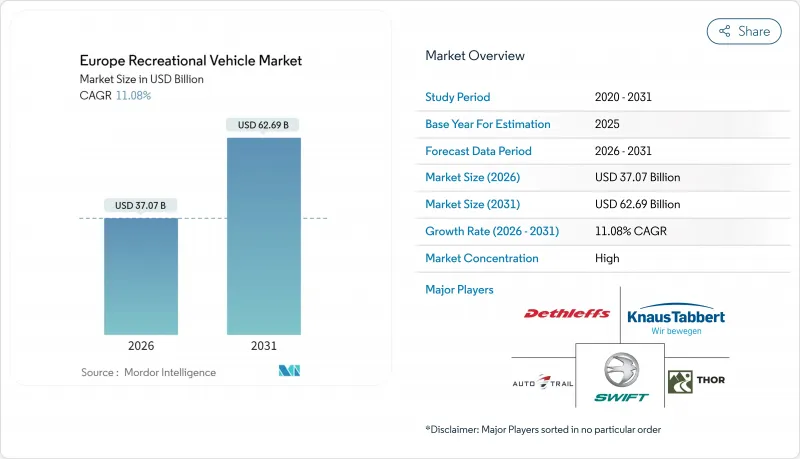
欧洲休閒车(RV)市场预计将从 2025 年的 333.8 亿美元成长到 2026 年的 370.7 亿美元,预计到 2031 年将达到 626.9 亿美元,2026 年至 2031 年的复合年增长率为 11.08%。
这一强劲的成长动能反映了疫情后復苏以及欧洲休閒模式结构性变化所展现的产业韧性。市场扩张得益于监管方面的利好,特别是欧洲议会核准到2028年将B类驾照的适用范围扩大至4.25吨级旅居车,这将使数百万新增驾驶员得以进入该行业。
欧洲休閒车市场趋势与洞察
疫情后,国内和欧洲内部旅游业激增
欧洲的露营活动正达到前所未有的水平,德国2024年的露营夜数预计将达到4,290万住宿,比疫情前的2019年增加19.9%。国内旅游的持续成长反映了欧洲休閒偏好的根本性转变,以本地为中心的旅行方式已从疫情期间的无奈之举演变为一种更受欢迎的生活方式选择。这一趋势并非德国独有,挪威的露营地也迎来了住宿人数的显着增长,比去年同期增长显着。露营活动持续活性化至2025年,尤其与以往露营在德国住宿中占据主导地位的历史水准相比,显示这是一种结构性需求,而非疫情带来的暂时性因素。旅游业的这种重塑为房车需求提供了持续的推动力,涵盖了从适合城市探索的紧凑型露营车到支持长途国内旅行的大型旅居车等所有车型。
房车共享和租赁平台的快速扩张
欧洲房车共享生态系统正快速成熟。 Roadsurfer 于 2025 年 4 月成功完成由 Avelina Capital 领投的 3000 万欧元资金筹措,尤其是其计划将车队规模从 8500 辆扩大到 10000 辆,印证了该行业的加速增长。此轮融资反映出机构投资者认可点对点房车平台已克服最初的信任障碍并实现了规模化。值得注意的是,该平台正在向东欧市场扩张。 Ruuts 透过 API 整合瞄准这些市场,提供欧洲主要房车的接入,并覆盖先前服务不足的地区。共享经济模式渗透到房车所有权模式中,正在产生双重市场效应:它使首次使用者更容易获得房车,同时为个人车主创造了基于使用量的收入来源,有效地将潜在市场扩展到传统所有权模式之外。
高昂的初始购买成本和保险费用
欧洲房车价格飙涨,导致各细分市场的购买力都受到挤压。价格上涨的原因包括价值链中断、底盘短缺以及製造商为应对疫情期间需求激增而涨价。此外,由于需要特殊维修,更高的重置成本和保险费用也进一步加重了消费者的财务负担。儘管中阶市场买家越来越多地选择二手车和租赁,但年轻买家和首次购车者仍面临许多障碍,儘管需求强劲,但市场成长仍受到限制。即使库存有所调整,持续高企的价格仍然凸显了结构性成本的上升,收入增长或采用其他所有权模式对于维持房车的可负担性至关重要。
细分市场分析
到2025年,旅居车将继续保持其主导地位,占据欧洲房车(休閒车)市场53.72%的份额,这反映出欧洲消费者偏好无需依赖外部设施、提供全面便利的自主型移动生活解决方案。这一细分市场的主导地位主要源自于其对55至75岁富裕消费者的吸引力,这些消费者更注重舒适性和便利性,而非行动限制。然而,露营车将展现出最高的成长率,到2031年复合年增长率将达到11.62%,这主要得益于年轻消费者对「露营车生活」文化的追捧以及都市区白领对灵活工作旅行解决方案的需求。拖曳式房车和第五轮拖曳式房车占据了小规模但稳定的细分市场,受到那些希望拥有一辆独立牵引车用于日常使用的消费者的青睐。弹出式和折迭式露营车构成了入门级市场,吸引着注重价格的买家和季节性用户。
法规环境支持这种细分市场,欧盟型式认证框架(2018/858 号法规)为多阶段车辆认证提供了清晰的路径,既方便了露营车改装,也确保了安全标准。 A 型旅居车价格较高,但受到都市区低排放区法规的限制,而 B 型露营车则受益于更高的都市区交通便利性和停车柔软性。
到2025年,柴油内燃机(ICE)动力传动系统将占据欧洲休閒车(RV)市场91.10%的份额,这反映了该细分市场历来依赖柴油引擎在重型应用中卓越的扭力特性和燃油效率。汽油内燃机(ICE)车型的市占率将保持小规模,主要集中在轻型露营车领域,因为汽油引擎在这些领域具有重量优势。然而,在欧盟日益严格的排放气体法规和不断完善的充电基础设施的推动下,电池式电动车(BEV)车型将以36.91%的复合年增长率快速增长至2031年。混合动力解决方案将处于过渡阶段,既能满足关注续航里程的消费者的需求,又能为都市区提供减少排放气体的优势。
挪威在汽车电气化领域处于领先地位,纯电动车在乘用车市场占有率高达96%,并对商用车和休閒车领域产生了连锁反应。製造商们正大力投资电气化解决方案,Truma公司已任命博世电气解决方案部门的Joachim Weckwerth博士担任产品开发负责人,这充分体现了其对电气化的战略承诺。
其他福利:
- Excel格式的市场预测(ME)表
- 分析师支持(3个月)
目录
第一章 引言
- 研究假设和市场定义
- 调查范围
第二章调查方法
第三章执行摘要
第四章 市场情势
- 市场概览
- 市场驱动因素
- 疫情后,国内和欧洲内部旅游业激增
- 房车共享和租赁平台的快速扩张
- 55-75岁年龄层的人虽然年龄增长,但经济条件优越,这推动了高端市场的需求。
- 超过3000个欧盟露营地升级到「互联住宿」标准
- 欧盟B类车辆牌照的重量限制提高到4.25吨,允许更大的楼层平面图。
- 厢型车改装车的兴起,为「随时随地工作」的数位游牧者提供了便利
- 市场限制
- 高昂的初始购买成本和保险费用
- 利率波动导致资金筹措困难
- 由于2021-22年度库存过剩,价格下跌
- 透过在都市区设立低排放气体区来限制柴油房车的通行
- 价值/价值链分析
- 监管环境
- 技术展望
- 波特五力模型
- 新进入者的威胁
- 买方的议价能力
- 供应商的议价能力
- 替代品的威胁
- 竞争对手之间的竞争
第五章 市场规模和成长预测(价值和数量)
- 按类型
- 拖曳式房车
- 旅行拖车
- 五轮拖车
- 弹出式/折迭式露营车
- 旅居车
- A级
- B级(露营车)
- C级
- 拖曳式房车
- 透过推进和燃料
- 柴油内燃机
- 汽油内燃机
- 油电混合车
- 电池式电动车
- 依所有权类型
- 个人所有者
- 租赁和共享车辆
- 按销售管道
- OEM特许经销商
- 直接面向消费者的线上销售
- 汽车租赁公司网络
- 按国家/地区
- 德国
- 英国
- 法国
- 义大利
- 西班牙
- 荷兰
- 挪威
- 其他欧洲地区
第六章 竞争情势
- 市场集中度
- 策略趋势
- 市占率分析
- 公司简介
- Erwin Hymer Group(Thor Industries)
- Trigano SA
- Auto Trail VR LTD
- Knaus Tabbert AG
- Hobby-Fendt Caravan GmbH
- Swift Group Ltd.
- Rapido Group
- Adria Mobil doo
- Dethleffs GmbH & Co. KG
- Rimor Motorhomes
- Eura Mobil GmbH
- Burstner GmbH
- Laika Caravans SpA
- Westfalia Mobil GmbH
- Globe-Traveller RV Sp. z Oo
- Malibu GmbH & Co. KG
- Benimar SL
- Challenger(Trigano)
- Possl Group
- Pilote Groupe
The Europe Recreational Vehicle market is expected to grow from USD 33.38 billion in 2025 to USD 37.07 billion in 2026 and is forecast to reach USD 62.69 billion by 2031 at 11.08% CAGR over 2026-2031.
This robust growth trajectory reflects the sector's resilience following post-pandemic recovery and structural shifts in European leisure patterns. The market's expansion is underpinned by regulatory tailwinds, particularly the EU Parliament's approval of extending B-license eligibility to 4.25-tonne motorhomes by 2028, which will unlock access for millions of additional drivers.
Europe Recreational Vehicle Market Trends and Insights
Post-pandemic Surge in Domestic and Intra-Europe Tourism
European camping activity has reached unprecedented levels, with Germany recording 42.9 million camping overnight stays in 2024, representing a 19.9% increase compared to 2019 pre-pandemic levels. This sustained elevation in domestic tourism reflects a fundamental shift in European leisure preferences, where proximity-based travel has evolved from pandemic necessity to preferred lifestyle choice. The trend extends beyond Germany, with Norway's camping sites witnessing a rise in guest nights, marking significant year-over-year growth. The persistence of elevated camping activity well into 2025 suggests this represents structural demand rather than temporary pandemic-driven behavior, particularly as camping accounts for most German guest overnight stays compared to historical levels. This tourism reorientation creates sustained tailwinds for RV demand across vehicle segments, from compact campervans enabling urban-adjacent exploration to larger motorhomes supporting extended domestic touring.
Rapid Expansion of RV-sharing and Rental Platforms
The European RV-sharing ecosystem has matured rapidly. The sector's growth acceleration is evidenced by Roadsurfer securing EUR 30 million from Avellinia Capital in April 2025, specifically for fleet expansion from 8,500 to 10,000 vehicles. This capital deployment reflects institutional recognition that peer-to-peer RV platforms have overcome initial trust barriers and achieved operational scale. Notably, platforms are expanding eastward, with Ruuts targeting Eastern European markets through API integrations, providing access to major European RVs, and addressing previously underserved regions. The sharing economy's penetration into RV ownership patterns creates dual market effects: democratizing access for first-time users while generating utilization-based revenue streams for private owners, effectively expanding the addressable market beyond traditional ownership models.
High Upfront Purchase and Insurance Costs
European RV prices have surged, straining affordability across market segments. This increase stems from supply chain disruptions, chassis shortages, and manufacturers leveraging pandemic-driven demand. Rising insurance premiums, driven by higher replacement values and specialized repair needs, add to the financial burden. Middle-market buyers increasingly opt for used vehicles or rentals, while younger and first-time buyers face barriers, limiting market growth despite strong demand. Even with inventory corrections, persistent high prices highlight structural cost inflation, necessitating income growth or alternative ownership models to sustain accessibility.
Other drivers and restraints analyzed in the detailed report include:
- Ageing but Affluent 55 to 75 Cohort Boosting Premium Demand
- EU B-license Weight Limit Rising to 4.25 t Enabling Larger Floorplans
- Volatile Interest-rate-driven Financing Squeeze
For complete list of drivers and restraints, kindly check the Table Of Contents.
Segment Analysis
Motorhomes maintained their dominant position with a 53.72% share of the Europe recreational vehicle market in 2025, reflecting European consumers' preference for self-contained mobile living solutions that provide comprehensive amenities without external dependencies. The segment's leadership stems from its appeal to the affluent 55-75 demographic, prioritizing comfort and convenience over mobility constraints. However, campervans are experiencing the fastest growth at 11.62% CAGR through 2031, driven by younger demographics embracing van life culture and urban professionals seeking flexible work-travel solutions. Travel and fifth-wheel trailers occupy smaller but stable niches, appealing to consumers who prefer to maintain separate towing vehicles for daily use. Pop-up and folding campers represent the entry-level segment, attracting price-sensitive buyers and seasonal users.
The regulatory environment supports this segmentation evolution, with EU type-approval frameworks under Regulation 2018/858 providing clear pathways for multi-stage vehicle approvals that facilitate campervan conversions while maintaining safety standards. Class A motorhomes command premium pricing but face headwinds from urban low-emission zone restrictions, while Class B campervans benefit from improved urban accessibility and parking flexibility.
Diesel ICE powertrains command 91.10% share of the Europe recreational vehicle market in 2025, reflecting the segment's traditional reliance on diesel's superior torque characteristics and fuel efficiency for heavy vehicle applications. Petrol ICE variants maintain a smaller presence, primarily in lighter campervan applications where weight considerations favor gasoline engines. However, battery-electric variants are surging at a 36.91% CAGR through 2031, driven by tightening EU emission regulations and expanding charging infrastructure. Hybrid-electric solutions occupy a transitional position, offering compromise solutions for range-anxious consumers while providing emission benefits for urban access.
Norway leads electric adoption with 96% BEV share in passenger cars, creating spillover effects into commercial and recreational vehicle segments. Manufacturers are investing heavily in electric solutions, with Truma appointing Dr. Joachim Weckwerth from Bosch's Electric Solutions division to lead product development, signaling a strategic commitment to electrification.
The Europe Recreational Vehicle Market Report is Segmented by Type (Towable RVs, Motorhomes), Propulsion and Fuel (Diesel ICE, Petrol ICE, Hybrid-Electric, Battery-Electric), Ownership Model (Private Owners, Rental and Sharing Fleets), Sales Channel (OEM-Franchised Dealers, and More), and Country (Germany, United Kingdom, and More). The Market Forecasts are Provided in Terms of Value (USD) and Volume (Units).
List of Companies Covered in this Report:
- Erwin Hymer Group (Thor Industries)
- Trigano SA
- Auto Trail VR LTD
- Knaus Tabbert AG
- Hobby-Fendt Caravan GmbH
- Swift Group Ltd.
- Rapido Group
- Adria Mobil d.o.o.
- Dethleffs GmbH & Co. KG
- Rimor Motorhomes
- Eura Mobil GmbH
- Burstner GmbH
- Laika Caravans S.p.A.
- Westfalia Mobil GmbH
- Globe-Traveller RV Sp. z O.o.
- Malibu GmbH & Co. KG
- Benimar SL
- Challenger (Trigano)
- Possl Group
- Pilote Groupe
Additional Benefits:
- The market estimate (ME) sheet in Excel format
- 3 months of analyst support
TABLE OF CONTENTS
1 Introduction
- 1.1 Study Assumptions and Market Definition
- 1.2 Scope of the Study
2 Research Methodology
3 Executive Summary
4 Market Landscape
- 4.1 Market Overview
- 4.2 Market Drivers
- 4.2.1 Post-Pandemic Surge In Domestic And Intra-Europe Tourism
- 4.2.2 Rapid Expansion Of RV-Sharing And Rental Platforms
- 4.2.3 Ageing But Affluent 55 to 75 Cohort Boosting Premium Demand
- 4.2.4 Upgrade Of More Than 3,000 EU Campsites To "Connected-Stay" Standards
- 4.2.5 EU B-License Weight Limit Rising To 4.25 t Enabling Larger Floorplans
- 4.2.6 Emergence Of "Work-From-Anywhere" Digital-Nomad Van Conversions
- 4.3 Market Restraints
- 4.3.1 High Upfront Purchase And Insurance Costs
- 4.3.2 Volatile Interest-Rate-Driven Financing Squeeze
- 4.3.3 Oversupply-Led Price Depreciation Of 2021-22 Inventory
- 4.3.4 Urban Low-Emission Zones Curbing Diesel RV Access
- 4.4 Value/Supply-Chain Analysis
- 4.5 Regulatory Landscape
- 4.6 Technological Outlook
- 4.7 Porter's Five Forces
- 4.7.1 Threat of New Entrants
- 4.7.2 Bargaining Power of Buyers
- 4.7.3 Bargaining Power of Suppliers
- 4.7.4 Threat of Substitutes
- 4.7.5 Competitive Rivalry
5 Market Size and Growth Forecast (Value (USD) and Volume (Units))
- 5.1 By Type
- 5.1.1 Towable RVs
- 5.1.1.1 Travel Trailers
- 5.1.1.2 Fifth-Wheel Trailers
- 5.1.1.3 Pop-up/Folding Campers
- 5.1.2 Motorhomes
- 5.1.2.1 Class A
- 5.1.2.2 Class B (Campervans)
- 5.1.2.3 Class C
- 5.1.1 Towable RVs
- 5.2 By Propulsion and Fuel
- 5.2.1 Diesel Internal Combustion Engine
- 5.2.2 Petrol Internal Combustion Engine
- 5.2.3 Hybrid-Electric
- 5.2.4 Battery-Electric
- 5.3 By Ownership Model
- 5.3.1 Private Owners
- 5.3.2 Rental and Sharing Fleets
- 5.4 By Sales Channel
- 5.4.1 OEM-Franchised Dealers
- 5.4.2 Direct-to-Consumer Online
- 5.4.3 Rental Agency Networks
- 5.5 By Country
- 5.5.1 Germany
- 5.5.2 United Kingdom
- 5.5.3 France
- 5.5.4 Italy
- 5.5.5 Spain
- 5.5.6 Netherlands
- 5.5.7 Norway
- 5.5.8 Rest of Europe
6 Competitive Landscape
- 6.1 Market Concentration
- 6.2 Strategic Moves
- 6.3 Market Share Analysis
- 6.4 Company Profiles (Includes Global level Overview, Market level overview, Core Segments, Financials as available, Strategic Information, Market Rank/Share for key companies, Products and Services, and Recent Developments)
- 6.4.1 Erwin Hymer Group (Thor Industries)
- 6.4.2 Trigano SA
- 6.4.3 Auto Trail VR LTD
- 6.4.4 Knaus Tabbert AG
- 6.4.5 Hobby-Fendt Caravan GmbH
- 6.4.6 Swift Group Ltd.
- 6.4.7 Rapido Group
- 6.4.8 Adria Mobil d.o.o.
- 6.4.9 Dethleffs GmbH & Co. KG
- 6.4.10 Rimor Motorhomes
- 6.4.11 Eura Mobil GmbH
- 6.4.12 Burstner GmbH
- 6.4.13 Laika Caravans S.p.A.
- 6.4.14 Westfalia Mobil GmbH
- 6.4.15 Globe-Traveller RV Sp. z O.o.
- 6.4.16 Malibu GmbH & Co. KG
- 6.4.17 Benimar SL
- 6.4.18 Challenger (Trigano)
- 6.4.19 Possl Group
- 6.4.20 Pilote Groupe

 休閒车市场:2026-2032年全球市场预测(依动力系统、车辆类型、购买方式、总长度、最终用户和销售管道)
 休閒车市场规模、份额和成长分析(按地区划分)-2026-2033年产业预测
 北美休閒车市场:市场占有率分析、产业趋势与统计、成长预测(2026-2031)
 全球休閒车市场:依类型、应用和地区划分 - 市场规模、行业趋势、机会分析和预测(2025-2033 年)
 全球休閒车金融市场休閒车复合板的全球市场。
 全球旅居车和拖挂式房车市场规模(按产品类型、应用、区域范围和预测)
 2025-2029年全球休閒车(RV)租赁市场
 2030 年休閒车市场预测:按车辆类型、燃料类型、价格分布、应用、最终用户和地区进行的全球分析
 休閒车市场机会、成长动力、产业趋势分析与 2025 - 2034 年预测