


 |
市场调查报告书
商品编码
1940563
欧洲自助仓储:市场占有率分析、产业趋势与统计、成长预测(2026-2031)Europe Self-storage - Market Share Analysis, Industry Trends & Statistics, Growth Forecasts (2026 - 2031) |
||||||

※ 本网页内容可能与最新版本有所差异。详细情况请与我们联繫。
2025年欧洲自助仓储市场价值270亿美元,预计2031年将达到342.1亿美元,高于2026年的280.9亿美元。
预计在预测期(2026-2031 年)内,复合年增长率将达到 4.02%。
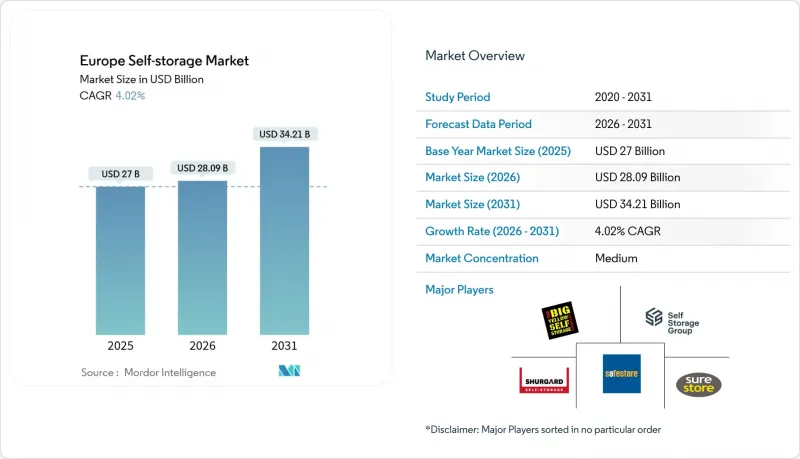
持续的都市区成长、住宅流动性的提高以及将仓储资产视为基础设施而非边缘房地产投资的机构投资者的涌入,都支撑着这一扩张趋势。伦敦、巴黎和柏林等主要城市的城市密度不断增加,加上人口老化导致住房规模缩小,使得仓储运转率率和租金水准在各个经济週期中都保持稳定。中小电商企业越来越多地采用微型仓库策略,而学生和外籍人士的流动也带来了可预测的季节性需求。气候政策驱动的维修虽然成本高昂,但却创造了一个高端市场,提高了能源效率,并提升了符合标准的设施的获利能力。
欧洲自助仓储市场趋势与洞察
城市高密度化和微型居住
地价上涨导致都市区平均居住面积缩水,迫使他们利用本地仓储设施作为户外「房间」。三年来,英国新增了100多家仓储设施,每年为用户带来10亿英镑的收入,用于存放家具和季节性物品。混合租赁模式和全天候数位化服务意味着这项服务正日益融入城市生活。
因老化而从大型住宅搬离,缩小居住面积
随着德国、义大利和英国的老年住宅搬进小规模的住宅,对临时存放传家宝和大型家具的需求日益增长。经合组织预测,到2050年,七国集团居住者中将有25%超过65岁,这将形成一个可持续的、以需求为导向的基本客群。
严格的消防安全标准
北欧法规要求采用先进的消防系统和检验的风险评估,这将使维修预算增加高达 25%,并减缓市场准入。
细分市场分析
截至2025年,个人用户将占欧洲自助仓储市场收入的69.35%。家庭搬迁、微型居住和退休缩减住房规模等因素将确保长期合约的签订,即使在宏观经济衝击下也能维持运转率的稳定。企业用户群虽然规模较小,但正以每年7.42%的速度成长,这主要得益于中小企业对计量型仓储空间的日益增长的需求。营运商目前正在建立双品牌策略,例如针对个人用户的生活方式通讯和针对企业的承包物流服务,以有效实现两个细分市场的收入成长。
欧洲自助仓储市场规模(主要指个人租赁市场)预计将在2031年之前保持主导地位,这主要得益于简化短期预订流程的数位化预订平台的普及。同时,随着电子商务在区域城市的渗透率不断提高,宅配代收、货架安装和保险等交叉销售服务正在提升企业客户的平均收入。
由于前期投入成本较低,到2025年,非空调自助仓储单位将占欧洲自助仓储市场59.35%的份额。然而,配备感测器、空调和严格门禁系统的空调自助仓储单元,由于其租金比标准间高出25%至40%,将以8.82%的复合年增长率增长,从而带来更高的利润率。
日益严格的监管正在加速这一转变,而达到E级标准的设施可以透过更高的租金和更低的客户流失率来收回维修成本。预计到2031年,欧洲空调市场规模将超过142亿美元,这将支撑对电子产品、艺术品和檔案等专业保险产品的需求。
其他福利:
- Excel格式的市场预测(ME)表
- 3个月的分析师支持
目录
第一章 引言
- 研究假设和市场定义
- 调查范围
第二章调查方法
第三章执行摘要
第四章 市场情势
- 市场概览
- 市场驱动因素
- 欧洲主要城市的城市压缩与微型生活趋势
- 德国、义大利和英国的居民因房屋老化而搬离大型住宅。
- 中小企业在电子商务领域的快速成长推动了对灵活的小规模仓库的需求。
- 申根区内学生和外籍人士流动迅速增加
- 混合办公模式的普及导致了在家工作环境的零碎化。
- 机构投资者对另类房地产收入的兴趣
- 市场限制
- 北欧国家严格的消防安全法规限制了设施改造。
- 历史城区中心缺乏适当的工业用地
- 法国和西班牙的通膨挂钩租金指数上限
- 日益严格的能源效率法规增加了维修成本。
- 消费者分析
- 监理展望
- 波特五力分析
- 供应商的议价能力
- 买方的议价能力
- 新进入者的威胁
- 替代品的威胁
- 竞争对手之间的竞争
- 投资分析
第五章 市场规模与成长预测
- 依使用者类型
- 个人
- 商业
- 依储存类型
- 空调管理
- 非空调管理
- 按空间大小
- 90平方英尺或更少
- 91-150平方英尺
- 151-300平方英尺
- 超过300平方英尺
- 透过使用
- 家居用品
- 电子商务小包裹配送中心
- 文件和檔案存储
- 车辆存放
- 按国家/地区
- 德国
- 英国
- 法国
- 义大利
- 西班牙
- 其他欧洲地区
第六章 竞争情势
- 市场集中度
- 策略趋势
- 市占率分析
- 公司简介
- Shurgard Self Storage SA
- Safestore Holdings PLC
- Big Yellow Group PLC
- Self Storage Group ASA
- Lok'nStore Group PLC
- SureStore Ltd
- Access Self Storage Ltd
- Lagerboks
- Nettolager
- Pelican Self Storage
- 24Storage AB
- Casaforte(SMC Self-Storage Management)
- W Wiedmer AG
- MyPlace SelfStorage GmbH
- BlueSpace Self-Storage SL
- Space Station Ltd
第七章 市场机会与未来展望
The Europe self-storage market was valued at USD 27 billion in 2025 and estimated to grow from USD 28.09 billion in 2026 to reach USD 34.21 billion by 2031, at a CAGR of 4.02% during the forecast period (2026-2031).
Expansion rests on steady urban population growth, rising residential mobility, and institutional capital inflows that treat storage assets as infrastructure rather than peripheral real-estate plays. Urban compression in London, Paris, Berlin, and similar Tier-1 cities, coupled with ageing populations downsizing, keeps occupancy and rental levels resilient across economic cycles. Small and medium e-commerce businesses increasingly adopt micro-warehousing strategies, while student and expatriate mobility supplies predictable seasonal demand. Climate-policy-driven retrofits, although costly, improve energy efficiency and create a premium segment that lifts yields for compliant facilities
Europe Self-storage Market Trends and Insights
Urban compression and micro-living
Intensifying land prices have shrunk average city dwellings, prompting residents to treat local storage facilities as an external "room." Over 100 new complexes opened in the UK in three years, earning operators GBP 1 billion annually as renters off-load furniture and seasonal goods. Hybrid leases and 24/7 digital access further embed the service into day-to-day urban living.
Ageing population downsizing from larger homes
Older homeowners in Germany, Italy, and the UK are shifting to smaller dwellings, creating interim storage demand for heirlooms and bulky furniture. OECD projections show the 65+ cohort reaching 25% of G7 city dwellers by 2050, locking in a durable, needs-based customer base
Stringent fire-safety codes
Nordic rules require advanced suppression systems and verified risk assessments, adding up to 25% to conversion budgets and delaying market entry
Other drivers and restraints analyzed in the detailed report include:
- E-commerce SMB boom driving flexible micro-warehousing
- Student & expat mobility
- Heightened energy-efficiency mandates
For complete list of drivers and restraints, kindly check the Table Of Contents.
Segment Analysis
Personal users accounted for 69.35% of Europe self-storage market revenue in 2025. Household moves, micro-living, and retirement downsizing secure long-tenure contracts that stabilise occupancy during macro shocks. The business cohort, while smaller, is expanding at 7.42% annually as SMEs embrace pay-as-you-go inventory space. Operators now tailor dual-branding strategies-lifestyle messaging for individuals and turnkey logistics features for corporations-to monetise both streams effectively.
The Europe self-storage market size attached to personal tenancy is forecast to maintain a dominant share through 2031, helped by digital reservation platforms that simplify short-cycle booking. Meanwhile, cross-selling services such as courier pick-up, racking, and insurance lift average revenue per business customer as e-commerce penetration deepens in peripheral cities.
Non-climate units delivered 59.35% of Europe self-storage market share in 2025 thanks to lower fit-out costs. Yet climate-controlled stock, growing at 8.82% CAGR, underpins margin expansion because sensors, HVAC, and stricter access controls command fees 25-40% above standard rooms.
Regulatory upgrades accelerate the pivot: facilities that already meet class E standards recoup retrofit spending via higher rents and lower churn. The Europe self-storage market size for climate-controlled units is on track to surpass USD 14.2 billion by 2031, supporting specialised insurance offerings for electronics, art, and archival documents.
Europe Self Storage Market Report is Segmented by User Type (Personal and Business), Storage Type (Climate-Controlled, Non-Climate-Controlled), Space Size (Up To 90 Sq Ft, 91-150 Sq Ft, and More), Application (Household Goods, E-Commerce Micro-Fulfilment, and More), and Country. The Market Forecasts are Provided in Terms of Value (USD).
List of Companies Covered in this Report:
- Shurgard Self Storage SA
- Safestore Holdings PLC
- Big Yellow Group PLC
- Self Storage Group ASA
- Lok'nStore Group PLC
- SureStore Ltd
- Access Self Storage Ltd
- Lagerboks
- Nettolager
- Pelican Self Storage
- 24Storage AB
- Casaforte (SMC Self-Storage Management)
- W Wiedmer AG
- MyPlace SelfStorage GmbH
- BlueSpace Self-Storage S.L.
- Space Station Ltd
Additional Benefits:
- The market estimate (ME) sheet in Excel format
- 3 months of analyst support
TABLE OF CONTENTS
1 INTRODUCTION
- 1.1 Study Assumptions and Market Definition
- 1.2 Scope of the Study
2 RESEARCH METHODOLOGY
3 EXECUTIVE SUMMARY
4 MARKET LANDSCAPE
- 4.1 Market Overview
- 4.2 Market Drivers
- 4.2.1 Urban Compression and Micro-Living Trends in Tier-1 European Cities
- 4.2.2 Aging Population Downsizing from Larger Homes in Germany, Italy and UK'
- 4.2.3 E-commerce SMB Boom Driving Need for Flexible Micro-Warehousing
- 4.2.4 Surging Student & Expat Mobility Within the Schengen Region
- 4.2.5 Rise of Hybrid Work Creating Home Office Clutter
- 4.2.6 Institutional Investor Appetite for Alternative Real-Estate Yields
- 4.3 Market Restraints
- 4.3.1 Stringent Fire-Safety Codes Limiting Facility Conversions in Nordics
- 4.3.2 Scarcity of Suitable Zoned Industrial Stock in Historic City Centres
- 4.3.3 Inflation-Linked Rental Index Caps in France and Spain
- 4.3.4 Heightened Energy-Efficiency Mandates Increasing Retrofit Costs
- 4.4 Consumer Analysis
- 4.5 Regulatory Outlook
- 4.6 Porter's Five Forces Analysis
- 4.6.1 Bargaining Power of Suppliers
- 4.6.2 Bargaining Power of Buyers
- 4.6.3 Threat of New Entrants
- 4.6.4 Threat of Substitutes
- 4.6.5 Intensity of Competitive Rivalry
- 4.7 Investment Analysis
5 MARKET SIZE AND GROWTH FORECASTS (VALUE)
- 5.1 By User Type
- 5.1.1 Personal
- 5.1.2 Business
- 5.2 By Storage Type
- 5.2.1 Climate-Controlled
- 5.2.2 Non-Climate-Controlled
- 5.3 By Space Size
- 5.3.1 Up to 90 sq ft
- 5.3.2 91-150 sq ft
- 5.3.3 151-300 sq ft
- 5.3.4 Above 300 sq ft
- 5.4 By Application
- 5.4.1 Household Goods
- 5.4.2 E-commerce Micro-Fulfilment
- 5.4.3 Document & Archive Storage
- 5.4.4 Vehicle Storage
- 5.5 By Country
- 5.5.1 Germany
- 5.5.2 United Kingdom
- 5.5.3 France
- 5.5.4 Italy
- 5.5.5 Spain
- 5.5.6 Rest of Europe
6 COMPETITIVE LANDSCAPE
- 6.1 Market Concentration
- 6.2 Strategic Moves
- 6.3 Market Share Analysis
- 6.4 Company Profiles (includes Global level Overview, Market level overview, Core Segments, Financials as available, Strategic Information, Market Rank/Share for key companies, Products and Services, and Recent Developments)
- 6.4.1 Shurgard Self Storage SA
- 6.4.2 Safestore Holdings PLC
- 6.4.3 Big Yellow Group PLC
- 6.4.4 Self Storage Group ASA
- 6.4.5 Lok'nStore Group PLC
- 6.4.6 SureStore Ltd
- 6.4.7 Access Self Storage Ltd
- 6.4.8 Lagerboks
- 6.4.9 Nettolager
- 6.4.10 Pelican Self Storage
- 6.4.11 24Storage AB
- 6.4.12 Casaforte (SMC Self-Storage Management)
- 6.4.13 W Wiedmer AG
- 6.4.14 MyPlace SelfStorage GmbH
- 6.4.15 BlueSpace Self-Storage S.L.
- 6.4.16 Space Station Ltd
7 MARKET OPPORTUNITIES AND FUTURE OUTLOOK
- 7.1 White-space and Unmet-Need Assessment

 自助仓储市场规模、份额、趋势和预测:按储存单元规模、最终用途和地区划分,2026-2034 年
 2026年全球自助仓储市场报告
 自助仓储市场:2026-2032年全球市场预测(按单位类型、租赁期限、单位面积、存取方式及最终用户划分)自助仓储及搬家服务市场:自助仓储、搬家服务、单位规模、应用、全球预测(2026-2032年)
 德国自助仓储市场占有率分析、产业趋势与统计、成长预测(2026-2031)
 自助仓储市场-全球产业规模、份额、趋势、机会、预测:按应用、最终用户、地区和竞争格局划分,2021-2031年日本自助仓储市场报告(按仓储单元尺寸(小型仓储单元、中型仓储单元、大型仓储单元)、最终用途(个人、商业)和地区划分,2026-2034年)
 自助仓储市场规模、份额、按类型、单位规模、最终用途和地区分類的成长分析 - 产业预测,2025 年至 2032 年美国自助仓储:市场份额分析、行业趋势、统计数据和成长预测(2025-2030 年)亚太地区自助仓储:市场占有率分析、产业趋势与统计、成长预测(2025-2030 年)