


 |
市场调查报告书
商品编码
1876816
清洁标籤配料市场机会、成长驱动因素、产业趋势分析及预测(2025-2034年)Clean Label Ingredients Market Opportunity, Growth Drivers, Industry Trend Analysis, and Forecast 2025 - 2034 |
||||||

2024 年全球清洁标籤成分市场价值为 282 亿美元,预计到 2034 年将以 12.2% 的复合年增长率增长至 897 亿美元。
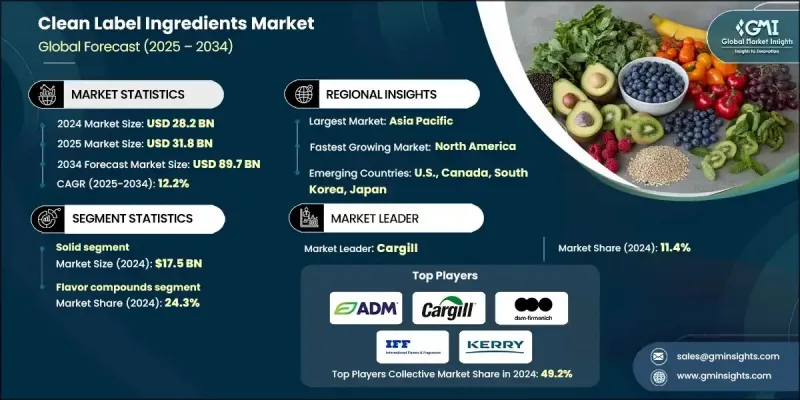
市场快速成长归功于消费者对透明度、天然来源和加工最少的食品的强劲需求。清洁标籤成分指的是不含人工添加物、色素、防腐剂和合成化学物质的天然且简单的成分。消费者对清洁且可追溯的食品来源的偏好已成为重要的购买因素,尤其是在註重安全和健康的健康意识强的消费者中。全球健康饮食习惯的趋势,以及政府对食品添加剂和标籤日益严格的监管,正在推动从合成成分向天然来源替代品的转变。製造商越来越多地使用有机、植物基和非基因改造成分来重新配製产品,以满足不断变化的消费者期望和永续发展目标。此外,天然萃取和发酵技术的进步使得成分更加清洁、稳定,同时又不影响风味、功能或保存期限。这些趋势、健康意识的提高、监管的演变以及天然加工技术的创新正在重塑全球清洁标籤成分的格局。
| 市场范围 | |
|---|---|
| 起始年份 | 2024 |
| 预测年份 | 2025-2034 |
| 起始值 | 282亿美元 |
| 预测值 | 897亿美元 |
| 复合年增长率 | 12.2% |
2024年,固态配料市场规模预计将达175亿美元。粉状蛋白质、颗粒状防腐剂、结晶甜味剂和脱水香精等固态配料因其稳定性好、易于操作且能适应各种食品生产过程而占据主导地位。这些固态配料能够延长保质期,实现精确的剂量控制,并可无缝整合到大规模食品生产系统中。在烘焙、糖果和加工食品等关键应用领域,固态配料的需求仍然旺盛,因为它们在保持产品一致性和口感方面发挥着至关重要的作用。
2024年,香精化合物市占率达24.3%。源自植物、水果、蔬菜和草药的天然香料正日益成为食品和饮料配方中不可或缺的成分,这些配方旨在实现复杂而真实的口味,而无需人工添加剂。随着消费者越来越将天然风味与品质、安全性和感官享受联繫起来,精油、发酵衍生化合物和植物萃取物的使用正在迅速增长。
受消费者对加工最少、天然且透明的成分偏好驱动,北美清洁标籤成分市场预计在2025年至2034年间将以12.4%的复合年增长率成长。该地区市场成长得益于众多关注健康、保健和永续发展的领导品牌越来越多地采用清洁标籤配方。天然防腐、萃取和配方方面的技术创新在保持产品纯度的同时,提升了产品性能。此外,企业正优先考虑永续采购,投资再生原料,并扩大有机成分组合,以满足消费者期望和监管标准。
全球清洁标籤配料市场的主要参与者包括A&B Ingredients、嘉吉、帝斯曼-菲美意、利马格兰配料、凯瑞集团、ADM、英联格、科比昂、国际香料香精公司(IFF)、布里森集团、泰莱和诺维信。这些主要市场参与者正采取一系列策略来巩固其在清洁标籤配料市场的地位,包括与食品製造商建立战略合作伙伴关係、扩大区域生产设施以及收购利基天然配料公司以拓展产品组合。持续的研发投入使企业能够推出创新且永续的清洁标籤配方,以满足不断变化的消费者趋势。
目录
第一章:方法论与范围
第二章:执行概要
第三章:行业洞察
- 产业生态系分析
- 供应商格局
- 利润率
- 每个阶段的价值增加
- 影响价值链的因素
- 中断
- 产业影响因素
- 成长驱动因素
- 消费者对透明度和天然成分的需求日益增长
- 监理机关推动标籤成分更清晰、减少合成添加剂
- 健康与保健趋势推动高端产品需求
- 产业陷阱与挑战
- 天然成分比合成成分成本更高
- 维护产品功能的技术挑战
- 市场机会
- 植物基和替代蛋白的新兴应用
- 采用先进处理技术
- 成长驱动因素
- 成长潜力分析
- 监管环境
- 北美洲
- 欧洲
- 亚太地区
- 拉丁美洲
- 中东和非洲
- 波特的分析
- PESTEL 分析
- 技术与创新格局
- 当前技术趋势
- 新兴技术
- 价格趋势
- 按地区
- 副产品
- 未来市场趋势
- 专利格局
- 贸易统计(HS编码)(註:仅提供重点国家的贸易统计资料)
- 主要进口国
- 主要出口国
- 永续性和环境方面
- 永续实践
- 减少废弃物策略
- 生产中的能源效率
- 环保倡议
- 碳足迹考量
第四章:竞争格局
- 介绍
- 公司市占率分析
- 按地区
- 北美洲
- 欧洲
- 亚太地区
- 拉丁美洲
- MEA
- 按地区
- 公司矩阵分析
- 主要市场参与者的竞争分析
- 竞争定位矩阵
- 关键进展
- 併购
- 合作伙伴关係与合作
- 新产品发布
- 扩张计划
第五章:市场估算与预测:依形式划分,2021-2034年
- 主要趋势
- 坚硬的
- 粉末和颗粒状
- 晶体和片状
- 片剂和压缩剂型
- 液体
- 溶液和糖浆
- 乳液和悬浮液
- 浓缩液体
- 半固体
- 膏状物和浓缩物
- 凝胶和粘稠溶液
- 蜡和固体分散体
第六章:市场估算与预测:依类别划分,2021-2034年
- 主要趋势
- 防腐剂和抗菌剂
- 有机酸(柠檬酸、醋酸、乳酸)
- 精油化合物
- 植物萃取物抗氧化剂
- 盐和矿物基防腐剂
- 着色剂和颜料
- 花青素和甜菜碱
- 类胡萝卜素和叶黄素
- 叶绿素衍生物
- 矿物和粘土基颜料
- 风味化合物
- 精油和油树脂
- 天然香料萃取物
- 植物香料
- 味觉调节剂和增强剂
- 甜味剂
- 高强度甜味剂(甜菊糖、罗汉果糖)
- 糖醇(赤藻醣醇、木糖醇)
- 稀有糖(阿洛酮糖、塔格糖)
- 天然糖替代品
- 蛋白质和胺基酸
- 植物性蛋白质浓缩物
- 蛋白质分离物和水解物
- 必需胺基酸混合物
- 生物活性胜肽
- 增稠剂
- 增稠剂
- 凝胶剂
- 稳定係统
- 抗结块剂
- 其他的
第七章:市场估算与预测:依最终用途产业划分,2021-2034年
- 主要趋势
- 饮料业
- 不含酒精的饮料
- 酒精饮料
- 功能饮料和运动饮料
- 乳製品饮料
- 食品製造
- 烘焙食品和谷物产品
- 糖果和甜点
- 加工食品及即食食品
- 休閒食品及方便食品
- 乳製品及替代品产业
- 传统乳製品
- 植物基乳製品替代品
- 发酵乳製品
- 冷冻乳製品甜点
- 肉品及蛋白质产业
- 加工肉製品
- 植物肉替代品
- 海鲜及海鲜
- 蛋白质补充剂和蛋白质棒
- 特殊营养
- 婴幼儿营养
- 临床与医学营养
- 运动与表现营养
- 老年人营养
- 餐饮服务及宴会
- 餐厅和快餐连锁店
- 机构餐饮
- 食品原料供应
- 其他的
第八章:市场估算与预测:依地区划分,2021-2034年
- 主要趋势
- 北美洲
- 我们
- 加拿大
- 欧洲
- 德国
- 英国
- 法国
- 西班牙
- 义大利
- 欧洲其他地区
- 亚太地区
- 中国
- 印度
- 日本
- 澳洲
- 韩国
- 亚太其他地区
- 拉丁美洲
- 巴西
- 墨西哥
- 阿根廷
- 拉丁美洲其他地区
- 中东和非洲
- 沙乌地阿拉伯
- 南非
- 阿联酋
- 中东和非洲其他地区
第九章:公司简介
- A&B Ingredients
- ADM
- Brisan Group
- Cargill
- Corbion
- DSM-Firmenich
- Ingredion
- International Flavors & Fragrances Inc. (IFF)
- Kerry Group
- Limagrain Ingredients
- Novozymes
- Tate & Lyle
The Global Clean Label Ingredients Market was valued at USD 28.2 billion in 2024 and is estimated to grow at a CAGR of 12.2% to reach USD 89.7 billion by 2034.
The market's rapid growth is attributed to the strong consumer demand for transparency, natural sourcing, and minimally processed food products. Clean label ingredients refer to natural and simple ingredients that are free from artificial additives, colors, preservatives, and synthetic chemicals. The preference for clean and traceable food sources has become a significant purchasing factor, especially among health-conscious consumers who prioritize safety and wellness. Global trends toward healthier eating habits, coupled with stricter government regulations regarding food additives and labeling, are encouraging the transition from synthetic ingredients to naturally derived alternatives. Manufacturers are increasingly reformulating products with organic, plant-based, and non-GMO ingredients to align with evolving consumer expectations and sustainability goals. In addition, technological advances in natural extraction and fermentation are enabling cleaner, more stable ingredient profiles without compromising flavor, functionality, or shelf life. These combined trends, health awareness, regulatory evolution, and innovation in natural processing are reshaping the global clean label ingredient landscape.
| Market Scope | |
|---|---|
| Start Year | 2024 |
| Forecast Year | 2025-2034 |
| Start Value | $28.2 Billion |
| Forecast Value | $89.7 Billion |
| CAGR | 12.2% |
The solid form segment generated USD 17.5 billion in 2024. Solid ingredients such as powdered proteins, granulated preservatives, crystalline sweeteners, and dehydrated flavor compounds dominate due to their stability, easy handling, and adaptability across food manufacturing processes. These forms provide manufacturers with extended shelf life, precise dosing control, and seamless integration into large-scale food production systems. Demand remains high across key applications, including bakery, confectionery, and processed food categories, where solid ingredients play a vital role in maintaining consistency and taste.
The flavor compounds segment captured 24.3% share in 2024. Natural flavoring agents sourced from botanicals, fruits, vegetables, and herbs are becoming indispensable for food and beverage formulations that aim to achieve complex and authentic taste profiles without artificial additives. The use of essential oils, fermentation-derived compounds, and plant-based extracts is expanding rapidly as consumers increasingly associate natural flavor with quality, safety, and sensory satisfaction.
North America Clean Label Ingredients Market is expected to record a CAGR of 12.4% between 2025 and 2034, driven by consumer preference for minimally processed, natural, and transparent ingredients. The region's market growth is supported by the rising adoption of clean label formulations across leading brands that focus on health, wellness, and sustainability. Technological innovations in natural preservation, extraction, and formulation are improving product performance while maintaining purity. Moreover, companies are prioritizing sustainable sourcing, investing in renewable raw materials, and expanding organic ingredient portfolios to meet consumer expectations and regulatory standards.
Leading companies operating in the Global Clean Label Ingredients Market include A&B Ingredients, Cargill, DSM-Firmenich, Limagrain Ingredients, Kerry Group, ADM, Ingredion, Corbion, International Flavors & Fragrances Inc. (IFF), Brisan Group, Tate & Lyle, and Novozymes. Key market players are adopting a range of strategies to strengthen their foothold in the Clean Label Ingredients Market. These include strategic partnerships with food manufacturers, expansion of regional production facilities, and acquisition of niche natural ingredient companies to broaden product portfolios. Continuous investment in research and development allows firms to introduce innovative and sustainable clean-label formulations that cater to evolving consumer trends.
Table of Contents
Chapter 1 Methodology & Scope
- 1.1 Market scope and definition
- 1.2 Research design
- 1.2.1 Research approach
- 1.2.2 Data collection methods
- 1.3 Data mining sources
- 1.3.1 Global
- 1.3.2 Regional/Country
- 1.4 Base estimates and calculations
- 1.4.1 Base year calculation
- 1.4.2 Key trends for market estimation
- 1.5 Primary research and validation
- 1.5.1 Primary sources
- 1.6 Forecast model
- 1.7 Research assumptions and limitations
Chapter 2 Executive Summary
- 2.1 Industry 360° synopsis
- 2.2 Key market trends
- 2.2.1 Form trends
- 2.2.2 Category trends
- 2.2.3 End Use industry trends
- 2.2.4 Regional trends
- 2.3 TAM Analysis, 2025-2034
- 2.4 CXO perspectives: strategic imperatives
- 2.4.1 Executive decision points
- 2.4.2 Critical success factors
- 2.5 Future outlook and strategic recommendations
Chapter 3 Industry Insights
- 3.1 Industry ecosystem analysis
- 3.1.1 Supplier landscape
- 3.1.2 Profit margin
- 3.1.3 Value addition at each stage
- 3.1.4 Factor affecting the value chain
- 3.1.5 Disruptions
- 3.2 Industry impact forces
- 3.2.1 Growth drivers
- 3.2.1.1 Rising consumer demand for transparency & natural ingredients
- 3.2.1.2 Regulatory push for cleaner labels & reduced synthetic additives
- 3.2.1.3 Health & wellness trends driving premium product demand
- 3.2.2 Industry pitfalls and challenges
- 3.2.2.1 Higher costs of natural vs synthetic ingredients
- 3.2.2.2 Technical challenges in maintaining product functionality
- 3.2.3 Market opportunities
- 3.2.3.1 Emerging applications in plant-based & alternative proteins
- 3.2.3.2 Advanced processing technology adoption
- 3.2.1 Growth drivers
- 3.3 Growth potential analysis
- 3.4 Regulatory landscape
- 3.4.1 North America
- 3.4.2 Europe
- 3.4.3 Asia Pacific
- 3.4.4 Latin America
- 3.4.5 Middle East & Africa
- 3.5 Porter's analysis
- 3.6 PESTEL analysis
- 3.7 Technology and Innovation landscape
- 3.7.1 Current technological trends
- 3.7.2 Emerging technologies
- 3.8 Price trends
- 3.8.1 By region
- 3.8.2 By product
- 3.9 Future market trends
- 3.10 Patent landscape
- 3.11 Trade statistics (HS code)( Note: the trade statistics will be provided for key countries only)
- 3.11.1 Major importing countries
- 3.11.2 Major exporting countries
- 3.12 Sustainability and environmental aspects
- 3.12.1 Sustainable practices
- 3.12.2 Waste reduction strategies
- 3.12.3 Energy efficiency in production
- 3.12.4 Eco-friendly initiatives
- 3.13 Carbon footprint consideration
Chapter 4 Competitive Landscape, 2024
- 4.1 Introduction
- 4.2 Company market share analysis
- 4.2.1 By region
- 4.2.1.1 North America
- 4.2.1.2 Europe
- 4.2.1.3 Asia Pacific
- 4.2.1.4 LATAM
- 4.2.1.5 MEA
- 4.2.1 By region
- 4.3 Company matrix analysis
- 4.4 Competitive analysis of major market players
- 4.5 Competitive positioning matrix
- 4.6 Key developments
- 4.6.1 Mergers & acquisitions
- 4.6.2 Partnerships & collaborations
- 4.6.3 New product launches
- 4.6.4 Expansion plans
Chapter 5 Market Estimates and Forecast, By Form, 2021-2034 (USD Billion) (Kilo Tons)
- 5.1 Key trends
- 5.2 Solid
- 5.2.1 Powder & granular
- 5.2.2 Crystalline & flake
- 5.2.3 Tablet & compressed forms
- 5.3 Liquid
- 5.3.1 Solutions & syrups
- 5.3.2 Emulsions & suspensions
- 5.3.3 Concentrated liquids
- 5.4 Semi-solid
- 5.4.1 Pastes & concentrates
- 5.4.2 Gels & viscous solutions
- 5.4.3 Wax & solid dispersions
Chapter 6 Market Estimates and Forecast, By Category, 2021-2034 (USD Billion) (Kilo Tons)
- 6.1 Key trends
- 6.2 Preservatives & antimicrobials
- 6.2.1 Organic acids (citric, acetic, lactic)
- 6.2.2 Essential oil compounds
- 6.2.3 Plant extract antioxidants
- 6.2.4 Salt & mineral-based preservatives
- 6.3 Colorants & pigments
- 6.3.1 Anthocyanins & betalains
- 6.3.2 Carotenoids & xanthophylls
- 6.3.3 Chlorophyll derivatives
- 6.3.4 Mineral & clay-based colors
- 6.4 Flavor compounds
- 6.4.1 Essential oils & oleoresins
- 6.4.2 Natural flavor extracts
- 6.4.3 Botanical aromatics
- 6.4.4 Taste modulators & enhancers
- 6.5 Sweetening agents
- 6.5.1 High-intensity sweeteners (stevia, monk fruit)
- 6.5.2 Sugar alcohols (erythritol, xylitol)
- 6.5.3 Rare sugars (allulose, tagatose)
- 6.5.4 Natural sugar alternatives
- 6.6 Proteins & amino acids
- 6.6.1 Plant protein concentrates
- 6.6.2 Protein isolates & hydrolysates
- 6.6.3 Essential amino acid blends
- 6.6.4 Bioactive peptides
- 6.7 Texturizing agents
- 6.7.1 Thickening compounds
- 6.7.2 Gelling agents
- 6.7.3 Stabilizing systems
- 6.7.4 Anti-caking agents
- 6.8 Others
Chapter 7 Market Estimates and Forecast, By End Use Industry, 2021-2034 (USD Billion) (Kilo Tons)
- 7.1 Key trends
- 7.2 Beverages industry
- 7.2.1 Non-alcoholic beverages
- 7.2.2 Alcoholic beverages
- 7.2.3 Functional & sports drinks
- 7.2.4 Dairy-based beverages
- 7.3 Food manufacturing
- 7.3.1 Bakery & cereal products
- 7.3.2 Confectionery & sweets
- 7.3.3 Processed foods & ready meals
- 7.3.4 Snack foods & convenience products
- 7.4 Dairy & alternatives industry
- 7.4.1 Traditional dairy products
- 7.4.2 Plant-based dairy alternatives
- 7.4.3 Fermented dairy products
- 7.4.4 Frozen dairy desserts
- 7.5 Meat & protein industry
- 7.5.1 Processed meat products
- 7.5.2 Plant-based meat alternatives
- 7.5.3 Seafood & marine products
- 7.5.4 Protein supplements & bars
- 7.6 Specialized nutrition
- 7.6.1 Infant & baby nutrition
- 7.6.2 Clinical & medical nutrition
- 7.6.3 Sports & performance nutrition
- 7.6.4 Senior & geriatric nutrition
- 7.7 Food service & catering
- 7.7.1 Restaurant & qsr chains
- 7.7.2 Institutional catering
- 7.7.3 Food ingredients Supply
- 7.8 Others
Chapter 8 Market Estimates and Forecast, By Region, 2021-2034 (USD Billion) (Kilo Tons)
- 8.1 Key trends
- 8.2 North America
- 8.2.1 U.S.
- 8.2.2 Canada
- 8.3 Europe
- 8.3.1 Germany
- 8.3.2 UK
- 8.3.3 France
- 8.3.4 Spain
- 8.3.5 Italy
- 8.3.6 Rest of Europe
- 8.4 Asia Pacific
- 8.4.1 China
- 8.4.2 India
- 8.4.3 Japan
- 8.4.4 Australia
- 8.4.5 South Korea
- 8.4.6 Rest of Asia Pacific
- 8.5 Latin America
- 8.5.1 Brazil
- 8.5.2 Mexico
- 8.5.3 Argentina
- 8.5.4 Rest of Latin America
- 8.6 Middle East and Africa
- 8.6.1 Saudi Arabia
- 8.6.2 South Africa
- 8.6.3 UAE
- 8.6.4 Rest of Middle East and Africa
Chapter 9 Company Profiles
- 9.1 A&B Ingredients
- 9.2 ADM
- 9.3 Brisan Group
- 9.4 Cargill
- 9.5 Corbion
- 9.6 DSM-Firmenich
- 9.7 Ingredion
- 9.8 International Flavors & Fragrances Inc. (IFF)
- 9.9 Kerry Group
- 9.10 Limagrain Ingredients
- 9.11 Novozymes
- 9.12 Tate & Lyle

 全球洁净标示香精市场规模、份额、趋势和成长分析报告(2026-2034年)
 全球洁净标示、天然和无添加快速消费品市场预测至2032年:按产品、成分类型、无添加声明、分销渠道和地区划分
 洁净标示原料市场-全球产业规模、份额、趋势、机会及预测(按类型、应用、形式、地区及竞争格局划分,2021-2031年)洁净标示香精市场-全球产业规模、份额、趋势、机会、预测:按类型、形式、分销管道、地区和竞争格局划分,2021-2031年全球洁净标示食品市场:预测(至2032年)-按产品、成分类型、形态、包装类型、分销管道和地区进行分析洁净标示和低加工食品市场预测至2032年:按产品类型、成分、分销管道、形式、来源、认证和地区分類的全球分析洁净标示和天然食品市场预测至2032年:按产品、成分、来源、分销管道、应用和地区分類的全球分析洁净标示食品创新市场预测至2032年:按产品类型、配料类型、原材料、分销管道、应用和地区分類的全球分析
 洁净标示成分市场规模、份额和成长分析(按形态、类型、应用、通路和地区划分)-2026-2033年产业预测洁净标示食品市场预测至2032年:按产品类型、成分类型、分销管道和地区分類的全球分析