


 |
市场调查报告书
商品编码
1892851
自主农业车辆市场机会、成长驱动因素、产业趋势分析及预测(2025-2034年)Autonomous Agricultural Vehicle Market Opportunity, Growth Drivers, Industry Trend Analysis, and Forecast 2025 - 2034 |
||||||

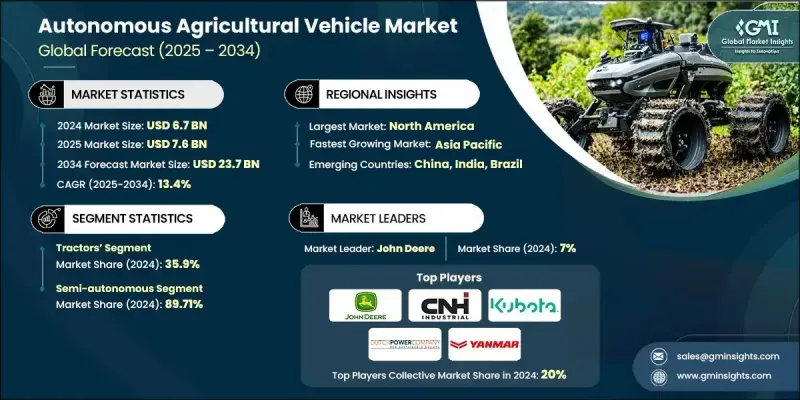
2024 年全球自主农业车辆市场价值为 67 亿美元,预计到 2034 年将以 13.4% 的复合年增长率增长至 237 亿美元。
随着农场不断寻求提高生产力并减少对劳动力的依赖,市场正在扩张。自动化和智慧技术在农业生产中的应用,推动了对自动驾驶拖拉机、收割机和辅助播种、作物监测和收割的专用机器人的需求。不断上涨的劳动成本和最大化作物产量的需求,促使农民采用这些自动化系统。此外,全球人口的成长和日益增长的粮食需求,也推动了对更有效率耕作方式的需求。电动和混合动力农业机械的创新、先进的感测器融合技术以及与农场管理软体的无缝连接,正在提升车辆的效率、精准度和可靠性。这些技术进步使自动驾驶农业车辆成为现代农业不可或缺的工具。
| 市场范围 | |
|---|---|
| 起始年份 | 2024 |
| 预测年份 | 2025-2034 |
| 起始值 | 67亿美元 |
| 预测值 | 237亿美元 |
| 复合年增长率 | 13.4% |
2024年,拖拉机市占率达35.9%。拖拉机仍是现代农业的支柱,承担耕地、播种、中耕、收割和运输农产品等任务。其多功能性使其成为自主作业的理想选择,因为一台机器即可完成多种田间作业。
到2024年,半自动农业机械市占率将达到89.71%。半自动解决方案,包括GPS导航、自动分段喷洒和基本农具管理等,旨在增强而非完全取代人工操作能力。这种广泛的应用凸显了农业辅助自动化技术的成熟度和市场需求。
北美自动驾驶农业车辆市场预计在2024年占据44.1%的市场份额,是成长最快的地区。该地区的农民是先进技术的早期采用者,而大型农场的普遍存在降低了自动驾驶车辆的单位投资成本,使他们能够受益于规模经济。
目录
第一章:方法论与范围
第二章:执行概要
第三章:行业洞察
- 产业生态系分析
- 供应商格局
- 利润率
- 每个阶段的价值增加
- 影响价值链的因素
- 产业影响因素
- 成长驱动因素
- 劳动力严重短缺
- 技术越来越便宜、越来越好
- 全球推动精准农业
- 产业陷阱与挑战
- 更严格的政府法规(安全与效率)
- 从“自主”转向“人工智慧增强”
- 机会
- 模组化小型机器人舰队
- 资料即服务 (DaaS) 集成
- 成长驱动因素
- 成长潜力分析
- 未来市场趋势
- 技术与创新格局
- 当前技术趋势
- 新兴技术
- 价格趋势
- 按地区
- 按类型
- 监管环境
- 标准和合规要求
- 区域监理框架
- 认证标准
- 波特的分析
- PESTEL 分析
第四章:竞争格局
- 介绍
- 公司市占率分析
- 按地区
- 公司矩阵分析
- 主要市场参与者的竞争分析
- 竞争定位矩阵
- 关键进展
- 併购
- 合作伙伴关係与合作
- 新产品发布
- 扩张计划
第五章:市场估算与预测:依产品划分,2021-2034年
- 联结机
- 低于 20 匹马力
- 21-45马力
- 46-60马力
- 61-75马力
- 75马力以上
- 收割机
- 自走式联合收割机
- 传统联合收割机
- 旋转式联合收割机
- 控制联合收割机
- 自走式联合收割机
- 播种机
- 广播种子
- 播种机
- 气动播种机
- 精密播种机
- 其他(指播等)
- 喷雾器
- 手持喷雾器
- 背包式喷雾器
- 无气喷涂机
- 压缩喷雾器
- 喷雾器
第六章:市场估算与预测,自动化,2021-2034年
- 完全自主
- 半自主
第七章:市场估计与预测:依应用领域划分,2021-2034年
- 培养
- 耕作
- 施肥
- 收割
- 种植
- 其他的
第八章:市场估算与预测:依地区划分,2021-2034年
- 北美洲
- 我们
- 加拿大
- 欧洲
- 德国
- 英国
- 法国
- 义大利
- 西班牙
- 亚太地区
- 中国
- 日本
- 印度
- 澳洲
- 韩国
- 拉丁美洲
- 巴西
- 墨西哥
- 阿根廷
- 中东和非洲
- 南非
- 沙乌地阿拉伯
- 阿联酋
第九章:公司简介
- ABB
- Assa Abloy
- Berger Stromversorgungen
- Camtec Power Supplies
- Delta Electronics
- Emerson
- Gebruder Frei
- Mean Well
- Murata Manufacturing
- Murrelektronik
- Schneider Electric
- Siemens
- TDK Corporation
- Weidmueller Interface
- XP Power
The Global Autonomous Agricultural Vehicle Market was valued at USD 6.7 billion in 2024 and is estimated to grow at a CAGR of 13.4% to reach USD 23.7 billion by 2034.
The market is expanding as farms increasingly seek to boost productivity while reducing reliance on labor. The integration of automation and smart technologies across agricultural operations is driving demand for self-driving tractors, harvesters, and specialized robots that assist in planting, monitoring crops, and harvesting. Rising labor costs and the need to maximize crop yields are pushing farmers to adopt these autonomous systems. Additionally, the growing global population and increasing demand for food are fueling the need for more efficient farming practices. Innovations in electric and hybrid agricultural machinery, advanced sensor fusion, and seamless connectivity with farm management software are enhancing vehicle efficiency, precision, and reliability. These technological improvements are positioning autonomous agricultural vehicles as indispensable tools in modern agriculture.
| Market Scope | |
|---|---|
| Start Year | 2024 |
| Forecast Year | 2025-2034 |
| Start Value | $6.7 Billion |
| Forecast Value | $23.7 Billion |
| CAGR | 13.4% |
In 2024, the tractors segment held a 35.9% share. Tractors remain the backbone of modern farming, performing tasks such as plowing, planting, cultivating, harvesting, and transporting produce. Their versatility makes them ideal candidates for autonomous operations, as a single machine can carry out multiple field activities.
The semi-autonomous segment held a 89.71% share in 2024. Semi-autonomous solutions, including GPS-guided steering, auto-section sprayer control, and basic implement management, enhance human operator capabilities rather than fully replacing them. This widespread adoption highlights the current maturity and preference for assisted automation in agriculture.
North America Autonomous Agricultural Vehicle Market accounted for 44.1% share in 2024 and is the fastest-growing region. Farmers in this region are early adopters of advanced technologies, and the prevalence of large-scale farms reduces the per-unit investment cost for autonomous vehicles, allowing them to benefit from economies of scale.
Major players operating in the Autonomous Agricultural Vehicle Market include AGCO, John Deere, CNH Industrial, Kubota Corporation, Dutch Power Company, Yanmar Co. Ltd, Zimeno Inc., AutoNxt Automation, Argo Tractors, Monarch Tractors, Case IH, and New Holland. Companies in the Autonomous Agricultural Vehicle Market focus on continuous innovation in robotics, electrification, and sensor integration to enhance vehicle efficiency and performance. Firms invest heavily in research and development to develop versatile machines capable of multiple tasks and operating in diverse agricultural conditions. Strategic partnerships with technology providers, software developers, and farm management platforms help companies integrate precision farming solutions. Expanding global distribution networks and after-sales service infrastructure ensures market reach and customer support. Companies also offer training programs and demonstration initiatives to educate farmers on autonomous technology benefits. Customizing vehicles for regional crops, terrains, and farm sizes strengthens market penetration.
Table of Contents
Chapter 1 Methodology and Scope
- 1.1 Market scope and definition
- 1.2 Research design
- 1.2.1 Research approach
- 1.2.2 Data collection methods
- 1.3 Data mining sources
- 1.3.1 Global
- 1.3.2 Regional/Country
- 1.4 Base estimates and calculations
- 1.4.1 Base year calculation
- 1.4.2 Key trends for market estimation
- 1.5 Primary research and validation
- 1.5.1 Primary sources
- 1.6 Forecast model
- 1.7 Research assumptions and limitations
Chapter 2 Executive Summary
- 2.1 Industry 360° synopsis
- 2.2 Key market trends
- 2.2.1 Regional
- 2.2.2 Product
- 2.2.3 Automation
- 2.2.4 Application
- 2.3 CXO perspectives: Strategic imperatives
- 2.3.1 Key decision points for industry executives
- 2.3.2 Critical success factors for market players
- 2.4 Future outlook and strategic recommendations
Chapter 3 Industry Insights
- 3.1 Industry ecosystem analysis
- 3.1.1 Supplier landscape
- 3.1.2 Profit margin
- 3.1.3 Value addition at each stage
- 3.1.4 Factor affecting the value chain
- 3.2 Industry impact forces
- 3.2.1 Growth drivers
- 3.2.1.1 Big Labor Shortages
- 3.2.1.2 Tech Getting Cheaper & Better
- 3.2.1.3 Global Push for Precision Farming
- 3.2.2 Industry pitfalls & challenges
- 3.2.2.1 Stricter Government Regulations (Safety & Efficiency)
- 3.2.2.2 Shift from "Autonomous" to "AI-Enhanced"
- 3.2.3 Opportunities
- 3.2.3.1 Modular, Small Robot Fleets
- 3.2.3.2 Data-as-a-Service (DaaS) Integration
- 3.2.1 Growth drivers
- 3.3 Growth potential analysis
- 3.4 Future market trends
- 3.5 Technology and innovation landscape
- 3.5.1 Current technological trends
- 3.5.2 Emerging technologies
- 3.6 Price trends
- 3.6.1 By region
- 3.6.2 By type
- 3.7 Regulatory landscape
- 3.7.1 Standards and compliance requirements
- 3.7.2 Regional regulatory frameworks
- 3.7.3 Certification standards
- 3.8 Porter's analysis
- 3.9 PESTEL analysis
Chapter 4 Competitive Landscape, 2024
- 4.1 Introduction
- 4.2 Company market share analysis
- 4.2.1 By region
- 4.2.1.1 North America
- 4.2.1.2 Europe
- 4.2.1.3 Asia Pacific
- 4.2.1.4 Latin America
- 4.2.1.5 Middle East and Africa
- 4.2.1 By region
- 4.3 Company matrix analysis
- 4.4 Competitive analysis of major market players
- 4.5 Competitive positioning matrix
- 4.6 Key developments
- 4.6.1 Mergers & acquisitions
- 4.6.2 Partnerships & collaborations
- 4.6.3 New product launches
- 4.6.4 Expansion plans
Chapter 5 Market Estimates and Forecast, By Product, 2021 - 2034 (USD Billion) (Thousand Units)
- 5.1 Key trends
- 5.2 Tractor
- 5.2.1 Below 20 HP
- 5.2.2 21-45 HP
- 5.2.3 46-60 HP
- 5.2.4 61-75 HP
- 5.2.5 Above 75 HP
- 5.3 Harvester
- 5.3.1 Self-propelled Combine Harvesters
- 5.3.1.1 Conventional combines
- 5.3.1.2 Rotary combines
- 5.3.2 Control Combine Harvester
- 5.3.1 Self-propelled Combine Harvesters
- 5.4 Seeders
- 5.4.1 Broadcast seeder
- 5.4.2 Drop seeder
- 5.4.3 Pneumatic seeder
- 5.4.4 Precision seeder
- 5.4.5 Others (Finger seeder, etc.)
- 5.5 Sprayers
- 5.5.1 Handheld sprayers
- 5.5.2 Backpack sprayers
- 5.5.3 Airless sprayers
- 5.5.4 Compression sprayers
- 5.5.5 Mist sprayers
Chapter 6 Market Estimates and Forecast, Automation, 2021 - 2034 (USD Billion) (Thousand Units)
- 6.1 Key trends
- 6.2 Fully autonomous
- 6.3 Semi-autonomous
Chapter 7 Market Estimates and Forecast, By Application, 2021 - 2034 (USD Billion) (Thousand Units)
- 7.1 Key trends
- 7.2 Cultivating
- 7.3 Plowing
- 7.4 Fertilizing
- 7.5 Harvesting
- 7.6 Planting
- 7.7 Others
Chapter 8 Market Estimates and Forecast, By Region, 2021 - 2034 (USD Billion) (Thousand Units)
- 8.1 Key trends
- 8.2 North America
- 8.2.1 U.S.
- 8.2.2 Canada
- 8.3 Europe
- 8.3.1 Germany
- 8.3.2 UK
- 8.3.3 France
- 8.3.4 Italy
- 8.3.5 Spain
- 8.4 Asia Pacific
- 8.4.1 China
- 8.4.2 Japan
- 8.4.3 India
- 8.4.4 Australia
- 8.4.5 South Korea
- 8.5 Latin America
- 8.5.1 Brazil
- 8.5.2 Mexico
- 8.5.3 Argentina
- 8.6 Middle East and Africa
- 8.6.1 South Africa
- 8.6.2 Saudi Arabia
- 8.6.3 UAE
Chapter 9 Company Profiles
- 9.1 ABB
- 9.2 Assa Abloy
- 9.3 Berger Stromversorgungen
- 9.4 Camtec Power Supplies
- 9.5 Delta Electronics
- 9.6 Emerson
- 9.7 Gebruder Frei
- 9.8 Mean Well
- 9.9 Murata Manufacturing
- 9.10 Murrelektronik
- 9.11 Schneider Electric
- 9.12 Siemens
- 9.13 TDK Corporation
- 9.14 Weidmueller Interface
- 9.15 XP Power

 农业RTK自主转向系统市场:按组件、转向解决方案类型、车辆类型、分销管道和应用划分-2026-2032年全球预测
 北美农业机械市场:市场占有率分析、产业趋势与统计、成长预测(2026-2031年)德国农业机械市场:市场占有率分析、产业趋势与统计、成长预测(2026-2031年)欧洲农业机械市场:市场占有率分析、产业趋势与统计、成长预测(2026-2031年)
 日本农业机械市场报告(依产品类型(拖拉机、耕作机械、播种机械、收割机械、干草收割机械、灌溉机械)和地区划分,2026-2034年)日本农业设备市场规模、份额、趋势及预测(按设备类型、应用、销售管道及地区划分,2026-2034年)
 农机市场机会、成长驱动因素、产业趋势分析及预测(2026-2035年)
 植被设备市场规模、占有率、成长及全球产业分析:依类型、应用和地区划分的洞察与预测(2024-2032 年)全球农业机械市场-2025-2030年预测
 农业机器人:全球市场份额和排名、总收入和需求预测(2025-2031年)