


 |
市场调查报告书
商品编码
1982350
地热能源市场机会、成长要素、产业趋势分析及2026-2035年预测。Geothermal Energy Market Opportunity, Growth Drivers, Industry Trend Analysis, and Forecast 2026 - 2035 |
||||||

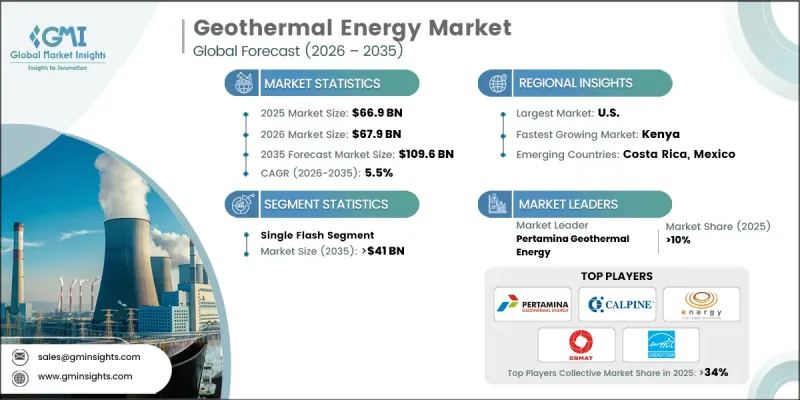
预计到 2025 年,全球地热能源市场价值将达到 669 亿美元,并将以 5.5% 的复合年增长率成长,到 2035 年达到 1,096 亿美元。
该市场受清洁农业电力采购义务的驱动,这些义务旨在保障电网可靠性并优先发展高运转率地热资源。较低的计划成本、透过学习效应实现的绩效提升以及电力公司监管支持的采购,为长期回报提供了保障,并增强了投资的合法性。企业正越来越多地利用底部循环汽电共生技术优化现有棕地,以重复利用现有油井和蒸气田,并快速扩大发电能力。对能源安全的担忧和优惠融资政策促成了世界首批地热发电厂在小规模岛屿地区的建设。市场成长依然缓慢且集中,现有设施的扩建是主要趋势。政策制定者正将地热定位为可靠的能源,以补充可变可再生能源,而先进的地热技术正从研发阶段迈向现场示范阶段,从而扩大了可应用的地质类型和计划。实施挑战和併网限制正在影响采购趋势,分阶段部署是首选方案。亚洲各国政府主导的措施正在扩大可用资金筹措管道,加剧计划开发权的竞争,而对现有发电厂进行改造和提高产量,比新建待开发区发电厂能更快地在短期内增加发电量。
| 市场范围 | |
|---|---|
| 开始年份 | 2025 |
| 预测期 | 2026-2035 |
| 上市时的市场规模 | 669亿美元 |
| 预测金额 | 1096亿美元 |
| 复合年增长率 | 5.5% |
预计2025年,单闪蒸地热发电市场占有率将达35.9%,2035年将达410亿美元。单闪蒸系统将高压地热水转化为蒸气驱动汽轮机,剩余流体则重新註入储存。其成熟的技术、简单的操作以及在高温地热田中的高效性使其成为全球领先的地热解决方案。
预计2025年,美国地热能源市场规模将达155亿美元。这一增长反映了对可再生能源投资的增加、对低排放电力需求的增长以及政府为促进清洁能源发展而采取的奖励。联邦政府对公共土地的许可和计划核准正在加速地热开发,这降低了不确定性并开闢了新的资源区域。
目录
第一章:调查方法和范围
第二章执行摘要
第三章业界考察
- 生态系分析
- 监理情势
- 影响产业的因素
- 促进因素
- 产业潜在风险与挑战
- 成长潜力分析
- 波特的分析
- 供应商的议价能力
- 买方的议价能力
- 新进入者的威胁
- 替代品的威胁
- PESTEL 分析
- 价格趋势分析,2022-2035年
- 新机会与趋势
- 投资分析及未来展望
第四章 竞争情势
- 介绍
- 企业市占率分析
- 主要进展
- 併购
- 伙伴关係与合作
- 新产品发布
- 业务拓展计划及资金筹措
- 竞争性标竿分析
- 创新与永续性现状
第五章 市场规模及预测:依技术划分,2022-2035年
- 二进位
- 单次闪光
- 双闪光
- 三重闪光
- 干燥
- 反压
第六章 市场规模与预测:依国家划分,2022-2035年
- 我们
- 墨西哥
- 土耳其
- 冰岛
- 义大利
- 德国
- 中国
- 菲律宾
- 印尼
- 纽西兰
- 日本
- 肯亚
- 衣索比亚
- 哥斯大黎加
- 萨尔瓦多
- 尼加拉瓜
- 瓜地马拉
- 世界其他地区
第七章:公司简介
- Ansaldo Energia
- Calpine
- Contact Energy
- Energy Development Corporation
- Enel Green Power
- Enertime
- Exergy International
- First Gen
- Fuji Electric
- GE Vernova
- Halliburton
- KenGen
- Mitsubishi Heavy Industries
- Ormat Technologies
- Pertamina Geothermal Energy
- Reykjavik Geothermal
- SLB
- Star Energy
- Toshiba
- Turboden
The Global Geothermal Energy Market was valued at USD 66.9 billion in 2025 and is estimated to grow 5.5% to reach USD 109.6 billion by 2035.
The market is propelled by clean-firm procurement mandates that support grid reliability, rewarding high-capacity-factor geothermal resources. Falling project costs, improved performance through learning effects, and regulatory-backed utility procurement are strengthening the investment case by providing long-term revenue certainty. Companies are increasingly optimizing brownfield sites using bottoming-cycle cogeneration, leveraging existing wells and steamfields to add capacity quickly. Energy security concerns and concessional financing are enabling first-of-a-kind geothermal plants in small island systems. Market growth remains gradual and concentrated, with incremental additions dominating. Policymakers are positioning geothermal as a reliable complement to variable renewables, while advanced geothermal technologies are moving from R&D to field demonstrations, expanding viable geologies and project types. Execution challenges and interconnection constraints are shaping procurement, favoring phased deployment. Government-led initiatives in Asia are expanding bankable pipelines and intensifying competition for project development rights, while repowering and uprating existing plants provide near-term output gains faster than new greenfield development.
| Market Scope | |
|---|---|
| Start Year | 2025 |
| Forecast Year | 2026-2035 |
| Start Value | $66.9 Billion |
| Forecast Value | $109.6 Billion |
| CAGR | 5.5% |
The single-flash geothermal segment accounted for 35.9% share in 2025 and is projected to reach USD 41 billion by 2035. Single-flash systems convert high-pressure geothermal water into steam to drive turbines, reinjecting remaining fluid into reservoirs. Their proven technology, operational simplicity, and efficiency in high-temperature hydrothermal fields make them the dominant geothermal solution globally.
U.S. Geothermal Energy Market reached USD 15.5 billion in 2025. This growth reflects rising investments in renewable energy, demand for low-emission electricity, and government incentives promoting clean power. Federal permitting and project approvals on public lands have accelerated geothermal development by reducing uncertainties and unlocking new resource areas.
Key players in the Global Geothermal Energy Market include Ansaldo Energia, Energy Development Corporation, Enel Green Power, Contact Energy, Ormat Technologies, Pertamina Geothermal Energy, GE Vernova, Halliburton, Mitsubishi Heavy Industries, Star Energy, Reykjavik Geothermal, Fuji Electric, SLB, Exergy International, Calpine, Enertime, Toshiba, Turboden, and KenGen. Companies in the Geothermal Energy Market are focusing on strategic initiatives to strengthen their position. They are investing in technology upgrades, including advanced drilling, resource characterization, and high-efficiency turbines, to improve plant output and operational reliability. Many are entering joint ventures and partnerships to share project risks, expand geographic reach, and accelerate development pipelines. Firms are also leveraging government incentives, concessional financing, and carbon credit programs to lower CAPEX barriers and improve ROI. Additionally, players are repowering and uprating existing plants to boost output cost-effectively while expanding service offerings to include engineering, procurement, and operations management for integrated solutions.
Table of Contents
Chapter 1 Methodology & Scope
- 1.1 Research design
- 1.1.1 Research approach
- 1.1.2 Data collection methods
- 1.2 Base estimates and calculations
- 1.2.1 Base year calculation
- 1.2.2 Market estimates & forecast parameters
- 1.3 Forecast
- 1.3.1 Key trends for market estimates
- 1.3.2 Quantified market impact analysis
- 1.3.2.1 Mathematical impact of growth parameters on forecast
- 1.3.3 Scenario analysis framework
- 1.4 Primary research and validation
- 1.4.1 Some of the primary sources (but not limited to)
- 1.5 Data mining sources
- 1.5.1 Paid Sources
- 1.5.2 Sources, by region
- 1.6 Research trail & scoring components
- 1.6.1 Research trail components
- 1.6.2 Scoring components
- 1.7 Research transparency addendum
- 1.7.1 Source attribution framework
- 1.7.2 Quality assurance metrics
- 1.7.3 Our commitment to trust
- 1.8 Market definitions
Chapter 2 Executive Summary
- 2.1 Industry synopsis, 2022 - 2035
- 2.1.1 Business trends
- 2.1.2 Technology trends
- 2.1.3 Country trends
Chapter 3 Industry Insights
- 3.1 Industry ecosystem analysis
- 3.2 Regulatory landscape
- 3.3 Industry impact forces
- 3.3.1 Growth drivers
- 3.3.2 Industry pitfalls & challenges
- 3.4 Growth potential analysis
- 3.5 Porter's analysis
- 3.5.1 Bargaining power of suppliers
- 3.5.2 Bargaining power of buyers
- 3.5.3 Threat of new entrants
- 3.5.4 Threat of substitutes
- 3.6 PESTEL analysis
- 3.6.1 Political factors
- 3.6.2 Economic factors
- 3.6.3 Social factors
- 3.6.4 Technological factors
- 3.6.5 Legal factors
- 3.6.6 Environmental factors
- 3.7 Price trend analysis, 2022-2035
- 3.8 Emerging opportunities & trends
- 3.9 Investment analysis & future prospects
Chapter 4 Competitive Landscape, 2025
- 4.1 Introduction
- 4.2 Company market share analysis, 2025
- 4.3 Key developments
- 4.3.1 Mergers & acquisitions
- 4.3.2 Partnerships & collaborations
- 4.3.3 New product launches
- 4.3.4 Expansion plans and funding
- 4.4 Competitive benchmarking
- 4.5 Innovation & sustainability landscape
Chapter 5 Market Size and Forecast, By Technology, 2022 - 2035 (USD Million & MW)
- 5.1 Key trends
- 5.2 Binary
- 5.3 Single flash
- 5.4 Double flash
- 5.5 Triple flash
- 5.6 Dry
- 5.7 Back pressure
Chapter 6 Market Size and Forecast, By Country, 2022 - 2035 (USD Million & MW)
- 6.1 Key trends
- 6.2 U.S.
- 6.3 Mexico
- 6.4 Turkey
- 6.5 Iceland
- 6.6 Italy
- 6.7 Germany
- 6.8 China
- 6.9 Philippines
- 6.10 Indonesia
- 6.11 New Zealand
- 6.12 Japan
- 6.13 Kenya
- 6.14 Ethiopia
- 6.15 Costa Rica
- 6.16 El Salvador
- 6.17 Nicaragua
- 6.18 Guatemala
- 6.19 Rest of World
Chapter 7 Company Profiles
- 7.1 Ansaldo Energia
- 7.2 Calpine
- 7.3 Contact Energy
- 7.4 Energy Development Corporation
- 7.5 Enel Green Power
- 7.6 Enertime
- 7.7 Exergy International
- 7.8 First Gen
- 7.9 Fuji Electric
- 7.10 GE Vernova
- 7.11 Halliburton
- 7.12 KenGen
- 7.13 Mitsubishi Heavy Industries
- 7.14 Ormat Technologies
- 7.15 Pertamina Geothermal Energy
- 7.16 Reykjavik Geothermal
- 7.17 SLB
- 7.18 Star Energy
- 7.19 Toshiba
- 7.20 Turboden

 地热能市场:依技术、组件、应用和最终用途划分-2026-2032年全球市场预测
 全球地热能源市场规模、份额、趋势和成长分析报告:2026-2034年
 2026年全球地热能源市场报告
 地热能市场规模、份额和成长分析(按类型、模式、深度、温度、功率、应用、最终用途和地区划分)-2026-2033年产业预测
 地热能市场预测至2032年:按电站类型、组件、技术、应用、最终用户和地区分類的全球分析
 全球地热能市场(按应用、技术、温度和地区划分)- 2030 年预测
 地热能-市场占有率分析、产业趋势与统计、成长预测(2025-2030 年)
 地热能源市场:市场分析和预测至 2033 年 - 按类型、按产品、按服务、按技术、按组件、按应用、按流程、按部署、按最终用户、按安装类型印尼地热能 -市场占有率分析、产业趋势与统计、成长预测(2025-2030)