


 |
市场调查报告书
商品编码
1906881
电子产业用聚氨酯(PU)黏合剂:市场占有率分析、产业趋势与统计、成长预测(2026-2031)Polyurethane (PU) Adhesives In Electronics - Market Share Analysis, Industry Trends & Statistics, Growth Forecasts (2026 - 2031) |
||||||

※ 本网页内容可能与最新版本有所差异。详细情况请与我们联繫。
预计到 2026 年,电子设备用聚氨酯 (PU)黏合剂市场规模将达到 13.1 亿美元。
这意味着从 2025 年的 12.5 亿美元成长到 2031 年的 16.8 亿美元,2026 年至 2031 年的复合年增长率为 5.00%。
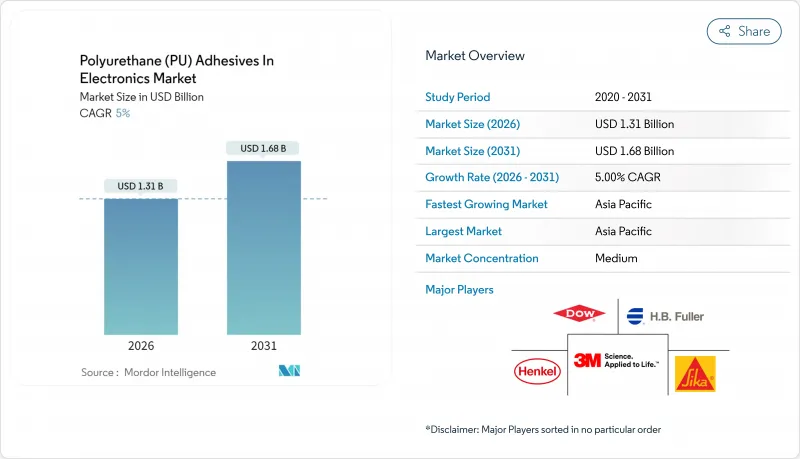
这一稳步增长得益于高性能粘合剂在电动汽车电池组中日益增长的重要性、消费电子设备的持续小型化以及鼓励使用低排放化学品的安全法规的加强。供应商正优先采用快速固化和精密点胶技术,以帮助缩短生产节拍时间,尤其是在亚洲的大批量生产工厂。随着设计人员面临功率模组和汽车逆变器中高功率密度,对导热和紫外光固化化学品的投资正在加速。儘管多元醇和二异氰酸酯的成本波动仍然是一个不利因素,但在强劲的下游需求(特别是来自柔性混合电子产品的需求)的推动下,整体成长动能依然强劲。
电子产业用聚氨酯(PU)黏合剂市场趋势与洞察
消费性电子设备的小型化推动了对低黏度灌封黏合剂的需求。
穿戴式装置、耳机和物联网感测器正变得越来越小型化,留给机械式紧固件的空间越来越小。因此,设计人员开始依赖黏度低于 1000 cPs 的超低黏度聚氨酯配方,这种配方可以填充小至 150 µm 的缝隙而不会产生气泡。这些材料可以封装易碎晶片、抑制振动,并能承受 -55 度C至 100 度C的热循环,Protavic 的 PNU-46202 系列产品证明了这一点。元件数量的大幅减少降低了组装成本,从而推动了电子市场对高性能聚氨酯黏合剂灌封化学物质的需求。亚洲的代工组装正在大规模采用新型产品,以提高一次产量比率并减少重工。中期来看,扩增实境(AR) 头戴装置日益普及预计将进一步推动复合年增长率 (CAGR) 的成长。
用于电动汽车电池的导热聚氨酯基热感间隙填充材料
如今电池组的储能能力高达 100 kWh,防止热失控已成为设计中的重中之重。导热聚氨酯接着剂能够在散热的同时对电池进行电绝缘,从而在一次涂覆过程中实现两项重要功能。陶氏化学的奈米碳管增强配方导热係数高达 5 W/m*K,收缩率低于 0.5%,有效降低了电池组应力,延长了循环寿命。随着电动车的普及加速,一级供应商纷纷签署多年供货协议,这有望成为推动电子聚氨酯 (PU)黏合剂市场成长最快的驱动因素。
全球范围内加强对挥发性有机化合物和异氰酸酯暴露的监管
美国环保署 (EPA) 和 REACH 法规将室内甲醛浓度限制在 0.062 mg/m³,并强制要求对处理二异氰酸酯的工人进行培训。小规模电子製造服务 (EMS) 公司被迫在烟雾净化设备和认证方面投入超过 25 万美元的合规资金,这迫使它们转向其他化学方法。由于每个司法管辖区都需要不同的 SKU,库存成本增加,新产品上市速度放缓。虽然主要供应商已经推出了低单体含量的产品,但长达六到九个月的认证週期减缓了电子聚氨酯 (PU)黏合剂市场的短期订单订单。
细分市场分析
预计到2025年,表面闪固化聚氨酯组合药物将占总收入的63.73%,并进一步巩固其市场地位,到2031年将以5.30%的复合年增长率成长。这一主导地位证实了聚氨酯接着剂在电子市场的卓越性能,可将组装的停留时间从几分钟缩短至几秒钟。许多契约製造製造商目前正在安装在线连续紫外光固化隧道,可在不到两秒的时间内固化50微米的黏合线,从而将週期时间缩短约30%。这种快速固化特性最大限度地减少了对夹具的需求,简化了在高密度基板上的自动化点胶。
导电和导热产品完善了现有产品线。虽然产量较低,但它们透过解决诸如LED阵列中的散热和相机模组中的接地路径等关键难题,实现了高于平均水平的利润。混合双固化化学技术结合了紫外光引发和二次湿气固化,可用于屏蔽接头,并扩大聚氨酯接着剂在电子市场的应用范围。新兴的热激活产品目前仍处于小众市场,但在折迭式显示器领域逐渐获得关注,因为可折迭显示器无法承受高峰值辐照度。
《电子业聚氨酯(PU)黏合剂市场报告》依产品类型(导电PU黏合剂、导热PU黏合剂等)、应用领域(表面黏着技术、三防胶、导线固定、灌封、封装及其他应用)和地区(亚太、北美、欧洲、南美、中东和非洲)进行分析。市场预测以美元计价。
区域分析
亚太地区将在2025年占据市场主导地位,收入份额将达到72.60%,这主要得益于中国在印刷电路板、智慧型手机和电动车电池领域无可比拟的产能。深圳和上海的工厂丛集使用高通量紫外线固化材料,这些材料在输送机式紫外线LED灯下可在3秒钟内完成固化,从而增强了该地区的规模经济效益。韩国的半导体製造厂则推动了对导热聚氨酯界面材料的消费,这些材料能够支援450W的晶片热通量密度。
在北美,密西根州、田纳西州和安大略省的电动车电池生产推动了对2 W/m K间隙填充剂的需求,而华盛顿州和德克萨斯州的主要航太製造商则指定使用低密度合成聚氨酯灌封化合物来减轻卫星控制基板的重量。更严格的法规、美国环保署(EPA)的挥发性有机化合物(VOC)限值以及美国职业安全与健康管理局(OSHA)的暴露阈值正在推动水性分散体的普及,这为早期转型本地配方商提供了在电子聚氨酯(PU)黏合剂市场占据更大份额的机会。
欧洲正经历与汽车电气化目标相关的均衡成长。德国高端汽车市场越来越多地使用聚氨酯结构材料来确保电池机壳的抗衝击性。同时,REACH法规附件十七对游离单体二异氰酸酯的限制日益严格,迫使汽车製造商转向新的低排放化学技术。由亚洲电子製造服务(EMS)公司供应的波兰和匈牙利新兴产业丛集预计将在2030年前推动东欧消费量的成长。儘管中东、非洲和南美洲仍处于欠发达状态,但越南主导的非洲行动电话组装的崛起预示着该地区的长期成长潜力。
其他福利:
- Excel格式的市场预测(ME)表
- 3个月的分析师支持
目录
第一章 引言
- 研究假设和市场定义
- 调查范围
第二章调查方法
第三章执行摘要
第四章 市场情势
- 市场概览
- 市场驱动因素
- 消费性电子设备的小型化推动了对低黏度聚氨酯灌封黏合剂的需求。
- 用于电动汽车电池的热感聚氨酯基热间隙填充材料
- 环境法规正在推动向水性、低VOC聚氨酯分散体转型。
- 柔性混合电子装置需要可拉伸和自修復的聚氨酯黏合剂
- 需要低释气PU晶片贴装的高温SiC功率模组
- 市场限制
- 全球范围内加强对挥发性有机化合物/异氰酸酯暴露的监管
- 多元醇和二异氰酸酯价格的波动会对利润率造成压力。
- 硅烷封端预聚物替代品在穿戴式装置中的兴起
- 价值链分析
- 波特五力模型
- 供应商的议价能力
- 买方的议价能力
- 新进入者的威胁
- 替代品的威胁
- 竞争程度
第五章 市场规模与成长预测
- 依产品类型
- 导电聚氨酯黏合剂
- 导热聚氨酯黏合剂
- UV固化聚氨酯黏合剂
- 其他产品类型
- 透过使用
- 表面黏着技术
- 三防胶
- 线束收纳
- 盆栽
- 封装
- 其他应用(显示器贴合与光学组件、电池组件等)
- 按地区
- 亚太地区
- 中国
- 日本
- 印度
- 韩国
- ASEAN
- 亚太其他地区
- 北美洲
- 美国
- 加拿大
- 墨西哥
- 欧洲
- 德国
- 英国
- 法国
- 义大利
- 西班牙
- 俄罗斯
- 其他欧洲地区
- 南美洲
- 巴西
- 阿根廷
- 南美洲其他地区
- 中东和非洲
- 沙乌地阿拉伯
- 南非
- 其他中东和非洲地区
- 亚太地区
第六章 竞争情势
- 市场集中度
- 策略趋势
- 市占率(%)/排名分析
- 公司简介
- 3M
- Arkema
- Ashland
- Avery Dennison Corporation
- BASF
- Covestro AG
- DELO Industrie
- Dow
- Dymax
- Epic Resins
- HB Fuller Company
- Henkel AG & Co. KGaA
- Huitian New Materials
- Huntsman International LLC.
- INTERTRONICS
- ITW Performance Polymers
- Kangda New Materials(Group)Co., Ltd
- Master Bond
- Parker Hannifin Corp
- Permabond
- Sika AG
第七章 市场机会与未来展望
Polyurethane Adhesives In Electronics market size in 2026 is estimated at USD 1.31 billion, growing from 2025 value of USD 1.25 billion with 2031 projections showing USD 1.68 billion, growing at 5.00% CAGR over 2026-2031.
This steady expansion rests on the growing importance of high-performance bonding materials for electric-vehicle (EV) battery packs, the continuing miniaturization of consumer devices, and stricter safety regulations that favor low-emission chemistries. Vendors are prioritizing rapid-cure, precision-dispense technologies that help shrink production tact times, especially in high-volume Asian factories. Investments in thermally conductive and UV-curing chemistries are accelerating as designers confront higher power densities in power modules and automotive inverters. Cost volatility for polyols and diisocyanates remains a headwind, yet strong downstream demand, particularly from flexible-hybrid electronics, keeps overall momentum positive.
Global Polyurethane (PU) Adhesives In Electronics Market Trends and Insights
Miniaturization of Consumer Devices Boosting Demand for Low-Viscosity Potting Adhesives
Wearables, hearables, and IoT sensors continue to shrink, leaving little room for mechanical fasteners. Designers therefore rely on ultra-low-viscosity polyurethane formulations, often below 1,000 cPs, that flow into 150 µm gaps without void creation. These materials encapsulate fragile chips, mitigate vibration, and survive -55 °C to 100 °C thermal cycles, as demonstrated by Protavic's PNU-46202 series. Sharp reductions in part counts cut assembly costs, which reinforces demand for high-function potting chemistries across the polyurethane adhesives in the electronics market. Asian outsourced-assembly providers are specifying the new grades in volume because they enhance first-pass yields and reduce rework. Over the medium term, growing adoption in augmented-reality headsets will magnify the positive CAGR contribution.
EV Battery Thermal-Gap Fillers Based on Thermally Conductive Polyurethane
Battery packs now carry up to 100 kWh of energy, making thermal runaway avoidance a design priority. Thermally conductive polyurethane adhesives dissipate heat while electrically insulating cells, combining two critical functions in a single dispense step. Dow's carbon-nanotube-enhanced formulations achieve 5 W/m*K conductivity with sub-0.5% shrinkage, reducing pack stresses and extending cycle life. As EV adoption accelerates, tier-one suppliers are locking in multiyear supply contracts, ensuring that this driver delivers the highest incremental growth within the polyurethane adhesives in electronics market.
VOC and Isocyanate Exposure Regulations Tightening Globally
EPA and REACH frameworks now cap indoor formaldehyde at 0.062 mg/m3 and mandate operator training for diisocyanate handling. Smaller EMS companies face compliance investments topping USD 250,000 for fume extraction and certification, pushing them toward alternative chemistries. Separate SKUs for different jurisdictions raise inventory costs, slowing new-product introductions. Although major suppliers are unveiling low-monomer grades, qualification cycles stretch six to nine months, dampening near-term orders in the polyurethane adhesives in the electronics market.
Other drivers and restraints analyzed in the detailed report include:
- Environmental Push Toward Water-Borne, Low-VOC Polyurethane Dispersions
- Flexible-Hybrid Electronics Needing Stretchable, Self-Healing Bonds
- Polyol and Diisocyanate Price Volatility Pressuring Margins
For complete list of drivers and restraints, kindly check the Table Of Contents.
Segment Analysis
Surface-flash curing polyurethane formulations commanded 63.73% revenue in 2025, a position they are set to strengthen by expanding at 5.30% CAGR to 2031. This leadership underscores how the polyurethane adhesives in the electronics market benefit when assembly lines slash dwell times from minutes to seconds. Many contract manufacturers now operate inline UV tunnels that cure 50 µm bond lines in under two seconds, delivering cycle-time savings near 30%. The rapid-cure feature also minimizes fixturing, which simplifies automated dispensing on densely populated boards.
Electrically conductive and thermally conductive variants round out the portfolio. Although they trail in volume, they capture above-average margins by solving mission-critical challenges such as thermal spreading in LED arrays or grounding paths in camera modules. Hybrid dual-cure chemistries that combine UV initiation with secondary moisture curing address shadowed joints, broadening the reachable share of the polyurethane adhesives in the electronics market. Emerging heat-activated products remain niche but draw interest in foldable displays that cannot tolerate high peak irradiance.
The Polyurethane Adhesives in Electronics Report is Segmented by Product Type (Electrically Conductive PU Adhesive, Thermally Conductive PU Adhesive, and More), Application (Surface Mounting, Conformal Coatings, Wire Tacking, Potting, Encapsulation, and Other Applications), and Geography (Asia-Pacific, North America, Europe, South America, and Middle-East and Africa). The Market Forecasts are Provided in Terms of Value (USD).
Geography Analysis
Asia-Pacific dominated with 72.60% revenue share in 2025 on the back of China's unmatched PCB, smartphone, and EV-battery output. Factory clusters in Shenzhen and Shanghai consume high-throughput UV grades that cure under conveyor-belt UV LEDs in less than three seconds, reinforcing regional scale advantages. South Korea's semiconductor fabs drive consumption of thermally conductive polyurethane interfaces that cope with 450 W chip heat-flux densities.
North America is buoyed by EV battery production in Michigan, Tennessee, and Ontario, which is fueling orders for 2 W/m*K gap fillers, while aerospace primes in Washington and Texas specify low-density syntactic polyurethane potting compounds that shave grams from satellite control boards. Regulatory rigor, EPA VOC limits, and OSHA-dictated exposure thresholds make water-borne dispersions more popular, positioning local formulators that pivot early for share gains in the polyurethane adhesives in electronics market.
Europe shows balanced growth tied to automotive electrification targets. The German premium-car segment increasingly specifies polyurethane structurals that provide impact resistance for battery enclosures. Meanwhile, REACH Annex XVII limits on free monomer diisocyanates push OEMs to new micro-emission chemistries. Emerging clusters in Poland and Hungary, supplied by Asian EMS players, are likely to raise Eastern European consumption through 2030. Middle-East and Africa, and South America remain nascent, but rising handset assembly in Vietnam-backed African ventures hints at longer-term upside.
- 3M
- Arkema
- Ashland
- Avery Dennison Corporation
- BASF
- Covestro AG
- DELO Industrie
- Dow
- Dymax
- Epic Resins
- H.B. Fuller Company
- Henkel AG & Co. KGaA
- Huitian New Materials
- Huntsman International LLC.
- INTERTRONICS
- ITW Performance Polymers
- Kangda New Materials (Group) Co., Ltd
- Master Bond
- Parker Hannifin Corp
- Permabond
- Sika AG
Additional Benefits:
- The market estimate (ME) sheet in Excel format
- 3 months of analyst support
TABLE OF CONTENTS
1 Introduction
- 1.1 Study Assumptions and Market Definition
- 1.2 Scope of the Study
2 Research Methodology
3 Executive Summary
4 Market Landscape
- 4.1 Market Overview
- 4.2 Market Drivers
- 4.2.1 Miniaturization of Consumer Devices Boosting Demand for Low-Viscosity PU Potting Adhesives
- 4.2.2 EV Battery Thermal-Gap Fillers Based on Thermally Conductive PU
- 4.2.3 Environmental Push toward Water-Borne, Low-VOC PU Dispersions
- 4.2.4 Flexible Hybrid Electronics Needing Stretchable, Self-Healing PU Bonds
- 4.2.5 High-Temperature SiC Power Modules Requiring Low-Outgassing PU Die-Attach
- 4.3 Market Restraints
- 4.3.1 VOC/Isocyanate Exposure Regulations Tightening Globally
- 4.3.2 Polyol and Diisocyanate Price Volatility Pressuring Margins
- 4.3.3 Rise of Silane-Terminated Prepolymer Alternatives in Wearables
- 4.4 Value Chain Analysis
- 4.5 Porter's Five Forces
- 4.5.1 Bargaining Power of Suppliers
- 4.5.2 Bargaining Power of Buyers
- 4.5.3 Threat of New Entrants
- 4.5.4 Threat of Substitutes
- 4.5.5 Degree of Competition
5 Market Size and Growth Forecasts (Value)
- 5.1 By Product Type
- 5.1.1 Electrically Conductive PU Adhesive
- 5.1.2 Thermally Conductive PU Adhesive
- 5.1.3 UV Curing PU Adhesive
- 5.1.4 Other Product Types
- 5.2 By Application
- 5.2.1 Surface Mounting
- 5.2.2 Conformal Coatings
- 5.2.3 Wire Tacking
- 5.2.4 Potting
- 5.2.5 Encapsulation
- 5.2.6 Other Applications (Display Bonding and Optical Assemblies, Battery Assembly, etc.)
- 5.3 By Geography
- 5.3.1 Asia-Pacific
- 5.3.1.1 China
- 5.3.1.2 Japan
- 5.3.1.3 India
- 5.3.1.4 South Korea
- 5.3.1.5 ASEAN
- 5.3.1.6 Rest of Asia-Pacific
- 5.3.2 North America
- 5.3.2.1 United States
- 5.3.2.2 Canada
- 5.3.2.3 Mexico
- 5.3.3 Europe
- 5.3.3.1 Germany
- 5.3.3.2 United Kingdom
- 5.3.3.3 France
- 5.3.3.4 Italy
- 5.3.3.5 Spain
- 5.3.3.6 Russia
- 5.3.3.7 Rest of Europe
- 5.3.4 South America
- 5.3.4.1 Brazil
- 5.3.4.2 Argentina
- 5.3.4.3 Rest of South America
- 5.3.5 Middle-East and Africa
- 5.3.5.1 Saudi Arabia
- 5.3.5.2 South Africa
- 5.3.5.3 Rest of Middle-East and Africa
- 5.3.1 Asia-Pacific
6 Competitive Landscape
- 6.1 Market Concentration
- 6.2 Strategic Moves
- 6.3 Market Share (%)/Ranking Analysis
- 6.4 Company Profiles (includes Global level Overview, Market-level Overview, Core Segments, Financials as available, Strategic Information, Market Rank/Share, Products and Services, Recent Developments)
- 6.4.1 3M
- 6.4.2 Arkema
- 6.4.3 Ashland
- 6.4.4 Avery Dennison Corporation
- 6.4.5 BASF
- 6.4.6 Covestro AG
- 6.4.7 DELO Industrie
- 6.4.8 Dow
- 6.4.9 Dymax
- 6.4.10 Epic Resins
- 6.4.11 H.B. Fuller Company
- 6.4.12 Henkel AG & Co. KGaA
- 6.4.13 Huitian New Materials
- 6.4.14 Huntsman International LLC.
- 6.4.15 INTERTRONICS
- 6.4.16 ITW Performance Polymers
- 6.4.17 Kangda New Materials (Group) Co., Ltd
- 6.4.18 Master Bond
- 6.4.19 Parker Hannifin Corp
- 6.4.20 Permabond
- 6.4.21 Sika AG
7 Market Opportunities and Future Outlook
- 7.1 White-Space and Unmet-Need Assessment

 聚氨酯黏合剂市场:按类型、固化机制、终端用户产业、应用和分销管道划分-2026-2032年全球市场预测
 全球聚氨酯接着剂市场规模、份额、趋势和成长分析报告(2026-2034年)
 2026年全球聚氨酯接着剂市场报告
 全球聚氨酯接着剂市场(按类型、技术、应用和地区划分)- 预测至 2030 年
 聚氨酯接着剂的全球市场:类别,各技术,各终端用户业界,各地区,机会,预测,2018年~2032年
 亚太聚氨酯接着剂:市场占有率分析、产业趋势与统计、成长预测(2025-2030 年)欧洲聚氨酯接着剂:市场占有率分析、产业趋势与统计、成长预测(2025-2030)聚氨酯接着剂:市场占有率分析、产业趋势与统计、成长预测(2025-2030)中东和非洲聚氨酯(PU)黏合剂市场占有率分析、产业趋势和成长预测(2025-2030)聚氨酯接着剂和密封剂:市场占有率分析、行业趋势和成长预测(2025-2030 年)