


 |
市场调查报告书
商品编码
1910568
地板材料:市场占有率分析、产业趋势与统计、成长预测(2026-2031)Floor Covering - Market Share Analysis, Industry Trends & Statistics, Growth Forecasts (2026 - 2031) |
||||||

※ 本网页内容可能与最新版本有所差异。详细情况请与我们联繫。
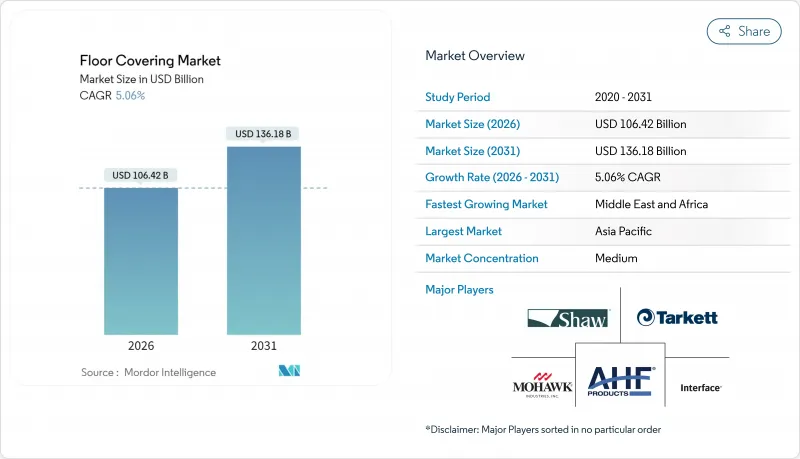
2025 年地板材料市场价值为 1,012.8 亿美元,预计从 2026 年的 1,064.2 亿美元成长到 2031 年的 1,361.8 亿美元,在预测期(2026-2031 年)内复合年增长率为 5.06%。
北美强劲的住宅维修需求、亚太地区的大规模计划活动以及中东酒店业的復苏,都推动了对高品质、耐用地板材料的需求。诸如硬芯防水地板和无PVC弹性地板材料等创新产品拓宽了地板的应用范围,使供应商能够在不大幅牺牲设计的情况下,满足从潮湿地下室到人流量大的商业走廊等各种场所的需求。製造商正在扩大其在美国的生产规模,以规避关税风险、缩短前置作业时间并遵守更严格的VOC排放法规。这项策略也有助于增强供应链抵御国际运输中断的能力。电子商务正在透过整合扩增实境(商店)视觉化工具和直接面向消费者的物流模式,改变购买流程,推动家居装潢连锁店采用虚拟设计咨询和线上订购线下取货服务。竞争差异化正在转向环境认证,再生材料含量、回收项目正成为企业采购规范的关键要素,而LEED、BREEAM和WELL标准也成为常规参考标准。
全球地板材料市场趋势与洞察
快速的都市化和蓬勃发展的维修活动
预计到2025年,光是印度的城市人口就将超过5亿。这种结构性变化,加上北美地区住宅存量,使得房屋维修房屋抵押贷款利率限制了新建房屋的供应。现有住宅的转售週期与地板材料升级密切相关,因为业主通常会在出售房产时更换磨损的地毯和破损的地砖。商业地产业主也在翻新职场,以适应混合办公模式,这就要求地板材料能够承受频繁的隔间和家具调整,同时保持表面的完整性。与节能维修相关的市政奖励通常将地板材料维修维修相结合,鼓励使用低挥发性有机化合物(VOC)黏合剂和可回收的底层材料。在亚太新兴城市,随着地方政府推广最低生活标准,要求高层住宅铺设防滑、易清洁的地板材料,公共住宅现代化进程正在加速。这些趋势的同步发展将确保稳定的需求基础,并保护地板材料市场免受新建房屋需求週期性下降的影响。能够将各种设计与快速应用系统结合的供应商,最有希望满足自居住和出租房屋的需求,因为在这些房屋中,最短的运作至关重要。
从软表面到硬表面的过渡
消费者的偏好显然正在转向兼具防水、耐刮擦和易于清洁的表面材料。对于有宠物和孩子的繁忙家庭来说,豪华硬乙烯基瓷砖已成为首选。这一趋势反映了生活方式的改变,例如养狗人数的增加和开放式室内设计的普及,使得液体泼洒更容易扩散到整个房间。石塑复合板能够模仿橡木、山核桃木和抛光混凝土的质感,同时在温度波动下保持尺寸稳定性,从而拓展了其在日光室和半封闭式地下室的应用范围。地毯製造商正在重新定位地毯,以满足特定用途的需求,例如为豪华酒店套房提供优质宽幅地毯,在这些场所,奢华的舒适度和隔音效果比维护保养更为重要。零售买家现在透过独立的压痕和抗污测试来评估产品的耐用性,而FloorScore和GREENGUARD等认证在最终选择中也变得越来越重要。随着硬质地板市场份额的持续成长,隔音垫层和柔性过渡条等相关配件市场也蓬勃发展。承包商反映,采用黏合剂浮动卡扣系统可加快计划週转速度,这一优势在一定程度上弥补了技术纯熟劳工短缺的问题。未来三年,随着数位喷墨印刷技术在美观性方面的不断提升,装饰工艺有望得到进一步完善,从而进一步巩固低维护成本的硬质板材的吸引力。
原物料价格波动
自2023年以来,PVC树脂、高岭土和硬木材料的价格季度波动幅度超过20%,这使得合约竞标中的利润率预测变得更加复杂。高度依赖进口的市场将最快感受到这种影响,因为外汇波动加剧了商品价格上涨,迫使经销商维持高额安全库存,从而占用大量营运资金。虽然远期购买树脂期货可以对冲成本,但如果设计週期发生变化,也会使企业面临库存过时的风险。价格波动也会促使企业使用替代材料。例如,当预算紧张时,客户可能会降低规格,例如从橡木改为桦木,或从釉药瓷砖改为抛光混凝土。由于合约中很少包含价格调整条款,小规模安装商被迫承担不成比例的高风险。虽然这种影响会限制地板材料市场的短期成长,但随着亚洲和北美产能扩张后供需平衡的恢復正常,长期前景依然乐观。供应商与多家供应商签订多年原物料采购协议,可降低风险,并为指定方维持物价稳定。
细分市场分析
到2025年,弹性地板材料将占据31.78%的最高市场份额,巩固其在维修和新建项目中的主导地位,这些项目优先考虑快速施工和防水性能。在这一类别中,石塑复合材料地板材料正以11.10%的复合年增长率推动市场规模的成长。传统地面材料无法企及此成长速度,这主要得益于可缩短安装时间的卡扣式拼接系统。瓷砖保持了18.23%的市场份额,这主要得益于能够承受更高机械负荷的改良瓷砖,使其在机场和购物中心等场所的应用范围不断扩大。儘管仿木纹乙烯基复合地板材料取得了长足进步,但实木地板材料仍维持了8.42%的市场份额。工程复合地板材料尤其受到青睐,因为它兼具实木装饰层板的美观性和地暖系统所需的尺寸稳定性。超耐磨地板的年增长率为6.18%,这得益于製造商开始对边缘倒角进行密封处理,并实现了此前只有乙烯基复合地板才具备的24小时防水保证。地毯和块毯占地面面积的31.45%,但在客厅中,其份额已被硬质地板超越。然而,在开放式办公室的模组化设计中,方块地毯的需求依然强劲。永续性是贯穿整个产业的优先事项,供应商正积极推动采用符合循环经济采购准则的再生PET背衬和不含PVC的耐磨层。性能提升与环境法规的整合,确保了产品创新将持续成为塑造整个地板材料市场品类组合的关键驱动力。
硬质芯材和数位印刷技术的快速发展从根本上改变了定价格局,使得中等价位的产品能够以更低的成本复製木材和石材的纹理细节,从而与高端产品展开竞争。各大品牌也开始采用复合材料,例如混合板材——在矿物芯材之间夹有木纹装饰层板和软木垫片——这种板材既能隔热又能防止潮气渗入。随着全球原料价格趋于稳定,复合材料相对于采石场大理石和实木的成本优势可能会进一步扩大,从而重新调整建筑师和住宅对价值的认知。儘管区域偏好依然显着(例如欧洲的宽幅橡木地板和东南亚的亮面瓷质砖),但线上视觉化工具正在逐步统一风格选择,并推动全球对统一图案的需求成长。陶瓷和地毯行业面临激烈的竞争,但防滑、隔音和防污技术的创新正在帮助这些材料保持其竞争优势。展望未来,能否将可再生材料和循环物流融入产品故事将决定谁能在不断扩大的地板材料市场中赢得份额。
地板材料市场报告按产品类型(地毯、木块毯、瓷砖地板材料、超耐磨地板地板材料、 PVC地板、石材地板材料及其他产品)、最终用户(商业、住宅)、分销渠道(家居装饰商店、旗舰店、专卖店及其他)和地区(北美及其他)进行细分。市场预测以美元为单位,并基于现有资讯提供。
区域分析
亚太地区在2025年将以37.10%的市场份额领跑,这主要得益于都市区住宅需求的持续增长和不断扩张的大都会圈交通网络,这些因素每年消耗数百万平方公尺的陶瓷和弹性地板材料。印度的房地产蓝图预计到2030年将打造一个1兆美元的市场,将推动高层公寓大楼、区域零售中心和IT园区大厅对复合地板材料的需求。儘管中国的宏观审慎政策抑制了投机性建设的开工,但该国仍在继续维修老旧多用户住宅,采用节能建筑幕墙,从而更换室内地板材料。越南958亿美元的建设产业正以7%的年增长率成长,这主要得益于政府基础设施支出以及地铁站和工业训练中心对瓷砖需求的稳定成长。东南亚4.5%的累积GDP成长率正在推动旅游业復苏,并促进采用设计感十足的复合木地板的精品酒店的发展。
北美市场持续维持30.95%的市占率和4.15%的复合年增长率,主要受翻新需求的推动。节能维修的税收优惠鼓励住宅用隔热、防水且可与地暖维修相容的地板材料替换老旧的地毯。国内LVT地板的生产降低了运费波动风险,而美墨加协定(USMCA)则促进了加拿大锯木厂和墨西哥层压板厂之间的原料流通。欧洲市场维持27.85%的市占率和3.06%的复合年增长率,主要得益于德国和义大利的维修计画。两国的补贴政策鼓励使用低VOC(挥发性有机化合物)涂料。同时,REACH法规制定了严格的化学品标准,加速了不合规进口产品的退出市场。中东和非洲地区虽然目前市占率小规模,但其复合年增长率高达8.05%,表现最为突出。沙乌地阿拉伯的「2030愿景」计画正在推动酒店业的快速发展,从而带动了NEOM等计划对地板材料的需求;与此同时,阿联酋的住宅项目正在使用大理石纹理的乙烯基材料来抵御沙漠沙砾的磨损。
不同地区的建筑标准差异导致产品组合的差异。在欧洲,符合地暖效率要求的卡扣式陶瓷复合地板占据主导地位;而在北美,宽幅SPC地板则因其适用于地下室维修备受青睐。物流基础设施也影响市场需求;非洲港口吞吐能力的提升为重型瓷砖的进口开闢了新的途径,而本地石材对于豪华别墅而言依然具有成本效益。货币稳定性影响拉丁美洲地区进口复合地板与本地实木地板的市场选择。然而,更广泛的南美洲数据超出了本文的研究范围,因此在此不做赘述。总体而言,地域多元化能够保护地板材料市场免受区域景气衰退,并确保其在全球范围内稳步扩张。
其他福利:
- Excel格式的市场预测(ME)表
- 3个月的分析师支持
目录
第一章 引言
- 研究假设和市场定义
- 调查范围
第二章调查方法
第三章执行摘要
第四章 市场情势
- 市场概览
- 市场驱动因素
- 快速的都市化和蓬勃发展的维修活动
- 从软地板材料过渡到硬地面(LVT、SPC、木纹地板材料)
- 亚太地区和中东及非洲市场的建筑业蓬勃发展
- 刚性芯材与防水技术的产品创新
- 美国LVT生产线回流(关税减免措施)
- 医疗和教育设施对抗菌地板材料的需求
- 市场限制
- 原料价格波动(PVC树脂、硬木、陶瓷)
- 对塑胶地板材料的环境法规更加严格
- 持证地板施工技术人员短缺
- 关税和贸易政策的突然变化导致进口供应链中断
- 价值/供应链分析
- 监管环境
- 技术展望
- 波特五力模型
- 新进入者的威胁
- 供应商的议价能力
- 买方的议价能力
- 替代品的威胁
- 竞争对手之间的竞争
第五章 市场规模与成长预测
- 副产品
- 地毯和块毯
- 木地板
- 磁砖地板材料
- 复合地板
- 乙烯基地板材料
- 石材地板材料
- 其他产品
- 最终用户
- 商业的
- 住宅
- 透过分销管道
- 家居建材商店
- 旗舰店
- 专卖店
- 网路商店
- 其他分销管道
- 按地区
- 北美洲
- 加拿大
- 美国
- 墨西哥
- 南美洲
- 巴西
- 秘鲁
- 智利
- 阿根廷
- 其他南美洲
- 欧洲
- 英国
- 德国
- 法国
- 西班牙
- 义大利
- 比荷卢经济联盟(比利时、荷兰、卢森堡)
- 北欧国家(丹麦、芬兰、冰岛、挪威、瑞典)
- 其他欧洲地区
- 亚太地区
- 印度
- 中国
- 日本
- 澳洲
- 韩国
- 东南亚(新加坡、马来西亚、泰国、印尼、越南、菲律宾)
- 亚太其他地区
- 中东和非洲
- 阿拉伯聯合大公国
- 沙乌地阿拉伯
- 南非
- 奈及利亚
- 其他中东和非洲地区
- 北美洲
第六章 竞争情势
- 市场集中度
- 策略趋势
- 市占率分析
- 公司简介
- Mohawk Industries
- Shaw Industries
- Tarkett SA
- Interface Inc.
- Armstrong Flooring/AHF Products
- Beaulieu International Group
- Gerflor Group
- Mannington Mills
- Milliken & Company
- Forbo Holding
- Congoleum Corporation
- Swiss Krono Group
- Boral Limited
- Orientbell Tiles
- Kajaria Ceramics
- Grupo Lamosa
- Ragno Ceramics
- Victoria PLC
- Roppe Corporation
- Ege Carpets
第七章 市场机会与未来展望
The floor covering market was valued at USD 101.28 billion in 2025 and estimated to grow from USD 106.42 billion in 2026 to reach USD 136.18 billion by 2031, at a CAGR of 5.06% during the forecast period (2026-2031).
Robust residential renovation in North America, megaproject activity in Asia-Pacific, and recovery in hospitality construction across the Middle East collectively anchor demand for premium, long-life surfaces. Technological breakthroughs such as rigid-core waterproof planks and PVC-free resilient options broaden application versatility, allowing suppliers to address both moisture-prone basements and high-traffic commercial corridors without major design compromises. Manufacturers are increasingly localizing production in the United States to sidestep tariff exposure, compress lead times, and meet stringent VOC emission rules, a strategy that also bolsters supply-chain resilience against global shipping disruptions. E-commerce is reshaping purchasing journeys by merging augmented-reality visualization tools with direct-to-consumer logistics, which is motivating home-center chains to integrate virtual design consultations and click-and-collect fulfillment. Competitive differentiation is shifting toward environmental credentials, with recycled-content formulations and take-back recycling programs becoming decisive in corporate procurement specifications that now routinely reference LEED, BREEAM, and WELL benchmarks.
Global Floor Covering Market Trends and Insights
Rapid Urbanization & Booming Renovation Activities
Urban populations in India alone are expected to top 500 million by 2025, and that structural shift, combined with aging housing stock across North America, keeps retrofit spending elevated even while mortgage rates temper new-build volumes. Existing-home resale cycles correlate strongly with flooring upgrades because owners typically replace outdated carpet or chipped tiles when preparing a property for listing. Commercial landlords are similarly retrofitting workplaces to support hybrid office strategies, which requires surfaces that tolerate frequent reconfiguration of partitions and furniture glides without losing finish integrity. Municipal incentives tied to energy-efficient retrofits often bundle floor replacement grants with broader envelope-upgrade programs, stimulating adoption of low-VOC adhesives and recycled underlayment. In emerging Asia-Pacific cities, public housing modernization is accelerating as provincial authorities push minimum living-standard codes that mandate non-slip, easy-clean floor materials in high-rise dwellings. These simultaneous dynamics ensure a consistent baseline demand that cushions the floor covering market against cyclical dips in new construction. Suppliers that package pattern-rich visuals and rapid-install systems are best positioned to capture volume across both owner-occupied and rental properties, where minimal downtime is critical.
Shift from Soft to Hard-Surface Flooring
Consumer attitudes have swung decisively toward surfaces that combine waterproof integrity, scratch resistance, and quick sanitation, propelling rigid luxury vinyl tile to the top of specification lists for busy households with pets and children. The move reflects lifestyle shifts such as rising dog ownership and open-concept interiors where spills travel unimpeded across rooms. Stone plastic composite boards emulate oak, hickory, or polished concrete yet remain dimensionally stable under temperature swings, which widens their suitability for sunrooms and semi-conditioned basements. Carpet manufacturers are repositioning toward niche use-cases like premium broadloom for high-end hospitality suites where plush comfort and acoustic dampening outweigh maintenance concerns. Retail buyers now benchmark product durability through independent indentation and stain-resistance tests, elevating the status of certifications such as FloorScore and GREENGUARD in final selection. As the hard-surface share widens, accessory markets for sound-absorbing underlayment and flexible transition strips experience adjacent growth spurts. Installers report quicker project turnover because floating-click systems eliminate the need for adhesives, a benefit that partially offsets skilled-labor shortages. Over the coming three years, incremental aesthetic gains from digital-ink printing are expected to satisfy decor cycles, further cementing the appeal of low-maintenance rigid formats.
Volatile Raw-Material Prices
PVC resin, ceramic clay, and hardwood lumber have experienced price swings exceeding 20% within single fiscal quarters since 2023, complicating margin forecasting for contract bids. Import-heavy markets feel the pinch fastest because currency fluctuations compound commodity spikes, compelling distributors to hold higher safety stocks that tie up working capital. Forward-buying resin futures can hedge costs but expose companies to inventory obsolescence if design cycles shift. Volatility encourages substitution; for example, customers may down-spec from oak to birch or from glazed porcelain to polished concrete overlays when budgets tighten. Smaller installers absorb disproportionately high risk because their contracts seldom include escalation clauses. The net effect trims near-term floor covering market growth, although the long-run outlook remains positive as supply-demand imbalances normalize post-capacity additions in Asia and North America. Suppliers that negotiate multi-year feedstock agreements with diversified sources limit exposure and maintain price stability for specification writers.
Other drivers and restraints analyzed in the detailed report include:
- Construction Boom in Asia-Pacific & MEA Markets
- On-shoring of LVT Production in the United States
- Environmental Scrutiny of Plastic-Based Flooring
For complete list of drivers and restraints, kindly check the Table Of Contents.
Segment Analysis
Resilient flooring commanded the highest share at 31.78% in 2025, confirming its dominance in renovation and new-build schedules that emphasize fast installation and water resistance. Within the category, stone plastic composite is propelling the floor covering market size by expanding at an 11.10% CAGR, a pace unmatched by traditional surfaces and aided by click systems that cut labor hours. Ceramic tiles held an 18.23% share thanks to porcelain improvements that now withstand high mechanical loads, widening their fit for airports and shopping centers. Wood flooring retained an 8.42% foothold despite encroachment from wood-look vinyl, with engineered formats gaining traction because they pair genuine veneer aesthetics with dimensional stability across radiant-heat subfloors. Laminate grew 6.18% yearly after manufacturers sealed edge bevels to deliver 24-hour water warranties, a feature once exclusive to vinyl. Carpet and area rugs still covered 31.45% of installed square footage, but ceded living-room ground to hard surfaces, even though carpet tiles thrive in open-office modular plans. Sustainability is a cross-cutting priority, pushing suppliers to introduce recycled PET backings and PVC-free wear layers that qualify under circular-economy procurement guidelines. The convergence of performance upgrades and environmental mandates ensures that product innovation remains the principal lever shaping category mix across the floor covering market.
The surge of rigid-core and digital-print capabilities fundamentally shifts pricing ladders, enabling mid-tier products to encroach on premium wood or stone positions by replicating texture nuances at a fraction of the cost. Brands are also embracing mixed materials such as hybrid planks that sandwich mineral cores between wood veneers or cork pads, delivering thermal comfort while guarding against moisture ingress. As global raw-material prices stabilize, cost advantages may widen for engineered composites over quarried marble or solid hardwood, realigning value perceptions among architects and homeowners. Geographic preferences persist-Europe still favors wide-plank oak while Southeast Asia leans toward glossy porcelain-but online visualization tools are gradually homogenizing style choices, funneling incremental volume toward globally consistent patterns. Although ceramic and carpet segments face stiff competition, innovations in slip-rating, acoustic insulation, and stain technology preserve niches where these materials outperform. In the future, the ability to weave renewable content and recycling logistics into product stories will increasingly determine which brands claim a share of the growing floor covering market size.
The Floor Covering Market Report is Segmented by Product (Carpet & Area Rugs, Wood Flooring, Ceramic Tiles Flooring, Laminate Flooring, Vinyl Flooring, Stone Flooring, Other Products), End User (Commercial, Residential), Distribution Channel (Home Centers, Flagship Stores, Specialty Stores, and Other), and Geography (North America, and Other). The Market Forecasts are Provided in Terms of Value (USD), Based On Availability.
Geography Analysis
Asia-Pacific led with 37.10% share in 2025, buoyed by unrelenting urban housing growth and megacity transportation expansions that consume millions of square meters of ceramic and resilient surfaces annually. India's real-estate roadmap envisions a USD 1 trillion sector by 2030, translating into compounded floor demand spanning high-rise condos, tier-III city retail hubs, and IT campus lobbies. China continues to retrofit older apartment blocks with energy-efficient facades that bundle interior floor replacement, although macroprudential controls temper speculative building starts. Vietnam's USD 95.8 billion construction sector grows at 7% annually on the back of government infrastructure outlays, reflecting steady tile uptake for metro stations and industrial training centers. Southeast Asia's cumulative 4.5% GDP growth propels tourism rebound, spurring boutique hotel developments that specify design-forward composite wood planks .
North America followed at 30.95% share and 4.15% CAGR, driven mainly by remodeling; stimulus tax incentives for energy-efficient retrofits encourage homeowners to swap outdated carpet for insulated, waterproof planks that integrate with radiant-heat upgrades. Domestic LVT production dampens exposure to freight volatility, and USMCA provisions facilitate raw-material flows between Canadian lumber mills and Mexican laminate plants. Europe maintained a 27.85% share and a 3.06% CAGR, anchored by renovation programs in Germany and Italy, where subsidies promote low-VOC finishes; meanwhile, the REACH regulation sets stringent chemical thresholds that accelerate market exit for non-compliant imports. The Middle East & Africa, albeit the smallest region today, stands out with the fastest 8.05% CAGR as Saudi Arabia's Vision 2030 hospitality boom expands flooring footprints in giga-projects like NEOM, and UAE residential schemes utilize marble-look vinyl that survives desert sand abrasion.
Regional variance in building codes produces product-mix differences: Europe leans toward click-ceramic hybrids to satisfy underfloor-heating efficiency, while North America favors wide-plank SPC for basement remodeling. Logistics infrastructure also shapes demand; Africa's improving port capacity opens routes for heavyweight porcelain imports while local quarry stone remains cost-effective for luxury villas. Currency stability influences the adoption of imported laminate versus locally milled hardwood across Latin America, though broader South American data were outside our input scope and are not elaborated here. Overall, geographic diversification balances the floor covering market against localized recessions, ensuring a globally steady expansion trajectory.
- Mohawk Industries
- Shaw Industries
- Tarkett SA
- Interface Inc.
- Armstrong Flooring / AHF Products
- Beaulieu International Group
- Gerflor Group
- Mannington Mills
- Milliken & Company
- Forbo Holding
- Congoleum Corporation
- Swiss Krono Group
- Boral Limited
- Orientbell Tiles
- Kajaria Ceramics
- Grupo Lamosa
- Ragno Ceramics
- Victoria PLC
- Roppe Corporation
- Ege Carpets
Additional Benefits:
- The market estimate (ME) sheet in Excel format
- 3 months of analyst support
TABLE OF CONTENTS
1 Introduction
- 1.1 Study Assumptions and Market Definition
- 1.2 Scope of the Study
2 Research Methodology
3 Executive Summary
4 Market Landscape
- 4.1 Market Overview
- 4.2 Market Drivers
- 4.2.1 Rapid urbanisation & booming renovation activities
- 4.2.2 Shift from soft to hard-surface flooring (LVT, SPC, wood-look)
- 4.2.3 Construction boom in APAC & MEA markets
- 4.2.4 Product innovations in rigid-core & waterproof technologies
- 4.2.5 On-shoring of LVT production in the U.S. (tariff mitigation)
- 4.2.6 Demand for antimicrobial-treated floors in healthcare & education
- 4.3 Market Restraints
- 4.3.1 Volatile raw-material prices (PVC, hardwood, ceramics)
- 4.3.2 Environmental scrutiny of plastic-based flooring
- 4.3.3 Shortage of certified floor-installation labour
- 4.3.4 Tariff/trade-policy shocks disrupting import supply chains
- 4.4 Value / Supply-Chain Analysis
- 4.5 Regulatory Landscape
- 4.6 Technological Outlook
- 4.7 Porter's Five Forces
- 4.7.1 Threat of New Entrants
- 4.7.2 Bargaining Power of Suppliers
- 4.7.3 Bargaining Power of Buyers
- 4.7.4 Threat of Substitutes
- 4.7.5 Competitive Rivalry
5 Market Size & Growth Forecasts
- 5.1 By Product
- 5.1.1 Carpet & Area Rugs
- 5.1.2 Wood Flooring
- 5.1.3 Ceramic Tiles Flooring
- 5.1.4 Laminate Flooring
- 5.1.5 Vinyl Flooring
- 5.1.6 Stone Flooring
- 5.1.7 Other Products
- 5.2 By End User
- 5.2.1 Commercial
- 5.2.2 Residential
- 5.3 By Distribution Channel
- 5.3.1 Home Centers
- 5.3.2 Flagship Stores
- 5.3.3 Specialty Stores
- 5.3.4 Online Stores
- 5.3.5 Other Distribution Channels
- 5.4 By Region
- 5.4.1 North America
- 5.4.1.1 Canada
- 5.4.1.2 United States
- 5.4.1.3 Mexico
- 5.4.2 South America
- 5.4.2.1 Brazil
- 5.4.2.2 Peru
- 5.4.2.3 Chile
- 5.4.2.4 Argentina
- 5.4.2.5 Rest of South America
- 5.4.3 Europe
- 5.4.3.1 United Kingdom
- 5.4.3.2 Germany
- 5.4.3.3 France
- 5.4.3.4 Spain
- 5.4.3.5 Italy
- 5.4.3.6 BENELUX (Belgium, Netherlands, Luxembourg)
- 5.4.3.7 NORDICS (Denmark, Finland, Iceland, Norway, Sweden)
- 5.4.3.8 Rest of Europe
- 5.4.4 Asia-Pacific
- 5.4.4.1 India
- 5.4.4.2 China
- 5.4.4.3 Japan
- 5.4.4.4 Australia
- 5.4.4.5 South Korea
- 5.4.4.6 South East Asia (SG, MY, TH, ID, VN, PH)
- 5.4.4.7 Rest of Asia-Pacific
- 5.4.5 Middle East & Africa
- 5.4.5.1 United Arab Emirates
- 5.4.5.2 Saudi Arabia
- 5.4.5.3 South Africa
- 5.4.5.4 Nigeria
- 5.4.5.5 Rest of Middle East & Africa
- 5.4.1 North America
6 Competitive Landscape
- 6.1 Market Concentration
- 6.2 Strategic Moves
- 6.3 Market Share Analysis
- 6.4 Company Profiles (includes Global level Overview, Market level overview, Core Segments, Financials as available, Strategic Information, Market Rank/Share for key companies, Products & Services, and Recent Developments)
- 6.4.1 Mohawk Industries
- 6.4.2 Shaw Industries
- 6.4.3 Tarkett SA
- 6.4.4 Interface Inc.
- 6.4.5 Armstrong Flooring / AHF Products
- 6.4.6 Beaulieu International Group
- 6.4.7 Gerflor Group
- 6.4.8 Mannington Mills
- 6.4.9 Milliken & Company
- 6.4.10 Forbo Holding
- 6.4.11 Congoleum Corporation
- 6.4.12 Swiss Krono Group
- 6.4.13 Boral Limited
- 6.4.14 Orientbell Tiles
- 6.4.15 Kajaria Ceramics
- 6.4.16 Grupo Lamosa
- 6.4.17 Ragno Ceramics
- 6.4.18 Victoria PLC
- 6.4.19 Roppe Corporation
- 6.4.20 Ege Carpets
7 Market Opportunities & Future Outlook
- 7.1 Circular-economy take-back & recycling platforms for post-consumer LVT
- 7.2 AI-guided virtual design tools that shorten specification-to-install cycle for commercial projects

 地板材料市场:2026-2032年全球市场预测(依产品类型、安装方式、销售管道及最终用户划分)
 美国地板材料:市场占有率分析、产业趋势与统计、成长预测(2026-2031)英国地板覆盖材料:市场占有率分析、产业趋势与统计、成长预测(2026-2031)
 2026年全球家居布置和地板覆盖材料市场报告
 日本地面铺装材料市场报告(按材料、配销通路、最终用户和地区划分,2026-2034年)
 地板覆盖市场-全球产业规模、份额、趋势、机会和预测,按材料(弹性、非弹性、软地板覆盖)、按应用(住宅、商业、工业)、按地区、按竞争细分,2020-2030 年预测弹性地板材料:市场占有率分析、产业趋势、统计数据和成长预测(2025-2030 年)印尼地板树脂:市场占有率分析、行业趋势和统计、成长预测(2025-2030 年)印度地板树脂:市场占有率分析、行业趋势和统计、成长预测(2025-2030 年)地板树脂:市场占有率分析、行业趋势和统计数据、成长预测(2025-2030 年)