


 |
市场调查报告书
商品编码
1910830
出行即服务 (MaaS) – 市场占有率分析、产业趋势与统计资料、成长预测 (2026-2031)Mobility As A Service - Market Share Analysis, Industry Trends & Statistics, Growth Forecasts (2026 - 2031) |
||||||

※ 本网页内容可能与最新版本有所差异。详细情况请与我们联繫。
预计出行即服务 (MaaS) 市场将从 2025 年的 3,289.8 亿美元成长到 2026 年的 3,745.5 亿美元,到 2031 年达到 7,163 亿美元,2026 年至 2031 年的复合年增长率为 13.85%。
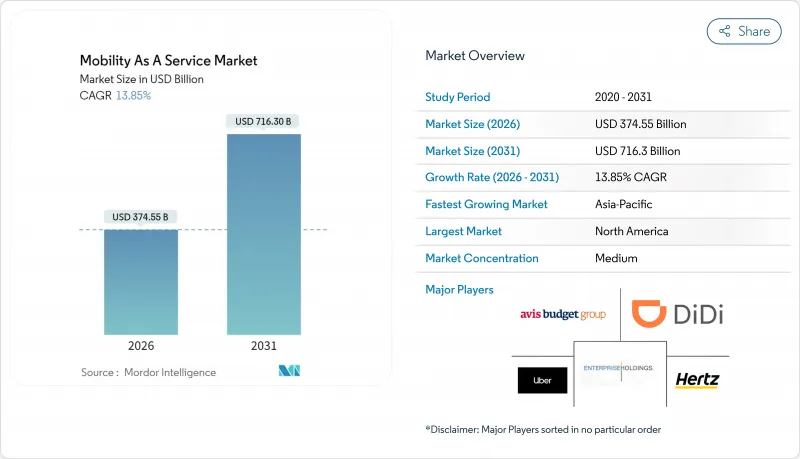
在都市区成长、智慧型手机普及率持续上升以及环保意识增强的推动下,消费者正从拥有私家车转向综合、共用和多模态的交通服务。 API标准化、电动和氢动力技术的应用以及无缝支付创新正在加速跨平台互通性,改善客户体验并实现服务提供者收入来源多元化。政策制定者优先考虑公私合营,并推动零排放目标,以鼓励电动车的大规模普及。同时,5G和物联网的升级正在实现即时车队管理和预测性出行管理。老牌叫车巨头与新兴的专业旅游即服务(MaaS)营运商之间日益激烈的竞争,促使各方大力投资人工智慧、数据货币化和订阅模式,以求脱颖而出。
全球出行即服务 (MaaS) 市场趋势与洞察
将微型交通与公共运输整合到欧洲城市
微出行与传统公共交通系统的无缝融合正在建构多模态网络,并显着改善「最后一公里」和「首公里」的交通连接。赫尔辛基和维也纳等欧洲城市走在前列,其公共运输部门积极将共享单车和电动Scooter服务纳入综合出行平台。这种融合已取得显着成效;国际交通论坛报告称,整合良好的微出行服务可将城市走廊的公共运输客流量提高高达35%。最成功的案例包括:在交通枢纽附近策略性地设置标准化停靠站、统一的支付系统以及即时可用性资料。除了改善交通便利性外,这种融合也在重塑城市规划的优先事项。巴塞隆纳等城市正在重新设计道路基础设施,以创建与公共交通站点直接相连的专用微出行车道。
政府零排放目标推动以电动车为中心的出行即服务 (MaaS) 包装
亚太地区及其他地区严格的排放目标正在推动以电动车为中心的出行即服务(MaaS)的发展,这些服务将电动车网约车、电动车共享和电动自行车租赁整合到一个全面的出行方案中。继中国要求在2030年实现40%的汽车保有量为电动车之后,滴滴出行等公司推出了「绿色联盟」出行即服务套餐,仅提供零排放出行服务。这些以电动车为中心的出行服务正获得显着增长,TÜV南德意志集团的报告显示,与传统汽车相比,电动出行服务可将城市交通排放减少高达70%。
美国各州法规结构的分割
由于美国各州交通法规的差异,出行即服务 (MaaS) 提供者在全国扩张时面临巨大的营运挑战。每个州都制定了不同的许可要求、保险义务和营运限制。这种监管上的割裂迫使企业为每个州开发专门的营运模式,从而显着增加了合规成本并减缓了市场渗透速度。美国联邦公路管理局指出,由于缺乏监管协调,在多个州运营的 MaaS 提供者的营运成本比在法规环境更为统一的地区运营的提供者高出 35%。
细分市场分析
凭藉其庞大的用户群和广泛的司机网络,叫车服务保持着市场领先地位,预计到2025年将以45.85%的市场份额主导出行即服务(MaaS)市场。然而,微出行服务(共享Scooter/自行车)正迅速崛起为成长最快的细分市场,预计2026年至2031年将以19.12%的复合年增长率增长,这主要得益于其在解决「最后一公里」出行难题方面的显着优势。根据IAA出行报告,配备物联网连接和高效能电池的微出行解决方案显着提升了用户体验,提高了可靠性并实现了即时使用情况追踪。此外,地方政府不断扩大专用微出行车道和停车区域的基础设施建设,也进一步推动了这一成长。
汽车共享领域正经历着显着的创新,灵活的自由浮动模式的引入消除了固定上下车地点的需求;与此同时,公车共享服务在企业和校园环境中越来越受欢迎。儘管在某些市场面临监管方面的挑战,但由于实施成本低、用户接受度高,共享Scooter领域仍在快速扩张。
到2025年,技术平台将以37.72%的市占率引领该领域,因为它们是实现服务整合和使用者介面的基础架构。同时,支付和钱包解决方案将成为成长最快的领域,2026年至2031年的复合年增长率将达到20.95%,因为它们消除了多模态出行体验中的关键摩擦点。开放回路支付系统的出现尤其具有变革性意义,PaymentGenes的报告显示,采用这些系统的出行即服务(MaaS)平台的用户采纳率比使用闭合迴路系统的平台高出40%。这些系统使用户无需预先充值或在不同的服务中维护多种支付方式。
随着人工智慧的集成,行程规划和导航解决方案不断发展,人工智慧可以预测中断情况并即时提案替代方案;连接和远端资讯处理解决方案增强了车辆追踪和车队管理能力;保险支援服务也在不断扩展,以满足共用出行用户的独特需求。
预计到2025年,乘用车将维持56.63%的市场份额,这意味着叫车和共享汽车服务将在出行即服务(MaaS)生态系统中继续发挥重要作用。然而,自动驾驶舱预计将在2026年至2031年间实现最高的复合年增长率(CAGR),达到22.74%,因为它们在可控环境和「最后一公里」出行方面提供了极具吸引力的解决方案。发表在IEEE智慧交通系统杂誌上的一项研究表明,与传统的固定路线交通相比,自动驾驶模组化车辆技术可以降低高达40%的营运成本,同时提高服务的柔软性。这些自动驾驶舱在校园、商业园区和规划完善的社区等基础设施可优化以适应自动驾驶的场所将特别有效。
微型交通工具(电动自行车、电动Scooter)的市场份额持续增长,尤其是在人口密集的都市区,它们凭藉卓越的操控性和便利性的停车条件脱颖而出。随着按需出行演算法的引入,接驳车和公车也在不断发展,这些演算法能够优化乘客效率并减少等待时间。
区域分析
亚太地区凭藉其人口密集的城市、先进的数位支付和协调的基础设施投资,预计将在2025年占据出行即服务(MaaS)市场34.12%的份额。在中国,主要大都市地区的车辆登记限制正促使通勤者转向共用平台;而在印度,不断壮大的中产阶级正在接受价格合理的叫车服务。新加坡的「智慧国家计画」将公共交通、微出行和统一支付整合到一个市民应用程式中,展现了最佳的整合实践。
北美是全球第二大共享旅游市场。高昂的车辆拥有成本、都市区密度增加以及企业差旅的永续性要求正在推动共用出行的发展,但各州监管政策的差异正在减缓全国性平台的规模扩张。旧金山、奥斯汀和多伦多等城市的技术领先地位正在推动预测分析和自动驾驶试点计画的早期应用。政府对电动车队的激励措施也进一步强化了该地区的出行转型。
预计中东和非洲将成为该地区成长最快的地区,到2031年复合年增长率将达到14.05% 。波湾合作理事会(GCC)各国政府正将出行即服务(MaaS)优先纳入NEOM和Eksports City等智慧城市大型企划中,并投入资金自动驾驶接驳车和综合票价系统。阿卜杜勒·拉蒂夫·贾米尔和Joby Aviation签署了一份谅解备忘录,计划部署多达200架电动垂直起降飞机,以扩展地面服务并加强多模态网络,这标誌着空中运输新的雄心壮志。
其他福利
- Excel格式的市场预测(ME)表
- 3个月的分析师支持
目录
第一章 引言
- 研究假设和市场定义
- 调查范围
第二章调查方法
第三章执行摘要
第四章 市场情势
- 市场概览
- 市场驱动因素
- 将微型交通与公共运输整合到欧洲城市
- 政府零排放目标推动以电动车为中心的旅游即服务 (MaaS) 套餐(亚太地区)
- 透过 API 标准化(NeTEx、GTFS-RT)实现基于帐户的票务系统
- 拉丁美洲MaaS超级创业投资资金筹措激增
- 基于5G/IoT的即时移动性编配
- 北美企业差旅永续性要求
- 市场限制
- 美国各州法规结构碎片化
- GDPR/CCPA 资料隐私合规成本
- 由于对驾驶人和运营商的补贴,盈利面临挑战。
- 由于传统交通运输资讯系统造成的整合深度限制
- 价值/供应链分析
- 监理展望
- 技术展望
- 波特五力分析
- 买方和消费者的议价能力
- 供应商的议价能力
- 新进入者的威胁
- 替代品的威胁
- 竞争对手之间的竞争
第五章 市场规模及成长预测(价值(美元))
- 按服务类型
- 共乘
- 汽车共享
- 自行车共享
- 共享Scooter
- 共乘
- 透过解决方案
- 技术平台
- 支付和钱包
- 行程规划和导航
- 互联互通和远端资讯处理
- 保险和支援服务
- 按车辆类型
- 搭乘用车
- 微型交通工具(电动自行车、电动Scooter)
- 接驳巴士和当地巴士
- 自动驾驶舱
- 透过交通工具
- 面向大众
- 私人的
- 按经营模式
- 订阅服务(行动套餐、企业套餐)
- 付费使用制
- P2P
- 仅限门票销售聚合器
- 透过使用
- 个人出行
- 商务/企业流动性
- 物流和最后一公里配送
- 最终用户
- 个人
- 公司
- 政府和地方政府机构
- 按作业系统
- iOS
- Android
- 其他的
- HarmonyOS
- KaiOS
- Windows/PWA
- 透过推进力
- 内燃机(ICE)
- 电动车
- 杂交种
- 氢燃料电池
- 按地区
- 北美洲
- 美国
- 加拿大
- 墨西哥
- 北美其他地区
- 欧洲
- 德国
- 英国
- 法国
- 西班牙
- 义大利
- 北欧国家
- 其他欧洲
- 亚太地区
- 中国
- 印度
- 日本
- 韩国
- 澳洲
- 其他亚洲地区
- 南美洲
- 巴西
- 智利
- 南美洲其他地区
- 中东和非洲
- 沙乌地阿拉伯
- 阿拉伯聯合大公国
- 埃及
- 土耳其
- 南非
- 其他中东和非洲地区
- 北美洲
第六章 竞争情势
- 市场集中度
- 策略趋势
- 市占率分析
- 公司简介
- Uber Technologies Inc.
- Didi Chuxing
- Lyft Inc.
- Grab Holdings Ltd.
- FREE NOW(GMBH)
- Bolt Technology OU
- MaaS Global(Whim)
- Moovit Inc.
- Citymapper Ltd.
- Via Transportation Inc.
- Beeline Mobility
- UbiGo AB
- Tier Mobility SE
- Lime Technology Inc.
- Bird Global Inc.
- Bridj Technology Pty Ltd.
- Zipcar(AVIS Budget Group)
- The Hertz Corporation
- Enterprise Holdings Inc.
- Free2Move(STELLANTIS)
- BlaBlaCar(Comuto SA)
- Gojek(GoTo Group)
- Uber Technologies Inc.
- 市场机会与未来展望
- 空白空间与未满足需求评估
- Government-Funded MaaS Vouchers for Low-Income Commuters
- Carbon-Credit Trading Linked to MaaS Usage Data
- AI-Driven Dynamic Fare Bundling and Personalised Subscriptions
- B2B Fleet Electrification Partnerships with OEMs
- 自主按需接驳车网路展望 ~ 2028 年
- Insurance-as-a-Service Platforms Tailored for MaaS Operators
- 空白空间与未满足需求评估
The mobility as a service market is expected to grow from USD 328.98 billion in 2025 to USD 374.55 billion in 2026 and is forecast to reach USD 716.3 billion by 2031 at 13.85% CAGR over 2026-2031.
Strong urban population growth, continuous smartphone adoption, and heightened environmental awareness are shifting consumers from private vehicle ownership toward integrated, shared, and multimodal transport offerings. API standardization, electric and hydrogen propulsion adoption, and seamless payment innovation are accelerating platform interoperability, improving customer experience, and driving provider revenue diversification. Policymakers are pushing zero-emission goals that prioritize public-private partnerships and stimulate large-scale deployments of electric fleets, while 5G and IoT upgrades enable real-time fleet orchestration and predictive journey management. Intensifying competition between incumbent ride-hailing leaders and emerging specialized MaaS orchestrators is prompting aggressive investment in artificial intelligence, data monetization, and subscription models as companies seek defensible differentiation.
Global Mobility As A Service Market Trends and Insights
Integration of Micro-Mobility and Public Transit Across European Cities
The seamless integration of micro-mobility options with traditional public transit systems creates multimodal transportation networks that significantly enhance first-mile/last-mile connectivity. European cities like Helsinki and Vienna are pioneering this integration, with public transport authorities actively incorporating bike-sharing and e-scooter services into unified mobility platforms. This integration is yielding remarkable results, with the International Transport Forum reporting that properly integrated micro-mobility can increase public transit ridership by up to 35% in urban corridors.The most successful implementations feature standardized docking stations strategically positioned near transit hubs, unified payment systems, and real-time availability data. Beyond improving transit accessibility, this integration is reshaping urban planning priorities, with cities like Barcelona redesigning street infrastructure to accommodate micro-mobility lanes that connect directly to transit stations.
Government Zero-Emission Targets Fueling EV-Centric MaaS Bundles
Stringent emission reduction targets across regions such as Asia-Pacific are catalyzing the development of electric vehicle-focused MaaS offerings that combine EV ride-hailing, electric car-sharing, and e-bike rentals into comprehensive mobility packages. China's mandate for 40% of vehicles to be electric by 2030 has prompted companies like Didi to launch "Green Alliance" MaaS bundles that exclusively feature zero-emission transportation options. These EV-centric services are gaining significant traction, with TUV SUD reporting that electric mobility services can reduce urban transport emissions by up to 70% compared to conventional vehicle usage
Fragmented Regulatory Frameworks Across U.S. States
The inconsistent patchwork of transportation regulations across U.S. states is creating significant operational challenges for MaaS providers attempting to scale nationally. Each state imposes different licensing requirements, insurance mandates, and operational restrictions. This regulatory fragmentation forces companies to develop state-specific operational models, substantially increasing compliance costs and slowing market penetration. The Federal Highway Administration highlights that this lack of regulatory harmonization has resulted in up to 35% higher operational costs for multi-state MaaS providers than those operating in more unified regulatory environments.
Other drivers and restraints analyzed in the detailed report include:
- API Standardization (NeTEx, GTFS-RT) Enabling Account-Based Ticketing
- Surge in VC Funding for South America MaaS Super-Apps
- GDPR/CCPA-Driven Data-Privacy Compliance Costs
For complete list of drivers and restraints, kindly check the Table Of Contents.
Segment Analysis
Ride-hailing dominates the MaaS market with a 45.85% share in 2025, leveraging its established user base and extensive driver networks to maintain market leadership. However, micro-mobility services (scooter/bike sharing) are emerging as the fastest-growing segment with a projected CAGR of 19.12% from 2026 to 2031, driven by their effectiveness in addressing first-mile/last-mile connectivity challenges. The IAA Mobility report indicates that micro-mobility solutions equipped with IoT connectivity and high-performance batteries significantly enhance user experience through improved stability and real-time availability tracking. This growth is further supported by city governments increasingly allocating dedicated infrastructure for micro-mobility lanes and parking zones.
The car sharing segment is witnessing substantial innovation through the introduction of flexible, free-floating models that eliminate fixed pickup and drop-off locations, while bus sharing services are gaining traction in corporate environments and campus settings. The scooter sharing segment, despite regulatory challenges in some markets, is expanding rapidly due to its low implementation costs and high user adoption rates.
Technology platforms lead this segment with 37.72% market share in 2025, serving as the foundational infrastructure that enables service integration and user interface. Meanwhile, payment and wallet solutions are experiencing the fastest growth at a 20.95% CAGR (2026-2031), as they address a critical friction point in the multimodal journey experience. The emergence of open-loop payment systems is particularly transformative, with PaymentGenes reporting that MaaS platforms implementing these systems see up to 40% higher user retention compared to those using closed-loop systems. These systems eliminate the need for users to preload funds or maintain multiple payment methods across different services.
Trip planning and navigation solutions continue to evolve with the integration of artificial intelligence that can predict disruptions and suggest alternatives in real-time. Connectivity and telematics solutions are enabling enhanced vehicle tracking and fleet management capabilities, while insurance and support services are expanding to address the unique needs of shared mobility users.
Passenger cars maintain their dominance with 56.63% market share in 2025, reflecting the continued importance of ride-hailing and car-sharing services in the MaaS ecosystem. However, autonomous pods are projected to achieve the highest growth rate at 22.74% CAGR from 2026-2031, as they offer a compelling solution for controlled environments and first/last-mile connectivity. Research published in the IEEE Intelligent Transportation Systems Magazine demonstrates that autonomous modular vehicle technology can reduce operational costs by up to 40% compared to traditional fixed-route transit while improving service flexibility.These self-driving pods are particularly effective in campus environments, business parks, and planned communities where infrastructure can be optimized for autonomous operation.
Micro-mobility vehicles (e-bikes, e-scooters) continue to gain market share, particularly in dense urban areas where they offer superior maneuverability and parking convenience. Shuttles and buses are evolving with the introduction of on-demand routing algorithms that optimize occupancy rates and reduce wait times.
The Mobility As A Service Market Report is Segmented by Service Type (Ride-Hailing, Car Sharing, and More), Solution (Technology Platform, Payment and Wallet, and More), Vehicle Type (Passenger Cars, Shuttles and Buses, and More), Transportation Type (Public and Private), Business Model, Application, End-User, Operating System, Propulsion, and Geography. The Market Forecasts are Provided in Terms of Value (USD).
Geography Analysis
Asia-Pacific contributed 34.12% of the mobility as a service market share in 2025, capitalizing on dense cities, advanced digital payments, and coordinated infrastructure investments. China's restriction on vehicle registrations in major metros nudges commuters toward shared platforms, while India's expanding middle class embraces affordable ride-hailing. Singapore's Smart Nation blueprint integrates public transit, micro-mobility, and unified payments into a single citizen app that exemplifies best-practice integration.
North America ranks second in market size. High ownership costs, renewed urban densification, and corporate travel sustainability mandates propel shared mobility growth, though state-by-state regulatory divergence slows national platform scale. Technology leadership in San Francisco, Austin, and Toronto supports early adoption of predictive analytics and autonomous pilots. Government incentives for electric vehicle fleets further strengthen the region's mobility shift.
The Middle East and Africa presents the fastest regional expansion at 14.05% CAGR through 2031. Gulf Cooperation Council governments prioritize MaaS within smart-city megaprojects like NEOM and Expo City, allocating capital for autonomous shuttles and integrated fare systems. The Memorandum of Understanding between Abdul Latif Jameel and Joby Aviation to deploy up to 200 electric vertical take-off aircraft signals nascent aerial mobility ambition, augmenting ground-based services and reinforcing multimodal networks.
- Uber Technologies Inc.
Additional Benefits:
- The market estimate (ME) sheet in Excel format
- 3 months of analyst support
TABLE OF CONTENTS
1 Introduction
- 1.1 Study Assumptions and Market Definition
- 1.2 Scope of the Study
2 Research Methodology
3 Executive Summary
4 Market Landscape
- 4.1 Market Overview
- 4.2 Market Drivers
- 4.2.1 Integration of Micro-Mobility and Public Transit Across European Cities
- 4.2.2 Government Zero-Emission Targets Fueling EV-Centric MaaS Bundles (Asia-Pacific)
- 4.2.3 API Standardization (NeTEx, GTFS-RT) Enabling Account-Based Ticketing
- 4.2.4 Surge in VC Funding for LatAm MaaS Super-Apps
- 4.2.5 5G/IoT-Driven Real-Time Mobility Orchestration
- 4.2.6 Corporate Travel Sustainability Mandates in North America
- 4.3 Market Restraints
- 4.3.1 Fragmented Regulatory Frameworks Across U.S. States
- 4.3.2 GDPR/CCPA-Driven Data-Privacy Compliance Costs
- 4.3.3 Profitability Challenges from Driver/Provider Subsidies
- 4.3.4 Legacy Transit IT Systems Limiting Integration Depth
- 4.4 Value / Supply-Chain Analysis
- 4.5 Regulatory Outlook
- 4.6 Technological Outlook
- 4.7 Porter's Five Forces Analysis
- 4.7.1 Bargaining Power of Buyers/Consumers
- 4.7.2 Bargaining Power of Suppliers
- 4.7.3 Threat of New Entrants
- 4.7.4 Threat of Substitute Products
- 4.7.5 Intensity of Competitive Rivalry
5 Market Size and Growth Forecasts (Value (USD))
- 5.1 By Service Type
- 5.1.1 Ride-Hailing
- 5.1.2 Car Sharing
- 5.1.3 Bike Sharing
- 5.1.4 Scooter Sharing
- 5.1.5 Bus Sharing
- 5.2 By Solution
- 5.2.1 Technology Platform
- 5.2.2 Payment and Wallet
- 5.2.3 Trip Planning and Navigation
- 5.2.4 Connectivity and Telematics
- 5.2.5 Insurance and Support Services
- 5.3 By Vehicle Type
- 5.3.1 Passenger Cars
- 5.3.2 Micro-Mobility Vehicles (E-Bikes, E-Scooters)
- 5.3.3 Shuttles and Buses
- 5.3.4 Autonomous Pods
- 5.4 By Transportation Type
- 5.4.1 Public
- 5.4.2 Private
- 5.5 By Business Model
- 5.5.1 Subscription (Mobility Bundles, Corporate Plans)
- 5.5.2 Pay-As-You-Go
- 5.5.3 Peer-to-Peer
- 5.5.4 Ticketing-Only Aggregator
- 5.6 By Application
- 5.6.1 Personal Mobility
- 5.6.2 Business/Corporate Mobility
- 5.6.3 Logistics and Last-Mile Delivery
- 5.7 By End-User
- 5.7.1 Individuals
- 5.7.2 Enterprises
- 5.7.3 Government and Municipal Agencies
- 5.8 By Operating System
- 5.8.1 iOS
- 5.8.2 Android
- 5.8.3 Others
- 5.8.3.1 HarmonyOS
- 5.8.3.2 KaiOS
- 5.8.3.3 Windows/PWAs
- 5.9 By Propulsion
- 5.9.1 Internal Combustion Engine (ICE)
- 5.9.2 Electric
- 5.9.3 Hybrid
- 5.9.4 Hydrogen Fuel-Cell
- 5.10 By Geography
- 5.10.1 North America
- 5.10.1.1 United States
- 5.10.1.2 Canada
- 5.10.1.3 Mexico
- 5.10.1.4 Rest of North America
- 5.10.2 Europe
- 5.10.2.1 Germany
- 5.10.2.2 United Kingdom
- 5.10.2.3 France
- 5.10.2.4 Spain
- 5.10.2.5 Italy
- 5.10.2.6 Nordics
- 5.10.2.7 Rest of Europe
- 5.10.3 Asia-Pacific
- 5.10.3.1 China
- 5.10.3.2 India
- 5.10.3.3 Japan
- 5.10.3.4 South Korea
- 5.10.3.5 Australia
- 5.10.3.6 Rest of Asia
- 5.10.4 South America
- 5.10.4.1 Brazil
- 5.10.4.2 Chile
- 5.10.4.3 Rest of South America
- 5.10.5 Middle East and Africa
- 5.10.5.1 Saudi Arabia
- 5.10.5.2 United Arab Emirates
- 5.10.5.3 Egypt
- 5.10.5.4 Turkey
- 5.10.5.5 South Africa
- 5.10.5.6 Rest of Middle East and Africa
- 5.10.1 North America
6 Competitive Landscape
- 6.1 Market Concentration
- 6.2 Strategic Moves
- 6.3 Market Share Analysis
- 6.4 Company Profiles (Includes Global Level Overview, Market Level Overview, Core Segments, Financials as Available, Strategic Information, Market Rank/Share for Key Companies, Products and Services, SWOT Analysis, and Recent Developments)
- 6.4.1 Uber Technologies Inc.
- 6.4.1.1 Didi Chuxing
- 6.4.1.2 Lyft Inc.
- 6.4.1.3 Grab Holdings Ltd.
- 6.4.1.4 FREE NOW (GMBH)
- 6.4.1.5 Bolt Technology OU
- 6.4.1.6 MaaS Global (Whim)
- 6.4.1.7 Moovit Inc.
- 6.4.1.8 Citymapper Ltd.
- 6.4.1.9 Via Transportation Inc.
- 6.4.1.10 Beeline Mobility
- 6.4.1.11 UbiGo AB
- 6.4.1.12 Tier Mobility SE
- 6.4.1.13 Lime Technology Inc.
- 6.4.1.14 Bird Global Inc.
- 6.4.1.15 Bridj Technology Pty Ltd.
- 6.4.1.16 Zipcar (AVIS Budget Group)
- 6.4.1.17 The Hertz Corporation
- 6.4.1.18 Enterprise Holdings Inc.
- 6.4.1.19 Free2Move (STELLANTIS)
- 6.4.1.20 BlaBlaCar (Comuto SA)
- 6.4.1.21 Gojek (GoTo Group)
- 6.4.1 Uber Technologies Inc.
- 6.5 Market Opportunities and Future Outlook
- 6.5.1 White-Space and Unmet-Need Assessment
- 6.5.1.1 Government-Funded MaaS Vouchers for Low-Income Commuters
- 6.5.1.2 Carbon-Credit Trading Linked to MaaS Usage Data
- 6.5.1.3 AI-Driven Dynamic Fare Bundling and Personalised Subscriptions
- 6.5.1.4 B2B Fleet Electrification Partnerships with OEMs
- 6.5.1.5 Autonomous On-Demand Shuttle Networks Post-2028
- 6.5.1.6 Insurance-as-a-Service Platforms Tailored for MaaS Operators
- 6.5.1 White-Space and Unmet-Need Assessment

 交通行动服务(MaaS) 市场:2026-2032 年全球市场预测(按服务类型、支付模式、提供者类型、车辆类型、出行模式、动力方式、经营模式和最终用户划分)
 2026年全球多模态交通行动服务(MaaS)平台市场报告
 交通行动服务(MaaS) 市场报告:依服务类型、交通方式、应用平台、动力方式及地区划分 (2026–2034)2026年全球旅游即服务市场报告
 绿色交通行动服务(MaaS) 市场:策略性洞察与预测 (2026–2031)
 2026-2030年全球旅游即服务市场全球出行即服务市场规模、份额、趋势和成长分析报告(2026-2034)交通行动服务(MaaS) 市场规模、份额、成长和全球产业分析:按类型、应用和地区分類的洞察,2026-2034 年预测
 全球在超当地语系化旅游即服务 (MaaS) 市场预测至 2032 年:按车辆类型、经营模式、技术、服务类型、最终用户和地区划分日本旅游即服务市场规模、份额、趋势及预测(依服务类型、交通类型、应用平台、动力类型及地区划分),2026-2034年