


 |
市场调查报告书
商品编码
1910869
日本第三方物流(3PL)市场:份额分析、产业趋势、统计数据和成长预测(2026-2031)Japan Third-Party Logistics (3PL) - Market Share Analysis, Industry Trends & Statistics, Growth Forecasts (2026 - 2031) |
||||||

※ 本网页内容可能与最新版本有所差异。详细情况请与我们联繫。
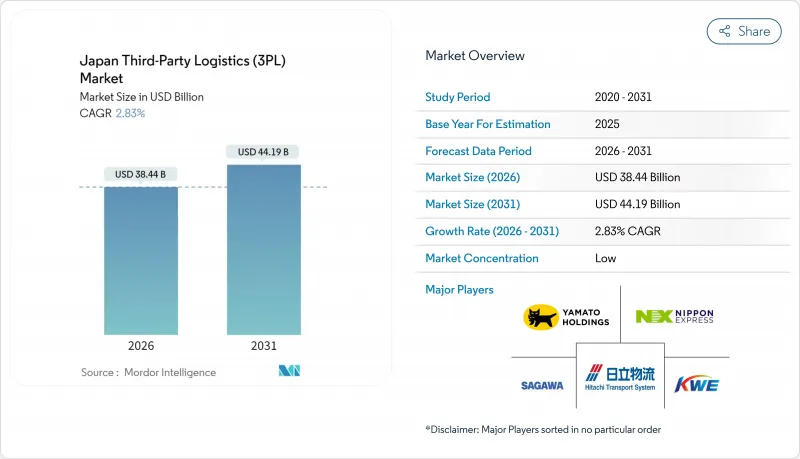
预计到 2026 年,日本第三方物流市场规模将达到 384.4 亿美元,从 2025 年的 373.8 亿美元成长到 2031 年的 441.9 亿美元。
预计2026年至2031年年复合成长率(CAGR)为2.83%。
新的驾驶人加班限制、旨在促进数位化的全面补贴以及日益严格的脱碳目标,正迫使所有物流业者重新思考其网路设计。资产密集型业者需要在自动化预算和不断上涨的租金之间寻求平衡,而利用数位平台的轻参与企业则无需拥有自有车辆也能蓬勃发展。零售商、医疗保健公司和半导体製造商都在寻求全国范围的覆盖和即时可视性,这推动了对能够缩短前置作业时间和减少碳排放的整合解决方案的需求。因此,日本的第三方物流市场正悄悄从单一功能的运输模式转型为数据驱动的编配,即使在劳动力和土地资源严重受限的情况下,也能确保货物的顺畅流通。
日本第三方物流(3PL)市场趋势与洞察
基于当日达和隔天达的电子商务文化正迫使零售商建立覆盖全国的第三方物流网路。
消费者对快速配送的需求日益增长,迫使零售商与在日本第三方物流 (3PL) 市场经营分散式履约中心的第三方物流合作伙伴携手。继大和运输退出亚马逊当日达服务后,丸和运输等新兴企业宣布引进 1 万辆新型轻型卡车以抢占新业务,凸显了灵活敏捷的企业所面临的机会。零售商正从单一库存模式转向多配送中心策略,以缩短最终配送距离,并在司机工时受限的情况下维持服务水准。在人口密集的都会区,第三方物流业者正在部署微型仓配中心并整合即时调度软体,以应对激增的需求。这些趋势使得建立全国性网路成为赢得大规模电商合约的先决条件,巩固了快速反应能力在日本第三方物流市场的战略重要性。
国家供应链数位化指令(绿色物流法案和开放API倡议)
日本的《绿色物流法》和开放API指令正在加速推动该国第三方物流市场的数位转型。国土交通省已投入880亿日圆公共资金,用于建造货运匹配平台、通用数据标准和碳排放追踪工具。一项联合交付试点计画能够衡量二氧化碳减排量并将其转化为可交易的碳信用额度,从而为早期采用者共用运力和数据提供切实的奖励。大型供应商正在部署以API为先导的运输管理系统,而中型业者则加入联盟平台以取得数位化货运代理服务。中期来看,标准化的资料流可望提高平均整车运输价格,部分抵销新劳动法规导致的运力下降。
长期卡车驾驶人短缺
新的加班限制减少了每週的驾驶时间,而货运量却持续成长。即使薪资上涨,五分之四的运输公司仍面临驾驶人空缺。机器人正在仓库中搬运托盘,使驾驶人能够腾出精力专注于道路运输,一些公司也开始透过体育特长生招募来吸引年轻员工。儘管有这些巧妙的解决方案,人才短缺仍然是限製成长的最迫切障碍。
细分市场分析
仓储和分类领域目前是成长最快的收入板块,年复合成长率达4.35%。需求主要来自全通路零售商和疫苗经销商,他们需要配备温控隔间、自动化穿梭车和单品扫描功能的设施。国内运输管理业务量仍然最大,但营运时间限制和燃油价格波动限制了其成长。能够将运输和智慧仓储管理相结合的供应商正在赢得更高的客户份额和长期合约。
机器人货物搬运、夹层拣货模组和语音控制收货站的投资正在增加。日本通运公司开设了一座配备自动推车的通用设计仓库,使员工能够专注于增值工作。这些资本投资透过提高每平方公尺的运转率,帮助企业克服人手不足并降低当地租金。
其他福利:
- Excel格式的市场预测(ME)表
- 分析师支持(3个月)
目录
第一章 引言
- 研究假设和市场定义
- 调查范围
第二章调查方法
第三章执行摘要
第四章 市场情势
- 市场概览
- 市场驱动因素
- 以当日达和隔日达为特征的电子商务文化,正促使零售商建立覆盖全国的第三方物流网络。
- 数位化(绿色物流法案与开放API倡议)
- 碳中和计画和排放交易试点推动绿色第三方物流模式转换
- 供应链韧性补贴和「中国+1」产业回流推动国内工厂物流需求
- 消费者群体老化;不断扩大的宅配和医疗配送通路需要温控第三方物流网络
- 5G 和物联网的引入推动了人们对即时可视性的期望,从而推动了对技术密集型第三方物流(3PL) 的投资。
- 市场限制
- 驾驶人和劳动力老化问题日益严重。
- 仓储空间短缺和租金上涨
- 竞争激烈的最后一公里包裹递送市场正在挤压利润空间,并阻碍创新投资。
- 中型製造企业内部物流的文化偏好
- 价值/供应链分析
- 主要政府法规和政策
- 技术趋势与自动化
- 仓储市场的整体趋势
- 来自快递、最后一公里配送和低温运输产业的需求
- 电子商务业务洞察
- 地缘政治事件如何影响市场
- 波特五力模型
- 新进入者的威胁
- 买方和消费者的议价能力
- 供应商的议价能力
- 替代品的威胁
- 竞争对手之间的竞争
第五章 市场规模与成长预测
- 透过服务
- 国内运输管理
- 路
- 铁路
- 航空
- 内河航道
- 国际运输管理
- 航空
- 海上运输
- 其他的
- 加值仓储及配送服务 (VAWD)
- 国内运输管理
- 按最终用户行业划分
- 车
- 能源与公共产业
- 製造业
- 生命科学与医疗保健
- 科技与电子
- 零售与电子商务
- 消费品/日用必需品
- 食品/饮料
- 其他的
- 透过物流模型
- 轻资产(管理基础)
- 资产密集型(拥有车辆和仓库)
- 杂交种
- 按地区(日本)
- 关东
- 关西
- 中部
- 九州、冲绳
- 中国
- 四国
- 北海道
- 东北
第六章 竞争情势
- 市场集中度
- 策略趋势
- 市占率分析
- 公司简介
- Nippon Express Co., Ltd.
- Yamato Holdings Co., Ltd.
- Kintetsu World Express, Inc.
- SG Holdings Co., Ltd.
- LOGISTEED, Ltd.
- NYK Line(Including Yusen Logistics)
- Mitsui-Soko Holdings Co., Ltd.
- Sankyu Inc.
- Nichirei Corporation
- Marubeni Logistics Corporation
- Kokusai Express Co., Ltd.
- Toyotsu Logistics Service Co., Ltd.
- Senko Group Holdings Co., Ltd.
- Japan Post Holdings Co., Ltd.
- Sumitomo Corporation
- Meitetsu Group
- DHL Group
- SBS Holdings, Inc.
- Kuehne+Nagel
- Samsung SDS
第七章 市场机会与未来展望
Japan Third-Party Logistics Market size in 2026 is estimated at USD 38.44 billion, growing from 2025 value of USD 37.38 billion with 2031 projections showing USD 44.19 billion, growing at 2.83% CAGR over 2026-2031.
New driver-overtime limits, sweeping digitalization grants, and rising decarbonization targets are forcing every logistics provider to rethink network design. Asset-heavy operators now balance automation budgets against rent inflation, while digital platforms let asset-light newcomers grow without owning fleets. Retailers, healthcare firms, and semiconductor manufacturers are asking for nationwide coverage and real-time visibility, lifting demand for integrated solutions that cut lead times and carbon footprints. As a result, the Japan 3PL market is quietly shifting from single-function transport toward data-enabled orchestration that keeps shipments moving despite deep labor and land constraints.
Japan Third-Party Logistics (3PL) Market Trends and Insights
Same-Day/Next-Day E-commerce Culture Forcing Retailers Toward Nationwide 3PL Networks
Accelerating consumer demand for rapid delivery is compelling retailers to engage 3PL partners that operate distributed fulfillment nodes across the Japan 3PL market. After Yamato Transport exited Amazon's same-day service, challengers such as Maruwa Transport committed to 10,000 new light trucks to capture the business, underscoring the opportunity for agile players. Retailers are shifting away from single-site inventory models toward multi-DC strategies that shorten final-mile distances and protect service standards despite driver-hour caps. Within densely populated metros, 3PLs now deploy micro-fulfillment centers and integrate real-time routing software to absorb demand spikes. As a result, nationwide network coverage has become a prerequisite for winning large e-commerce contracts, solidifying the strategic importance of fast-response capabilities across the Japan 3PL market.
National Supply-Chain Digitalization Mandates (Green Logistics Act & Open-API Initiatives)
Japan's Green Logistics Act and Open-API directives are accelerating digital adoption throughout the Japan 3PL market. Public funding totaling USD 88 billion supports load-matching platforms, common data standards, and carbon-tracking tools overseen by the Ministry of Land, Infrastructure, Transport, and Tourism. Collaborative delivery pilots measure CO2 savings that can translate into tradable credits, giving early movers a tangible incentive to share capacity and data. Leading providers are rolling out API-first transport management systems, while midsize operators join consortium platforms to access digital freight brokerage. Over the medium term, standardized data flows are expected to lift average truck load factors and partially offset the capacity loss triggered by new labor rules.
Chronic Truck-Driver Shortage
New overtime caps slice weekly driving hours, yet delivery counts keep climbing. Four out of five carriers report open seats even after pay bumps. Robots now shuttle pallets inside depots, letting scarce drivers focus on road miles, while some firms target younger recruits through sports-based hiring drives. Despite creative fixes, the talent gap remains the single most immediate brake on growth.
Other drivers and restraints analyzed in the detailed report include:
- Carbon-Neutral Commitments & Emissions-Trading Pilots Driving Modal Shift to Green 3PLs
- Reshoring & Supply-Chain Resilience Subsidies
- Warehouse Land Scarcity & Rent Inflation
For complete list of drivers and restraints, kindly check the Table Of Contents.
Segment Analysis
Warehousing Space that stores and sorts now accounts for the fastest revenue line, expanding at 4.35% CAGR. Demand comes from omnichannel retailers and vaccine distributors that need temperature-zoned rooms, automated shuttles, and item-level scanning. Domestic transportation management still carries the largest volume, yet driver-hour rules and fuel volatility cap its growth. Providers that blend both-transport plus smart storage-capture higher wallet share and longer contract tenures.
Investments flow into goods-to-person robots, mezzanine pick modules, and voice-directed receiving stations. Nippon Express opened a universal design warehouse where autonomous carts free staff to handle value-adding tasks. These upgrades help operators overcome labor shortages and keep regional rents under control by squeezing more turns from every square meter.
The Japan Third-Party Logistics (3PL) Market Report is Segmented by Service (Domestic Transportation Management, International Transportation Management, and More), by End User (Automotive, Energy and Utilities, and More), by Logistics Model (Asset-Light, Asset-Heavy, and Hybrid), by Region (Kanto, Kansai, Chubu, Kyushu and Okinawa, Chugoku, Shikoku, Hokkaido, Tohoku). The Market Forecasts are Provided in Terms of Value (USD).
List of Companies Covered in this Report:
- Nippon Express Co., Ltd.
- Yamato Holdings Co., Ltd.
- Kintetsu World Express, Inc.
- SG Holdings Co., Ltd.
- LOGISTEED, Ltd.
- NYK Line (Including Yusen Logistics)
- Mitsui-Soko Holdings Co., Ltd.
- Sankyu Inc.
- Nichirei Corporation
- Marubeni Logistics Corporation
- Kokusai Express Co., Ltd.
- Toyotsu Logistics Service Co., Ltd.
- Senko Group Holdings Co., Ltd.
- Japan Post Holdings Co., Ltd.
- Sumitomo Corporation
- Meitetsu Group
- DHL Group
- SBS Holdings, Inc.
- Kuehne+Nagel
- Samsung SDS
Additional Benefits:
- The market estimate (ME) sheet in Excel format
- 3 months of analyst support
TABLE OF CONTENTS
1 Introduction
- 1.1 Study Assumptions and Market Definition
- 1.2 Scope of the Study
2 Research Methodology
3 Executive Summary
4 Market Landscape
- 4.1 Market Overview
- 4.2 Market Drivers
- 4.2.1 Same-Day / Next-Day E-commerce Culture Forcing Retailers Toward Nationwide 3PL Networks
- 4.2.2 National Supply-Chain Digitalization Mandates (Green Logistics Act and Open-API Initiatives)
- 4.2.3 Carbon-Neutral Commitments and Emissions-Trading Pilots Driving Modal Shift to Green 3PLs
- 4.2.4 Supply-Chain Resilience Subsidies and China-plus-One Reshoring Fueling Domestic Plant Logistics Demand
- 4.2.5 Ageing Consumer Base Expanding Home-Delivery Grocery and Healthcare Channels Requiring Temperature-Stable 3PL Networks
- 4.2.6 5G & IoT Roll-Out Elevating Real-Time Visibility Expectations and Forcing Tech-Heavy 3PL Investments
- 4.3 Market Restraints
- 4.3.1 Chronic Truck-Driver Shortage and Aging Workforce
- 4.3.2 Warehouse Land Scarcity and Rent Inflation
- 4.3.3 Hyper-Competitive Last-Mile Parcel Market Compressing Margins and Discouraging Innovation Investment
- 4.3.4 Cultural Preference for In-House Logistics among Mid-Size Manufacturers
- 4.4 Value / Supply-Chain Analysis
- 4.5 Key Government Regulations & Initiatives
- 4.6 Technological Trends and Automation
- 4.7 General Trends in Warehousing Market
- 4.8 Demand from CEP, Last-Mile Delivery and Cold-Chain Segments
- 4.9 Insights on E-Commerce Business
- 4.10 Impact of Geopolitical Events on the Market
- 4.11 Porter's Five Forces
- 4.11.1 Threat of New Entrants
- 4.11.2 Bargaining Power of Buyers/Consumers
- 4.11.3 Bargaining Power of Suppliers
- 4.11.4 Threat of Substitute Products
- 4.11.5 Intensity of Competitive Rivalry
5 Market Size and Growth Forecasts (Value, USD Billion)
- 5.1 By Service
- 5.1.1 Domestic Transportation Management
- 5.1.1.1 Road
- 5.1.1.2 Rail
- 5.1.1.3 Air
- 5.1.1.4 Inland Waterway
- 5.1.2 International Transportation Management
- 5.1.2.1 Air
- 5.1.2.2 Sea
- 5.1.2.3 Others
- 5.1.3 Value-Added Warehousing and Distribution (VAWD)
- 5.1.1 Domestic Transportation Management
- 5.2 By End-User Industry
- 5.2.1 Automotive
- 5.2.2 Energy and Utilities
- 5.2.3 Manufacturing
- 5.2.4 Life Sciences and Healthcare
- 5.2.5 Technology and Electronics
- 5.2.6 Retail and E-commerce
- 5.2.7 Consumer Goods and FMCG
- 5.2.8 Food and Beverages
- 5.2.9 Others
- 5.3 By Logistics Model
- 5.3.1 Asset-Light (Management-Based)
- 5.3.2 Asset-Heavy (Own Fleet and Warehouses)
- 5.3.3 Hybrid
- 5.4 By Region (Japan)
- 5.4.1 Kanto
- 5.4.2 Kansai
- 5.4.3 Chubu
- 5.4.4 Kyushu and Okinawa
- 5.4.5 Chugoku
- 5.4.6 Shikoku
- 5.4.7 Hokkaido
- 5.4.8 Tohoku
6 Competitive Landscape
- 6.1 Market Concentration
- 6.2 Strategic Moves
- 6.3 Market Share Analysis
- 6.4 Company Profiles {(includes Global level Overview, Market level overview, Core Segments, Financials as available, Strategic Information, Market Rank/Share for key companies, Products and Services, and Recent Developments)}
- 6.4.1 Nippon Express Co., Ltd.
- 6.4.2 Yamato Holdings Co., Ltd.
- 6.4.3 Kintetsu World Express, Inc.
- 6.4.4 SG Holdings Co., Ltd.
- 6.4.5 LOGISTEED, Ltd.
- 6.4.6 NYK Line (Including Yusen Logistics)
- 6.4.7 Mitsui-Soko Holdings Co., Ltd.
- 6.4.8 Sankyu Inc.
- 6.4.9 Nichirei Corporation
- 6.4.10 Marubeni Logistics Corporation
- 6.4.11 Kokusai Express Co., Ltd.
- 6.4.12 Toyotsu Logistics Service Co., Ltd.
- 6.4.13 Senko Group Holdings Co., Ltd.
- 6.4.14 Japan Post Holdings Co., Ltd.
- 6.4.15 Sumitomo Corporation
- 6.4.16 Meitetsu Group
- 6.4.17 DHL Group
- 6.4.18 SBS Holdings, Inc.
- 6.4.19 Kuehne+Nagel
- 6.4.20 Samsung SDS
7 Market Opportunities and Future Outlook

 2026年全球第三方物流(3PL)市场报告
 2026-2030年全球汽车第三者物流市场
 第三方物流软体市场分析及预测(至2035年):依类型、产品类型、服务、技术、组件、应用、部署类型、最终用户、功能及解决方案划分
 美国第三方物流:市场占有率分析、产业趋势与统计、成长预测(2026-2031)英国第三方物流(3PL):市场占有率分析、产业趋势与统计、成长预测(2026-2031)西班牙第三方物流(3PL) 市场:份额分析、产业趋势与统计、成长预测 (2026-2031)
 第三方物流全球市场规模、份额、趋势和成长分析报告(2026-2034)
 生物製药低温运输物流服务市场按服务类型、温度类型、运输方式、产品类型、包装类型和最终用途划分,全球预测(2026-2032年)新加坡第三方物流(3PL) 市场:份额分析、产业趋势、统计数据和成长预测 (2026-2031)
 第三方物流市场-全球产业规模、份额、趋势、机会及预测(依运输方式、服务类型、产业、地区及竞争格局划分,2021-2031年预测)