


 |
市场调查报告书
商品编码
1911742
德国电动自行车:市场占有率分析、产业趋势与统计、成长预测(2026-2031)Germany E-Bike - Market Share Analysis, Industry Trends & Statistics, Growth Forecasts (2026 - 2031) |
||||||

※ 本网页内容可能与最新版本有所差异。详细情况请与我们联繫。
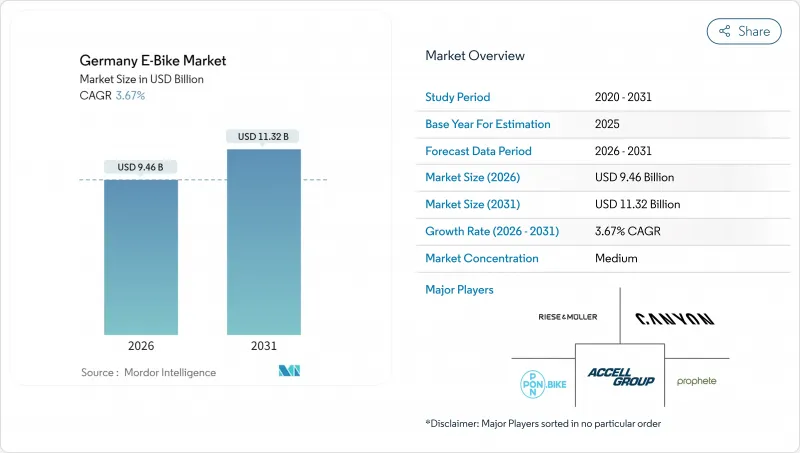
德国电动自行车市场预计将从 2025 年的 91.3 亿美元成长到 2026 年的 94.6 亿美元,预计到 2031 年将达到 113.2 亿美元,2026 年至 2031 年的复合年增长率为 3.67%。
随着疫情后需求激增逐渐恢復正常,成长模式正转向稳定的更换週期,商用车队规模不断扩大,新装数量也逐渐增加。电池法规、企业出行预算和基础设施的改善都在支撑成长势头,即便平均售价趋于稳定。竞争格局反映了行业整合、库存调整以及从追求销量转向追求盈利的重大转变,但德国电动自行车市场在2024年仍将占据自行车总销量的相当大份额。
德国电动自行车市场趋势与洞察
都市区壅塞导致的交通方式转变
德国联邦政府宣布了国家自行车计画(NCP)3.0,这是一项旨在全国推广自行车出行的战略倡议,其愿景展望至2030年。 NCP 3.0的主要目标是提升德国自行车出行的吸引力和安全性,并显着增加骑乘者的出行里程。儘管电动自行车在自行车总量中所占比例较小,但它们在整体自行车出行中发挥着至关重要的作用。预计到2025年,慕尼黑将拥有1,200公里的专用自行车道,以开闢出先前仅供汽车通勤的道路。电动自行车续航里程长、坡道辅助功能以及受天气影响小等优点,解释了为什么城市居民更倾向于用电动自行车而非传统自行车来替代汽车。
企业出行预算租赁
德国企业自行车租赁的蓬勃发展主要得益于税收政策。 2019 年对《所得税法》的修订允许员工透过工资扣除的方式租赁自行车或电动式自行车,只需将製造商建议零售价的一小部分作为每月课税员工福利。国家自行车计画 3.0 将企业自行车租赁定位为推动通勤方式从汽车转向自行车的「关键措施」。据估计,如果大部分短程通勤都转向自行车或电动式自行车,将显着减少每年的二氧化碳排放量。工资总额租赁模式使员工能够以大幅折扣的价格使用自行车。雇主重视每月扣款的可预测性,而供应商则看重大批量合约的稳定性,因为这种合约受零售价格波动的影响较小。
补贴后的初始成本较高
2024年的调查显示,消费者对价格的敏感度日益提高,许多人推迟了大额非必需品的购买。儘管当年的平均零售价格有所下降,但许多购物者仍然将某些价格区间视为心理上的界线。由于缺乏全国性的奖励,德国的消费支持力道低于邻国法国,这促使人们在边境城镇进行跨境购物。
细分市场分析
由于其法律地位与自行车相同,无需缴纳保险和办理牌照,到2025年,助力型电动自行车将占据德国电动自行车市场79.35%的份额。随着通勤者寻求在长途路线上以45公里/小时的速度巡航,高速辅助电动自行车的复合年增长率将达到3.76%。预计在2026年至2031年间,这一细分市场将成为德国电动自行车市场成长的主要动力之一。
关于EPAC定义的监管争论将是预测结果的一个重要因素。德国车辆协会(ZIV)提案最大功率限制在750瓦,辅助比设定为1:4,旨在维持其非机动车辆的分类。而德国电动自行车协会(LEVA-EU)则认为,更严格的法规会扼杀货运领域的创新。预计2026年将推出的决定可能会扩大或缩小高辅助自行车的潜在市场规模,直接影响德国电动式自行车市场份额的演变。
预计到2025年,都市区用途电动自行车将占德国电动自行车市场总收入的70.92%,构成比货运/多用途电动自行车市场预计到2031年将以3.74%的复合年增长率增长,成为德国电动自行车市场增长最快的细分市场。随着宅配公司和生鲜平台为了符合都市区排放控制区的要求而将其「最后一公里」配送车辆电动化,货运/多用途电动自行车市场正在迅速扩张。
预计2024年货运车辆数量将显着成长,较上年增幅尤为显着。许多车辆标配1000Wh电池,无需充电即可完成一整班运输。加之柏林柴油车禁令的实施,商业订单可望带来稳定的市场需求,从而稳定过去受消费季节性影响的季度运输週期。
到 2025 年,锂离子电池组将占出货量的 99.82%,并将支撑德国电动自行车市场规模的大部分成长,到 2031 年,其复合年增长率将达到 3.67%。其他化学技术目前仍仅限于售价低于 1000 美元的入门级车型和实验性的固态电池试点计画。
欧盟电池法规将于 2027 年 2 月起强制实施数位护照制度,并设定 2028 年实现 51% 的回收目标。这些措施将使循环经济实践制度化,并加强锂离子电池的现有优势,同时促进欧洲的电池生产,减少范围 3 的排放,并降低运输风险。
其他福利:
- Excel格式的市场预测(ME)表
- 3个月的分析师支持
目录
第一章 引言
- 研究假设和市场定义
- 调查范围
第二章调查方法
第三章执行摘要
第四章:主要产业趋势
- 年度自行车销售额
- 平均销售价格和价格范围构成
- 电动自行车及零件的跨境贸易
- 电动自行车在自行车总销量中所占的百分比
- 单程通勤距离为 5-15 公里的通勤者比例 (%)
- 自行车和电动式自行车租赁市场规模
- 电动自行车电池组价格
- 电池化学价格比较
- 最后一公里(超本地化)配送量
- 受保护的自行车道(公里)
- 健行和户外活动的参与率
- 电动自行车电池容量(瓦时)
- 都市交通壅塞指数
- 法律规范
- 电动自行车型式认证与认可
- 进出口/贸易限制
- 分类、道路使用法规和使用者规则
- 电池、充电器和充电安全
第五章 市场情势
- 市场概览
- 市场驱动因素
- 都市区壅塞导致的交通方式转变
- 企业出行预算租赁
- 电池和马达技术的进步
- 政府采购奖励
- 环保意识与排放减量目标
- 旅游需求推动电动山地自行车道的扩张
- 市场限制
- 补助结束后,初期成本较高
- 国内电池供应风险
- 售后服务工厂的瓶颈
- 窃盗保险费上涨
- 价值/供应链分析
- 监管环境
- 技术展望
- 波特五力模型
- 新进入者的威胁
- 供应商的议价能力
- 买方的议价能力
- 替代品的威胁
- 竞争对手之间的竞争
第六章 市场规模及成长预测(价值及数量)
- 依推进类型
- 踏板辅助
- 速度踏板
- 油门辅助
- 透过使用
- 货物/多用途
- 城镇/城市
- 健行/登山
- 依电池类型
- 铅酸电池
- 锂离子电池
- 其他的
- 按下马达安装位置
- 轮毂(前/后)
- 中置马达
- 透过驱动系统
- 链传动
- 皮带传动
- 透过马达输出
- 小于250瓦
- 251~350 W
- 351~500 W
- 501~600 W
- 600瓦或以上
- 按价格范围
- 低于1000美元
- 1,000-1,499 美元
- 1500-2499美元
- 2,500-3,499 美元
- 3,500-5,999 美元
- 超过6000美元
- 按销售管道
- 在线的
- 离线
- 按最终用途
- 商业航运
- 零售和商品分销
- 食品/饮料配送
- 服务供应商
- 个人和家庭用途
- 公共利益
- 其他的
- 商业航运
第七章 竞争情势
- 市场集中度
- 策略趋势
- 市占率分析
- 公司简介
- Accell Group
- Canyon Bicycles GmbH
- CUBE Bikes
- Giant Manufacturing Co. Ltd.
- KTM Fahrrad GmbH
- Merida Industry Co. Ltd.
- Pon Holdings BV
- Prophete In Moving GmbH
- Riese & Muller GmbH
- Specialized Bicycle Components, Inc.
- Winora Staiger GmbH
- Bulls Bikes(ZEG)
- STEVENS Vertriebs GmbH
- Moustache Bikes
- Urban Arrow
第八章:市场机会与未来展望
第九章:CEO们需要思考的关键策略问题
The German E-Bike market is expected to grow from USD 9.13 billion in 2025 to USD 9.46 billion in 2026 and is forecast to reach USD 11.32 billion by 2031 at 3.67% CAGR over 2026-2031.
Demand normalization after the pandemic surge now pivots growth toward steady replacement cycles, commercial fleet expansions, and incremental first-time adoption. Battery regulation, corporate mobility budgets, and improving infrastructure sustain forward momentum even as average selling prices stabilize. Competitive dynamics reflect consolidation, inventory rebalancing, and a decisive shift from volume chasing to profitability, yet the German E-Bike market continues to capture a notable share of total bicycle sales as of 2024.
Germany E-Bike Market Trends and Insights
Urban Congestion-Driven Modal Shift
Germany's Federal Government has unveiled the National Cycling Plan (NCP) 3.0, a strategic initiative aimed at promoting cycling across the nation, with a vision extending to 2030. NCP 3.0's primary objective is to enhance the appeal and safety of cycling in Germany, thereby aiming for a substantial uptick in the distance covered by cyclists . E-bikes, although forming a smaller portion of the total fleet, play a disproportionately significant role in overall bicycle usage. Protected lanes in Munich are set to reach 1,200 km by 2025, enabling commutes once considered car-only. Longer range, hill-flattening assistance, and lower weather sensitivity explain why urban residents substitute cars with e-bikes more often than with acoustic bikes.
Corporate Mobility-Budget Leasing
Germany's corporate bike-leasing boom is largely driven by fiscal policy. A 2019 amendment to the Income Tax Act, which allows employees leasing bicycles or e-bikes through salary sacrifice to treat only a small portion of the manufacturer's list price as a monthly taxable benefit. The National Cycling Plan 3.0 highlights company-bike leasing as a "key action" to shift work-related travel from cars. They estimate a substantial annual CO2 saving if a significant portion of short commutes transitions to bicycles or e-bikes. Through gross-salary leasing, employees enjoy significant savings on bike models. Employers value the predictability of monthly deductions, while suppliers appreciate the stability of bulk contracts, which are less vulnerable to retail fluctuations.
High Upfront Cost Post-Subsidy
In 2024, consumers became increasingly price-conscious, with many opting to delay significant discretionary purchases, according to surveys. In 2024, average retail prices declined, but many mainstream buyers still perceive a specific price point as a psychological ceiling. Without nationwide incentives, Germany ranks below neighboring France on net purchase support, encouraging cross-border shopping in border towns.
Other drivers and restraints analyzed in the detailed report include:
- Battery and Motor Technology Advances
- Government Purchase Incentives
- Domestic Battery-Cell Supply Risk
For complete list of drivers and restraints, kindly check the Table Of Contents.
Segment Analysis
Pedal-assisted systems generated 79.35% of the Germany E-Bike market in 2025, benefiting from a bicycle-equivalent legal status that avoids insurance and license requirements. Speed Pedelecs post a 3.76% CAGR as commuters seek 45 km/h cruising on longer routes. This segment will contribute disproportionately to the expansion of the German e-bike market between 2026 and 2031.
Regulatory debate on EPAC definitions adds forecast volatility. ZIV's proposal to cap peak power at 750 W and maintain a 1:4 assist ratio aims to preserve the non-motor-vehicle classification. Advocacy group LEVA-EU counters that tighter rules would restrain cargo innovation. A decision expected in 2026 could widen or narrow the addressable market for high-assist bicycles, directly influencing Germany's E-Bike market share trajectories.
City/Urban riding held 70.92% of 2025 revenue, but the cargo/utility segment is on track for a 3.74% CAGR to 2031, the top growth lane within the German E-Bike market. Cargo/Utility usage follows closely as parcel companies and grocery platforms electrify last-mile fleets to meet city emission zones.
In 2024, the industry experienced significant growth in cargo units, reflecting a notable year-on-year increase, with many fleets now spec 1,000 Wh batteries to secure a full shift without midday recharging. Combined with diesel vehicle bans in Berlin, fleet orders promise steady demand inflows that stabilize quarterly shipment cycles previously driven by consumer seasonality.
Lithium-ion packs represented 99.82% of 2025 shipments and will chart a parallel 3.67% CAGR through 2031, underpinning most gains in the German E-Bike market size. Alternative chemistries remain relegated to sub-USD 1,000 entry bikes or experimental solid-state pilots.
The EU Battery Regulation introduces mandatory digital passports from February 2027 and collection targets of 51% by 2028. These measures institutionalize circular-economy practices, reinforcing lithium-ion incumbency while encouraging European cell production to cut embedded scope-3 emissions and lower transport risk.
The Germany E-Bike Market Report is Segmented by Propulsion Type (Pedal Assisted, Speed Pedelec, and More), Application Type (Cargo/Utility, City/Urban, and More), Battery Type (Lead Acid Battery, Lithium-Ion Battery, and More), Motor Placement (Hub (Front/Rear), Mid-Drive), Drive Systems, Motor Power, Price Band, Sales Channel, and End Use. The Market Forecasts are Provided in Terms of Value (USD) and Volume (Units).
List of Companies Covered in this Report:
- Accell Group
- Canyon Bicycles GmbH
- CUBE Bikes
- Giant Manufacturing Co. Ltd.
- KTM Fahrrad GmbH
- Merida Industry Co. Ltd.
- Pon Holdings B.V.
- Prophete In Moving GmbH
- Riese & Muller GmbH
- Specialized Bicycle Components, Inc.
- Winora Staiger GmbH
- Bulls Bikes (ZEG)
- STEVENS Vertriebs GmbH
- Moustache Bikes
- Urban Arrow
Additional Benefits:
- The market estimate (ME) sheet in Excel format
- 3 months of analyst support
TABLE OF CONTENTS
1 Introduction
- 1.1 Study Assumptions & Market Definition
- 1.2 Scope of the Study
2 Research Methodology
3 Executive Summary
4 Key Industry Trends
- 4.1 Annual Bicycle Sales
- 4.2 Average Selling Price & Price-Band Mix
- 4.3 Cross-Border Trade in E-Bikes & Parts
- 4.4 E-Bike Share of Total Bicycle Sales
- 4.5 Commuters with 5-15 km One-Way Trips (%)
- 4.6 Bicycle/E-Bike Rental Market Size
- 4.7 E-Bike Battery Pack Price
- 4.8 Battery Chemistry Price Comparison
- 4.9 Last-Mile (Hyper-Local) Delivery Volume
- 4.10 Protected Bicycle Lanes (km)
- 4.11 Trekking/Outdoor Activity Participation
- 4.12 E-Bike Battery Capacity (Wh)
- 4.13 Urban Traffic Congestion Index
- 4.14 Regulatory Framework
- 4.14.1 Homologation & Certification of E-Bicycles
- 4.14.2 Export-Import & Trade Regulation
- 4.14.3 Classification, Road Access and User Rules
- 4.14.4 Battery, Charger and Charging Safety
5 Market Landscape
- 5.1 Market Overview
- 5.2 Market Drivers
- 5.2.1 Urban Congestion-Driven Modal Shift
- 5.2.2 Corporate Mobility-Budget Leasing
- 5.2.3 Battery and Motor Technology Advances
- 5.2.4 Government Purchase Incentives
- 5.2.5 Environmental Awareness and CO2 Targets
- 5.2.6 Tourism-Driven E-MTB Trail Expansion
- 5.3 Market Restraints
- 5.3.1 High Upfront Cost Post-Subsidy
- 5.3.2 Domestic Battery-Cell Supply Risk
- 5.3.3 After-Sales Workshop Bottlenecks
- 5.3.4 Rising Theft-Insurance Premiums
- 5.4 Value / Supply-Chain Analysis
- 5.5 Regulatory Landscape
- 5.6 Technological Outlook
- 5.7 Porter's Five Forces
- 5.7.1 Threat of New Entrants
- 5.7.2 Bargaining Power of Suppliers
- 5.7.3 Bargaining Power of Buyers
- 5.7.4 Threat of Substitutes
- 5.7.5 Competitive Rivalry
6 Market Size & Growth Forecasts (Value (USD) and Volume (Units))
- 6.1 By Propulsion Type
- 6.1.1 Pedal Assisted
- 6.1.2 Speed Pedelec
- 6.1.3 Throttle Assisted
- 6.2 By Application Type
- 6.2.1 Cargo/Utility
- 6.2.2 City/Urban
- 6.2.3 Trekking/Mountain
- 6.3 By Battery Type
- 6.3.1 Lead Acid Battery
- 6.3.2 Lithium-ion Battery
- 6.3.3 Others
- 6.4 By Motor Placement
- 6.4.1 Hub (Front/Rear)
- 6.4.2 Mid-Drive
- 6.5 By Drive Systems
- 6.5.1 Chain Drive
- 6.5.2 Belt Drive
- 6.6 By Motor Power
- 6.6.1 Below 250 W
- 6.6.2 251-350 W
- 6.6.3 351-500 W
- 6.6.4 501-600 W
- 6.6.5 Above 600 W
- 6.7 By Price Band
- 6.7.1 Up to USD 1,000
- 6.7.2 USD 1,000-1,499
- 6.7.3 USD 1,500-2,499
- 6.7.4 USD 2,500-3,499
- 6.7.5 USD 3,500-5,999
- 6.7.6 Above USD 6,000
- 6.8 By Sales Channel
- 6.8.1 Online
- 6.8.2 Offline
- 6.9 By End Use
- 6.9.1 Commercial Delivery
- 6.9.1.1 Retail and Goods Delivery
- 6.9.1.2 Food and Beverage Delivery
- 6.9.2 Service Providers
- 6.9.3 Personal and Family Use
- 6.9.4 Institutional
- 6.9.5 Others
- 6.9.1 Commercial Delivery
7 Competitive Landscape
- 7.1 Market Concentration
- 7.2 Strategic Moves
- 7.3 Market Share Analysis
- 7.4 Company Profiles (Includes Global Level Overview, Market Level Overview, Core Segments, Financials as Available, Strategic Information, Market Rank/Share for Key Companies, Products and Services, SWOT Analysis, and Recent Developments)
- 7.4.1 Accell Group
- 7.4.2 Canyon Bicycles GmbH
- 7.4.3 CUBE Bikes
- 7.4.4 Giant Manufacturing Co. Ltd.
- 7.4.5 KTM Fahrrad GmbH
- 7.4.6 Merida Industry Co. Ltd.
- 7.4.7 Pon Holdings B.V.
- 7.4.8 Prophete In Moving GmbH
- 7.4.9 Riese & Muller GmbH
- 7.4.10 Specialized Bicycle Components, Inc.
- 7.4.11 Winora Staiger GmbH
- 7.4.12 Bulls Bikes (ZEG)
- 7.4.13 STEVENS Vertriebs GmbH
- 7.4.14 Moustache Bikes
- 7.4.15 Urban Arrow
8 Market Opportunities & Future Outlook
9 Key Strategic Questions for E-Bikes CEOs

 电动自行车市场:2026-2032年全球市场预测(依产品类型、电池类型、驱动系统、功率输出、速度类型、应用和销售管道)折迭式电动自行车市场:依使用者类型、马达功率、驱动系统和销售管道划分-2026-2032年全球市场预测
 2026-2030年全球折迭式电动自行车市场专业电动自行车市场:依马达配置、电池容量、价格范围、应用和分销管道划分-2026-2032年全球预测高阶电动自行车市场:2026 年至 2032 年全球预测,按自行车类型、价格范围、应用、电池容量、通路和马达功率划分。脚踏辅助电动自行车市场:按类型、马达功率、电池容量、辅助等级、价格范围、分销管道和应用划分-全球预测,2026-2032年锂离子电池驱动自行车市场:按型号、驱动系统、电池容量、电池类型、额定输出功率和推进方式划分-全球预测,2026-2032年
 电动自行车市场规模、份额、趋势和预测:按交通方式、马达类型、电池类型、等级、设计、应用和地区划分(2026-2034 年)
 电动自行车市场分析及预测(至2035年):依类型、产品类型、技术、组件、应用、最终用户、功能、安装类型及模式划分
 电动自行车电池市场规模、份额、成长率及全球产业分析:按类型、应用和地区划分,预测2026-2034年