


 |
市场调查报告书
商品编码
1934592
南美洲杀软体动物剂:市场占有率分析、产业趋势与统计、成长预测(2026-2031 年)South America Molluscicides - Market Share Analysis, Industry Trends & Statistics, Growth Forecasts (2026 - 2031) |
||||||

※ 本网页内容可能与最新版本有所差异。详细情况请与我们联繫。
预计南美洲杀软体动物剂市场将从 2025 年的 1.2 亿美元成长到 2026 年的 1.2702 亿美元,到 2031 年将达到 1.6862 亿美元,2026 年至 2031 年的复合年增长率为 5.83%。
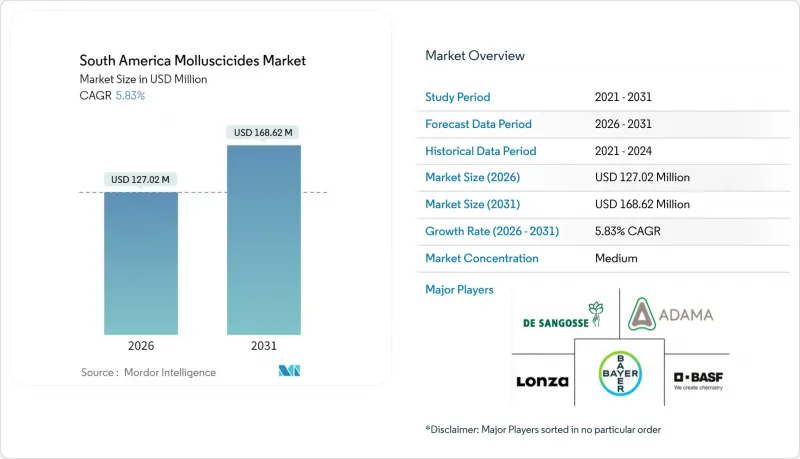
南美洲的杀螺剂市场受益于气候变迁导致的湿度激增,这加速了腹足类动物的繁殖週期;同时,市场迅速转向更安全的磷酸铁基活性成分,以及鼓励采用综合虫害管理(IPM)措施的公共补贴计划。巴西在园艺产品大规模出口、咖啡和甘蔗面积庞大以及政府信贷额度(将贷款合格与永续虫害控制通讯协定挂钩)方面保持主导地位。哥伦比亚的特色作物蓬勃发展和智利的出口品质标准进一步增强了区域需求,推动了优质耐雨颗粒剂的创新。儘管竞争程度适中,五家供应商占据了相当大的市场份额,但专注于特定领域的本地配方生产商仍然是关键参与者,他们根据微气候和抗药性管理需求量身定制产品。
南美杀软体动物剂市场趋势与洞察
气候变迁导致湿度上升,蛞蝓和蜗牛造成的损害急剧增加。
气温升高和降雨量增加正在缩短地钱属(Deloceras)和福寿螺属(Pomacea)蛞蝓的休眠期,加剧了这些腹足类动物对大豆、咖啡和蔬菜的危害。田间研究表明,气温升高摄氏2度,降雨量增加20%,可能导致其繁殖率增加两倍,迫使种植者将防治期延长至收穫期。在巴西塞拉多地区,越来越多的农场为了保护早熟的园艺作物,每个生长季要额外施用两次颗粒剂。哥伦比亚安第斯山谷也出现了类似的趋势,那里露水持续时间长,即使在传统的旱季,蛞蝓也能在夜间觅食。这种危害的加剧推高了每公顷的杀螺剂支出,尤其是那些能够承受反覆降雨的高效颗粒剂。
政府对永续咖啡、甘蔗和园艺产品生产的补贴计划
巴西国家家庭农业强化计划仅向生产者提供补贴贷款,前提是他们必须提交一份综合虫害管理计划,该计划优先使用磷酸铁而非甲醛。哥伦比亚的咖啡产业现代化津贴在使用GPS导航喷雾器时,可报销高达30%的杀螺剂费用,从而鼓励采用可变剂量颗粒剂。阿根廷于2025年扩大了其永续农业税收体系,将杀螺剂抗性管理计画纳入税额扣抵,间接促进了对双效诱饵的需求。这些财政奖励促使消费者从追求最低成本产品转向更安全、能通过残留审核的产品。由于补贴与贷款期限挂钩,即使在商品价格走低的情况下,需求依然强劲。
加强南美洲金属醛残留法规
巴西国家卫生监督局 (ANVISA) 于 2024 年将残留基准值与欧洲标准接轨,迫使生产商降低喷洒量或改用磷酸铁处理出口产品。阿根廷国家农业卫生安全局 (SENASA) 增加了缓衝区和时间限制,使得雨季期间甲醛喷洒的计画更加复杂。合规性审核往往与收穫高峰期重合,加剧了因残留罚款而导致的货物运输中断的经济风险。在以咖啡和浆果为主要作物的地区,经销商报告说甲醛处理量下降了 15%。因此,儘管传统化学品具有成本优势,但监管限制阻碍了其应用范围的扩大。
细分市场分析
由于甲醛在黄豆、玉米和园艺作物中数十年来一直具有成本效益,2025年,其在南美杀螺剂市场占了59.35%的份额。然而,由于出口认证机构和国内监管机构对残留物的限制更加严格,磷酸铁的销售额预计将以9.26%的复合年增长率成长。到2031年,南美洲磷酸铁杀螺剂的市场规模预计将翻倍。高价值的水果、蔬菜和观赏植物领域预计将吸收高端需求。第二代活性成分,例如灭虫威,将继续保持其重要性,尤其是在观赏植物领域,因为在分销给都市区零售商之前需要快速控制虫害。
随着连作系统中抗药性的出现,结合多种作用机制的复配产品正日益受到关注。尼克酰胺和西维因复配产品的专利申请表明,业界正努力在满足不断提高的安全标准的同时,分散化学压力。供应商也在探索生物復配製剂,以改善偏好并调节饲料水分,从而延长潮湿微气候下的田间保质期。总而言之,这些创新进一步巩固了南美杀螺剂市场对未来活性成分应用趋势的认识,即有效的管理和对安全标准的严格遵守将决定未来活性成分的使用趋势。
由于接触型製剂具有广谱杀灭能力、易于配製且与现有颗粒撒播器相容等优点,预计到2025年,其将占南美洲杀螺剂市场规模的40.75%。目前,市场重点正转向新一代驱避剂化学技术,可在最短时间内形成持续2-3週的保护屏障,从而最大限度地减少人员重返作业的间隔,尤其受到劳动力成本高昂的特种作物种植者的青睐。预计到2031年,驱避剂的销售额将以8.87%的复合年增长率成长。
饵剂仍然是温室週边防御的主要手段,而内吸性产品则在水生环境中有着特定的应用,它们透过溶解和吸收作用来控制入侵性蜗牛。巴西和阿根廷的监管机构越来越建议轮调使用接触性、驱避性和饵剂类产品,以降低抗药性的风险。随着综合虫害管理(IPM)的普及,人们对能够清楚标示作用机制的产品需求日益增长,这有助于种植者更好地规划整个生长季节的轮换使用。
其他福利:
- Excel格式的市场预测(ME)表
- 3个月的分析师支持
目录
第一章 引言
- 研究假设和市场定义
- 调查范围
第二章调查方法
第三章执行摘要
第四章 市场情势
- 市场概览
- 市场驱动因素
- 气候变迁导致湿度骤升,进而加剧了蛞蝓和蜗牛造成的伤害。
- 政府对永续咖啡、甘蔗和园艺产品生产的补贴计划
- 园艺产品出口激增,带动了对无瑕疵农产品的需求。
- 推出耐雨、具有残留效应的颗粒配方
- 安第斯山脉特种作物的扩张加剧了高地软体动物害虫的压力。
- 欧盟禁止使用金属醛将更安全的磷酸铁生产能力转移到巴西
- 市场限制
- 加强南美洲金属醛残留法规
- 磷酸铁活性成分的高成本溢价
- 软体动物对单效化学物质的抗药性日益增强
- 非官方的仿冒农药交易
- 监管环境
- 技术展望
- 波特五力分析
- 新进入者的威胁
- 供应商的议价能力
- 买方的议价能力
- 替代品的威胁
- 竞争对手之间的竞争
第五章 市场规模与成长预测
- 按活性成分
- 甲醛
- 磷酸铁
- 其他化学活性成分(例如,甲硫威)
- 透过作用机制
- 接触
- 口服型
- 渗透性
- 驱虫剂
- 配方
- 颗粒
- 颗粒
- 液体
- 粉末
- 按作物类型
- 水果和蔬菜
- 谷类/豆类
- 油籽和豆类
- 观赏植物
- 饲料和牧草作物
- 透过应用方法
- 农地
- 水体
- 工业和商业设施
- 住宅花园
- 按地区
- 巴西
- 阿根廷
- 智利
- 哥伦比亚
- 秘鲁
- 其他南美洲
第六章 竞争情势
- 市场集中度
- 策略趋势
- 市占率分析
- 公司简介
- Bayer AG
- BASF SE
- Syngenta AG
- De Sangosse Ltd.
- Lonza Group AG
- Adama Ltd.
- American Vanguard Corporation(AMVAC)
- ANASAC
- UPL Ltd.
- Bequisa
- Certis Biologicals
- Nufarm Limited
第七章 市场机会与未来展望
The South America molluscicides market is expected to grow from USD 120 million in 2025 to USD 127.02 million in 2026 and is forecast to reach USD 168.62 million by 2031 at 5.83% CAGR over 2026-2031.
The South America molluscicides market is benefiting from climate-induced humidity spikes that accelerate gastropod breeding cycles, a swift transition toward safer iron-phosphate actives, and public subsidy programs that reward integrated pest management compliance. Brazil retains leadership in large-scale horticulture exports, robust coffee and sugarcane acreage, and government credit lines that link loan eligibility to sustainable pest-control protocols. Colombia's specialty-crop boom and Chile's export-quality mandates further reinforce regional demand while favoring premium, rain-fast pellet innovations. Competitive intensity is moderate, with five suppliers capturing significant revenue share, yet niche local formulators remain relevant by tailoring products to micro-climates and resistance-management needs.
South America Molluscicides Market Trends and Insights
Escalating Slug and Snail Infestations from Climate-Change-Driven Humidity Spikes
Warmer temperatures and heavier rainfall shorten the dormancy period for Deroceras and Pomacea species, intensifying gastropod attacks in soybeans, coffee, and vegetables. Field studies show that a 2 °C temperature increase combined with 20% more precipitation can triple reproductive rates, forcing growers to extend baiting windows well into harvest. Brazilian Cerrado farms now schedule two additional pellet applications per season to protect early-maturing horticulture crops. Similar trends surface in Colombia's Andean valleys, where persistent dew films allow slugs to feed overnight even during traditionally dry months. The expanded pressure elevates per-hectare molluscicide spending, especially on high-potency pellets that survive recurring rain events.
Government Subsidy Programs for Sustainable Coffee, Sugarcane, and Horticulture Production
Brazil's National Program for Strengthening Family Agriculture offers subsidized credit only when growers document integrated pest-management plans that favor ferric-phosphate over metaldehyde. Colombia's coffee-sector modernization grants reimburse up to 30% of molluscicide costs if GPS-guided spreaders are used, spurring adoption of variable-rate pellets. Argentina widened its sustainable-farming tax code in 2025 to credit molluscicide resistance-management plans, indirectly lifting demand for dual-mode baits. These financial carrots shift purchasing decisions away from lowest-cost options toward safer formulations that pass residue audits. As subsidies tie compliance to loan terms, demand remains resilient even when commodity prices soften .
Tightening South American Regulations on Metaldehyde Residues
Brazil's ANVISA harmonized maximum-residue limits with European thresholds in 2024, forcing growers to lower field rates or pivot to ferric-phosphate for export-bound produce. Argentina's SENASA added buffer-zone and timing rules that complicate metaldehyde scheduling during rainy seasons. Compliance audits often coincide with peak harvest, magnifying economic risk if residue fines suspend shipments. Distributors report a 15% drop in metaldehyde volume where coffee and berries are dominant. Regulatory drag, therefore, tempers the expansion of legacy chemistries despite their cost advantage.
Other drivers and restraints analyzed in the detailed report include:
- Surge in Horticulture Exports Demanding Blemish-Free Produce
- Launch of Rain-Fast, Extended-Residual Pellet Formulations
- High Cost Premium of Iron-Phosphate Active Ingredient
For complete list of drivers and restraints, kindly check the Table Of Contents.
Segment Analysis
Metaldehyde held 59.35% of South America's molluscicides market share in 2025, due to decades of cost-effective performance across soybeans, maize, and horticulture. Even so, iron-phosphate revenue is climbing at a 9.26% CAGR as export-certification bodies and domestic regulators impose stricter residue controls. The South America molluscicides market size for iron-phosphate products is forecast to almost double by 2031, with high-value fruit, vegetable, and ornamental segments absorbing the premium. Second-tier actives such as methiocarb maintain pockets of relevance in ornamentals, especially where rapid knockdown is required before shipment to urban retailers.
Combination products linking multiple modes of action are gaining traction as resistance emerges in continuous-cropping systems. Patent filings that pair niclosamide with carbaryl illustrate industry efforts to diversify chemical pressure while meeting evolving safety thresholds . Suppliers also explore biological co-formulants that improve palatability and regulate bait moisture, extending field life in humid micro-climates. These innovations collectively reinforce the perception that robust stewardship and safety compliance will dictate future active-ingredient adoption trajectories across the South America molluscicides market.
Contact formulations generated 40.75% of the South America molluscicides market size in 2025 due to proven broad-spectrum lethality, simple calibration, and compatibility with existing pellet spreaders. Marketing focus now pivots to next-generation repellent chemistries that create protective barriers for 2-3 weeks with minimal re-entry intervals, appealing to specialty-crop growers with high labor costs. Repellent revenues are forecast to expand at a 8.87% CAGR through 2031.
Ingestive baits remain a staple for perimeter defense around greenhouses, while systemic options serve niche aquatic uses where dissolved uptake curbs invasive snails. Regulatory agencies in Brazil and Argentina increasingly encourage rotation among contact, repellent, and ingestive modes to reduce resistance risk. As integrated pest management becomes mainstream, demand tilts toward labeled products that clearly specify mode-of-action groups, enabling growers to plan season-long rotation calendars.
The South America Molluscicides Market Report is Segmented by Active Ingredient (Metaldehyde, Iron Phosphate and More), by Mode of Action (Contact, Ingestive and More), by Formulation (Pellets, Liquids and More), by Crop Type (Cereals and Grains, and More), by Application Method (Agricultural Fields and More), and by Geography (Brazil, Argentina, and More). The Market Forecasts are Provided in Terms of Value (USD).
List of Companies Covered in this Report:
- Bayer AG
- BASF SE
- Syngenta AG
- De Sangosse Ltd.
- Lonza Group AG
- Adama Ltd.
- American Vanguard Corporation (AMVAC)
- ANASAC
- UPL Ltd.
- Bequisa
- Certis Biologicals
- Nufarm Limited
Additional Benefits:
- The market estimate (ME) sheet in Excel format
- 3 months of analyst support
TABLE OF CONTENTS
1 Introduction
- 1.1 Study Assumptions and Market Definition
- 1.2 Scope of the Study
2 Research Methodology
3 Executive Summary
4 Market Landscape
- 4.1 Market Overview
- 4.2 Market Drivers
- 4.2.1 Escalating slug and snail infestations from climate-change-driven humidity spikes
- 4.2.2 Government subsidy programs for sustainable coffee, sugarcane, and horticulture production
- 4.2.3 Surge in horticulture exports demanding blemish-free produce
- 4.2.4 Launch of rain-fast, extended-residual pellet formulations
- 4.2.5 Andean shift toward specialty crops increasing mollusk pressure in high-altitude zones
- 4.2.6 EU metaldehyde ban diverting safer iron-phosphate production capacity to Brazil
- 4.3 Market Restraints
- 4.3.1 Tightening South American regulations on metaldehyde residues
- 4.3.2 High-cost premium of the iron-phosphate active ingredient
- 4.3.3 Rising mollusk resistance to single-mode chemistries
- 4.3.4 Informal trade in counterfeit crop-protection inputs
- 4.4 Regulatory Landscape
- 4.5 Technological Outlook
- 4.6 Porter's Five Forces Analysis
- 4.6.1 Threat of New Entrants
- 4.6.2 Bargaining Power of Suppliers
- 4.6.3 Bargaining Power of Buyers
- 4.6.4 Threat of Substitutes
- 4.6.5 Intensity of Competitive Rivalry
5 Market Size and Growth Forecasts (Value, USD)
- 5.1 By Active Ingredient
- 5.1.1 Metaldehyde
- 5.1.2 Iron Phosphate
- 5.1.3 Other Chemical Actives (e.g., Methiocarb)
- 5.2 By Mode of Action
- 5.2.1 Contact
- 5.2.2 Ingestive
- 5.2.3 Systemic
- 5.2.4 Repellent
- 5.3 By Formulation
- 5.3.1 Pellets
- 5.3.2 Granules
- 5.3.3 Liquids
- 5.3.4 Powders
- 5.4 By Crop Type
- 5.4.1 Fruits and Vegetables
- 5.4.2 Cereals and Grains
- 5.4.3 Oilseeds and Pulses
- 5.4.4 Ornamentals
- 5.4.5 Forage and Pasture Crops
- 5.5 By Application Method
- 5.5.1 Agricultural Fields
- 5.5.2 Aquatic Areas
- 5.5.3 Industrial and Commercial Premises
- 5.5.4 Residential Gardens
- 5.6 By Geography
- 5.6.1 Brazil
- 5.6.2 Argentina
- 5.6.3 Chile
- 5.6.4 Colombia
- 5.6.5 Peru
- 5.6.6 Rest of South America
6 Competitive Landscape
- 6.1 Market Concentration
- 6.2 Strategic Moves
- 6.3 Market Share Analysis
- 6.4 Company Profiles (includes Global-level Overview, Market-level Overview, Core Segments, Financials as available, Strategic Information, Market Rank/Share, Products and Services, and Recent Developments)
- 6.4.1 Bayer AG
- 6.4.2 BASF SE
- 6.4.3 Syngenta AG
- 6.4.4 De Sangosse Ltd.
- 6.4.5 Lonza Group AG
- 6.4.6 Adama Ltd.
- 6.4.7 American Vanguard Corporation (AMVAC)
- 6.4.8 ANASAC
- 6.4.9 UPL Ltd.
- 6.4.10 Bequisa
- 6.4.11 Certis Biologicals
- 6.4.12 Nufarm Limited
7 Market Opportunities and Future Outlook

 软体动物控製剂市场:2026-2032年全球市场预测(依活性成分类型、製剂类型、作用机制、应用及通路划分)
 2026年全球生物杀软体动物剂市场报告
 生物软体动物杀虫剂市场-全球产业规模、份额、趋势、机会、预测:按类型、应用、地区和竞争格局划分,2021-2031年杀软体动物剂市场-全球产业规模、份额、趋势、机会和预测(按类型、形式、应用、地区和竞争细分,2020-2030 年)
 亚太杀软体动物剂市场:市场占有率分析、产业趋势与成长预测(2025-2030 年)杀软体动物剂:市场占有率分析、产业趋势与统计、成长预测(2025-2030 年)欧洲杀软体动物剂市场:市场占有率分析、产业趋势与统计、成长预测(2025-2030 年)
 软体动物驱除剂市场:各类别,不同形态,各用途,各地区,机会,预测,2018年~2032年