

 |
市场调查报告书
商品编码
1913408
润滑油市场机会、成长要素、产业趋势分析及预测(2026年至2035年)Lubricants Market Opportunity, Growth Drivers, Industry Trend Analysis, and Forecast 2026 - 2035 |
||||||

全球润滑油市场预计到 2025 年将达到 1,667 亿美元,到 2035 年将达到 2,307 亿美元,年复合成长率为 3.2%。
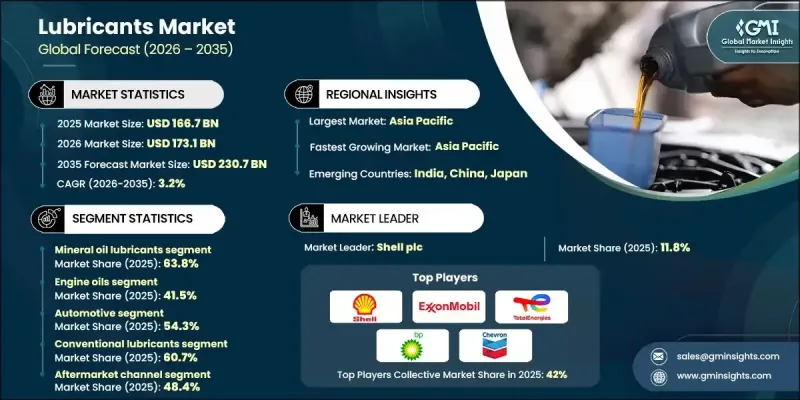
润滑剂不仅能减少机械摩擦和磨损,还能提供热稳定性、耐腐蚀性,并与日益复杂的设备设计相容。技术创新正在推动市场成长,新型合成混合物、生物基配方和混合润滑剂在满足更严格的环保标准的同时,也树立了更高的性能标准。永续性如今已成为全球优先事项,促使製造商开发可生物降解且毒性较低的润滑剂。营运效率仍然是关键的需求驱动因素,因为各行业都在寻求能够延长设备寿命、减少维护并提高能源利用效率的产品。生物润滑剂、智慧润滑系统和多功能组合药物等新兴趋势进一步扩大了市场潜力,并塑造全球工业和汽车应用的未来。
| 市场覆盖范围 | |
|---|---|
| 开始年份 | 2025 |
| 预测年份 | 2026-2035 |
| 起始值 | 1667亿美元 |
| 预测金额 | 2307亿美元 |
| 复合年增长率 | 3.2% |
2025年,机油市占率占41.5%,预计到2035年将以2.6%的复合年增长率成长。这些油品对船舶和汽车引擎至关重要,可保护部件免受磨损、高温和污染物的侵害;而变速箱油则有助于平稳换檔和保持热稳定性,尤其是在恶劣条件下运行的先进变速箱系统中。
2025年,汽车领域占据了54.3%的市场份额,预计到2035年将以2.4%的复合年增长率成长。该领域的润滑油可确保更长的引擎寿命、更高的燃油效率和符合排放气体标准,从而导致对专为混合动力汽车和电动车量身定制的专用配方的需求增加。
预计到 2025 年,欧洲润滑油市场规模将达到 309 亿美元,由于严格的环境法规、先进的工业基础设施以及在永续性倡议的推动下对优质合成润滑油和生物基润滑油的大力采用,欧洲将成为重要的增长区域。
目录
第一章调查方法和范围
第二章执行摘要
第三章业界考察
- 生态系分析
- 供应商情况
- 利润率
- 每个阶段的附加价值
- 影响价值链的因素
- 中断
- 产业影响因素
- 司机
- 汽车产量和汽车零件增加
- 工业製造的扩张
- 更严格的排放法规推动合成油的普及
- 产业潜在风险与挑战
- 原油和基础油价格波动
- 由于汽车产业转型,润滑油需求下降
- 市场机会
- 生物基和生物降解润滑剂的成长
- 再生精炼润滑油和循环经济润滑油
- 司机
- 成长潜力分析
- 监管环境
- 北美洲
- 欧洲
- 亚太地区
- 拉丁美洲
- 中东和非洲
- 波特五力分析
- PESTEL 分析
- 价格趋势
- 按地区
- 依基础油类型
- 未来市场趋势
- 科技与创新趋势
- 当前技术趋势
- 新兴技术
- 专利状态
- 贸易统计(HS编码)(註:仅提供主要国家的贸易统计)
- 主要进口国
- 主要出口国
- 永续性和环境方面
- 永续努力
- 减少废弃物策略
- 生产中的能源效率
- 环保倡议
- 考虑到碳足迹
第四章 竞争情势
- 介绍
- 公司市占率分析
- 按地区
- 北美洲
- 欧洲
- 亚太地区
- 拉丁美洲
- 中东和非洲
- 按地区
- 企业矩阵分析
- 主要市场公司的竞争分析
- 竞争定位矩阵
- 重大进展
- 併购
- 伙伴关係与合作
- 新产品发布
- 业务拓展计划
第五章 依基础油类型分類的市场估算与预测,2022-2035年
- 矿物油润滑剂
- 第一组(溶剂精炼)
- 第二组(加氢处理)
- 第三组(高级加氢处理)
- 合成润滑油
- 第四类-聚α烯烃(PAO)
- 第五组—合成酯
- 聚亚烷基二醇(PAG)
- 硅基润滑剂
- 半合成/混合
- 生物基/可再生润滑剂
- 植物油基
- 源自动物脂肪
- 由可再生原料製成的合成酯
第六章 依产品类型分類的市场估算与预测,2022-2035年
- 机油
- 乘用车引擎机油(PCMO)
- 重负荷机油(HDEO)
- 二衝程机油
- 船用机油
- 变速箱油
- 自排变速箱油(ATF)
- 手排变速箱油
- 电动汽车变速箱油
- 油压
- 矿物基液压油
- 耐火液压油
- 可生物降解液压油
- 航空液压油
- 齿轮油
- 汽车齿轮油
- 工业齿轮油
- 开式齿轮复合
- 润滑脂
- 锂/锂复合润滑脂
- 钙基/钙复合润滑脂
- 聚脲润滑脂
- 铝复合润滑脂
- 其他增稠剂类型
- 金属加工油
- 切削油
- 成型和拉拔用润滑油
- 研磨油
- 纯切削油
- 加工油
- 橡胶加工油
- 纺织油
- 白油
- 特殊润滑剂
- 压缩机油
- 涡轮机油
- 冷冻油
- 其他特殊润滑剂
第七章 按应用领域分類的市场估算与预测,2022-2035年
- 车
- 工业製造
- 船
- 航太/国防
- 发电
- 采矿和建筑
- 农业/非公路
- 食品/饮料加工
- 其他工业应用
第八章 依技术类型分類的市场估算与预测,2022-2035年
- 传统润滑剂
- 高性能/全合成油
- 生物基/可生物降解
- 再生/回收
- 先进技术
9. 2022-2035年按分销管道分類的市场估算与预测
- OEM/直销通路
- 工厂灌装润滑油
- OEM品牌产品
- 直接工业供应合约
- 售后市场通路
- 零售
- 批发的
- 工业分销商
- 工业分销商
- MRO供应商
- 专业工业经销商
第十章 2022-2035年各地区市场估计与预测
- 北美洲
- 美国
- 加拿大
- 欧洲
- 德国
- 英国
- 法国
- 西班牙
- 义大利
- 其他欧洲地区
- 亚太地区
- 中国
- 印度
- 日本
- 澳洲
- 韩国
- 亚太其他地区
- 拉丁美洲
- 巴西
- 墨西哥
- 阿根廷
- 其他拉丁美洲地区
- 中东和非洲
- 沙乌地阿拉伯
- 南非
- 阿拉伯聯合大公国
- 其他中东和非洲地区
第十一章 公司简介
- Shell plc
- ExxonMobil Corporation
- TotalEnergies SE
- BP plc(Castrol)
- Chevron Corporation
- FUCHS Group
- Valvoline Inc
- PetroChina Company Limited
- Sinopec Lubricant Company
- Indian Oil Corporation Limited(IOCL)
- ENEOS Corporation
- Petronas Lubricants International
- Lukoil
- Kluber Lubrication(Freudenberg Group)
The Global Lubricants Market was valued at USD 166.7 billion in 2025 and is estimated to grow at a CAGR of 3.2% to reach USD 230.7 billion by 2035.
Lubricants are not only essential for reducing friction and wear in machinery but also provide thermal stability, corrosion resistance, and compatibility with increasingly advanced equipment designs. Technological innovation is driving market growth, with new synthetic blends, bio-based formulations, and hybrid lubricants setting higher performance benchmarks while meeting stricter environmental standards. Sustainability is now a global priority, encouraging manufacturers to develop biodegradable and less toxic lubricants. Operational efficiency remains a major demand driver, as industries seek products that extend equipment life, reduce maintenance, and improve energy consumption. Emerging trends such as bio-lubricants, smart lubrication systems, and multifunctional formulations are further expanding market potential and shaping the future of industrial and automotive applications worldwide.
| Market Scope | |
|---|---|
| Start Year | 2025 |
| Forecast Year | 2026-2035 |
| Start Value | $166.7 Billion |
| Forecast Value | $230.7 Billion |
| CAGR | 3.2% |
The engine oils segment held 41.5% share in 2025 and is expected to grow at a CAGR of 2.6% through 2035. These oils are vital for marine and automotive engines, protecting components against wear, heat, and contaminants, while transmission fluids support smooth gear shifting and thermal stability, particularly in advanced transmission systems operating under extreme conditions.
The automotive segment held 54.3% share in 2025 and is anticipated to grow at a CAGR of 2.4% by 2035. Lubricants in this segment ensure engine longevity, fuel efficiency, and compliance with emission standards, with growing demand for specialized formulations tailored to hybrid and electric vehicles.
Europe Lubricants Market accounted for USD 30.9 billion in 2025, emerging as a key growth region due to stringent environmental regulations, advanced industrial infrastructure, and strong adoption of premium synthetic and bio-based lubricants driven by sustainability initiatives.
Major players in the Global Lubricants Market include Chevron Corporation, FUCHS Group, Shell plc, Valvoline Inc, BP plc (Castrol), ENEOS Corporation, Lukoil, TotalEnergies SE, Sinopec Lubricant Company, Indian Oil Corporation Limited (IOCL), PetroChina Company Limited, Kluber Lubrication (Freudenberg Group), and Petronas Lubricants International. Companies in the Global Lubricants Market are employing multiple strategies to strengthen their market presence and maintain competitiveness. Key approaches include continuous innovation in synthetic, bio-based, and hybrid lubricants to meet performance and environmental standards. Firms are expanding global production capacities and investing in advanced R&D for high-performance applications. Strategic partnerships with OEMs and industrial clients secure long-term supply agreements, while sustainability initiatives promote eco-friendly formulations to align with regulatory trends.
Table of Contents
Chapter 1 Methodology & Scope
- 1.1 Market scope and definition
- 1.2 Research design
- 1.2.1 Research approach
- 1.2.2 Data collection methods
- 1.3 Data mining sources
- 1.3.1 Global
- 1.3.2 Regional/Country
- 1.4 Base estimates and calculations
- 1.4.1 Base year calculation
- 1.4.2 Key trends for market estimation
- 1.5 Primary research and validation
- 1.5.1 Primary sources
- 1.6 Forecast model
- 1.7 Research assumptions and limitations
Chapter 2 Executive Summary
- 2.1 Industry 360° synopsis
- 2.2 Key market trends
- 2.2.1 Regional
- 2.2.2 Base Oil Type
- 2.2.3 Product Type
- 2.2.4 Application
- 2.2.5 Technology Type
- 2.2.6 Distribution Channel
- 2.3 TAM Analysis, 2025-2035
- 2.4 CXO perspectives: Strategic imperatives
- 2.4.1 Executive decision points
- 2.4.2 Critical success factors
- 2.5 Future Outlook and Strategic Recommendations
Chapter 3 Industry Insights
- 3.1 Industry ecosystem analysis
- 3.1.1 Supplier landscape
- 3.1.2 Profit margin
- 3.1.3 Value addition at each stage
- 3.1.4 Factor affecting the value chain
- 3.1.5 Disruptions
- 3.2 Industry impact forces
- 3.2.1 Growth drivers
- 3.2.1.1 Growing automotive production & vehicle part
- 3.2.1.2 Industrial manufacturing expansion
- 3.2.1.3 Stringent emission regulations driving synthetic adoption
- 3.2.2 Industry pitfalls and challenges
- 3.2.2.1 Volatility in crude oil & base oil prices
- 3.2.2.2 Shift toward electric vehicles reducing lubricant demand
- 3.2.3 Market opportunities
- 3.2.3.1 Bio-based & biodegradable lubricants growth
- 3.2.3.2 Re-refined & circular economy lubricants
- 3.2.1 Growth drivers
- 3.3 Growth potential analysis
- 3.4 Regulatory landscape
- 3.4.1 North America
- 3.4.2 Europe
- 3.4.3 Asia Pacific
- 3.4.4 Latin America
- 3.4.5 Middle East & Africa
- 3.5 Porter's analysis
- 3.6 PESTEL analysis
- 3.7 Price trends
- 3.7.1 By region
- 3.7.2 By Base Oil Type
- 3.8 Future market trends
- 3.9 Technology and Innovation landscape
- 3.9.1 Current technological trends
- 3.9.2 Emerging technologies
- 3.10 Patent Landscape
- 3.11 Trade statistics (HS code) ( Note: the trade statistics will be provided for key countries only)
- 3.11.1 Major importing countries
- 3.11.2 Major exporting countries
- 3.12 Sustainability and environmental aspects
- 3.12.1 Sustainable practices
- 3.12.2 Waste reduction strategies
- 3.12.3 Energy efficiency in production
- 3.12.4 Eco-friendly initiatives
- 3.13 Carbon footprint consideration
Chapter 4 Competitive Landscape, 2025
- 4.1 Introduction
- 4.2 Company market share analysis
- 4.2.1 By region
- 4.2.1.1 North America
- 4.2.1.2 Europe
- 4.2.1.3 Asia Pacific
- 4.2.1.4 LATAM
- 4.2.1.5 MEA
- 4.2.1 By region
- 4.3 Company matrix analysis
- 4.4 Competitive analysis of major market players
- 4.5 Competitive positioning matrix
- 4.6 Key developments
- 4.6.1 Mergers & acquisitions
- 4.6.2 Partnerships & collaborations
- 4.6.3 New Product Launches
- 4.6.4 Expansion Plans
Chapter 5 Market Estimates and Forecast, By Base Oil Type, 2022-2035 (USD Billion) (Kilo Tons)
- 5.1 Key trends
- 5.2 Mineral oil lubricants
- 5.2.1 Group i (solvent-refined)
- 5.2.2 Group ii (hydroprocessed)
- 5.2.3 Group iii (severely hydroprocessed)
- 5.3 Synthetic lubricants
- 5.3.1 Group iv - polyalphaolefins (pao)
- 5.3.2 Group v - synthetic esters
- 5.3.3 Polyalkylene glycols (pag)
- 5.3.4 Silicone-based lubricants
- 5.4 Semi-synthetic/blends
- 5.5 Bio-based/renewable lubricants
- 5.5.1 Vegetable oil-based
- 5.5.2 Animal fat-based
- 5.5.3 Synthetic esters from renewable sources
Chapter 6 Market Estimates and Forecast, By Product Type, 2022-2035 (USD Billion) (Kilo Tons)
- 6.1 Key trends
- 6.2 Engine Oils
- 6.2.1 Passenger Car Motor Oils (PCMO)
- 6.2.2 Heavy-Duty Engine Oils (HDEO)
- 6.2.3 Two-Stroke Engine Oils
- 6.2.4 Marine Engine Oils
- 6.3 Transmission Fluids
- 6.3.1 Automatic Transmission Fluids (ATF)
- 6.3.2 Manual Transmission Fluids
- 6.3.3 Electric Vehicle Transmission Fluids
- 6.4 Hydraulic Fluids
- 6.4.1 Mineral Oil-Based Hydraulic Fluids
- 6.4.2 Fire-Resistant Hydraulic Fluids
- 6.4.3 Biodegradable Hydraulic Fluids
- 6.4.4 Aviation Hydraulic Fluids
- 6.5 Gear Oils
- 6.5.1 Automotive Gear Oils
- 6.5.2 Industrial Gear Oils
- 6.5.3 Open Gear Compounds
- 6.6 Greases
- 6.6.1 Lithium/Lithium Complex Greases
- 6.6.2 Calcium/Calcium Complex Greases
- 6.6.3 Polyurea Greases
- 6.6.4 Aluminum Complex Greases
- 6.6.5 Other Thickener Types
- 6.7 Metalworking Fluids
- 6.7.1 Cutting Fluids
- 6.7.2 Forming/Drawing Fluids
- 6.7.3 Grinding Fluids
- 6.7.4 Neat Cutting Oils
- 6.8 Process Oils
- 6.8.1 Rubber Process Oils
- 6.8.2 Textile Oils
- 6.8.3 White Oils
- 6.9 Specialty Lubricants
- 6.9.1 Compressor Oils
- 6.9.2 Turbine Oils
- 6.9.3 Refrigeration Oils
- 6.9.4 Other Specialty Lubricants
Chapter 7 Market Estimates and Forecast, By Application, 2022-2035 (USD Billion) (Kilo Tons)
- 7.1 Key trends
- 7.2 Automotive
- 7.3 Industrial manufacturing
- 7.4 Marine
- 7.5 Aerospace & defense
- 7.6 Power generation
- 7.7 Mining & construction
- 7.8 Agriculture & off-highway
- 7.9 Food & beverage processing
- 7.10 Other industrial applications
Chapter 8 Market Estimates and Forecast, By Technology Type, 2022-2035 (USD Billion) (Kilo Tons)
- 8.1 Key trends
- 8.2 Conventional lubricants
- 8.3 High-performance/fully synthetic
- 8.4 Bio-based/biodegradable
- 8.5 Re-refined/recycled
- 8.6 Advanced technology
Chapter 9 Market Estimates and Forecast, By Distribution Channel, 2022-2035 (USD Billion) (Kilo Tons)
- 9.1 Key trends
- 9.2 OEM/direct channel
- 9.2.1 Factory-fill lubricants
- 9.2.2 Oem-branded products
- 9.2.3 Direct industrial supply contracts
- 9.3 Aftermarket channel
- 9.3.1 Retail
- 9.3.2 Wholesale
- 9.4 Industrial distributors
- 9.4.1 Industrial distributors
- 9.4.2 Mro suppliers
- 9.4.3 Specialty industrial distributors
Chapter 10 Market Estimates and Forecast, By Region, 2022-2035 (USD Billion) (Kilo Tons)
- 10.1 Key trends
- 10.2 North America
- 10.2.1 U.S.
- 10.2.2 Canada
- 10.3 Europe
- 10.3.1 Germany
- 10.3.2 UK
- 10.3.3 France
- 10.3.4 Spain
- 10.3.5 Italy
- 10.3.6 Rest of Europe
- 10.4 Asia Pacific
- 10.4.1 China
- 10.4.2 India
- 10.4.3 Japan
- 10.4.4 Australia
- 10.4.5 South Korea
- 10.4.6 Rest of Asia Pacific
- 10.5 Latin America
- 10.5.1 Brazil
- 10.5.2 Mexico
- 10.5.3 Argentina
- 10.5.4 Rest of Latin America
- 10.6 Middle East and Africa
- 10.6.1 Saudi Arabia
- 10.6.2 South Africa
- 10.6.3 UAE
- 10.6.4 Rest of Middle East and Africa
Chapter 11 Company Profiles
- 11.1 Shell plc
- 11.2 ExxonMobil Corporation
- 11.3 TotalEnergies SE
- 11.4 BP plc (Castrol)
- 11.5 Chevron Corporation
- 11.6 FUCHS Group
- 11.7 Valvoline Inc
- 11.8 PetroChina Company Limited
- 11.9 Sinopec Lubricant Company
- 11.10 Indian Oil Corporation Limited (IOCL)
- 11.11 ENEOS Corporation
- 11.12 Petronas Lubricants International
- 11.13 Lukoil
- 11.14 Kluber Lubrication (Freudenberg Group)

 东非润滑油市场:市场占有率分析、产业趋势与统计、成长预测(2026-2031年)印尼润滑油市场:市场占有率分析、产业趋势、统计数据和成长预测(2026-2031年)拉丁美洲润滑油市场:市场占有率分析、产业趋势与统计、成长预测(2026-2031年)日本润滑油市场-份额分析、产业趋势与统计、成长预测(2026-2031)润滑油:市场占有率分析、产业趋势与统计、成长预测(2026-2031)马来西亚润滑油市场:市场占有率分析、产业趋势与统计、成长预测(2026-2031)
 日本润滑油市场报告(按产品类型、最终用户和地区划分,2026-2034年)
 水性润滑剂市场规模、份额及成长分析(按产品类型、通路及地区划分)-2026-2033年产业预测
 2025年全球开式齿轮润滑油市场报告
 干式润滑剂市场-2025年至2030年预测