


 |
市场调查报告书
商品编码
1928964
摩托车市场机会、成长要素、产业趋势分析及2026年至2035年预测Two Wheeler Market Opportunity, Growth Drivers, Industry Trend Analysis, and Forecast 2026 - 2035 |
||||||

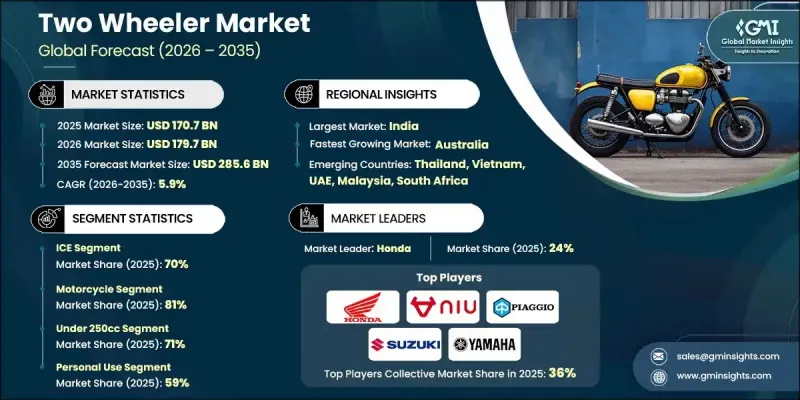
全球摩托车市场预计到 2025 年将达到 1,707 亿美元,到 2035 年将达到 2,856 亿美元,年复合成长率为 5.9%。
电动车市场扩张的驱动力来自多个地区电动车製造商的快速成长,以及全球对更清洁、更永续交通途径日益增长的需求。不断增强的环保意识和监管压力正在加速向电动两轮车的转型,重塑全球个人出行模式。持续的技术进步提升了车辆的性能、效率和便利性,促进了其在已开发国家和开发中国家的广泛应用。随着全球减排排放的加大,电动出行解决方案的接受度也稳定提高。同时,该行业也在不断发展,以应对不断变化的消费者偏好、都市区拥堵挑战以及车辆工程技术的进步。有利的政策框架和对更环保交通途径日益增长的需求正在推动电动摩托车和电动Scooter的普及,使两轮车市场成为未来出行生态系统的重要组成部分。
| 市场覆盖范围 | |
|---|---|
| 开始年份 | 2025 |
| 预测期 | 2026-2035 |
| 起始值 | 1707亿美元 |
| 预测金额 | 2856亿美元 |
| 复合年增长率 | 5.9% |
预计到2025年,内燃机摩托车市占率将达到70%,并在2026年至2035年间以5%的复合年增长率成长。在开发中国家,由于内燃机摩托车相比电动车前期成本更低,因此持续吸引消费者。价格实惠、产品种类丰富以及完善的分销网络,使这些车辆成为注重成本的消费者的理想选择。此外,完善的加油基础设施也进一步支撑了对内燃机摩托车的持续需求。
预计到2025年,摩托车市占率将达到81%,2026年至2035年期间的复合年增长率将达到5.9%。都市区的成长和公共交通系统日益紧张,促使人们越来越依赖两轮车这种便利经济的交通工具。摩托车的操控性好、营运成本低、停车方便,使其成为日常通勤的理想选择,尤其是在人口密集的都市区。
预计到2025年,印度两轮车市场将占据21%的市场份额,市场规模将达到269亿美元。与摩托车主要用于休閒娱乐的成熟市场不同,印度市场主要受日常交通需求所驱动。在印度,消费者的购买决策很大程度上取决于价格、燃油效率和长期可靠性,这使得两轮车成为许多消费者不可或缺的交通工具。
目录
第一章调查方法和范围
第二章执行摘要
第三章业界考察
- 生态系分析
- 供应商情况
- 利润率分析
- 成本结构
- 每个阶段的附加价值
- 影响价值链的因素
- 中断
- 产业影响因素
- 司机
- 电动摩托车需求不断成长
- 电池和马达系统的技术进步
- 都市化加速与交通拥挤加剧
- 燃油价格上涨与环境问题
- 产业潜在风险与挑战
- 电动车初始成本高
- 电动车基础设施的限制
- 市场机会
- 扩大电动车的使用
- 新兴市场的成长
- 智慧技术集成
- 政府支持的基础建设
- 成长潜力分析
- 监管环境
- 北美洲
- 联邦法律规范
- 各州监管差异
- 加拿大法规环境
- 欧洲
- 欧盟法规结构
- CE标誌和符合性要求
- 国内实施上的差异
- 个人行动装置监管
- 摩托车安全标准和个人防护设备(PPE)法规
- 亚太地区
- 中国的法规结构
- 印度法规环境
- 东协协调努力
- 日本的法规结构
- 其他地区差异
- 拉丁美洲
- 巴西法规结构
- 墨西哥的法规环境
- 促进区域和谐的倡议
- 中东和非洲
- 波湾合作理事会(GCC)框架
- 南非法规环境
- 社区发展倡议
- 北美洲
- 波特分析
- PESTEL 分析
- 科技与创新趋势
- 当前技术趋势
- 新兴技术
- 价格趋势
- 按地区
- 副产品
- 生产统计
- 生产基地
- 消费基础
- 进出口
- 成本細項分析
- 专利分析
- 永续性和环境方面
- 永续实践
- 减少废弃物策略
- 生产中的能源效率
- 环保倡议
- 碳足迹考量
- 消费者购买行为与偏好分析
- 总拥有成本 (TCO) 分析
- 品牌认知与忠诚度分析
- 电动摩托车生态系统的全面分析
- 电池更换系统与固定电池系统的比较
- 充电基础设施发展状况
- 电池租借/订阅模式
第四章 竞争情势
- 介绍
- 公司市占率分析
- 北美洲
- 欧洲
- 亚太地区
- 拉丁美洲
- 中东和非洲
- 主要市场公司的竞争分析
- 竞争定位矩阵
- 战略展望矩阵
- 重大进展
- 併购
- 伙伴关係与合作
- 新产品发布
- 企业扩张计画和资金筹措
第五章 依车辆类型分類的市场估计与预测,2022-2035年
- 摩托车
- 巡航自行车
- 运动摩托车
- 旅行自行车
- 标准/裸车
- 探险/双用途摩托车
- 越野/泥地摩托车
- Scooter
- 大型Scooter
- 2类轻型机踏车Scooter
6. 2022-2035年按推进方式分類的市场估计与预测
- 内燃机(ICE)
- 电的
第七章 依引擎排气量分類的市场估算与预测,2022-2035年
- 排气量低于250cc
- 250cc~500cc
- 500cc~1000cc
- 1000cc 或以上
第八章 依最终用途分類的市场估算与预测,2022-2035年
- 个人使用
- 商业的
9. 2022-2035年按分销管道分類的市场估算与预测
- 离线
- 在线的
第十章 2022-2035年各地区市场估计与预测
- 北美洲
- 我们
- 加拿大
- 欧洲
- 英国
- 德国
- 法国
- 义大利
- 西班牙
- 波兰
- 荷兰
- 比利时
- 亚太地区
- 中国
- 印度
- 日本
- 韩国
- 台湾
- 缅甸
- 泰国
- 越南
- 新加坡
- 印尼
- ANZ
- 拉丁美洲
- 巴西
- 阿根廷
- 墨西哥
- 中东和非洲
- 阿拉伯聯合大公国
- 沙乌地阿拉伯
- 南非
第十一章 公司简介
- 世界玩家
- Bajaj
- Hero
- Honda
- Piaggio
- Suzuki
- TVS
- Yamaha
- Premium Motorcycle Brands
- BMW Motorrad
- Ducati
- Harley-Davidson
- KTM
- Royal Enfield
- Kawasaki
- Electric Two Wheeler Manufacturers
- Ather
- Ola Electric
- Revolt
- Ultraviolette
- Yadea
- Zero Motorcycles
- Niu Technologies
The Global Two Wheeler Market was valued at USD 170.7 billion in 2025 and estimated to grow at a CAGR of 5.9% to reach USD 285.6 billion by 2035.
Market expansion is driven by the rapid rise in electric vehicle producers across multiple regions and the growing global emphasis on cleaner and more sustainable transportation. Environmental awareness and regulatory pressure are accelerating the shift toward electric two-wheelers, which is reshaping personal mobility patterns worldwide. Ongoing technological progress is improving vehicle performance, efficiency, and usability, supporting wider adoption across both developed and developing economies. As global efforts to reduce emissions increase, acceptance of electric mobility solutions is increasing steadily. At the same time, the industry is evolving in response to changing consumer preferences, urban congestion challenges, and advancements in vehicle engineering. Electric motorcycles and scooters are gaining broader acceptance due to supportive policy frameworks and increasing demand for environmentally responsible transportation options, positioning the two-wheeler market as a key contributor to future mobility ecosystems.
| Market Scope | |
|---|---|
| Start Year | 2025 |
| Forecast Year | 2026-2035 |
| Start Value | $170.7 Billion |
| Forecast Value | $285.6 Billion |
| CAGR | 5.9% |
The internal combustion engine segment accounted for 70% share in 2025 and is projected to register a CAGR of 5% between 2026 and 2035. In developing economies, ICE two-wheelers continue to attract buyers due to their lower upfront cost compared to electric alternatives. Affordable pricing, broad product availability, and strong distribution networks make these vehicles a practical choice for cost-sensitive consumers. The presence of extensive refueling infrastructure further supports the sustained demand for ICE-powered two-wheelers.
The motorcycles segment held 81% share in 2025 and is expected to grow at a CAGR of 5.9% from 2026 to 2035. Rising urban populations and increasing pressure on public transportation systems are encouraging greater reliance on motorcycles as a convenient and economical mode of travel. Their maneuverability, low operating costs, and ease of parking make them well-suited for daily commuting, particularly in densely populated urban areas.
India Two Wheeler Market held 21% share and generated USD 26.9 billion in 2025. Unlike mature markets where two-wheelers are often used for leisure, the Indian market is primarily driven by daily transportation needs. Purchasing decisions in the country are heavily influenced by affordability, fuel efficiency, and long-term reliability, making two-wheelers an essential mobility solution for a broad consumer base.
Key companies operating in the Global Two Wheeler Market include Yamaha, Honda, Bajaj, Hero, Suzuki, Royal Enfield, Piaggio, Yadea, Kawasaki, BMW Motorrad, and Harley-Davidson. Companies in the two wheeler market are reinforcing their market positions through product diversification, investment in electric mobility, and expansion across high-growth regions. Manufacturers are focusing on cost optimization and localized production to improve affordability and strengthen supply chains. Strategic investments in research and development are enabling continuous improvements in performance, efficiency, and design. Many players are also enhancing dealer networks and after-sales services to improve customer engagement and brand loyalty.
Table of Contents
Chapter 1 Methodology & Scope
- 1.1 Research approach
- 1.2 Quality Commitments
- 1.2.1 GMI AI policy & data integrity commitment
- 1.2.1.1 Source consistency protocol
- 1.2.1 GMI AI policy & data integrity commitment
- 1.3 Research Trail & Confidence Scoring
- 1.3.1 Research Trail Components
- 1.3.2 Scoring Components
- 1.4 Data Collection
- 1.4.1 Partial list of primary sources
- 1.5 Data mining sources
- 1.5.1 Paid sources
- 1.5.1.1 Sources, by region
- 1.5.1 Paid sources
- 1.6 Base estimates and calculations
- 1.6.1 Base year calculation for any one approach
- 1.7 Forecast model
- 1.7.1 Quantified market impact analysis
- 1.7.1.1 Mathematical impact of growth parameters on forecast
- 1.7.1 Quantified market impact analysis
- 1.8 Research transparency addendum
- 1.8.1 Source attribution framework
- 1.8.2 Quality assurance metrics
- 1.8.3 Our commitment to trust
Chapter 2 Executive Summary
- 2.1 Industry 3600 synopsis, 2022 - 2035
- 2.2 Key market trends
- 2.2.1 Regional
- 2.2.2 Vehicle
- 2.2.3 Propulsion
- 2.2.4 Displacement
- 2.2.5 End use
- 2.2.6 Distribution channel
- 2.3 TAM Analysis, 2026-2035
- 2.4 CXO perspectives: Strategic imperatives
- 2.4.1 Executive decision points
- 2.4.2 Critical success factors
- 2.5 Future outlook and strategic recommendations
Chapter 3 Industry Insights
- 3.1 Industry ecosystem analysis
- 3.1.1 Supplier landscape
- 3.1.2 Profit margin analysis
- 3.1.3 Cost structure
- 3.1.4 Value addition at each stage
- 3.1.5 Factor affecting the value chain
- 3.1.6 Disruptions
- 3.2 Industry impact forces
- 3.2.1.1 Growth drivers
- 3.2.1.2 Rise in demand for electric two-wheelers
- 3.2.1.3 Technological advancements in battery and motor systems
- 3.2.1.4 Expansion of urbanization and traffic congestion
- 3.2.1.5 High fuel prices and environmental concerns
- 3.2.2 Industry pitfalls and challenges
- 3.2.2.1 High initial cost of electric vehicles
- 3.2.2.2 Infrastructure limitations for electric vehicles
- 3.2.3 Market opportunities
- 3.2.3.1 Expansion of electric vehicle adoption
- 3.2.3.2 Growth in emerging markets
- 3.2.3.3 Integration of smart technology
- 3.2.3.4 Government-backed infrastructure development
- 3.3 Growth potential analysis
- 3.4 Regulatory landscape
- 3.4.1 North America
- 3.4.1.1 Federal regulatory framework
- 3.4.1.2 State-level regulatory variations
- 3.4.1.3 Canadian regulatory environment
- 3.4.2 Europe
- 3.4.2.1 EU regulatory framework
- 3.4.2.2 CE marking and compliance requirements
- 3.4.2.3 National implementation variations
- 3.4.2.4 Personal mobility device regulations
- 3.4.2.5 Motorcycle safety and PPE regulations
- 3.4.3 Asia Pacific
- 3.4.3.1 Chinese regulatory framework
- 3.4.3.2 Indian regulatory environment
- 3.4.3.3 ASEAN harmonization efforts
- 3.4.3.4 Japanese regulatory framework
- 3.4.3.5 Other regional variations
- 3.4.4 Latin America
- 3.4.4.1 Brazilian regulatory framework
- 3.4.4.2 Mexican regulatory environment
- 3.4.4.3 Regional harmonization efforts
- 3.4.5 Middle East & Africa
- 3.4.5.1 Gulf cooperation council (GCC) framework
- 3.4.5.2 South African regulatory environment
- 3.4.5.3 Regional development initiatives
- 3.4.1 North America
- 3.5 Porter';s analysis
- 3.6 PESTEL analysis
- 3.7 Technology and innovation landscape
- 3.7.1 Current technological trends
- 3.7.2 Emerging technologies
- 3.8 Price trends
- 3.8.1 By region
- 3.8.2 By product
- 3.9 Production statistics
- 3.9.1 Production hubs
- 3.9.2 Consumption hubs
- 3.9.3 Export and import
- 3.10 Cost breakdown analysis
- 3.11 Patent analysis
- 3.12 Sustainability and environmental aspects
- 3.12.1 Sustainable practices
- 3.12.2 Waste reduction strategies
- 3.12.3 Energy efficiency in production
- 3.12.4 Eco-friendly Initiatives
- 3.12.5 Carbon footprint considerations
- 3.13 Consumer buying behavior & preference analysis
- 3.14 Total cost of ownership (TCO) analysis
- 3.15 Brand perception & loyalty analysis
- 3.16 Electric two-wheeler ecosystem deep dive
- 3.16.1 Battery swapping vs fixed battery models
- 3.16.2 Charging infrastructure readiness
- 3.16.3 Battery leasing & subscription models
Chapter 4 Competitive Landscape, 2025
- 4.1 Introduction
- 4.2 Company market share analysis
- 4.2.1 North America
- 4.2.2 Europe
- 4.2.3 Asia Pacific
- 4.2.4 LATAM
- 4.2.5 MEA
- 4.3 Competitive analysis of major market players
- 4.4 Competitive positioning matrix
- 4.5 Strategic outlook matrix
- 4.6 Key developments
- 4.6.1 Mergers & acquisitions
- 4.6.2 Partnerships & collaborations
- 4.6.3 New Product Launches
- 4.6.4 Expansion Plans and funding
Chapter 5 Market Estimates & Forecast, By Vehicle, 2022 - 2035 ($Mn, Units)
- 5.1 Key trends
- 5.2 Motorcycles
- 5.2.1 Cruiser motorcycles
- 5.2.2 Sport motorcycles
- 5.2.3 Touring motorcycles
- 5.2.4 Standard/naked motorcycles
- 5.2.5 Adventure/dual-sport motorcycles
- 5.2.6 Off-road/dirt motorcycles
- 5.3 Scooters
- 5.3.1 Maxi scooters
- 5.3.2 Moped-style scooters
Chapter 6 Market Estimates & Forecast, By Propulsion, 2022 - 2035 ($Mn, Units)
- 6.1 Key trends
- 6.2 ICE
- 6.3 Electric
Chapter 7 Market Estimates & Forecast, By Displacement, 2022 - 2035 ($Mn, Units)
- 7.1 Key trends
- 7.2 Under 250cc
- 7.3 250cc-500cc
- 7.4 500cc-1000cc
- 7.5 Above 1000cc
Chapter 8 Market Estimates & Forecast, By End Use, 2022 - 2035 ($Mn, Units)
- 8.1 Key trends
- 8.2 Personal use
- 8.3 Commercial
Chapter 9 Market Estimates & Forecast, By Distribution Channel, 2022 - 2035 ($Mn, Units)
- 9.1 Key trends
- 9.2 Offline
- 9.3 Online
Chapter 10 Market Estimates & Forecast, By Region, 2022 - 2035 ($Mn, Units)
- 10.1 Key trends
- 10.2 North America
- 10.2.1 US
- 10.2.2 Canada
- 10.3 Europe
- 10.3.1 UK
- 10.3.2 Germany
- 10.3.3 France
- 10.3.4 Italy
- 10.3.5 Spain
- 10.3.6 Poland
- 10.3.7 Netherlands
- 10.3.8 Belgium
- 10.4 Asia Pacific
- 10.4.1 China
- 10.4.2 India
- 10.4.3 Japan
- 10.4.4 South Korea
- 10.4.5 Taiwan
- 10.4.6 Myanmar
- 10.4.7 Thailand
- 10.4.8 Vietnam
- 10.4.9 Singapore
- 10.4.10 Indonesia
- 10.4.11 ANZ
- 10.5 Latin America
- 10.5.1 Brazil
- 10.5.2 Argentina
- 10.5.3 Mexico
- 10.6 MEA
- 10.6.1 UAE
- 10.6.2 Saudi Arabia
- 10.6.3 South Africa
Chapter 11 Company Profiles
- 11.1 Global Players
- 11.1.1 Bajaj
- 11.1.2 Hero
- 11.1.3 Honda
- 11.1.4 Piaggio
- 11.1.5 Suzuki
- 11.1.6 TVS
- 11.1.7 Yamaha
- 11.2 Premium Motorcycle Brands
- 11.2.1 BMW Motorrad
- 11.2.2 Ducati
- 11.2.3 Harley-Davidson
- 11.2.4 KTM
- 11.2.5 Royal Enfield
- 11.2.6 Kawasaki
- 11.3 Electric Two Wheeler Manufacturers
- 11.3.1 Ather
- 11.3.2 Ola Electric
- 11.3.3 Revolt
- 11.3.4 Ultraviolette
- 11.3.5 Yadea
- 11.3.6 Zero Motorcycles
- 11.3.7 Niu Technologies

 摩托车市场:2026年至2032年全球预测(按车型、动力系统、性能类型、类别、变速箱类型、价格范围、应用和最终用户划分)
 摩托车照明市场规模、份额、成长及全球产业分析:按类型、应用和地区划分,并预测至2026-2034年摩托车市场规模、份额、成长及全球产业分析:按类型、应用和地区分類的洞察,2026-2034 年预测
 日本摩托车市场:规模、份额、趋势和预测:按类型、技术、变速箱、引擎排气量、燃料类型、分销管道、最终用户和地区划分(2026-2034 年)
 欧洲摩托车市场份额分析、行业趋势、统计数据和成长预测(2026-2031)
 摩托车智能化与产业链(2025-2026)
 全球摩托车市场南美洲摩托车市场占有率分析、产业趋势和成长预测(2025-2029)摩托车 -市场占有率分析、行业趋势和统计、成长预测(2025-2030 年)非洲两轮车:市场占有率分析、产业趋势与统计、成长预测(2025-2030 年)