


 |
市场调查报告书
商品编码
1907260
菲律宾太阳能市场:市场占有率分析、产业趋势与统计、成长预测(2026-2031年)Philippines Solar Energy - Market Share Analysis, Industry Trends & Statistics, Growth Forecasts (2026 - 2031) |
||||||

※ 本网页内容可能与最新版本有所差异。详细情况请与我们联繫。
预计菲律宾太阳能市场将从 2025 年的 4.25 吉瓦成长到 2026 年的 5.43 吉瓦,到 2031 年达到 18.49 吉瓦,2026 年至 2031 年的复合年增长率为 27.78%。
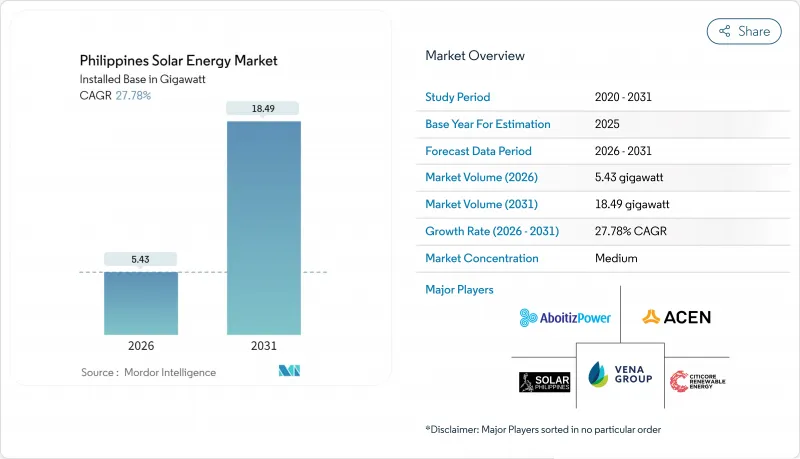
组件和系统整体成本的下降已使大型太阳能光电的平准化电力成本低至每千瓦时0.044美元,使新增太阳能发电容量成为满足基本负载需求的最低成本选择。超大规模资料中心和业务流程外包公司的强劲需求正在推动混合式太阳能-储能计划的应用,以确保全天候清洁电力供应。同时,美国能源部绿色能源竞标计画(GEAP)在第四轮竞标中授予了10.2吉瓦的容量,使国内在开发平臺总数超过36吉瓦。在拉古纳湖和灌溉水库上安装的浮体式太阳能光电系统正成为一种无需占用土地的替代方案,而将净计量上限从100千瓦提高到1兆瓦的监管改革预计将鼓励在商业和工业建筑的屋顶上安装太阳能发电系统。
菲律宾太阳能市场趋势及展望
光学模组和BOS成本快速下降
预计2023年,全球公用事业规模太阳能光电的平准化电成本(LCOE)将降至0.044美元/度数,较2010年下降90%。这显着降低了菲律宾所有计划的资本支出。当地企业现在可以以低于0.19美元/瓦的价格采购一级组件,从而扩大了计划的利润空间。为此,Sol-Go计划建立一条本地组装线。曾经占亚洲太阳能预算75%的系统平衡(BOS)支出,如今正成为国内增值发电的新途径,金属框架、逆变器和电缆製造商正在重组,以转向出口。这一成本趋势使菲律宾太阳能市场与进口液化天然气和传统煤炭相比更具竞争力,加速了公用事业公司的采购和公司间的购电协议(PPA)的签订。从中长期来看,这将支持一个新兴的国内製造基地,该基地到 2030 年每年能够供应 3-5 吉瓦的组件,从而进一步巩固供应链。
绿色能源竞标(GEAP)预计将从 2025 年起创造超过 1 吉瓦的太阳能发电专案储备。
能源部采用竞争性竞标模式,以价格发现机制取代上网电价补贴,首轮竞标即选定了1吉瓦的太阳能发电计画。第四轮竞标的目标装置容量为9,378兆瓦,其中包括光伏和储能混合系统。开发商的热情仍然高涨,第三轮能源市场招标(GEA-3)收到的太阳能竞标容量达到7,500兆瓦,远超4,650兆瓦的上限,从而确保了较低的上网电价补贴和20年的稳定电力供应。与竞标挂钩的购电协议(PPA)降低了资金筹措风险,缩小了贷款机构的利差,并允许开发商透过增加运转率。从第四轮能源市场招标(GEA-4)开始强制要求安装电池储能係统,标誌着菲律宾政府在发展有利于电网的可再生能源方面政策日益成熟,这将有助于解决白天弃电问题。总而言之,这些竞标正在推动菲律宾太阳能市场走向可预测的建设週期和透明的成本标准。
维萨亚斯-棉兰老岛走廊电网容量薄弱
截至2023年,16个优先输电计划中仅有6个完工,耗资披索亿披索的棉兰老岛-维萨亚斯主干输电线路已延期三年。吕宋岛以南地区的太阳能普及受到瓶颈限制,迫使开发商将重点放在已接入电网的地区,导致丰富的太阳辐射资源未能充分利用。儘管《2022-2040年输电网发展规划》概述了扩建计划,但实施进度落后于需求。在高压输电线路建设跟上需求之前,计划规划可能仍将以吕宋岛为中心。
细分市场分析
预计到2025年,太阳能光伏发电将占菲律宾全部装置容量,巩固其在菲律宾太阳能市场100%的份额。高效的n型i-TOPCon和双面组件正在提高发电量并减少土地需求,以27.78%的复合年增长率推动菲律宾太阳能光伏市场规模不断扩大。另一方面,由于土地短缺和颱风的影响,聚光型太阳光电(CSP)在商业性并不现实,能源部(DOE)总体规划中也没有为该技术设定目标。
市场正朝着采用串列型逆变器的光伏+储能混合架构发展,以提高运转率并满足企业购电协议中全天候采购条款的要求。 Terra Solar 的 3.5GW 光伏 + 4.5GWh 储能专案凸显了这一混合趋势,并与超大规模资料中心业者营运商签订了长期供货协议。
菲律宾太阳能市场报告按技术(光伏和聚光型太阳热能发电)、併网类型(併网和离网)以及最终用户(大型公用事业公司、商业/工业用户和住宅)进行细分。市场规模和预测以装置容量(吉瓦)为单位。
其他福利:
- Excel格式的市场预测(ME)表
- 3个月的分析师支持
目录
第一章 引言
- 研究假设和市场定义
- 调查范围
第二章调查方法
第三章执行摘要
第四章 市场情势
- 市场概览
- 市场驱动因素
- 光学模组和BOS成本快速下降
- 绿色能源竞标(GEAP)将从2025年起促成超过1吉瓦的太阳能发电工程。
- 超大规模资料中心业者和业务流程外包 (BPO) 公司的购电协议 (PPA) 要求全天候 (24/7) 提供清洁电力。
- 美国能源部净计量改革将把100千瓦的上限提高到1兆瓦(2024年)。
- 在灌溉水库引进浮体式太阳能发电系统(与国家灌溉管理局签署谅解备忘录)
- 东协内部的碳排放边境调节机制对出口製造业带来压力。
- 市场限制
- 维萨亚斯-棉兰老岛走廊电网容量薄弱
- 与越南和马来西亚相比,资金筹措成本较高(加权平均资本成本超过9%)
- 根据《综合农业改革计画农业用地法》提出的土地征用纠纷
- 颱风相关的运维中断会使平准化能源成本增加约4%。
- 供应链分析
- 监管环境
- 技术展望
- 波特五力模型
- 新进入者的威胁
- 买方的议价能力
- 供应商的议价能力
- 替代品的威胁
- 竞争对手之间的竞争
- PESTEL 分析
第五章 市场规模与成长预测
- 透过技术
- 光伏(PV)
- 聚光型太阳热能发电(CSP)
- 按网格类型
- 併网
- 离网
- 最终用户
- 公用事业规模
- 商业和工业(C&I)
- 住宅
- 按成分(定性分析)
- 光学模组/面板
- 逆变器(组串式、集中式、微型)
- 安装和追踪系统
- 系统周边设备和电气设备
- 储能和混合整合
第六章 竞争情势
- 市场集中度
- 策略性倡议(併购、联盟、购电协议)
- 市场占有率分析(主要企业的市场排名和份额)
- 公司简介
- Solar Philippines Power Project Holdings
- ACEN Corp.
- Vena Energy
- Citicore Power Inc.
- Aboitiz Power Corp.
- Solenergy Systems Inc.
- SunAsia Energy
- Helios Solar Energy Corp.
- Cleantech Global Renewables
- Trina Solar Ltd.
- Canadian Solar
- JinkoSolar
- First Gen Corp.
- Meralco PowerGen(MGen)
- Shell Pilipinas-Solar
- TotalEnergies-Solar
- NextGen Power
- Enfinity Global
- Rizal Wind-Solar Energy Corp.
- Greenergy Holdings
第七章 市场机会与未来展望
The Philippines Solar Energy Market is expected to grow from 4.25 gigawatt in 2025 to 5.43 gigawatt in 2026 and is forecast to reach 18.49 gigawatt by 2031 at 27.78% CAGR over 2026-2031.
Declining module and balance-of-system costs have driven the levelized cost of utility-scale solar down to USD 0.044 per kWh, making new photovoltaic capacity the least-cost choice for meeting baseload demand. Strong demand from hyperscale data centers and business-process outsourcing firms is accelerating hybrid solar-plus-storage projects that guarantee 24/7 clean power. Meanwhile, the Department of Energy's Green Energy Auction Program (GEAP) has awarded 10.2 GW of capacity in its fourth round, pushing the national development pipeline above 36 GW. Floating solar on Laguna Lake and irrigation reservoirs is emerging as a land-neutral alternative, and reforms that lifted the net-metering ceiling from 100 kW to 1 MW are expected to unlock commercial and industrial rooftops.
Philippines Solar Energy Market Trends and Insights
Rapid Decline in PV Module & BOS Costs
Global utility-scale solar leveledized costs fell to USD 0.044 /kWh in 2023, a 90% drop since 2010, slashing capital outlays for every Philippine project.Local firms now receive price quotes under USD 0.19 /W for Tier-1 modules, widening project margins and spurring Sol-Go to locate assembly lines in the country. Balance-of-system spending, historically 75% of Asian solar budgets, is becoming a new domestic value-add avenue, with metal frame, inverter, and cable manufacturers repositioning for export. This cost trajectory raises the competitive standing of the Philippines' solar energy market against imported LNG and legacy coal, accelerating utility procurement and corporate PPAs. Over the medium term, it also underpins a nascent local manufacturing base that could supply 3-5 GW of modules annually by 2030, further anchoring the supply chain.
Green Energy Auctions (GEAP) Unlocking >=1 GW Solar Pipeline from 2025
The Department of Energy's competitive tender model replaces static feed-in tariffs with price discovery, awarding 1 GW of solar in its inaugural round and setting a 9,378 MW target for the fourth auction that includes solar-storage hybrids. Developer appetite remains robust, GEA-3 drew 7,500 MW of solar bids for a 4,650 MW cap, compressing tariffs and ensuring 20-year off-take certainty. Auction-linked PPAs lower financing risk, enabling lenders to trim spreads and developers to stretch capacity factors with storage add-ons. The integration of mandatory battery systems from GEA-4 onwards signals policy maturation toward grid-friendly renewables that can address midday curtailment. Collectively, auctions move the Philippines' solar energy market toward predictable build-out cycles and transparent cost benchmarks.
Weak Grid Capacity in Visayas-Mindanao Corridor
Only 6 of 16 priority transmission projects were completed by 2023, delaying the PHP 52 billion Mindanao-Visayas backbone by three years.Bottlenecks restrict solar additions south of Luzon, compelling developers to cluster where interconnection is available and leaving ample irradiance unexploited. The Transmission Development Plan 2022-2040 maps expansions, but execution lags grid demand. Until high-voltage lines catch up, project pipelines will stay skewed toward Luzon.
Other drivers and restraints analyzed in the detailed report include:
- Corporate PPAs by Hyperscalers & BPOs Demanding 24/7 Clean Power
- DOE Net-Metering Reform Lifting 100 kW Cap to 1 MW (2024)
- High Financing Costs vs Vietnam & Malaysia (>=9% WACC)
For complete list of drivers and restraints, kindly check the Table Of Contents.
Segment Analysis
Solar photovoltaic accounted for the entire 2025 installation base, reinforcing a Philippines solar energy market share of 100.00%. High-efficiency n-type i-TOPCon and bifacial modules lift output and cut land needs, helping the Philippines' solar energy market size for PV rise at a 27.78% CAGR. CSP remains commercially non-viable due to land scarcity and typhoons, and the DOE master plan allocates no targets for the technology.
The market's equipment shift toward string inverters and hybrid PV-plus-storage architectures improves uptime and meets 24/7 procurement clauses in corporate PPAs. Terra Solar's 3.5 GW PV and 4.5 GWh storage confirm this hybrid trend, locking in long-duration supply contracts with hyperscalers.
The Philippines Solar Energy Market Report is Segmented by Technology (Solar Photovoltaic and Concentrated Solar Power), Grid Type (On-Grid and Off-Grid), and End-User (Utility-Scale, Commercial and Industrial, and Residential). The Market Sizes and Forecasts are Provided in Terms of Installed Capacity (GW).
List of Companies Covered in this Report:
- Solar Philippines Power Project Holdings
- ACEN Corp.
- Vena Energy
- Citicore Power Inc.
- Aboitiz Power Corp.
- Solenergy Systems Inc.
- SunAsia Energy
- Helios Solar Energy Corp.
- Cleantech Global Renewables
- Trina Solar Ltd.
- Canadian Solar
- JinkoSolar
- First Gen Corp.
- Meralco PowerGen (MGen)
- Shell Pilipinas - Solar
- TotalEnergies - Solar
- NextGen Power
- Enfinity Global
- Rizal Wind-Solar Energy Corp.
- Greenergy Holdings
Additional Benefits:
- The market estimate (ME) sheet in Excel format
- 3 months of analyst support
TABLE OF CONTENTS
1 Introduction
- 1.1 Study Assumptions & Market Definition
- 1.2 Scope of the Study
2 Research Methodology
3 Executive Summary
4 Market Landscape
- 4.1 Market Overview
- 4.2 Market Drivers
- 4.2.1 Rapid decline in PV module & BOS costs
- 4.2.2 Green energy auctions (GEAP) unlocking >=1 GW solar pipeline from 2025
- 4.2.3 Corporate PPAs by hyperscalers & BPOs demanding 24/7 clean power
- 4.2.4 DOE net-metering reform lifting 100 kW cap to 1 MW (2024)
- 4.2.5 Floating-solar deployment on irrigation reservoirs (National Irrigation Admin MoU)
- 4.2.6 ASEAN-wide carbon border adjustment pressure on export manufacturers
- 4.3 Market Restraints
- 4.3.1 Weak grid capacity in Visayas-Mindanao corridor
- 4.3.2 High financing costs vs. Vietnam & Malaysia (>=9 % WACC)
- 4.3.3 Land-acquisition disputes under CARP agrarian rules
- 4.3.4 Typhoon-related O&M disruptions raising LCOE by ~4 %
- 4.4 Supply-Chain Analysis
- 4.5 Regulatory Landscape
- 4.6 Technological Outlook
- 4.7 Porter's Five Forces
- 4.7.1 Threat of New Entrants
- 4.7.2 Bargaining Power of Buyers
- 4.7.3 Bargaining Power of Suppliers
- 4.7.4 Threat of Substitutes
- 4.7.5 Competitive Rivalry
- 4.8 PESTLE Analysis
5 Market Size & Growth Forecasts
- 5.1 By Technology
- 5.1.1 Solar Photovoltaic (PV)
- 5.1.2 Concentrated Solar Power (CSP)
- 5.2 By Grid Type
- 5.2.1 On-Grid
- 5.2.2 Off-Grid
- 5.3 By End-User
- 5.3.1 Utility-Scale
- 5.3.2 Commercial and Industrial (C&I)
- 5.3.3 Residential
- 5.4 By Component (Qualitative Analysis)
- 5.4.1 Solar Modules/Panels
- 5.4.2 Inverters (String, Central, Micro)
- 5.4.3 Mounting and Tracking Systems
- 5.4.4 Balance-of-System and Electricals
- 5.4.5 Energy Storage and Hybrid Integration
6 Competitive Landscape
- 6.1 Market Concentration
- 6.2 Strategic Moves (M&A, Partnerships, PPAs)
- 6.3 Market Share Analysis (Market Rank/Share for key companies)
- 6.4 Company Profiles (includes Global level Overview, Market level overview, Core Segments, Financials as available, Strategic Information, Products & Services, and Recent Developments)
- 6.4.1 Solar Philippines Power Project Holdings
- 6.4.2 ACEN Corp.
- 6.4.3 Vena Energy
- 6.4.4 Citicore Power Inc.
- 6.4.5 Aboitiz Power Corp.
- 6.4.6 Solenergy Systems Inc.
- 6.4.7 SunAsia Energy
- 6.4.8 Helios Solar Energy Corp.
- 6.4.9 Cleantech Global Renewables
- 6.4.10 Trina Solar Ltd.
- 6.4.11 Canadian Solar
- 6.4.12 JinkoSolar
- 6.4.13 First Gen Corp.
- 6.4.14 Meralco PowerGen (MGen)
- 6.4.15 Shell Pilipinas - Solar
- 6.4.16 TotalEnergies - Solar
- 6.4.17 NextGen Power
- 6.4.18 Enfinity Global
- 6.4.19 Rizal Wind-Solar Energy Corp.
- 6.4.20 Greenergy Holdings
7 Market Opportunities & Future Outlook
- 7.1 White-space & Unmet-Need Assessment

 太阳能发电系统市场:2026-2032年全球市场预测(依产品、系统规模、安装类型及应用划分)
 2026年全球太阳能市场报告
 太阳能发电系统市场分析及预测(至2035年):依类型、产品类型、服务、技术、组件、应用、安装类型、最终用户、功能及设备划分
 东南亚太阳能:市场占有率分析、产业趋势与统计、成长预测(2026-2031)泰国太阳能:市场占有率分析、产业趋势与统计、成长预测(2026-2031)西班牙太阳能:市场份额分析、行业趋势和统计数据、成长预测(2026-2031 年)越南太阳能市场:市场占有率分析、产业趋势与统计、成长预测(2026-2031年)
 太阳能解决方案市场 - 全球产业规模、份额、趋势、机会及预测(按类型、应用、地区和竞争格局划分,2021-2031年)义大利太阳能市场:市场占有率分析、产业趋势与统计、成长预测(2026-2031)印尼太阳能市场:市场占有率分析、产业趋势与统计、成长预测(2026-2031)