


 |
市场调查报告书
商品编码
1938987
泰国太阳能:市场占有率分析、产业趋势与统计、成长预测(2026-2031)Thailand Solar Energy - Market Share Analysis, Industry Trends & Statistics, Growth Forecasts (2026 - 2031) |
||||||

※ 本网页内容可能与最新版本有所差异。详细情况请与我们联繫。
预计泰国太阳能发电市场将从 2025 年的 5.20 吉瓦成长到 2026 年的 5.55 吉瓦,到 2031 年达到 7.71 吉瓦,2026 年至 2031 年的复合年增长率为 6.78%。
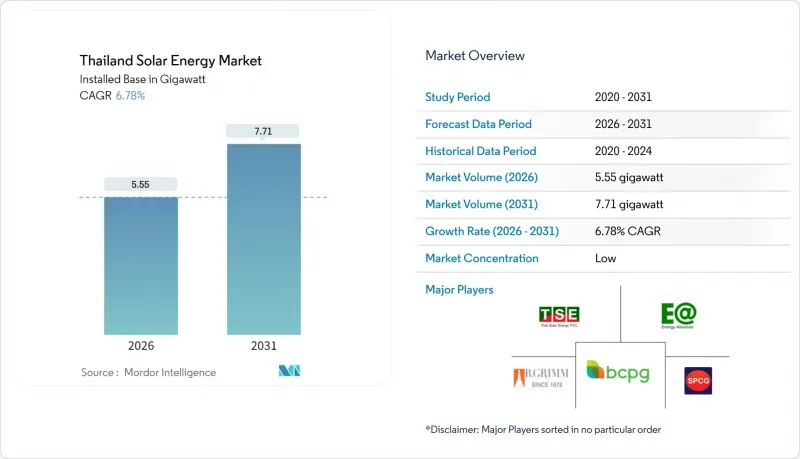
儘管电网基础设施存在瓶颈,但持续的价格压力、可再生能源政策目标以及不断下降的太阳能发电成本预计将推动泰国太阳能市场稳步成长。一项于2024年核准的2000兆瓦直接购电试点项目,为资料中心和大型製造商开闢了新的采购途径,并缩短了独立发电商(IPP)的销售週期。组件价格在2024年降至每瓦0.10至0.12美元,将商业投资回收期缩短至5至7年,并提高了所有客户群体的融资可行性。计画在九个水库上建造的浮体式太阳能混合计划将新增2.7吉瓦的装置容量,同时避免了地面安装工程面临的土地征用障碍。太阳能租赁模式和1兆瓦以下系统的简化许可程序,正在推动曼谷及其周边省份住宅安装的蓬勃发展,预示着光纤接入的普及程度正在不断提高。
泰国太阳能市场趋势与洞察
零售电价上涨与电价波动
儘管2024年零售电价维持在每千瓦时4.15-4.18泰铢不变,但泰国发电局(EGA)报告累计亏损约980亿泰铢,并表示到2025年底电价可能上涨8-12%。东部经济走廊的製造商正转向屋顶光电发电,以对冲天然气价格波动风险,典型的1兆瓦安装工程可在不到7年的时间内回收成本。根据能源政策与规划办公室的数据,燃气发电厂仍为泰国电网提供约60%的电力,其电价与液化天然气现货进口价格挂钩。面临欧盟碳边境调节课税的商业买家正在加速采购光伏发电系统,以确保其出口利润。这种不断增长的需求正在推动泰国太阳能市场的新发展势头,无论是自装系统还是第三方资金筹措系统。
双面和拓普康太阳能组件成本快速下降
2024年,双面组件的平均价格降至每瓦0.10-0.12美元,拓普康电池的效率达24-25%,但成本略有上升。开发商透过谈判达成多年供应协议,将组件价格锁定至2027年,以稳定平准化能源成本。较低的资本密集度使得小规模屋顶光电系统即使在净计费模式下也能在五年内收回成本。中国工厂的产能过剩导致产品流向东南亚,进一步压低了当地价格。 2024年,美国对泰国组装的光伏组件征收反倾销税,重塑了出口路线,但国内产能过剩为当地计划提供了广泛的价格优惠。
併网审批时间过长以及输出限制的风险
开发商表示,取得併网许可需要6到18个月的时间,因为电力公司必须进行电压稳定性研究和变电站容量评估。超过10兆瓦的计划还需要进行环境影响评估并获得国家能源政策委员会的核准,这将延长施工前期并增加拥有成本。 2024年,太阳能渗透率超过日间需求18%的配电线路经历了长达50小时的限电。如果没有即时定价和强制储能,过剩发电量可能导致强制停电,从而侵蚀计划收益。这些障碍使预期成长率下降了近一个百分点。
细分市场分析
预计到2025年,太阳能光电系统将占泰国装置容量的100%,并在2031年之前以每年6.72%的速度成长。泰国太阳能市场规模(光电技术)预计2025年达到5.20吉瓦,到2031年达到7.71吉瓦。由于聚光型太阳热能发电在泰国潮湿的气候条件下经济效益不佳,预计光伏发电将继续占据较大的市场份额。双面组件能够捕捉反射辐射,正迅速成为浮体式太阳能光电专案竞标的标准配置。乌汶叻差那加计画(Ubon Ratana 计划)的发电量比单面组件阵列高出5-8%。效率高达24-25%的拓普康(TOPCon)电池在土地资源有限、价格溢价合理的大型竞标中,正逐渐取代PERC组件。
成本的持续下降正在扩大光伏发电和聚光型太阳热能发电之间的经济差距,后者需要充足的直射太阳辐射,而季风季节很难达到这种水平。能源部2024年的上网电价补贴计画将聚光太阳能热发电排除在外,实际上锁定了太阳能产业的垄断地位。国际能源总署(IEA)的数据预测,到2027年,光电模组价格将进一步下降15-20%,这将使光电发电成为泰国唯一具有商业性可行性的太阳能技术。
泰国太阳能市场报告按技术(光伏和聚光型太阳热能发电)、併网类型(併网和离网)以及最终用户(大型发电、商业/工业和住宅)进行细分。市场规模和预测以装置容量(吉瓦)为单位。
其他福利:
- Excel格式的市场预测(ME)表
- 3个月的分析师支持
目录
第一章 引言
- 研究假设和市场定义
- 调查范围
第二章调查方法
第三章执行摘要
第四章 市场情势
- 市场概览
- 市场驱动因素
- 零售电价上涨与电价波动
- 双面和拓普康太阳能组件成本快速下降
- 直接购电协议试点计画为工商业需求打开了大门
- 政府推广2.7吉瓦浮体式太阳能混合发电项目
- 透过农地和太阳能发电相结合的计画来降低土地征用风险
- 出口导向企业对绿色可再生能源证书(REC)的需求不断增长
- 市场限制
- 冗长的併网核准程序和发电量削减的风险
- 曼谷和东部经济走廊的输电线路饱和
- 美国和欧盟市场对泰国製造的模组提高进口关税
- 国内储能係统用锂离子电池生产的限制
- 供应链分析
- 监管环境
- 技术展望
- 波特五力模型
- 新进入者的威胁
- 供应商的议价能力
- 买方的议价能力
- 替代品的威胁
- 产业间竞争
- PESTEL 分析
第五章 市场规模与成长预测
- 透过技术
- 光伏(PV)
- 聚光型太阳热能发电(CSP)
- 按网格类型
- 併网
- 离网
- 最终用户
- 公用事业规模
- 商业和工业(C&I)
- 住宅
- 按成分(定性分析)
- 光学模组/面板
- 逆变器(组串式、集中式、微型)
- 安装和追踪系统
- 系统周边设备和电气设备
- 储能和混合整合
第六章 竞争情势
- 市场集中度
- 策略性倡议(併购、伙伴关係、购电协议)
- 市场占有率分析(主要企业的市场排名和份额)
- 公司简介
- SPCG PLC
- BCPG PLC
- Thai Solar Energy PLC
- B.Grimm Power PLC
- Energy Absolute PLC
- Solartron PLC
- Delta Electronics(Thailand)PLC
- Huawei Technologies Co. Ltd.
- Sungrow Power Supply Co. Ltd.
- JinkoSolar Holding Co. Ltd.
- Trina Solar Co. Ltd.
- LONGi Green Energy Co. Ltd.
- Canadian Solar Inc.
- First Solar Inc.
- Risen Energy Co. Ltd.
- Seraphim Solar Group
- Sharp Energy Solutions Corp.
- Hitachi Energy Thailand
- Black & Veatch Holding Co.
- Marubeni Corp.
第七章 市场机会与未来展望
The Thailand Solar Energy Market is expected to grow from 5.20 gigawatt in 2025 to 5.55 gigawatt in 2026 and is forecast to reach 7.71 gigawatt by 2031 at 6.78% CAGR over 2026-2031.
Continued tariff pressure, renewable energy policy targets, and declining photovoltaic costs position the Thai solar energy market for steady growth, despite grid infrastructure bottlenecks. A 2,000 MW direct power purchase pilot, approved in 2024, is opening an alternative procurement pathway for data centers and large manufacturers, which shortens sales cycles for independent power producers. Module prices that fell to USD 0.10-0.12 per watt in 2024 trimmed commercial payback periods to five to seven years, enhancing bankability across all customer classes. Floating-solar hybrid projects planned for nine hydroelectric reservoirs will add 2.7 GW of incremental capacity, circumventing land-acquisition hurdles that limit the use of ground-mounted sites. Solar leasing models and simplified licensing for systems below 1 MW are driving a residential installation boom in Bangkok and peri-urban provinces, signaling broader democratization of solar access.
Thailand Solar Energy Market Trends and Insights
Rising Retail-Grid Tariffs and Electricity-Price Volatility
Retail tariffs remained at THB 4.15-4.18 per kWh in 2024; however, the Electricity Generating Authority of Thailand reported cumulative losses of nearly THB 98 billion, suggesting an 8-12% tariff hike by late 2025 is likely. Manufacturers in the Eastern Economic Corridor now view rooftop solar as a hedge against gas price swings, as a typical 1 MW installation pays for itself within seven years. Data from the Energy Policy and Planning Office show that gas-fired units still supply about 60% of the grid's electricity, linking tariffs to spot LNG imports. Commercial buyers facing European Union carbon-border fees have accelerated solar procurement to protect export margins. The resulting demand is giving the Thai solar energy market fresh momentum across both on-site and third-party financed systems.
Rapid Cost Decline of Bifacial and TOPCon PV Modules
Average bifacial module prices declined to USD 0.10-0.12 per watt in 2024, while TOPCon cells achieved 24-25% efficiencies at only marginally higher costs. Developers now negotiate multi-year supply contracts, locking in component prices to 2027 and stabilizing levelized energy costs. Lower capital intensity has enabled smaller rooftops to achieve five-year paybacks even under net-billing. Oversupply in Chinese factories diverted products to Southeast Asia, further pushing down local prices. Although United States antidumping tariffs on Thai-assembled panels reshuffled export channels in 2024, domestic oversupply created broader price relief for local projects.
Long-Cycle Grid-Connection Approvals and Curtailment Risks
Developers report approval times of six to eighteen months because utilities must conduct voltage-stability studies and substation-capacity reviews before granting interconnection. Projects larger than 10 MW also require environmental impact assessments and National Energy Policy Council sign-offs, which extend pre-construction periods and increase holding costs. In 2024, curtailment events totaled up to fifty hours in feeders where solar penetration exceeded 18% of daytime demand. Absent real-time pricing or mandatory storage, over-generation causes forced shutdowns that undermine project revenue. These obstacles shave nearly one percentage point off forecast growth.
Other drivers and restraints analyzed in the detailed report include:
- Direct PPA Pilot Opening Commercial and Industrial Demand
- Government Push for 2.7 GW Floating-Solar Hybrids
- Saturated Feeders in Bangkok and Eastern Economic Corridor
For complete list of drivers and restraints, kindly check the Table Of Contents.
Segment Analysis
Photovoltaic systems accounted for 100.00% of the installed capacity in 2025 and are expected to expand at a 6.72% growth rate through 2031. The Thailand solar energy market size for photovoltaic technology reached 5.20 GW in 2025 and is expected to reach 7.71 GW by 2031, maintaining a significant share, as concentrated solar power remains economically impractical under Thailand's humid climate. Bifacial modules that capture reflected irradiance are quickly becoming standard in floating-solar tenders, with the Ubolratana project registering 5-8% higher output than monofacial arrays. TOPCon cells, which offer 24-25% conversion efficiency, are overtaking PERC modules in utility-scale bids where land constraints justify premium pricing.
Continuous cost declines widen the economic gap between photovoltaic and concentrated solar power, which needs direct-normal-irradiance levels rarely achieved in the monsoon season. The Ministry of Energy's 2024 feed-in-tariff schedule excludes concentrated solar power, effectively cementing photovoltaics' monopoly. Looking forward, International Energy Agency data project module prices dropping another 15-20% by 2027, ensuring photovoltaic technologies remain the only commercially viable solar option in Thailand.
The Thailand Solar Energy Market Report is Segmented by Technology (Solar Photovoltaic and Concentrated Solar Power), Grid Type (On-Grid and Off-Grid), and End-User (Utility-Scale, Commercial and Industrial, and Residential). The Market Sizes and Forecasts are Provided in Terms of Installed Capacity (GW).
List of Companies Covered in this Report:
- SPCG PLC
- BCPG PLC
- Thai Solar Energy PLC
- B.Grimm Power PLC
- Energy Absolute PLC
- Solartron PLC
- Delta Electronics (Thailand) PLC
- Huawei Technologies Co. Ltd.
- Sungrow Power Supply Co. Ltd.
- JinkoSolar Holding Co. Ltd.
- Trina Solar Co. Ltd.
- LONGi Green Energy Co. Ltd.
- Canadian Solar Inc.
- First Solar Inc.
- Risen Energy Co. Ltd.
- Seraphim Solar Group
- Sharp Energy Solutions Corp.
- Hitachi Energy Thailand
- Black & Veatch Holding Co.
- Marubeni Corp.
Additional Benefits:
- The market estimate (ME) sheet in Excel format
- 3 months of analyst support
TABLE OF CONTENTS
1 Introduction
- 1.1 Study Assumptions & Market Definition
- 1.2 Scope of the Study
2 Research Methodology
3 Executive Summary
4 Market Landscape
- 4.1 Market Overview
- 4.2 Market Drivers
- 4.2.1 Rising retail-grid tariffs & electricity-price volatility
- 4.2.2 Rapid cost decline of bifacial & TOPCon PV modules
- 4.2.3 Direct-PPA pilot opening C&I demand flood-gates
- 4.2.4 Government push for 2.7 GW floating-solar hybrids
- 4.2.5 Agro-PV programs easing land-acquisition risks
- 4.2.6 Growing demand for green RECs from export-oriented firms
- 4.3 Market Restraints
- 4.3.1 Long-cycle grid-connection approvals & curtailment risks
- 4.3.2 Saturated feeders in Bangkok & Eastern Economic Corridor
- 4.3.3 Rising import tariffs on Thai modules in US/EU markets
- 4.3.4 Limited domestic Li-ion cell production for BESS
- 4.4 Supply-Chain Analysis
- 4.5 Regulatory Landscape
- 4.6 Technological Outlook
- 4.7 Porter's Five Forces
- 4.7.1 Threat of New Entrants
- 4.7.2 Bargaining Power of Suppliers
- 4.7.3 Bargaining Power of Buyers
- 4.7.4 Threat of Substitutes
- 4.7.5 Industry Rivalry
- 4.8 PESTLE Analysis
5 Market Size & Growth Forecasts
- 5.1 By Technology
- 5.1.1 Solar Photovoltaic (PV)
- 5.1.2 Concentrated Solar Power (CSP)
- 5.2 By Grid Type
- 5.2.1 On-Grid
- 5.2.2 Off-Grid
- 5.3 By End-User
- 5.3.1 Utility-Scale
- 5.3.2 Commercial and Industrial (C&I)
- 5.3.3 Residential
- 5.4 By Component (Qualitative Analysis)
- 5.4.1 Solar Modules/Panels
- 5.4.2 Inverters (String, Central, Micro)
- 5.4.3 Mounting and Tracking Systems
- 5.4.4 Balance-of-System and Electricals
- 5.4.5 Energy Storage and Hybrid Integration
6 Competitive Landscape
- 6.1 Market Concentration
- 6.2 Strategic Moves (M&A, Partnerships, PPAs)
- 6.3 Market Share Analysis (Market Rank/Share for key companies)
- 6.4 Company Profiles (includes Global level Overview, Market level overview, Core Segments, Financials as available, Strategic Information, Products & Services, and Recent Developments)
- 6.4.1 SPCG PLC
- 6.4.2 BCPG PLC
- 6.4.3 Thai Solar Energy PLC
- 6.4.4 B.Grimm Power PLC
- 6.4.5 Energy Absolute PLC
- 6.4.6 Solartron PLC
- 6.4.7 Delta Electronics (Thailand) PLC
- 6.4.8 Huawei Technologies Co. Ltd.
- 6.4.9 Sungrow Power Supply Co. Ltd.
- 6.4.10 JinkoSolar Holding Co. Ltd.
- 6.4.11 Trina Solar Co. Ltd.
- 6.4.12 LONGi Green Energy Co. Ltd.
- 6.4.13 Canadian Solar Inc.
- 6.4.14 First Solar Inc.
- 6.4.15 Risen Energy Co. Ltd.
- 6.4.16 Seraphim Solar Group
- 6.4.17 Sharp Energy Solutions Corp.
- 6.4.18 Hitachi Energy Thailand
- 6.4.19 Black & Veatch Holding Co.
- 6.4.20 Marubeni Corp.
7 Market Opportunities & Future Outlook
- 7.1 White-space & Unmet-Need Assessment

 太阳能发电系统市场:2026-2032年全球市场预测(依产品、系统规模、安装类型及应用划分)
 2026年全球太阳能市场报告
 太阳能发电系统市场分析及预测(至2035年):依类型、产品类型、服务、技术、组件、应用、安装类型、最终用户、功能及设备划分
 东南亚太阳能:市场占有率分析、产业趋势与统计、成长预测(2026-2031)西班牙太阳能:市场份额分析、行业趋势和统计数据、成长预测(2026-2031 年)越南太阳能市场:市场占有率分析、产业趋势与统计、成长预测(2026-2031年)
 太阳能解决方案市场 - 全球产业规模、份额、趋势、机会及预测(按类型、应用、地区和竞争格局划分,2021-2031年)义大利太阳能市场:市场占有率分析、产业趋势与统计、成长预测(2026-2031)印尼太阳能市场:市场占有率分析、产业趋势与统计、成长预测(2026-2031)菲律宾太阳能市场:市场占有率分析、产业趋势与统计、成长预测(2026-2031年)