


 |
市场调查报告书
商品编码
1937436
西班牙太阳能:市场份额分析、行业趋势和统计数据、成长预测(2026-2031 年)Spain Solar Energy - Market Share Analysis, Industry Trends & Statistics, Growth Forecasts (2026 - 2031) |
||||||

※ 本网页内容可能与最新版本有所差异。详细情况请与我们联繫。
2025 年西班牙太阳能市场价值为 47.95 吉瓦,预计到 2031 年将达到 85.77 吉瓦,高于 2026 年的 52.83 吉瓦。
预计在预测期(2026-2031 年)内,复合年增长率将达到 10.18%。
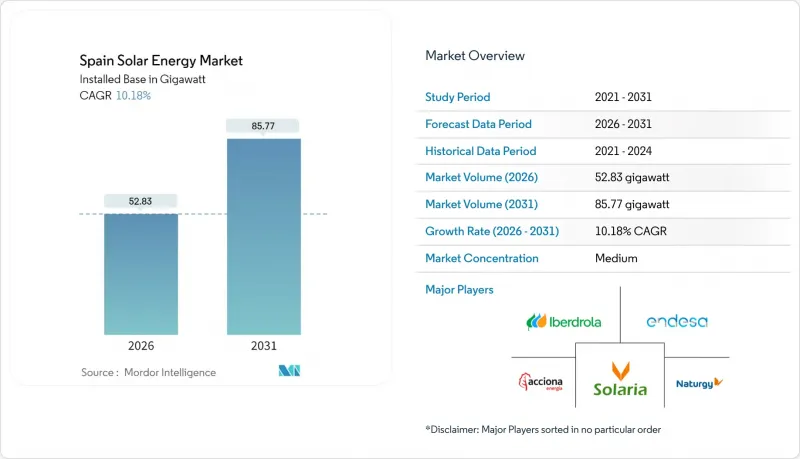
西班牙太阳能发电装置容量的快速扩张已使其占全国发电量的21%,远高于欧盟平均。这使西班牙有望实现修订后的国家能源与气候计画中设定的76吉瓦太阳能目标。组件价格的下降、符合欧盟「Fit for 55」指令的更快捷的审批流程,以及企业对购电协议(PPA)的强劲需求,正在推动西班牙整体太阳能市场的成长。由于限电和价格竞争导致收入下降,混合式太阳能-储能係统正在兴起,尤其是在太阳能资源丰富的地区。儘管国际开发商正在加速发展,例如道达尔能源的塞维利亚丛集(263兆瓦)和Plenitude的Renopur计划(330兆瓦),但电网拥堵和Natura 2000土地使用限制正在限制近期项目的部署。
西班牙太阳能市场趋势与分析
大型光学模组成本下降
由于全球供应过剩,组件价格持续下降,使得卡斯蒂利亚-拉曼恰和埃斯特雷马杜拉即使在土地品质较差的情况下也能实现具有竞争力的平准化能源成本 (LCOE)。双面太阳能板与单轴追踪器的组合,使得容量係数超过 25%,从而扩大了大型地面光电站的经济潜力。道达尔能源等国际公用事业公司报告称,与 2023 年相比,资本支出 (CAPEX) 可节省高达 15%。成本持平使得节省下来的资金可以重新用于周边设备升级和能源管理软体,从而促进与电池储能的混合应用。当地工程公司报告称,系统设计正显着转向 1500VDC,这可以减少电缆损耗和人工投入。因此,西班牙的太阳能市场正在不断扩大,即使在传统经济欠发达地区也是如此。
欧盟「适合55岁人士」和「REPowerEU」合规期限
具有法律约束力的2030年脱碳目标为开发商提供了监管确定性,并加快了竞标和资金筹措速度。西班牙核准2024年新增22,326兆瓦太阳能发电项目,并在2025年第一季新增3,019兆瓦。监管一致性也延伸至储能领域,家用电池可获得容量收益,并改善分散式资产的现金流量。地方政府也回应国家政策,安达卢西亚政府正加速推进2025年1.4吉瓦计划的併网进程。明确的政策时间表最大限度地降低了市场价格风险,并鼓励外国直接投资进入西班牙太阳能市场。
土地利用与 Natura 2000 保护区衝突
西班牙约30%的土地面积被划为保护区,所有超过5公顷的计划都必须进行全面的环境影响评估。光是穆尔西亚一地就计画在2030年安装3万公顷的太阳能发电设施,其中60%位于曾经的耕地上,这些土地正面临来自农业合作社的强烈反对。开发商越来越多地将目光投向废弃矿场等棕地地,这使得每兆瓦的修復成本增加了5万至10万欧元。在衝突较少的土地上集中开发,使得本已受电网脆弱性限制的地区电力容量更加集中,从而加剧了限电风险。
细分市场分析
截至2025年,太阳能将占西班牙太阳能市场的94.45%,到2031年将以10.45%的复合年增长率成长。同时,西班牙国家太阳能委员会(PNIEC)将聚光型太阳热能发电发电(CSP)的目标装置容量下调至4.8吉瓦。预计到2024年,锂离子电池的成本将低于140美元/千瓦时,并且能够以熔盐系统一半的成本提供2-4小时的储能,因此开发商正优先考虑太阳能-储能混合系统。这将使西班牙太阳能市场在2025年至2030年间新增超过31吉瓦的装置容量。
聚光型太阳热能发电发电(CSP)仍能以每兆瓦时20-50欧元的价格提供工业製程热,比价格波动较大的天然气更经济。西班牙目前拥有2.3吉瓦的运作电站。然而,2024年尚无新的公用事业规模聚光太阳能发电计划完成融资。随着公用事业公司将资金重新分配给采用n型电池的双面太阳能发电(其发电量可提高10-15%),预计聚光太阳能发电的份额将进一步下降。
太阳能市场报告按技术(太阳能和聚光型太阳热能发电)、併网类型(併网和离网)以及最终用户(大型企业、商业/工业和住宅)进行细分。市场规模和预测以装置容量(吉瓦)为单位。
其他福利:
- Excel格式的市场预测(ME)表
- 3个月的分析师支持
目录
第一章 引言
- 研究假设和市场定义
- 调查范围
第二章调查方法
第三章执行摘要
第四章 市场情势
- 市场概览
- 市场驱动因素
- 公用事业规模光学模组成本下降
- 欧盟「Fit for 55」和「REPowerEU」合规期限
- IBEX-35 指数成分股公司之间的公司间购电协议 (PPA) 数量迅速增长
- 利用併网电池混合动力系统提高计划内部报酬率
- 干旱地区(安达卢西亚、卡斯蒂利亚-拉曼查)农业太阳能(Agri-PV)激励措施
- 自给自足型合作社(autoconsumo colectivo)的激增
- 人工智慧优化的发电规划可提高商家的收入。
- 市场限制
- 土地利用与 Natura 2000 保护区衝突
- 在阳光照射强烈的地区,逆变器饱和可能导致输出功率下降。
- 日前合约池中不稳定的蚕食折扣
- 双轴追踪器获得地方政府批准所需时间较长。
- 供应链分析
- 监管环境
- 技术展望
- 波特五力模型
- 新进入者的威胁
- 供应商的议价能力
- 买方的议价能力
- 替代品的威胁
- 产业间竞争
- PESTEL 分析
第五章 市场规模与成长预测
- 透过技术
- 太阳能(光伏)
- 聚光型太阳热能发电(CSP)
- 按网格类型
- 併网
- 离网
- 最终用户
- 公用事业规模
- 商业和工业(C&I)
- 住宅
- 按成分(定性分析)
- 光学模组/面板
- 逆变器(组串式、集中式、微型)
- 安装和追踪系统
- 系统周边设备和电气设备
- 储能和混合整合
第六章 竞争情势
- 市场集中度
- 策略性倡议(併购、联盟、购电协议)
- 市场占有率分析(主要企业的市场排名和份额)
- 公司简介
- Iberdrola SA
- Acciona Energia
- Endesa(Enel Group)
- Solaria Energia y Medio Ambiente SA
- Repsol SA
- Engie Espana
- Naturgy Renovables
- Gransolar Group
- Soltec Power Holdings
- Cobra IS(ACS Group)
- RIC Energy
- Forestalia Renovables
- Prodiel
- Powertis(SPIC)
- Q-Energy
- X-Elio
- Opdenergy
- TotalEnergies Renewables Espana
- Sonnedix
- Fit Energy
第七章 市场机会与未来展望
The Spain Solar Energy Market was valued at 47.95 gigawatt in 2025 and estimated to grow from 52.83 gigawatt in 2026 to reach 85.77 gigawatt by 2031, at a CAGR of 10.18% during the forecast period (2026-2031).
Rapid capacity growth already lifts solar to 21% of national electricity generation, well ahead of the European Union average, and places the country on a clear trajectory to meet its 76 GW solar PV target under the revised National Energy and Climate Plan. Declining module prices, accelerated permitting aligned with EU Fit-for-55 mandates, and strong corporate PPA appetite underpin momentum across the Spain solar energy market. Hybrid solar-and-storage configurations, especially in high-irradiance provinces, are emerging as a hedge against curtailment and price cannibalization. International developers are deepening commitments, as illustrated by TotalEnergies' 263 MW Sevilla cluster and Plenitude's 330 MW Renopool project, while grid congestion and Natura-2000 land constraints temper short-term volumes.
Spain Solar Energy Market Trends and Insights
Declining cost of utility-scale PV modules
Module prices continue to fall due to global oversupply, allowing projects in Castilla-La Mancha and Extremadura to reach competitive levelized costs even on lower-grade land. Bifacial panels paired with single-axis trackers now achieve capacity factors above 25%, widening the economic envelope for large ground-mounted plants. International utilities such as TotalEnergies cite capex savings of up to 15% compared with 2023 figures. Cost parity encourages hybridization with battery storage because freed capital can be reallocated to balance-of-system upgrades and energy management software. Local engineering firms report a notable shift toward 1,500 VDC system designs that cut cable losses and labor inputs. The net effect is an enlarged Spain solar energy market pipeline in regions previously on the economic margin.
EU Fit-for-55 & REPowerEU Compliance Deadlines
Binding 2030 decarbonization targets give developers regulatory certainty, accelerating auction participation and bankability. Spain authorized 22,326 MW of PV construction in 2024 and cleared an additional 3,019 MW in Q1 2025. Regulatory alignment extends to storage: behind-the-meter batteries now qualify for capacity revenues, improving cash flows for distributed assets. Regional authorities echo the national stance; the Junta de Andalucia fast-tracked grid interconnection for 1.4 GW of projects in 2025. Clear policy timelines minimize merchant-price risk, drawing foreign direct investment into the Spain solar energy market.
Land-Use Conflicts with Natura-2000 Conservation Areas
Protected zones cover about 30% of Spain and trigger full environmental impact studies for any project footprint larger than 5 hectares. Murcia alone plans 30,000 ha of PV by 2030, yet 60% lies on former cropland that faces organized opposition from farm cooperatives. Developers increasingly target brownfield sites such as disused mines, adding EUR 50,000-100,000/MW in remediation costs. Concentration in low-conflict land funnels capacity into regions already constrained by weak transmission, thereby amplifying curtailment risk.
Other drivers and restraints analyzed in the detailed report include:
- Corporate PPA Boom Among IBEX-35 Firms
- Grid-Connected Battery Hybrids Enhancing Project IRR
- Curtailment Risk from Inverter Saturation
For complete list of drivers and restraints, kindly check the Table Of Contents.
Segment Analysis
Solar photovoltaic commanded 94.45% of the Spain solar energy market in 2025 and is expanding at a 10.45% CAGR to 2031, whereas CSP's PNIEC target has fallen to 4.8 GW. Lithium-ion batteries cost below USD 140/kWh in 2024 and enable two-to-four-hour storage at half the cost of molten-salt systems, so developers prioritise PV-plus-battery hybrids. Spain's solar energy market size for photovoltaic additions will therefore increase by more than 31 GW between 2025 and 2030.
CSP still offers industrial process heat at EUR 20-50/MWh, cheaper than volatile natural gas prices, and Spain hosts 2.3 GW of operating plants. Yet no new utility-scale CSP projects reached financial close in 2024. As utilities redeploy capital into bifacial PV with n-type cells that lift yield by 10-15%, CSP's share will shrink further.
The Solar Energy Market Report is Segmented by Technology (Solar Photovoltaic and Concentrated Solar Power), Grid Type (On-Grid and Off-Grid), and End-User (Utility-Scale, Commercial and Industrial, and Residential). The Market Sizes and Forecasts are Provided in Terms of Installed Capacity (GW).
List of Companies Covered in this Report:
- Iberdrola SA
- Acciona Energia
- Endesa (Enel Group)
- Solaria Energia y Medio Ambiente SA
- Repsol SA
- Engie Espana
- Naturgy Renovables
- Gransolar Group
- Soltec Power Holdings
- Cobra IS (ACS Group)
- RIC Energy
- Forestalia Renovables
- Prodiel
- Powertis (SPIC)
- Q-Energy
- X-Elio
- Opdenergy
- TotalEnergies Renewables Espana
- Sonnedix
- Fit Energy
Additional Benefits:
- The market estimate (ME) sheet in Excel format
- 3 months of analyst support
TABLE OF CONTENTS
1 Introduction
- 1.1 Study Assumptions & Market Definition
- 1.2 Scope of the Study
2 Research Methodology
3 Executive Summary
4 Market Landscape
- 4.1 Market Overview
- 4.2 Market Drivers
- 4.2.1 Declining cost of utility-scale PV modules
- 4.2.2 EU Fit-for-55 & REPowerEU compliance deadlines
- 4.2.3 Corporate PPA boom among IBEX-35 firms
- 4.2.4 Grid-connected battery hybrids enhancing project IRR
- 4.2.5 Agri-PV incentives in drought-stricken regions (Andalucia, Castilla-La Mancha)
- 4.2.6 Surge in self-consumption cooperatives (autoconsumo colectivo)
- 4.2.7 AI-optimised dispatch lifting merchant revenue capture
- 4.3 Market Restraints
- 4.3.1 Land-use conflicts with Natura-2000 conservation areas
- 4.3.2 Curtailment risk from inverter saturation in high-irradiance provinces
- 4.3.3 Volatile cannibalisation discounts in day-ahead pool
- 4.3.4 Lengthy municipal permitting for 2-axis trackers
- 4.4 Supply-Chain Analysis
- 4.5 Regulatory Landscape
- 4.6 Technological Outlook
- 4.7 Porter's Five Forces
- 4.7.1 Threat of New Entrants
- 4.7.2 Bargaining Power of Suppliers
- 4.7.3 Bargaining Power of Buyers
- 4.7.4 Threat of Substitutes
- 4.7.5 Industry Rivalry
- 4.8 PESTLE Analysis
5 Market Size & Growth Forecasts
- 5.1 By Technology
- 5.1.1 Solar Photovoltaic (PV)
- 5.1.2 Concentrated Solar Power (CSP)
- 5.2 By Grid Type
- 5.2.1 On-Grid
- 5.2.2 Off-Grid
- 5.3 By End-User
- 5.3.1 Utility-Scale
- 5.3.2 Commercial and Industrial (C&I)
- 5.3.3 Residential
- 5.4 By Component (Qualitative Analysis)
- 5.4.1 Solar Modules/Panels
- 5.4.2 Inverters (String, Central, Micro)
- 5.4.3 Mounting and Tracking Systems
- 5.4.4 Balance-of-System and Electricals
- 5.4.5 Energy Storage and Hybrid Integration
6 Competitive Landscape
- 6.1 Market Concentration
- 6.2 Strategic Moves (M&A, Partnerships, PPAs)
- 6.3 Market Share Analysis (Market Rank/Share for key companies)
- 6.4 Company Profiles (includes Global level Overview, Market level overview, Core Segments, Financials as available, Strategic Information, Products & Services, and Recent Developments)
- 6.4.1 Iberdrola SA
- 6.4.2 Acciona Energia
- 6.4.3 Endesa (Enel Group)
- 6.4.4 Solaria Energia y Medio Ambiente SA
- 6.4.5 Repsol SA
- 6.4.6 Engie Espana
- 6.4.7 Naturgy Renovables
- 6.4.8 Gransolar Group
- 6.4.9 Soltec Power Holdings
- 6.4.10 Cobra IS (ACS Group)
- 6.4.11 RIC Energy
- 6.4.12 Forestalia Renovables
- 6.4.13 Prodiel
- 6.4.14 Powertis (SPIC)
- 6.4.15 Q-Energy
- 6.4.16 X-Elio
- 6.4.17 Opdenergy
- 6.4.18 TotalEnergies Renewables Espana
- 6.4.19 Sonnedix
- 6.4.20 Fit Energy
7 Market Opportunities & Future Outlook
- 7.1 White-space & Unmet-need Assessment

 太阳能发电系统市场:2026-2032年全球市场预测(依产品、系统规模、安装类型及应用划分)
 2026年全球太阳能市场报告
 太阳能发电系统市场分析及预测(至2035年):依类型、产品类型、服务、技术、组件、应用、安装类型、最终用户、功能及设备划分
 东南亚太阳能:市场占有率分析、产业趋势与统计、成长预测(2026-2031)泰国太阳能:市场占有率分析、产业趋势与统计、成长预测(2026-2031)越南太阳能市场:市场占有率分析、产业趋势与统计、成长预测(2026-2031年)
 太阳能解决方案市场 - 全球产业规模、份额、趋势、机会及预测(按类型、应用、地区和竞争格局划分,2021-2031年)义大利太阳能市场:市场占有率分析、产业趋势与统计、成长预测(2026-2031)印尼太阳能市场:市场占有率分析、产业趋势与统计、成长预测(2026-2031)菲律宾太阳能市场:市场占有率分析、产业趋势与统计、成长预测(2026-2031年)