


 |
市场调查报告书
商品编码
1940736
东南亚太阳能:市场占有率分析、产业趋势与统计、成长预测(2026-2031)Southeast Asia Solar Energy - Market Share Analysis, Industry Trends & Statistics, Growth Forecasts (2026 - 2031) |
||||||

※ 本网页内容可能与最新版本有所差异。详细情况请与我们联繫。
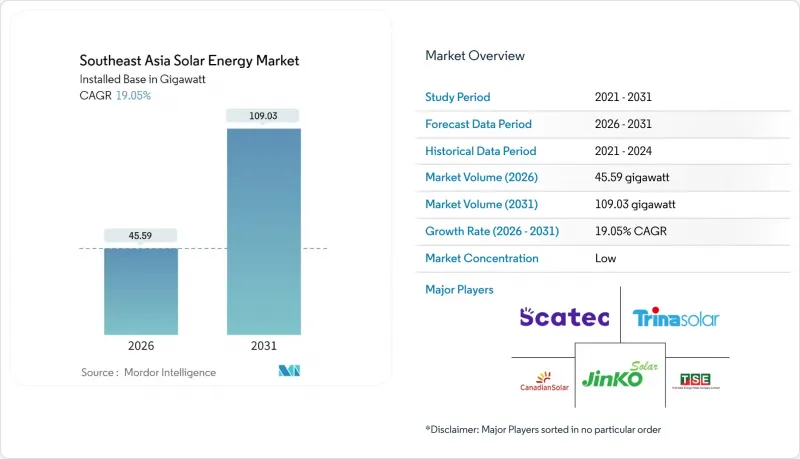
预计东南亚太阳能市场将从 2025 年的 38.29 吉瓦成长到 2026 年的 45.59 吉瓦,到 2031 年达到 109.03 吉瓦,2026 年至 2031 年的复合年增长率为 19.05%。
组件价格下降、碳中和力度加大以及零售电价与电网电价差距缩小,正推动越南、印尼、泰国、菲律宾、马来西亚、新加坡和汶莱等国的投资热潮。国家竞标项目定价为每千瓦时0.04-0.05美元,正在取代新建燃煤发电厂,而企业可再生能源购电协议(PPA)则提前满足了工商业(C&I)需求。儘管併网挑战依然严峻,但将太阳能与储能结合的混合型太阳能电站有助于降低弃电风险、创造新的辅助业务收益收入并提高计划融资可行性。由于对中国组件征收反倾销税以及高日照地区土地使用纠纷日益增多,供应链两极化限制了短期利润率,但也为浮体式太阳能和农光互补创造了新的机会。
东南亚太阳能市场趋势与展望
加速实现国家可再生能源目标和碳中和承诺
修订后的电力计画提高了2024年的区域太阳能目标,其依据不再是气候外交,而是能源安全的经济效益。越南修订后的第八版电力发展计画(PDP VIII)提出,公用事业规模的发电装置容量将达到30吉瓦。印尼将2030年的目标翻了一番,达到9.2吉瓦,泰国承诺到2030年将其再生能源比例提高到30%。液化天然气进口成本的上涨(2024年平均价格为14-16美元/百万英热单位)推动太阳能成为成本最低的能源之一。菲律宾在其绿色能源竞标项目中以有史以来最低的单价授予了3.5吉瓦的合同,这表明透明竞标比上网电价补贴(FIT)更具资金筹措优势。新加坡承诺2035年进口4吉瓦的可再生能源,促成了超过20亿新元的跨境输电投资。
单晶PERC和TOPCon光学模组成本快速下降
随着多晶硅价格跌破每公斤6美元,到2024年,拓普康(TOPCon)组件的价格将降至每瓦0.12-0.15美元,进一步拉大其与传统PERC组件的性能差距。其优异的温度係数可使热带气候下的年发电量提高4-6%,并将越南的平准化电力成本(LCOE)降低至每千瓦时0.038-0.042美元。即使计入环境监管成本,这项成本也远低于新建燃煤发电厂。印尼145兆瓦的Sirata浮体式计划采用双面拓普康组件,由于水面反照率效应,发电量提高了12-15%。缅甸和柬埔寨正在兴起二手PERC组件的次市场,降低了离网电气化的进入门槛。
高光照区域的土地利用竞争
在越南宁顺省和平顺省,农业用地竞争激烈,导致年租金超过每公顷2,000美元,内部报酬率下降了1.2个百分点。泰国已将1.8万公顷军事用地排除在2024年太阳能发电计画之外,以优先保障粮食安全。在印尼,面积超过10公顷的太阳能发电厂,其环境评估核准时间将延长约一年。水库浮体式太阳能发电和农光互补系统(将农作物与太阳能结合)正在成为新兴的解决方案,但它们的初始投资成本较高,约为18%至22%。
细分市场分析
2025年,东南亚太阳能市场将以太阳能装置容量为主。聚光太阳热能发电(CSP)在商业性不可行,因为直接太阳辐射量很少超过每平方公尺1500千瓦时。 TOPCon和异质接面技术将转换效率提升至24-25%,使系统总成本降低每瓦0.08-0.12美元,预计2031年将维持19.12%的年复合成长率(CAGR)。东南亚太阳能市场受益于中国供应链的规模优势。隆基、天合光能和晶科能源等公司将到岸成本控制在比全球平均低15-20%的水平,使越南公共产业计划能够以每千瓦时0.042-0.048美元的竞标中标。儘管异质结组件的价格溢价高达 25-30%,但在新加坡和马来西亚,异质结组件仍占高端屋顶光伏需求的 8%,这表明在空间受限的地区,人们更愿意为千瓦级密度支付更高的价格。
薄膜碲化镉技术仅占市场份额的2%,但其卓越的高温效率已在菲律宾150兆瓦的卡拉塔甘(Calatagan )计划中得到证实。钙钛矿-硅串联电池已在新加坡太阳能研究院完成实验室测试,并进入现场测试阶段。如果湿度稳定性方面取得技术突破,该技术可望在2027年进入商业试点阶段。在此之前,晶体硅预计将继续主导东南亚太阳能市场,随着传统PERC技术的逐步淘汰,预计到2031年,高阶双面TOPCon电池的出货量将占总出货量的70%以上。
东南亚太阳能市场报告按技术(太阳能和聚光型太阳热能发电)、併网类型(併网和离网)、终端用户(大型电站、商业/工业、住宅)和地区(越南、印尼、菲律宾、泰国、马来西亚、新加坡和东南亚其他地区)进行细分。市场规模和预测以装置容量(吉瓦)为单位。
其他福利:
- Excel格式的市场预测(ME)表
- 3个月的分析师支持
目录
第一章 引言
- 研究假设和市场定义
- 调查范围
第二章调查方法
第三章执行摘要
第四章 市场情势
- 市场概览
- 市场驱动因素
- 加速实现国家可再生能源目标和碳中和承诺
- 单晶PERC和TOPCon光学模组成本快速下降
- 商业和工业用户的市电平价屋顶太阳能
- 东协区域电力贸易试点计画(寮国-泰国-马来西亚-新加坡走廊)
- 绿氢能出口雄心推动了大型太阳能计划的推进
- 市场限制
- 高光照区域的土地利用竞争
- 区域城市脆弱的电力分配基础设施
- 越南和马来西亚提高模组级进口关税(有贸易救济措施风险)
- 菲律宾和越南与飓风相关的资产风险溢价上升
- 供应链分析
- 监管环境
- 技术展望
- 波特五力模型
- 供应商的议价能力
- 消费者议价能力
- 新进入者的威胁
- 替代产品和服务的威胁
- 竞争对手之间的竞争
第五章 市场规模与成长预测
- 透过技术
- 太阳能(光伏)
- 聚光太阳能发电(CSP)
- 按电网连接类型
- 併网
- 离网
- 最终用户
- 实用规模
- 商业和工业(C&I)
- 住宅
- 按成分(定性分析)
- 太阳能模组/面板
- 逆变器(组串式、集中式、微型)
- 安装和追踪系统
- 系统周边设备和电气设备
- 储能和混合整合
- 按地区
- 越南
- 印尼
- 菲律宾
- 泰国
- 马来西亚
- 新加坡
- 其他东南亚国家
第六章 竞争情势
- 市场集中度
- 策略性倡议(併购、伙伴关係、购电协议)
- 市场占有率分析(主要企业的市场排名和份额)
- 公司简介
- Canadian Solar Inc.
- JinkoSolar Holding Co. Ltd.
- Trina Solar Co. Ltd.
- LONGi Green Energy Technology Co. Ltd.
- Vena Energy Pte Ltd.
- Scatec ASA
- Thai Solar Energy PCL
- Blue Solar Co. Ltd.
- Sunseap Group Pte Ltd.
- AC Energy Corp.
- Sembcorp Industries Ltd.
- Cleantech Solar Energy Pte Ltd.
- First Solar Inc.
- Hanwha Q CELLS GmbH
- TotalEnergies Renewables Asia
- ENGIE South-East Asia
- Neoen SA
- Adaro Power
- PT Platinum Energy
- Solarie Energy
第七章 市场机会与未来展望
The Southeast Asia Solar Energy Market is expected to grow from 38.29 gigawatt in 2025 to 45.59 gigawatt in 2026 and is forecast to reach 109.03 gigawatt by 2031 at 19.05% CAGR over 2026-2031.
Falling module prices, rising carbon-neutral pledges, and widening retail-grid parity are reinforcing investment momentum across Vietnam, Indonesia, Thailand, the Philippines, Malaysia, Singapore, and Brunei. National auction programs priced between USD 0.04 and 0.05 per kWh have displaced new coal builds, while corporate renewable power purchase agreements (PPAs) are pulling commercial and industrial (C&I) demand forward. Grid integration remains a significant challenge, yet hybrid solar-plus-storage plants are mitigating curtailment risk, unlocking new ancillary service revenues, and enhancing project bankability. Heightened supply-chain bifurcation, triggered by anti-dumping duties on Chinese modules, and rising land-use conflicts in high-irradiance provinces are tempering near-term margins but are also spawning opportunities in floating solar and agrivoltaics.
Southeast Asia Solar Energy Market Trends and Insights
Accelerated National Renewable-Energy Targets and Carbon-Neutral Pledges
Revised power plans elevated regional solar targets in 2024 and are now anchored in energy-security economics rather than climate diplomacy. Vietnam's updated PDP VIII calls for 30 GW of utility-scale capacity. Indonesia has doubled its 2030 goal to 9.2 GW, and Thailand has lifted its renewable electricity commitment to 30% by 2030. Higher import costs for liquefied natural gas, averaging USD 14-16 per MMBtu in 2024, pushed solar to the top of least-cost supply stacks. The Philippines awarded 3.5 GW of contracts at record-low tariffs under its Green Energy Auction Program, signalling that transparent auctions can outcompete feed-in tariffs in capital attraction. Singapore's pledge to import 4 GW of renewables by 2035 has mobilized more than SGD 2 billion of cross-border transmission investment.
Rapid Cost Decline of Mono-PERC and TOPCon PV Modules
TOPCon module prices fell to USD 0.12-0.15 per W in 2024 as polysilicon costs slipped below USD 6 per kg, widening the performance gap with legacy PERC. Superior temperature coefficients deliver 4-6% higher annual yields in tropical heat, driving Vietnamese levelized costs down to USD 0.038-0.042 per kWh, well below new coal plants once environmental compliance is priced in. Indonesia's 145 MW Cirata floating project used bifacial TOPCon panels to capture 12-15% extra generation from water-surface albedo. Secondary markets for retired PERC modules are emerging across Myanmar and Cambodia, lowering entry barriers for off-grid electrification.
Land-Availability Conflicts in High-Irradiance Zones
Competition for farmland is elevating lease prices above USD 2,000 per hectare annually in Vietnam's Ninh Thuan and Binh Thuan provinces, eroding internal rates of return by up to 1.2 percentage points. Thailand withdrew 18,000 hectares of military land from solar allocation in 2024 to prioritize food security. Indonesia's environmental checks add almost one year to permitting for arrays larger than 10 hectares. Floating solar on reservoirs and agrivoltaic crop-sharing schemes are emerging workarounds, albeit at 18-22% capital-cost premiums.
Other drivers and restraints analyzed in the detailed report include:
- Grid-Parity Rooftop PV for Commercial and Industrial Users
- ASEAN Cross-Border Power-Trade Pilot
- Weak Distribution-Grid Infrastructure in Secondary Cities
For complete list of drivers and restraints, kindly check the Table Of Contents.
Segment Analysis
Photovoltaic installations captured the entire Southeast Asia solar energy market in 2025, making concentrated solar power commercially unviable due to direct normal irradiance seldom exceeding 1,500 kWh per m2. TOPCon and heterojunction lines are pushing conversion efficiency to 24-25%, decreasing balance-of-system costs by USD 0.08-0.12 per W and sustaining a 19.12% CAGR forecast through 2031. The Southeast Asia solar energy market benefits from the scale of the Chinese supply chain: LONGi, Trina Solar, and JinkoSolar delivered landed costs 15-20% below global averages, enabling utility projects in Vietnam to clear auctions at USD 0.042-0.048 per kWh. Heterojunction modules carved out an 8% slice of premium rooftop demand in Singapore and Malaysia despite 25-30% price premiums, underscoring the willingness to pay for kW-density in space-constrained zones.
Thin-film cadmium-telluride technology gained only 2% share but posted better high-temperature yield in the Philippines' 150 MW Calatagan project. Perovskite-silicon tandem cells are transitioning from lab to field trials at Singapore's Solar Energy Research Institute and could enter commercial pilots by 2027, pending breakthroughs in humidity stability. Until then, crystalline silicon will continue to dominate the Southeast Asia solar energy market, with premium bifacial TOPCon projected to command more than 70% of shipments by 2031 as legacy PERC technologies retire.
The Southeast Asia Solar Energy Market Report is Segmented by Technology (Solar Photovoltaic and Concentrated Solar Power), Grid Type (On-Grid and Off-Grid), End-User (Utility-Scale, Commercial and Industrial, and Residential), and Geography (Vietnam, Indonesia, Philippines, Thailand, Malaysia, Singapore, and Rest of Southeast Asia). The Market Sizes and Forecasts are Provided in Terms of Installed Capacity (GW)
List of Companies Covered in this Report:
- Canadian Solar Inc.
- JinkoSolar Holding Co. Ltd.
- Trina Solar Co. Ltd.
- LONGi Green Energy Technology Co. Ltd.
- Vena Energy Pte Ltd.
- Scatec ASA
- Thai Solar Energy PCL
- Blue Solar Co. Ltd.
- Sunseap Group Pte Ltd.
- AC Energy Corp.
- Sembcorp Industries Ltd.
- Cleantech Solar Energy Pte Ltd.
- First Solar Inc.
- Hanwha Q CELLS GmbH
- TotalEnergies Renewables Asia
- ENGIE South-East Asia
- Neoen SA
- Adaro Power
- PT Platinum Energy
- Solarie Energy
Additional Benefits:
- The market estimate (ME) sheet in Excel format
- 3 months of analyst support
TABLE OF CONTENTS
1 Introduction
- 1.1 Study Assumptions & Market Definition
- 1.2 Scope of the Study
2 Research Methodology
3 Executive Summary
4 Market Landscape
- 4.1 Market Overview
- 4.2 Market Drivers
- 4.2.1 Accelerated national RE targets & carbon-neutral pledges
- 4.2.2 Rapid cost decline of mono-PERC and TOPCon PV modules
- 4.2.3 Grid-parity rooftop PV for C&I users
- 4.2.4 ASEAN cross-border power-trade pilot (Lao-Thai-Malaysian-Singapore corridor)
- 4.2.5 Green-hydrogen export ambitions driving utility-scale solar pipelines
- 4.3 Market Restraints
- 4.3.1 Land-availability conflicts in high-irradiance zones
- 4.3.2 Weak distribution-grid infrastructure in secondary cities
- 4.3.3 Rising module-level import tariffs in Vietnam & Malaysia (trade-remedy risk)
- 4.3.4 Heightened cyclone-related asset-risk premiums in Philippines & Vietnam
- 4.4 Supply-Chain Analysis
- 4.5 Regulatory Landscape
- 4.6 Technological Outlook
- 4.7 Porters Five Forces
- 4.7.1 Bargaining Power of Suppliers
- 4.7.2 Bargaining Power of Consumers
- 4.7.3 Threat of New Entrants
- 4.7.4 Threat of Substitute Products & Services
- 4.7.5 Intensity of Competitive Rivalry
5 Market Size & Growth Forecasts
- 5.1 By Technology
- 5.1.1 Solar Photovoltaic (PV)
- 5.1.2 Concentrated Solar Power (CSP)
- 5.2 By Grid Type
- 5.2.1 On-Grid
- 5.2.2 Off-Grid
- 5.3 By End-User
- 5.3.1 Utility-Scale
- 5.3.2 Commercial and Industrial (C&I)
- 5.3.3 Residential
- 5.4 By Component (Qualitative Analysis)
- 5.4.1 Solar Modules/Panels
- 5.4.2 Inverters (String, Central, Micro)
- 5.4.3 Mounting and Tracking Systems
- 5.4.4 Balance-of-System and Electricals
- 5.4.5 Energy Storage and Hybrid Integration
- 5.5 By Geography
- 5.5.1 Vietnam
- 5.5.2 Indonesia
- 5.5.3 Philippines
- 5.5.4 Thailand
- 5.5.5 Malaysia
- 5.5.6 Singapore
- 5.5.7 Rest of South East Asia
6 Competitive Landscape
- 6.1 Market Concentration
- 6.2 Strategic Moves (M&A, Partnerships, PPAs)
- 6.3 Market Share Analysis (Market Rank/Share for key companies)
- 6.4 Company Profiles (includes Global level Overview, Market level overview, Core Segments, Financials as available, Strategic Information, Products & Services, and Recent Developments)
- 6.4.1 Canadian Solar Inc.
- 6.4.2 JinkoSolar Holding Co. Ltd.
- 6.4.3 Trina Solar Co. Ltd.
- 6.4.4 LONGi Green Energy Technology Co. Ltd.
- 6.4.5 Vena Energy Pte Ltd.
- 6.4.6 Scatec ASA
- 6.4.7 Thai Solar Energy PCL
- 6.4.8 Blue Solar Co. Ltd.
- 6.4.9 Sunseap Group Pte Ltd.
- 6.4.10 AC Energy Corp.
- 6.4.11 Sembcorp Industries Ltd.
- 6.4.12 Cleantech Solar Energy Pte Ltd.
- 6.4.13 First Solar Inc.
- 6.4.14 Hanwha Q CELLS GmbH
- 6.4.15 TotalEnergies Renewables Asia
- 6.4.16 ENGIE South-East Asia
- 6.4.17 Neoen SA
- 6.4.18 Adaro Power
- 6.4.19 PT Platinum Energy
- 6.4.20 Solarie Energy
7 Market Opportunities & Future Outlook
- 7.1 White-Space & Unmet-Need Assessment

 太阳能发电系统市场:2026-2032年全球市场预测(依产品、系统规模、安装类型及应用划分)
 2026年全球太阳能市场报告
 太阳能发电系统市场分析及预测(至2035年):依类型、产品类型、服务、技术、组件、应用、安装类型、最终用户、功能及设备划分
 泰国太阳能:市场占有率分析、产业趋势与统计、成长预测(2026-2031)西班牙太阳能:市场份额分析、行业趋势和统计数据、成长预测(2026-2031 年)越南太阳能市场:市场占有率分析、产业趋势与统计、成长预测(2026-2031年)
 太阳能解决方案市场 - 全球产业规模、份额、趋势、机会及预测(按类型、应用、地区和竞争格局划分,2021-2031年)义大利太阳能市场:市场占有率分析、产业趋势与统计、成长预测(2026-2031)印尼太阳能市场:市场占有率分析、产业趋势与统计、成长预测(2026-2031)菲律宾太阳能市场:市场占有率分析、产业趋势与统计、成长预测(2026-2031年)