


 |
市场调查报告书
商品编码
1910907
印尼资料中心市场占有率分析、产业趋势与统计、成长预测(2026-2031)Indonesia Data Center - Market Share Analysis, Industry Trends & Statistics, Growth Forecasts (2026 - 2031) |
||||||

※ 本网页内容可能与最新版本有所差异。详细情况请与我们联繫。
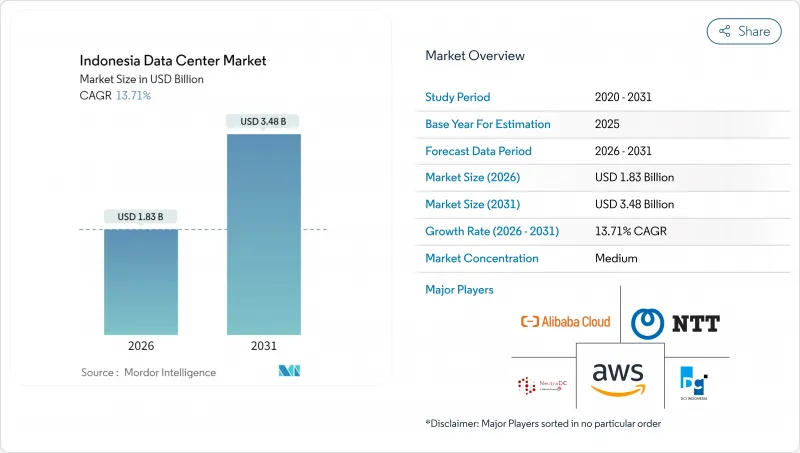
2025年印尼资料中心市场价值16.1亿美元,预计到2031年将达到34.8亿美元,高于2026年的18.3亿美元。
预计在预测期(2026-2031 年)内,复合年增长率将达到 13.71%。
就IT负载容量而言,预计市场将从2025年的1440兆瓦成长到2030年的3560兆瓦,在预测期(2025-2030年)内复合年增长率(CAGR)为19.89%。市场占有率和估计值均以兆瓦(MW)为超大规模资料中心业者计算和报告。超大规模资料中心的快速部署、允许外资在经济特区100%持股的税收优惠政策,以及印尼2.72亿居民呈指数级增长的数位消费,使印尼的资料中心市场成为东南亚最具活力的数位基础设施前沿之一。雅加达凭藉其密集的光纤网路和海底光缆登陆点,主导容量部署;而巴淡岛由于接近性新加坡,正在吸引溢出需求并加速新建设。虽然託管服务仍然占据部署的大部分份额,但随着全球云端服务供应商将其平台在地化以遵守严格的资料居住法,超大规模投资正以每年超过21%的速度成长。三级架构已成为预设架构,反映了企业在避免四级架构高成本的同时,对可维护性的需求。与印尼国家电力公司 (PLN) 签订的长期购电协议也使得兆瓦级可再生能源能够为人工智慧配置提供动力。
印尼资料中心市场趋势与洞察
超大规模资料中心业者加速云端区域部署
AWS、Google云端和微软正在推出或宣布多可用区(multi-AZ)区域,以确保国内运作的延迟低于20毫秒。雅加达和巴淡岛正在筹备超过250兆瓦的大规模託管交易。 Indosat-NVIDIA投资2.5亿美元的AI工厂将于2024年10月投入运作,目前已为20多家印尼企业提供服务,併计划在18个月内将GPU从H100升级到Blackwell GB200,以满足生成式AI推理的需求。超大规模资料中心业者严格的可再生能源采购政策促成了与印尼国家电力公司(PLN)签订包含可再生能源认证的长期电力合同,帮助营运商实现其永续性目标。本地通讯业者受益于最后一公里连接和託管服务的结合,随着核心系统迁移到云端,这正在推动企业市场的客户留存。这些发展使印尼成为全球流量路由的关键组成部分,重新分配了先前在新加坡和吉隆坡终止的工作负载。由此产生的资本投资週期推高了建筑业薪资,导致技术纯熟劳工短缺,并加速了供应商与理工学院之间签订劳动力技能培训协议的必要性。
政府税收优惠及放宽外资所有权限制
印尼允许外资100%控股其经济特区内的资料中心计划,并对数位基础设施投资实行加速折旧政策,将新建设计划的实际内部收益率(IRR)门槛降低了250-300个基点。芝卡朗和巴淡岛经济特区对进口设备增值税(VAT),使初始资本支出减少了约11%。简化的线上单一申请(OSS)系统将符合资格的计划核准时间从24週缩短至最短10週。这些优惠政策吸引了韩国投资伙伴公司(Korea Investment Partners)和金光集团(Sinar Masland)、以及数位房地产公司(Digital Realty)和米特拉·阿迪塔玛公司(Mitra Adithama)等合资企业,这些企业承诺从2024年起总合投资超过7.5亿美元。政策制定者已将数位基础设施定位为实现印尼到2025年数位经济规模达到1,300亿美元目标的基础,并确保即使在政府更迭的情况下,税收优惠政策也能继续有效。虽然关税豁免降低了壁垒,但开发商仍必须满足建筑材料严格的在地采购要求,这鼓励他们与印尼EPC承包商合作。
电网碳排放强度增加会推高合规成本。
煤炭仍占印尼发电结构的40.5%,使得营运商面临范围2排放,且与跨国客户的净零排放义务不符。印尼国家电力公司(PLN)依赖123万亿印尼币(约80亿美元)的补贴,限制了可再生能源的快速发展,迫使数据中心开发商采购离网太阳能+储能係统和生物质混烧合同,以满足其碳预算。由于供应落后于需求,可再生能源证书(REC)交易价格居高不下,导致电力成本增加约6美元/兆瓦时。超大规模超大规模资料中心业者正在协商虚拟购电协议(PPA),但在PLN完成併网权分离之前,他们仍面临交易对手风险。更复杂的是,印尼银行的资料中心认证清单现在要求披露生命週期碳排放信息,这增加了银行、金融服务和保险(BFSI)客户的审核负担。在 2030 年代巴布亚大规模水力发电投入使用之前,印尼的资料中心产业将不得不权衡其成长雄心与高昂的脱碳成本之间的关係。
细分市场分析
截至2025年,大型资料中心将占印尼资料中心市场的46.12%。这反映出企业倾向于选择单园区解决方案,此类方案可提供稳定的电力供应、营运商中立的连接以及低于1.5的园区PUE值。随着Telkom在芝卡朗(Cikarang)的扩建项目(预计到2025年园区容量将增至60MW)以及EdgeConnex在勿加泗(Bekasi)分阶段开发(每个阶段30MW)项目的推进,印尼的大型资料中心市场预计将进一步扩张。同时,中型资料中心正以21.18%的复合年增长率(CAGR)推动市场成长,这主要得益于分散式企业倾向将边缘节点部署在更靠近使用者的区域。 NeutraDC等营运商已在二线城市以「neuCentrIX」品牌经营19个微型边缘站点,凸显了区域市场对小规模资料中心的需求驱动因素。超大型资料中心也正在涌现,例如印尼卫星公司(Indosat)和英伟达(NVIDIA)的AI Factory已预订80兆瓦的容量用于未来扩展。这印证了GPU丛集推动高功率密度设计(每个机架80千瓦)的趋势。小型模组化资料中心仍然是小众市场,主要支援政府边缘工作负载和离岛的农村连接试点计画。总体而言,营运商正在使其建设模式多样化,以平衡雅加达兆瓦级设施与岛屿的分散式延迟需求,从而透过规模化满足并行需求。
预计到2027年,随着印尼国家电力公司(PLN)在泗水和万隆的变电站升级改造完成,释放出150兆伏安的备用容量,中型资料中心的扩容速度将加快。在这些大都市部署4-6兆瓦资料中心单元的开发商,可以充分利用金融科技公司和电商平台对低于5毫秒延迟支付处理的需求。同时,超大规模资料超大规模资料中心业者继续预租超过10兆瓦的整个资料中心机房,为大规模的场地扩建奠定基础。因此,企划案融资模式越来越多地结合多元化的收入来源(批发主力租户和零售边缘机房),以优化资本支出回收,并充分利用印尼的十年免税期。这些混合经营模式凸显了印尼资料中心市场如何鼓励灵活的容量规划,以实现规模和覆盖范围的双重成长。
预计到2025年,三级资料中心将占印尼资料中心市场的83.90%,并继续保持行业标准,在满足银行、金融和保险(BFSI)以及电信行业的服务水平协议(SLA)要求的同时,提供可维护性,且无需承担四级数据中心建设35%的额外成本。四级资料中心容量仅限于大型园区内的特定机房,这些机房通常用于满足游戏发行商和高频交易者对容错正常运作的需求。巴厘巴板和日惹的物联网和智慧城市试点计画的边缘部署仍然采用一级或二级面积,因为生命週期经济效益高于冗余性。 《个人资讯保护法》下的监管清单要求使用双电源和N+1冷却系统,这实际上为新建设中心设定了准入门槛。 Neutra资料中心的芝卡朗资料中心已获得三级和四级执行时间认证,并采用模组化电力撬装系统,可在不同等级之间实现无缝过渡。这项功能无需重新安置机架,对于希望逐步扩展业务的公司来说很有吸引力。
未来的分级设计将纳入诸如WUE(用水效率)等永续性指标,将使传统的分类系统看起来不够整体性。营运商已经开始安装屋顶太阳能发电系统,以满足其5%的年度用电量,预计一旦印尼国家电力公司(PLN)最终确定净计量电价政策,这一比例将翻倍。此外,高密度GPU机房需要液冷迴路,将冷却冗余从机房级别转移到机架级别,进一步增加了分级的复杂性。儘管存在这些变化,Tier 3仍将是印尼资料中心市场成长的核心,因为它在成本、合规性和可靠的运作之间取得了良好的平衡,并且可以满足90%的企业工作负载需求。
印尼资料中心市场报告按资料中心规模(大型、超大型、中型、巨型、小规模)、等级(Tier 1-2、Tier 3、Tier 4)、资料中心类型(超大规模/自建、企业/边缘、託管)、最终用户(银行、金融服务和保险 (BFSI)、IT 和 ITES、电子商务、政府、製造业)、媒体和娱乐等)以及热点进行细分。市场预测以 IT 负载容量(兆瓦)为单位。
其他福利:
- Excel格式的市场预测(ME)表
- 3个月的分析师支持
目录
第一章 引言
- 研究假设和市场定义
- 调查范围
第二章调查方法
第三章执行摘要
第四章 市场情势
- 市场概览
- 市场驱动因素
- 超大规模资料中心业者加速云端区域的部署(AWS、微软、Google)
- 政府为数位基础设施提供税收优惠并放宽外商投资限制
- 印尼年轻人的网路和行动数据消费量呈指数级增长
- 到2030年,三级/四级产能供不应求将无法满足预计的1吉瓦需求。
- 确保与波兰国家电力公司 (PLN) 签订长期购电协议 (PPA),以提供人工智慧赋能的兆瓦级电力供应
- 巴淡岛经济特区成为新加坡的限电中心
- 市场限制
- 电网碳排放强度不断增加以及对煤炭的依赖程度不断提高,正在推高永续性合规成本。
- 关键IT设备和冷却设备的高关税和非关税壁垒
- 多机构核准过程中复杂的许可程序和土地征用障碍
- GPU密集型工作机会国内熟练劳工短缺,推动薪资上涨
- 市场展望
- IT负载能力
- 高架地板面积
- 託管收入
- 预装机架
- 机架空间利用率
- 海底电缆
- 主要行业趋势
- 智慧型手机用户数量
- 每部智慧型手机的数据流量
- 行动资料通讯速度
- 宽频资料通讯速度
- 光纤连接网路
- 法律规范
- 价值炼和通路分析
- 波特五力分析
- 新进入者的威胁
- 买方的议价能力
- 供应商的议价能力
- 替代品的威胁
- 竞争对手之间的竞争
第五章 市场规模及成长预测(兆瓦)
- 按资料中心规模
- 大规模
- 超大规模
- 中号
- 百万
- 小规模
- 按层级标准
- 一级和二级
- 三级
- 第四级
- 依资料中心类型
- 超大规模/内部建设
- 企业/边缘运算
- 搭配
- 运作
- 运作
- 零售共址
- 批发託管
- 按最终用户行业划分
- BFSI
- 资讯科技与资讯科技服务
- 电子商务
- 政府
- 製造业
- 媒体与娱乐
- 沟通
- 其他最终用户
- 透过热点
- 雅加达
- 巴淡岛
- 其他印尼
第六章 竞争情势
- 市场集中度
- 策略趋势
- 市占率分析
- 公司简介
- PT. Telkom Data Ekosistem(NeutraDC)
- PT DCI Indonesia
- Amazon Web Services, Inc.
- Alibaba Cloud
- K2 Data Centers-Sinar Mas Land
- Indosat Tbk PT(Big Data Exchange(BDx))
- Biznet Data Center
- Space DC Pte Ltd
- Bersama Digital Data Centres(BDDC)
- Princeton Digital Group
- Tencent Cloud
- Digital Edge(Singapore)Holdings Pte. Ltd.(Indonet)
- Google LLC
- MettaDC
- NTT Ltd.
第七章 市场机会与未来展望
The Indonesia Data Center Market was valued at USD 1.61 billion in 2025 and estimated to grow from USD 1.83 billion in 2026 to reach USD 3.48 billion by 2031, at a CAGR of 13.71% during the forecast period (2026-2031).
In terms of IT load capacity, the market is expected to grow from 1.44 thousand megawatt in 2025 to 3.56 thousand megawatt by 2030, at a CAGR of 19.89% during the forecast period (2025-2030). The market segment shares and estimates are calculated and reported in terms of MW. Rapid hyperscaler roll-outs, tax exemptions that allow 100% foreign ownership in Special Economic Zones, and a sharp rise in digital consumption among 272 million residents position the Indonesia data center market as one of Southeast Asia's most dynamic digital infrastructure frontiers. Jakarta dominates capacity deployment due to its dense fiber network and submarine cable landing points, while Batam's proximity to Singapore attracts spillover demand, accelerating greenfield builds. Colocation still commands most deployments, yet hyperscale investments are advancing more than 21% a year as global cloud providers localize platforms to comply with strict data-residency laws. Tier 3 designs remain the default architecture, reflecting enterprises' need for concurrent maintainability without the premium of Tier 4, and long-term PLN power-purchase agreements unlock renewable megawatt blocks that support AI-ready configurations.
Indonesia Data Center Market Trends and Insights
Accelerating Hyperscaler Cloud Region Roll-outs
AWS, Google Cloud, and Microsoft have each activated or announced multi-AZ regions, guaranteeing sub-20 ms latency for domestic workloads and driving a pipeline of wholesale colocation deals exceeding 250 MW in Jakarta and Batam. The Indosat-NVIDIA USD 250 million AI factory that went live in October 2024 already serves more than 20 Indonesian enterprises and plans to migrate from H100 to Blackwell GB200 GPUs within 18 months to satisfy generative-AI inferencing demand. Hyperscalers' strict renewable-energy procurement policies catalyze long-term power contracts with PLN that bundle renewable certificates, helping operators meet sustainability targets. Local carriers benefit by bundling last-mile connectivity and managed services, which embeds stickiness in an enterprise market still migrating core systems to the cloud. These deployments anchor Indonesia in global traffic routes, redirecting workloads that would otherwise terminate in Singapore or Kuala Lumpur. The resulting capex cycle raises construction wages and tightens the skilled-labor pool, hastening the need for workforce upskilling agreements between providers and polytechnic institutes.
Government Tax Incentives and Eased Foreign Ownership
Indonesia allows 100% foreign ownership in data-center projects located within Special Economic Zones and grants accelerated depreciation on digital-infrastructure investments, lowering effective project IRR thresholds by 250-300 basis points for greenfield builds. Cikarang and Batam SEZs each offer 0% VAT on imported equipment, shaving up-front capex by around 11%. The streamlined Online Single Submission (OSS) system compresses approval timelines from 24 to as little as 10 weeks for compliant projects. These incentives have attracted joint ventures such as Korea Investment Partners-Sinar Mas Land and Digital Realty-Mitra Aditama, which collectively announced more than USD 750 million in commitments since 2024. Policymakers view digital infrastructure as a cornerstone for the USD 130 billion digital economy target by 2025, ensuring continuity of fiscal privileges even under changing administrations. While tariff holidays lower barriers, developers must still meet stringent local content requirements for construction materials, prompting partnerships with Indonesian EPC contractors.
Grid Carbon Intensity Increases Compliance Costs
Coal still accounts for 40.5% of the national generation mix, exposing operators to Scope 2 emissions that conflict with the net-zero mandates of multinational clients. PLN's financial reliance on IDR 123 trillion (USD 8 billion) in subsidies constrains the rapid build-out of renewable energy, forcing data-center developers to source off-grid solar-plus-storage or biomass co-firing contracts to meet their carbon budgets. Renewable energy certificates (RECs) sell at premium prices because supply lags behind demand, adding roughly USD 6 per MWh to power costs. Hyperscalers negotiate virtual PPAs but face counterparty risk until PLN finalizes unbundling of grid-injection rights. Further complicating matters, Bank Indonesia's data center accreditation checklist now requires life-cycle carbon disclosures, increasing audit overhead for BFSI clients. Until large-scale hydropower from Papua is delivered in the 2030s, the Indonesian data center industry must balance growth aspirations with steep decarbonization expenses.
Other drivers and restraints analyzed in the detailed report include:
- Rapid Internet and Mobile Data Consumption
- Undersupply of Tier 3/4 Capacity
- High Import Tariffs on Critical Equipment
For complete list of drivers and restraints, kindly check the Table Of Contents.
Segment Analysis
Large facilities held 46.12% of the Indonesia data center market share in 2025, reflecting enterprises' preference for single-campus solutions that offer resilient power, carrier-neutral connectivity, and campus-wide PUE below 1.5. The Indonesia data center market size for large builds is predicted to widen further as Telkom's Cikarang expansion raises its campus capacity to 60 MW by 2025, and EdgeConneX commits to multi-phase developments of 30 MW each in Bekasi. Medium-sized facilities, however, are pacing the field with a 21.18% CAGR because distributed enterprises deploy edge nodes closer to users. Operators such as NeutraDC already run 19 micro-edge sites branded neuCentrIX across tier-2 cities, highlighting how geography drives smaller footprints. Mega and massive categories are emerging, exemplified by the Indosat-NVIDIA AI factory that reserves 80 MW for future phases, underlining how GPU clusters skew power density design toward 80 kW per rack. Small modular data centers remain niche, mainly supporting government edge workloads and rural connectivity pilots on outer islands. Overall, operators are diversifying build templates to strike a balance between Jakarta megawatts and the islands' distributed latency needs, thus sustaining parallel demand across size cohorts.
Medium-size capacity gains are likely to accelerate once PLN's substation upgrades in Surabaya and Bandung unlock 150 MVA of spare load by 2027. Developers deploying 4 - 6 MW pods in those metros can monetize demand from fintechs and e-commerce platforms that require sub-5 ms latency for payment processing. Meanwhile, hyperscalers continue to sign pre-lease agreements for entire data halls exceeding 10 MW each, anchoring large-site expansions. As a result, project financing models increasingly bundle diversified revenue streams, wholesale anchor tenants plus retail edge cages, to optimize capex payback under Indonesia's 10-year tax-holiday horizon. The resulting hybrid business models underscore how the Indonesia data center market incentivizes flexible capacity planning to capture both scale and reach.
Tier 3 facilities captured 83.90% of the Indonesia data center market share in 2025 and will remain the de facto standard owing to concurrent maintainability that satisfies BFSI and telecom SLAs without the 35% cost premium of Tier 4 builds. Tier 4 supply is restricted to a handful of suites within major campuses where gaming publishers and high-frequency traders demand fault-tolerant uptime. Tier 1-2 footprints persist in edge deployments serving IoT and smart-city pilots in Balikpapan and Yogyakarta, where lifecycle economics trump redundancy. Regulatory checklists issued under the Personal Data Protection Law require dual-power feeds and N + 1 cooling, effectively making Tier 3 the entry barrier for new builds. NeutraDC's Cikarang complex holds both Uptime Tier III and Tier IV certifications and utilizes modular electrical skids to facilitate seamless transitions between tiers, eliminating the need to migrate racks, a feature that appeals to enterprises scaling over time.
Future tier designs will incorporate sustainability metrics such as WUE and render traditional classifications less comprehensive. Operators are already integrating rooftop solar that supplies 5% of annual consumption, a figure expected to double once PLN finalizes net-metering rules. In addition, GPU-dense halls demand liquid-cooling loops that complicate tier labels because cooling redundancy becomes rack-level rather than hall-level. Despite such shifts, Tier 3 will retain dominance because it balances cost, compliance, and reliable uptime for 90% of enterprise workloads, thereby remaining integral to Indonesia's data center market growth.
The Indonesia Data Center Market Report is Segmented by Data Center Size (Large, Massive, Medium, Mega, and Small), Tier Type (Tier 1 and 2, Tier 3, and Tier 4), Data Center Type (Hyperscale/Self-Built, Enterprise/Edge, and Colocation), End User (BFSI, IT and ITES, E-Commerce, Government, Manufacturing, Media and Entertainment, and More), and Hotspot. The Market Forecasts are Provided in Terms of IT Load Capacity (MW).
List of Companies Covered in this Report:
- PT. Telkom Data Ekosistem (NeutraDC)
- PT DCI Indonesia
- Amazon Web Services, Inc.
- Alibaba Cloud
- K2 Data Centers-Sinar Mas Land
- Indosat Tbk PT (Big Data Exchange (BDx))
- Biznet Data Center
- Space DC Pte Ltd
- Bersama Digital Data Centres (BDDC)
- Princeton Digital Group
- Tencent Cloud
- Digital Edge (Singapore) Holdings Pte. Ltd. (Indonet)
- Google LLC
- MettaDC
- NTT Ltd.
Additional Benefits:
- The market estimate (ME) sheet in Excel format
- 3 months of analyst support
TABLE OF CONTENTS
1 INTRODUCTION
- 1.1 Study Assumptions and Market Definition
- 1.2 Scope of the Study
2 RESEARCH METHODOLOGY
3 EXECUTIVE SUMMARY
4 MARKET LANDSCAPE
- 4.1 Market Overview
- 4.2 Market Drivers
- 4.2.1 Accelerating hyperscaler cloud region roll-outs (AWS, Microsoft, Google)
- 4.2.2 Government tax incentives and eased foreign ownership for digital infrastructure
- 4.2.3 Rapidly rising internet and mobile data consumption among Indonesia's young population
- 4.2.4 Undersupply of Tier-3/4 capacity versus estimated 1 GW demand by 2030
- 4.2.5 Secured long-term PLN PPAs enabling AI-ready megawatt blocks
- 4.2.6 Batam SEZ emerging as spill-over hub for Singapore load balancing
- 4.3 Market Restraints
- 4.3.1 Grid carbon intensity and coal reliance increasing sustainability compliance costs
- 4.3.2 High import tariffs and non-tariff barriers on critical IT and cooling equipment
- 4.3.3 Permitting complexity and land-acquisition hurdles across multi-agency approvals
- 4.3.4 Limited domestic skilled workforce for GPU-dense operations driving wage inflation
- 4.4 Market Outlook
- 4.4.1 IT Load Capacity
- 4.4.2 Raised Floor Space
- 4.4.3 Colocation Revenue
- 4.4.4 Installed Racks
- 4.4.5 Rack Space Utilization
- 4.4.6 Submarine Cable
- 4.5 Key Industry Trends
- 4.5.1 Smartphone Users
- 4.5.2 Data Traffic Per Smartphone
- 4.5.3 Mobile Data Speed
- 4.5.4 Broadband Data Speed
- 4.5.5 Fiber Connectivity Network
- 4.5.6 Regulatory Framework
- 4.6 Value Chain and Distribution Channel Analysis
- 4.7 Porter's Five Forces Analysis
- 4.7.1 Threat of New Entrants
- 4.7.2 Bargaining Power of Buyers
- 4.7.3 Bargaining Power of Suppliers
- 4.7.4 Threat of Substitutes
- 4.7.5 Intensity of Competitive Rivalry
5 MARKET SIZE AND GROWTH FORECASTS (MEGAWATT)
- 5.1 By Data Center Size
- 5.1.1 Large
- 5.1.2 Massive
- 5.1.3 Medium
- 5.1.4 Mega
- 5.1.5 Small
- 5.2 By Tier Standard
- 5.2.1 Tier 1 and 2
- 5.2.2 Tier 3
- 5.2.3 Tier 4
- 5.3 By Data Center Type
- 5.3.1 Hyperscale / Self-Built
- 5.3.2 Enterprise / Edge
- 5.3.3 Colocation
- 5.3.3.1 Non-Utilized
- 5.3.3.2 Utilized
- 5.3.3.2.1 Retail Colocation
- 5.3.3.2.2 Wholesale Colocation
- 5.4 By End User Industry
- 5.4.1 BFSI
- 5.4.2 IT and ITES
- 5.4.3 E-Commerce
- 5.4.4 Government
- 5.4.5 Manufacturing
- 5.4.6 Media and Entertainment
- 5.4.7 Telecom
- 5.4.8 Other End Users
- 5.5 By Hotspot
- 5.5.1 Jakarta
- 5.5.2 Batam
- 5.5.3 Rest of Indonesia
6 COMPETITIVE LANDSCAPE
- 6.1 Market Concentration
- 6.2 Strategic Moves
- 6.3 Market Share Analysis
- 6.4 Company Profiles {(includes Global level Overview, Market level overview, Core Segments, Financials as available, Strategic Information, Market Rank/Share for key companies, Products and Services, and Recent Developments)}
- 6.4.1 PT. Telkom Data Ekosistem (NeutraDC)
- 6.4.2 PT DCI Indonesia
- 6.4.3 Amazon Web Services, Inc.
- 6.4.4 Alibaba Cloud
- 6.4.5 K2 Data Centers-Sinar Mas Land
- 6.4.6 Indosat Tbk PT (Big Data Exchange (BDx))
- 6.4.7 Biznet Data Center
- 6.4.8 Space DC Pte Ltd
- 6.4.9 Bersama Digital Data Centres (BDDC)
- 6.4.10 Princeton Digital Group
- 6.4.11 Tencent Cloud
- 6.4.12 Digital Edge (Singapore) Holdings Pte. Ltd. (Indonet)
- 6.4.13 Google LLC
- 6.4.14 MettaDC
- 6.4.15 NTT Ltd.
7 MARKET OPPORTUNITIES AND FUTURE OUTLOOK
- 7.1 White-space and Unmet-need Assessment

 资料中心能源概况 - Oracle:自 2019 年以来,能源使用量以 24% 的复合年增长率成长,由于可再生能源的使用,排放保持稳定,但 Stargate 专案可能会大幅增加碳足迹。
 氢动力资料中心市场分析及预测(至2035年):类型、产品类型、服务、技术、组件、应用、部署模式、最终用户、功能、安装模式资料中心市场分析及预测(至2035年):类型、产品类型、服务、技术、组件、应用、部署模式、最终用户、解决方案
 2026年全球资料中心市场报告
 在轨资料中心:趋势与分析太空资料中心:趋势与分析
 2026-2030年全球资料中心维护与支援服务市场小型资料中心市场分析及预测(至2035年):依类型、产品类型、服务、技术、元件、应用、部署类型、最终使用者、模组及功能划分模组化资料中心市场分析及预测(至2035年):按类型、产品类型、服务、技术、组件、应用、形式、部署类型、最终用户和功能划分
 亚太地区资料中心市场占有率分析、产业趋势与统计、成长预测(2026-2031)