


 |
市场调查报告书
商品编码
1934660
玻璃瓶和容器:市场份额分析、行业趋势和统计数据、成长预测(2026-2031)Glass Bottles And Containers - Market Share Analysis, Industry Trends & Statistics, Growth Forecasts (2026 - 2031) |
||||||

※ 本网页内容可能与最新版本有所差异。详细情况请与我们联繫。
预计玻璃瓶和容器市场将从 2025 年的 8,421 万吨成长到 2026 年的 8,709 万吨,到 2031 年将达到 1.0306 亿吨,2026 年至 2031 年的复合年增长率为 3.42%。
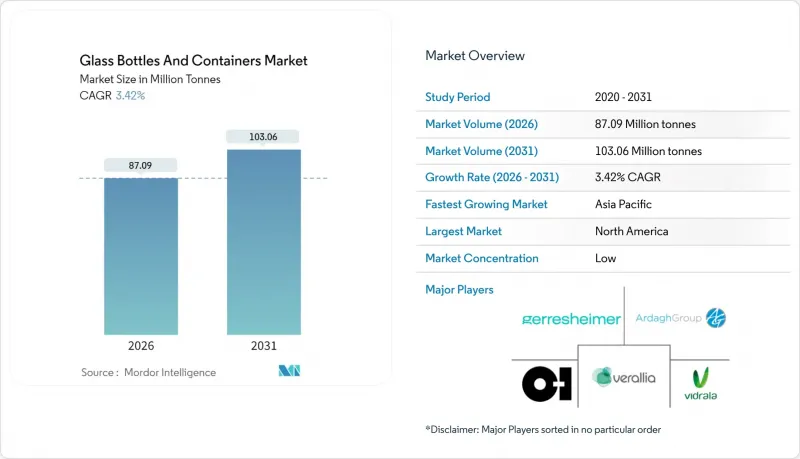
儘管面临能源价格上涨、一次性塑胶製品监管趋严、美容和酒类饮品行业优质化以及药品填充和表面处理工程扩张等不利因素,但市场仍保持稳定成长。加州强制减塑65%的塑胶用量以及法国禁止使用聚苯乙烯泡沫塑胶的政策,已经推动了市场对可无限循环利用玻璃的需求。混合熔炉、富氧燃烧技术和高玻璃屑配方降低了成本风险,而像Vidrala公司推出的260克750毫升玻璃瓶这样的轻量化创新产品,在不影响货架陈列效果的前提下,减少了材料的使用。製造商也利用颜色差异,特别是琥珀色,来保护对光敏感的药品和精酿饮品,并强化其相对于其他轻质替代品的价值。
全球玻璃瓶及容器市场趋势及洞察
塑胶法规推动可回收玻璃包装转型
加州SB54法案规定,到2032年一次性塑胶包装的使用量必须减少65%。法国也将于2025年1月起禁止使用发泡聚苯乙烯食品容器,将促使品牌商转向玻璃包装。欧盟正在审议的双酚A法规也将进一步推动食品接触应用领域的玻璃包装转型。玻璃包装形成了一个无限闭合迴路,完善的上门回收系统使加工商能够在满足新需求的同时,有效吸收设备升级成本。这种连锁反应在大零售商的饮料和调味品生产线上体现得淋漓尽致,玻璃容器正逐渐回归市场。儘管玻璃屑供应暂时紧张,但混合熔炉和轻量化技术在一定程度上抵消了利润率的下降,从而在预测期内保持了持续增长的趋势。
高端美妆产品中玻璃材质的流行趋势正在推动对瓶罐的需求。
为了提升产品品质和环保理念,高端护肤和香水品牌正越来越多地采用玻璃包装。 Veraria 的 Vista 瓶身采用 100% 回收玻璃 (PCR) 製成,与使用原生原料生产相比,能耗降低了 40%,充分展现了循环经济与奢华理念的和谐共存。压纹、渐层色和可重复填充设计增强了商店脱颖而出的视觉效果,也为高价位提供了合理的依据。由于包装成本在美妆产业的零售价格中所占比例较小,品牌更容易承受单价上涨,这在一般饮料市场中并不常见。这一趋势正在全球蔓延,尤其在北美和西欧地区更为显着,从而带动了对客製化模具和小批量生产的长期需求。
能源价格波动威胁反应器经济效益
2024年,英国电价飙升至历史新高,迫使玻璃製造商在尖峰时段时段停产。能源成本约占製造成本的18%,因此,在市场价格调整反映之前,价格波动会迅速压低利润率。碳定价进一步加剧了石化燃料的消耗,加速了对混合熔炉和自备发电设施的资本投资。同时,儘管OI Glass获得了1.25亿美元的联邦资金用于脱碳,但规模较小的区域性玻璃厂却难以融资,这可能导致短期供应减少。
区域分析
到2025年,北美将占据全球玻璃容器包装市场55.18%的份额,这主要得益于成熟的上门回收系统以及推动高玻璃屑含量的企业永续性目标。玻璃包装协会提出的2030年达到50%回收率的蓝图,为长期原料供应提供了保障。然而,能源价格波动以及再生PET(rPET)在低价饮料领域的渗透率不断提高,正在抑制销售成长,因此策略重点正转向高端酒类和美容护理领域。
欧洲虽然落后于其他国家,但欧盟80.8%的回收率确保了玻璃屑供应安全,并降低了熔炉的能源需求。 Ardagh和Verallia正在投资建造电力辅助、氢气熔炉,以维持产量并规避排放交易风险。然而,电价上涨和环境课税限制了短期利润,促使企业加强在共用可再生能源微电网和跨境碎玻璃屑交易的合作。
亚太地区是成长最快的地区,预计到2031年将以4.76%的复合年增长率成长,并迅速缩小容器玻璃包装市场的差距。印度和中国正在建造需要无菌管瓶的新型製药厂,而韩国和日本则正在进口用于高端护肤品的优质化妆品玻璃。 OI Glass在哥伦比亚锡帕基拉投资1.2亿美元的工厂升级项目,体现了生产商致力于在新兴地区复製最尖端科技以满足市场需求并遵守ESG(环境、社会和治理)要求的决心。东南亚部分地区玻璃屑加工基础设施有限,限制了再生材料的使用,使製造商与西方竞争对手相比处于成本劣势。然而,收入水准的提高和促进循环经济的法规的加强预计将支撑强劲的长期需求。
其他福利:
- Excel格式的市场预测(ME)表
- 3个月的分析师支持
目录
第一章 引言
- 研究假设和市场定义
- 调查范围
第二章调查方法
第三章执行摘要
第四章 市场情势
- 市场概览
- 市场驱动因素
- 塑胶禁令推动可回收玻璃包装转型
- 奢侈美妆产品中「玻璃」包装的流行趋势推动了对瓶罐的需求。
- 药品填充和表面处理工程的扩展推动了对管瓶的需求。
- 精酿酒精饮料的蓬勃发展带动了对客製化玻璃容器的需求
- 外商直接投资将用于实施混合炉技术,以扩大绿色玻璃产能。
- ESG合规性推动出口市场迈向高玻璃屑玻璃转型
- 市场限制
- 能源价格波动威胁炉窑的经济效益
- 在通路严重的配送通路中,采用 rPET 瓶将减少对玻璃容器的需求。
- 薄弱的玻璃屑收集基础设施限制了再生材料的使用。
- 长途运输过程中路缘玻璃的破损损失
- 产业供应链分析
- 全球容器玻璃熔炉产能及位置
- 工厂选址及投产
- 生产能力
- 炉型
- 所产玻璃的颜色
- 货柜玻璃进出口资料-涵盖主要进出口目的地
- 进口量及进口额(2021-2024 年)
- 出口量和出口额(2021-2024 年)
- 波特五力分析
- 新进入者的威胁
- 供应商的议价能力
- 买方的议价能力
- 替代品的威胁
- 竞争对手之间的竞争
- 原料分析
- 玻璃包装的回收趋势
- 玻璃包装需求与供给分析
第五章 市场规模与成长预测
- 最终用户
- 饮料
- 酒精饮料
- 啤酒
- 葡萄酒
- 烈酒
- 其他酒精饮料(苹果酒和其他发酵饮料)
- 非酒精性
- 汁
- 碳酸软性饮料(CSD)
- 乳製品饮料
- 其他非酒精饮料
- 酒精饮料
- 食品(果酱、果冻、橘子酱、蜂蜜、香肠和调味品、食用油、腌菜)
- 化妆品和个人护理
- 药品(不含管瓶和安瓿瓶)
- 香水
- 饮料
- 按颜色
- 绿色的
- 琥珀色
- 燧石
- 其他颜色
- 按地区
- 北美洲
- 我们
- 加拿大
- 墨西哥
- 南美洲
- 巴西
- 阿根廷
- 其他南美洲
- 欧洲
- 英国
- 德国
- 法国
- 义大利
- 西班牙
- 俄罗斯
- 其他欧洲地区
- 亚太地区
- 中国
- 日本
- 印度
- 韩国
- 澳洲
- 亚太其他地区
- 中东和非洲
- 中东
- 阿拉伯聯合大公国
- 沙乌地阿拉伯
- 土耳其
- 其他中东地区
- 非洲
- 南非
- 奈及利亚
- 其他非洲地区
- 中东
- 北美洲
第六章 竞争情势
- 市场集中度
- 策略趋势与发展
- 公司市占率分析(基于当前产能)
- 公司简介
- OI Glass, Inc.
- Verallia SA
- Ardagh Group SA
- Vidrala SA
- Vetropack Holding AG
- Gerresheimer AG
- SGD SA
- Stoelzle Oberglas GmbH
- Wiegand-Glas Holding GmbH
- Hindusthan National Glass & Industries Limited
- Piramal Glass Private Limited
- Nihon Yamamura Glass Co., Ltd.
- Sisecam
- Compagnie de Saint-Gobain SA(Packaging division)
- Heinz-Glas GmbH & Co. KGaA
- Vitro, SAB de CV
- BA Glass BV
- Ciner Glass Holdings Limited
第七章 市场机会与未来展望
The Glass Bottles and Containers market is expected to grow from 84.21 million tonnes in 2025 to 87.09 million tonnes in 2026 and is forecast to reach 103.06 million tonnes by 2031 at 3.42% CAGR over 2026-2031.
Heightened regulatory pressure on single-use plastics, premiumization in beauty and spirits, and pharmaceutical fill-finish expansion are steering steady gains despite energy-price headwinds. California's 65% plastic-reduction mandate and France's polystyrene ban have already swung demand toward infinitely recyclable glass.Hybrid furnaces, oxy-fuel combustion, and high-cullet recipes are mitigating cost exposure, while lightweighting breakthroughs such as Vidrala's 260-gram 75 cl bottle trim material intensity without sacrificing shelf appeal. Producers also leverage color differentiation, especially amber, to protect light-sensitive drugs and craft beverages, reinforcing value over lighter substitutes.
Global Glass Bottles And Containers Market Trends and Insights
Plastic Bans Drive Shift to Recyclable Glass Packaging
California's SB 54 mandates a 65% cut in single-use plastic packaging by 2032, while France has barred expanded polystyrene food containers from January 2025, propelling brand owners to switch to glass. The European Union's pending bisphenol-A restrictions further reinforce conversion in food contact segments. Because glass maintains an endless closed loop and established curb-side collection, converters are capturing new volumes even as they absorb retooling costs. The ripple effect is evident in beverage and condiment lines moving back to glass at big-box retailers. Though cullet supply tightens temporarily, hybrid furnaces and lightweighting partially offset margin compression, paving a sustained uplift through the forecast horizon.
Prestige Beauty "Glassification" Trend Lifts Jar and Bottle Volumes
Luxury skincare and fragrance brands increasingly adopt glass to signal premium quality and environmental stewardship. Verallia's 100% post-consumer-recycled (PCR) Vista bottles cut energy use by 40% versus virgin production, proving that circularity can coexist with high-end aesthetics.Embossing, color gradations, and refillable designs amplify shelf differentiation and justify higher price points. Since packaging cost is a small share of retail value in beauty, brands absorb higher unit costs more easily than mass-market beverages. The trend scales globally but is most pronounced in North America and Western Europe, reinforcing long-tail demand for custom molds and short production runs.
Energy Price Volatility Threatens Furnace Economics
Electricity prices in the United Kingdom spiked to record levels in 2024, compelling glassmakers to idle lines during peak tariffs. Energy constitutes roughly 18% of production costs, so volatility can erase margins faster than price adjustments reach the market. Carbon-pricing schemes further penalize fossil-fuel consumption, intensifying capital commitments toward hybrid furnaces and on-site renewables. In contrast, O-I Glass secured USD 125 million in federal funding for decarbonization, but smaller regional plants face liquidity strains, potentially curbing short-term supply.
Other drivers and restraints analyzed in the detailed report include:
- Pharma Fill-Finish Expansion Boosts Demand for Glass Vials
- Craft Alcohol Boom Spurs Custom Glass Container Demand
- rPET Bottle Adoption Undercuts Glass in Logistics-Sensitive Channels
For complete list of drivers and restraints, kindly check the Table Of Contents.
Geography Analysis
North America captured 55.18% of the container glass packaging market in 2025, leveraging mature curbside collection and corporate sustainability goals that encourage high-cullet recipes. The Glass Packaging Institute's roadmap to reach a 50% recycling rate by 2030 underpins the long-term feedstock base. Yet energy-price swings and growing rPET penetration in value beverages temper volume gains, shifting strategic emphasis toward premium spirits and beauty care.
Europe trails but benefits from the EU's 80.8% recycling rate, which secures cullet and lowers furnace energy demand. Ardagh and Verallia are investing in electric-boost and hydrogen-ready furnaces to hedge carbon-pricing exposure while maintaining output. However, power-price stress and environmental levies suppress near-term margins, sparking collaboration on shared renewable micro-grids and cross-border cullet trade.
Asia Pacific is the fastest-growing region, expanding 4.76% CAGR through 2031 and rapidly closing the gap in the container glass packaging market. India and China build greenfield pharmaceutical plants that require sterile vials, while South Korea and Japan import premium cosmetic glass for luxury skincare. O-I Glass's USD 120 million upgrade in Zipaquira, Colombia, signals how producers replicate best-in-class technology in emerging regions to capture demand while aligning with ESG mandates. Limited cullet infrastructure in parts of Southeast Asia constrains recycled content, creating cost penalties versus Western peers; nevertheless, rising incomes and regulatory push for circularity promise robust long-term demand.
- O-I Glass, Inc.
- Verallia S.A.
- Ardagh Group S.A.
- Vidrala S.A.
- Vetropack Holding AG
- Gerresheimer AG
- SGD S.A.
- Stoelzle Oberglas GmbH
- Wiegand-Glas Holding GmbH
- Hindusthan National Glass & Industries Limited
- Piramal Glass Private Limited
- Nihon Yamamura Glass Co., Ltd.
- Sisecam
- Compagnie de Saint-Gobain S.A. (Packaging division)
- Heinz-Glas GmbH & Co. KGaA
- Vitro, S.A.B. de C.V.
- BA Glass B.V.
- Ciner Glass Holdings Limited
Additional Benefits:
- The market estimate (ME) sheet in Excel format
- 3 months of analyst support
TABLE OF CONTENTS
1 INTRODUCTION
- 1.1 Study Assumptions and Market Definition
- 1.2 Scope of the Study
2 RESEARCH METHODOLOGY
3 EXECUTIVE SUMMARY
4 MARKET LANDSCAPE
- 4.1 Market Overview
- 4.2 Market Drivers
- 4.2.1 Plastic Bans Drive Shift to Recyclable Glass Packaging
- 4.2.2 Prestige Beauty "Glassification" Trend Lifts Jar and Bottle Volumes
- 4.2.3 Pharma Fill-Finish Expansion Boosts Demand for Glass Vials
- 4.2.4 Craft Alcohol Boom Spurs Custom Glass Container Demand
- 4.2.5 FDI-Funded Hybrid Furnaces Expand Green Glass Capacity
- 4.2.6 ESG Compliance Spurs Shift to High-Cullet Glass for Export Markets
- 4.3 Market Restraints
- 4.3.1 Energy Price Volatility Threatens Furnace Economics
- 4.3.2 rPET Bottle Adoption Undercuts Glass in Logistics-Sensitive Channels
- 4.3.3 Weak Cullet Collection Infrastructure Limits Recycled Content
- 4.3.4 Breakage Losses in Long-Haul Shipping Discourage Glass Use
- 4.4 Industry Supply-Chain Analysis
- 4.5 Container Glass Furnace Capacity and Locations in Global
- 4.5.1 Plant Locations and Year of Commencement
- 4.5.2 Production Capacities
- 4.5.3 Types of Furnaces
- 4.5.4 Color of Glass Produced
- 4.6 Export-Import Data of Container Glass - Covering Key Import and Export Destinations
- 4.6.1 Import Volume and Value, 2021-2024
- 4.6.2 Export Volume and Value, 2021-2024
- 4.7 Porter's Five Forces Analysis
- 4.7.1 Threat of New Entrants
- 4.7.2 Bargaining Power of Suppliers
- 4.7.3 Bargaining Power of Buyers
- 4.7.4 Threat of Substitutes
- 4.7.5 Competitive Rivalry
- 4.8 Raw Material Analysis
- 4.9 Recycling Trends for Glass Packaging
- 4.10 Demand vs Supply Analysis for Glass Packaging
5 MARKET SIZE AND GROWTH FORECASTS (VOLUME)
- 5.1 By End-user
- 5.1.1 Beverages
- 5.1.1.1 Alcoholic
- 5.1.1.1.1 Beer
- 5.1.1.1.2 Wine
- 5.1.1.1.3 Spirits
- 5.1.1.1.4 Other Alcoholic Beverages (Cider and Other Fermented Drinks)
- 5.1.1.2 Non-Alcoholic
- 5.1.1.2.1 Juices
- 5.1.1.2.2 Carbonated Drinks (CSDs)
- 5.1.1.2.3 Dairy Product Based Drinks
- 5.1.1.2.4 Other Non-Alcoholic Beverages
- 5.1.1.1 Alcoholic
- 5.1.2 Food (Jam, Jelly, Marmalades, Honey, Sausages and Condiments, Oil, Pickles)
- 5.1.3 Cosmetics and Personal Care
- 5.1.4 Pharmaceuticals (excluding Vials and Ampoules)
- 5.1.5 Perfumery
- 5.1.1 Beverages
- 5.2 By Color
- 5.2.1 Green
- 5.2.2 Amber
- 5.2.3 Flint
- 5.2.4 Other Colors
- 5.3 By Geography
- 5.3.1 North America
- 5.3.1.1 United States
- 5.3.1.2 Canada
- 5.3.1.3 Mexico
- 5.3.2 South America
- 5.3.2.1 Brazil
- 5.3.2.2 Argentina
- 5.3.2.3 Rest of South America
- 5.3.3 Europe
- 5.3.3.1 United Kingdom
- 5.3.3.2 Germany
- 5.3.3.3 France
- 5.3.3.4 Italy
- 5.3.3.5 Spain
- 5.3.3.6 Russia
- 5.3.3.7 Rest of Europe
- 5.3.4 Asia Pacific
- 5.3.4.1 China
- 5.3.4.2 Japan
- 5.3.4.3 India
- 5.3.4.4 South Korea
- 5.3.4.5 Australia
- 5.3.4.6 Rest of Asia Pacific
- 5.3.5 Middle East and Africa
- 5.3.5.1 Middle East
- 5.3.5.1.1 United Arab Emirates
- 5.3.5.1.2 Saudi Arabia
- 5.3.5.1.3 Turkey
- 5.3.5.1.4 Rest of Middle East
- 5.3.5.2 Africa
- 5.3.5.2.1 South Africa
- 5.3.5.2.2 Nigeria
- 5.3.5.2.3 Rest of Africa
- 5.3.5.1 Middle East
- 5.3.1 North America
6 COMPETITIVE LANDSCAPE
- 6.1 Market Concentration
- 6.2 Strategic Moves and Developments
- 6.3 Company Market Share Analysis, (Based on Latest Production Capacity)
- 6.4 Company Profiles (includes Global level Overview, Market level overview, Core Segments, Financials as available, Strategic Information, Market Rank/Share for key companies, Products and Services, and Recent Developments)
- 6.4.1 O-I Glass, Inc.
- 6.4.2 Verallia S.A.
- 6.4.3 Ardagh Group S.A.
- 6.4.4 Vidrala S.A.
- 6.4.5 Vetropack Holding AG
- 6.4.6 Gerresheimer AG
- 6.4.7 SGD S.A.
- 6.4.8 Stoelzle Oberglas GmbH
- 6.4.9 Wiegand-Glas Holding GmbH
- 6.4.10 Hindusthan National Glass & Industries Limited
- 6.4.11 Piramal Glass Private Limited
- 6.4.12 Nihon Yamamura Glass Co., Ltd.
- 6.4.13 Sisecam
- 6.4.14 Compagnie de Saint-Gobain S.A. (Packaging division)
- 6.4.15 Heinz-Glas GmbH & Co. KGaA
- 6.4.16 Vitro, S.A.B. de C.V.
- 6.4.17 BA Glass B.V.
- 6.4.18 Ciner Glass Holdings Limited
7 MARKET OPPORTUNITIES AND FUTURE OUTLOOK
- 7.1 White-space and Unmet-Need Assessment

 非洲玻璃瓶和容器:市场份额分析、行业趋势和统计数据、成长预测(2026-2031 年)
 玻璃瓶和容器市场规模、份额和成长分析(按产品、应用、颜色、最终用途产业和地区划分)—产业预测(2026-2033 年)
 2025-2029年全球玻璃瓶与容器市场英国玻璃瓶和容器:市场占有率分析、行业趋势和成长预测(2025-2030 年)中东和非洲玻璃瓶和容器市场占有率分析、行业趋势、统计数据和成长预测(2025-2030)亚太地区玻璃瓶和容器:市场占有率分析、行业趋势和统计、成长预测(2025-2030 年)拉丁美洲玻璃瓶和容器:市场占有率分析、行业趋势和成长预测(2025-2030)欧洲玻璃瓶和容器:市场占有率分析、行业趋势和成长预测(2025-2030)
 玻璃瓶及容器市场机会、成长动力、产业趋势分析及 2025 - 2034 年预测
 全球玻璃瓶和容器市场