


 |
市场调查报告书
商品编码
1937364
西班牙低温运输物流:市场占有率分析、产业趋势与统计、成长预测(2026-2031)Spain Cold Chain Logistics - Market Share Analysis, Industry Trends & Statistics, Growth Forecasts (2026 - 2031) |
||||||

※ 本网页内容可能与最新版本有所差异。详细情况请与我们联繫。
2025年西班牙低温运输物流市场价值为51.6亿美元,预计到2031年将达到65.7亿美元,高于2026年的53.7亿美元。
预计在预测期(2026-2031 年)内,复合年增长率将达到 4.11%。
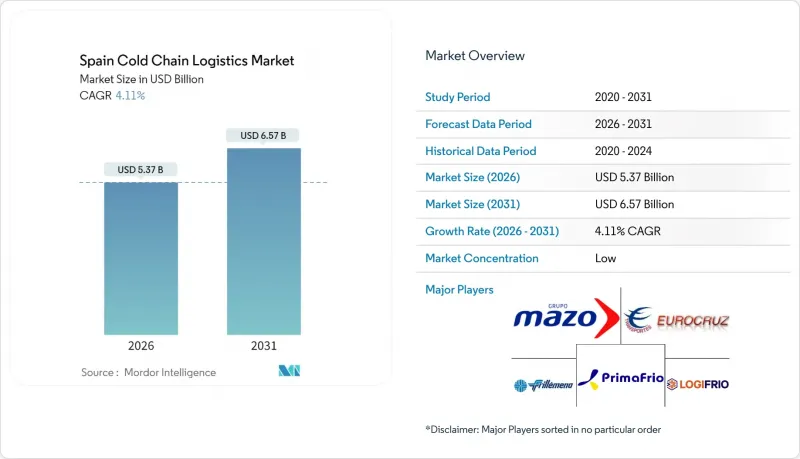
农产品出口成长、公路和港口基础设施改善以及电商配送加速向温控模式转型,支撑了仓储、运输和附加价值服务的稳定需求前景。国际物流集团持续收购区域营运商,以确保战略定位和多温区配送能力,而本地企业则投资自动化以控制人事费用和能源成本。政策支持铁路货运、清洁冷冻技术以及可再生能源的推广,正在拓展西班牙低温运输物流市场的运输选择并减少排放。最具成长潜力的领域包括药品分销、人工智慧赋能的都市区微型仓配以及连接西班牙生产区与北欧和北非的多式联运走廊。
西班牙低温运输物流市场趋势与洞察
生鲜食品配送电子商务快速成长
随着消费者对冷藏和冷冻产品当日送达的需求不断增长,线上食品杂货销售额持续以两位数的速度增长,这促使零售商建设微型仓配中心并投资自动化仓库,以减少废弃物和人工成本。例如,SimCorp为Mercadona开发的自动化配送系统,能够实现生鲜食品从采摘到门市的当日送达,这充分展现了现代机器人技术为西班牙低温运输物流市场带来的效率提升。都市区营运商正在利用基于人工智慧的需求预测来优化配送路线并降低能耗,从而打造高利润的加值服务领域。亚马逊在阿斯图里亚斯投资3亿欧元(约3.3109亿美元)的设施,正是大型零售商如何将机器人技术融入温控履约以满足顾客期望的典型案例。这些投资正鼓励第三方物流供应商在人口中心週边扩大多温区转运站,并在人口密集的都市区地区安装小包裹大小的冷藏柜。
药品和疫苗低温运输需求不断增长
西班牙生物製药产业正在扩大国内生产和转口业务,推动了对符合GDP认证标准的仓库、检验的包装和追踪技术的需求。 DHL计划在2030年投资20亿欧元(22亿美元)用于医疗物流,其中包括其在西班牙的设施。该设施将配备温度控制区,温度范围从-80°C的超低温到+15°C的室温控制(CRT),以确保先进疗法的安全运输。从干线运输到最后一公里配送,提供即时温度警报的物联网感测器已成为标准配置,满足了卫生当局日益严格的审核要求。光是加泰隆尼亚的公共疫苗接种计划,其疫苗剂量处理量就比20年前增加了21倍,凸显了该产业的结构性扩张。日益复杂的服务以及不断加强的监管审查,使得供应商能够提供价格更高的解决方案,从而促成了西班牙低温运输物流市场更强有力的长期合约。
冷藏仓库能源和房地产成本高昂
批发电力价格的波动推高了深冷冻库和多温区仓库的营运成本,迫使营运商对其维修,加装变速驱动装置、高效能压缩机和屋顶太阳能板。新的氟化气体法规逐步淘汰高全球暖化潜势(GWP)冷媒,迫使超级市场和第三方物流业者投资自然冷气系统,增加了初始资本支出。马德里和巴塞隆纳附近优质土地的短缺推高了租金,迫使营运商建造高层、全自动化的设施,以最大限度地提高仓储容量。西班牙的电网级电池储能蓝图预计在未来缓解这一问题,但目前能源成本转嫁的政策仍不明确,限制了其扩张计画。
细分市场分析
到2025年,冷藏仓库将占西班牙低温运输物流市场41.35%的份额,这主要得益于出口商、食品杂货商和製药公司为应对供应链中断而寻求缓衝能力的需求。像Carnicas Chamberí公司位于托莱多的仓库这样的自动化高层冷藏仓库,可以在-18 度C的低温环境下处理超过1800个托盘,同时降低能耗和人事费用。公共仓库因其资产共用和灵活的部位安排而日益受到欢迎,而大型加工商则在建造配备整合式产品专用温区的专用设施。包括重新包装、贴标、套件组装和越库作业在内的附加价值服务正以3.84%的复合年增长率成长,这反映出客户倾向于将非核心业务外包并缩短交货时间。由于西班牙15825公里的高速公路网络,运输服务的需求保持稳定,但利润压力正推动企业采用液化天然气、电力和铁路兼容的冷藏集装箱,以达到排放目标。西班牙的低温运输物流市场正受益于《ATP条约》的实施,该条约对该国约30万辆车队的隔热材料和製冷设备进行了标准化。
其他福利:
- Excel格式的市场预测(ME)表
- 3个月的分析师支持
目录
第一章 引言
- 研究假设和市场定义
- 调查范围
第二章调查方法
第三章执行摘要
第四章 市场情势
- 市场概览
- 市场驱动因素
- 生鲜食品配送电子商务快速成长
- 药品和疫苗低温运输需求不断增长
- 出口导向园艺和水产品的发展
- 根据欧盟「Fit-for-55」倡议,向以铁路为基础的多式联运低温运输过渡
- 人工智慧驱动的微型仓配减少了最后一公里环节的损耗
- 气候变迁导致从南向北的逆向物流
- 市场限制
- 冷藏仓库能源和房地产成本高昂
- 农村地区基础设施匮乏
- 合格冷冻技术人员短缺
- 氨/二氧化碳工厂水资源管理条例
- 价值/供应链分析
- 监管环境
- 技术展望
- 波特五力模型
- 新进入者的威胁
- 买方的议价能力
- 供应商的议价能力
- 替代品的威胁
- 激烈的竞争
- 排放标准对低温运输的影响
- 新冠疫情与地缘政治事件的影响
第五章 市场规模与成长预测
- 按服务类型
- 冷藏保管
- 公共仓库
- 私人仓库
- 冷藏运输
- 道路运输
- 铁路
- 海
- 航空邮件
- 附加价值服务
- 冷藏保管
- 按温度类型
- 冷藏(0-5°C)
- 冷冻(-18 至 0°C)
- 环境的
- 超低温冷冻(低于-20°C)
- 透过使用
- 水果和蔬菜
- 肉类/家禽
- 鱼贝类
- 乳製品和冷冻甜点
- 麵包糖果甜点
- 调理食品
- 製药和生物製药
- 疫苗和临床试验材料
- 化学品/特殊材料
- 其他生鲜产品
- 按地区
- 安达卢西亚
- 加泰隆尼亚
- 瓦伦西亚地区
- 马德里及西班牙中部
- 其他的
第六章 竞争情势
- 市场集中度
- 策略趋势
- 市占率分析
- 公司简介
- Grupo Mazo
- Eurocruz
- Primafrio
- Frillemena SA
- Logifrio
- STEF
- Lineage Logistics
- DHL
- Transportes Corredor
- Frimercat
- Ferro-Montajes Albacete SCL de Balazote
- Asgasa Servicios Frigorificos
- ID Logistics
- Frigorifics Gelada SL
- CubeCold
- Frigorificos SOLY
- Frigorificos Sanchidrian
- Antonio Marco
- Vitotrans
- Autransa SL
第七章 市场机会与未来展望
The Spain Cold Chain Logistics Market was valued at USD 5.16 billion in 2025 and estimated to grow from USD 5.37 billion in 2026 to reach USD 6.57 billion by 2031, at a CAGR of 4.11% during the forecast period (2026-2031).
Rising agrifood exports, highway and port upgrades, and the accelerating shift toward temperature-sensitive e-commerce deliveries underpin a stable demand outlook for warehousing, transport, and value-added services. International logistics groups continue acquiring regional operators to secure strategic locations and multi-temperature capacity, while local firms invest in automation to curb labor and energy costs. Policy support for rail freight, clean refrigeration technologies, and renewable energy adoption is widening modal choices and lowering emissions across the Spain cold chain logistics market. Growth opportunities remain strongest in pharmaceutical distribution, AI-enabled urban micro-fulfillment, and intermodal corridors linking Spanish production zones with Northern Europe and North Africa.
Spain Cold Chain Logistics Market Trends and Insights
E-commerce boom in fresh grocery delivery
Online food sales are growing at double-digit rates as consumers demand same-day delivery of chilled and frozen items, compelling retailers to build micro-fulfillment hubs and invest in automated storage that reduces spoilage and labor requirements. Automated distribution systems such as Cimcorp's installation for Mercadona now move fresh produce from field to store within a single day, demonstrating the efficiency gains that modern robotics bring to the Spain cold chain logistics market. Urban operators leverage AI-based demand forecasting to optimize route planning and shrink energy consumption, creating premium service niches that command higher margins. The EUR 300 million (USD 331.09 million) Amazon facility in Asturias exemplifies how large retailers are embedding robotics into temperature-controlled fulfillment to meet customer expectations . These investments stimulate third-party logistics providers to expand multi-temperature cross-docks near population centers and embed parcel-sized cool lockers inside dense city zones.
Rising pharma and vaccine cold-chain needs
Spain's biopharmaceutical sector is scaling both domestic manufacturing and re-export activity, elevating demand for GDP-certified warehousing, validated packaging, and track-and-trace technology. DHL's pledge to inject EUR 2 billion (USD 2.20 billion) into health logistics by 2030 includes Spanish hubs with controlled zones ranging from -80 °C deep-freeze to +15 °C CRT, enabling safe movement of advanced therapies. IoT sensors that deliver real-time temperature alerts are becoming standard across line-haul and last-mile operations, satisfying stricter health authority audits. The public immunization program in Catalonia alone processes vaccine volumes 21 times larger than two decades earlier, underscoring the sector's structural expansion. Higher service complexity and regulatory scrutiny allow providers to price premium solutions and reinforce long-term contracts in the Spain cold chain logistics market.
High energy and real-estate costs for cold storage
Wholesale electricity volatility has elevated operating costs for blast freezers and multi-temperature warehouses, prompting operators to retrofit variable-speed drives, high-efficiency compressors, and rooftop solar arrays. New F-Gas rules that phase down high-GWP refrigerants force supermarkets and 3PLs to invest in natural refrigerant systems, raising upfront capex. Prime land scarcity near Madrid and Barcelona pushes lease prices upward, compelling operators to build taller, fully automated facilities that maximize cubic capacity. Spain's grid-scale battery storage roadmap promises future relief, yet current policy clarity on energy cost pass-through remains limited, constraining expansion plans.
Other drivers and restraints analyzed in the detailed report include:
- Export-oriented horticulture and seafood growth
- EU Fit-for-55 rail intermodal transition
- Rural infrastructure gaps
For complete list of drivers and restraints, kindly check the Table Of Contents.
Segment Analysis
Refrigerated storage generated 41.35% of the Spain cold chain logistics market size in 2025 as exporters, grocers, and pharmaceutical firms sought buffer capacity against supply chain shocks. Automated high-bay freezers such as the Toledo site of Carnicas Chamberi handle more than 1,800 pallets at -18°C while cutting power use and labor expense. Public warehouses gain appeal by offering pooled assets and flexible slotting, whereas large processors build private facilities that integrate product-specific temperature zones. Value-added services, covering repacking, labeling, kitting, and cross-docking, are growing at a 3.84% CAGR, reflecting customer willingness to outsource non-core tasks and tighten turnaround times. Transportation services retain steady demand thanks to Spain's 15,825 km motorway network, yet margin pressure encourages adoption of LNG, electric, and rail-compatible reefers to align with emission goals. The Spain cold chain logistics market benefits from ATP treaty enforcement, which standardizes vehicle insulation and refrigeration equipment across the roughly 300,000-unit national fleet.
The Spain Cold Chain Logistics Market Report is Segmented by Service Type (Refrigerated Storage, Refrigerated Transportation, Value-Added Services), Temperature Type (Chilled, Frozen, Ambient, Deep-Frozen), Application (Fruits & Vegetables, Meat & Poultry, Fish & Seafood, Dairy, and More), and Geography (Andalusia, Valencia Region, Madrid & Central Spain, Others). The Market Forecasts are Provided in Terms of Value (USD).
List of Companies Covered in this Report:
- Grupo Mazo
- Eurocruz
- Primafrio
- Frillemena SA
- Logifrio
- STEF
- Lineage Logistics
- DHL
- Transportes Corredor
- Frimercat
- Ferro-Montajes Albacete SCL de Balazote
- Asgasa Servicios Frigorificos
- ID Logistics
- Frigorifics Gelada SL
- CubeCold
- Frigorificos SOLY
- Frigorificos Sanchidrian
- Antonio Marco
- Vitotrans
- Autransa SL
Additional Benefits:
- The market estimate (ME) sheet in Excel format
- 3 months of analyst support
TABLE OF CONTENTS
1 Introduction
- 1.1 Study Assumptions and Market Definition
- 1.2 Scope of the Study
2 Research Methodology
3 Executive Summary
4 Market Landscape
- 4.1 Market Overview
- 4.2 Market Drivers
- 4.2.1 E-commerce boom in fresh grocery delivery
- 4.2.2 Rising pharma and vaccine cold-chain needs
- 4.2.3 Export-oriented horticulture and seafood growth
- 4.2.4 EU "Fit-for-55" shift to rail intermodal cold-chain
- 4.2.5 AI-enabled micro-fulfilment cuts last-mile spoilage
- 4.2.6 Climate-driven south-to-north reverse logistics
- 4.3 Market Restraints
- 4.3.1 High energy and real-estate costs for cold storage
- 4.3.2 Rural infrastructure gaps
- 4.3.3 Shortage of certified refrigeration technicians
- 4.3.4 Water-scarcity rules for ammonia/CO? plants
- 4.4 Value / Supply-Chain Analysis
- 4.5 Regulatory Landscape
- 4.6 Technological Outlook
- 4.7 Porter's Five Forces
- 4.7.1 Threat of New Entrants
- 4.7.2 Bargaining Power of Buyers
- 4.7.3 Bargaining Power of Suppliers
- 4.7.4 Threat of Substitutes
- 4.7.5 Intensity of Rivalry
- 4.8 Impact of Emission Standards on Cold-Chain
- 4.9 Impact of COVID-19 and Geo-Political Events
5 Market Size & Growth Forecasts (Value)
- 5.1 By Service Type
- 5.1.1 Refrigerated Storage
- 5.1.1.1 Public Warehousing
- 5.1.1.2 Private Warehousing
- 5.1.2 Refrigerated Transportation
- 5.1.2.1 Road
- 5.1.2.2 Rail
- 5.1.2.3 Sea
- 5.1.2.4 Air
- 5.1.3 Value-Added Services
- 5.1.1 Refrigerated Storage
- 5.2 By Temperature Type
- 5.2.1 Chilled (0-5 °C)
- 5.2.2 Frozen (-18-0 °C)
- 5.2.3 Ambient
- 5.2.4 Deep-Frozen / Ultra-Low (less than-20 °C)
- 5.3 By Application
- 5.3.1 Fruits and Vegetables
- 5.3.2 Meat and Poultry
- 5.3.3 Fish and Seafood
- 5.3.4 Dairy and Frozen Desserts
- 5.3.5 Bakery and Confectionery
- 5.3.6 Ready-to-Eat Meals
- 5.3.7 Pharmaceuticals and Biologics
- 5.3.8 Vaccines and Clinical Trial Materials
- 5.3.9 Chemicals and Specialty Materials
- 5.3.10 Other Perishables
- 5.4 By Region
- 5.4.1 Andalusia
- 5.4.2 Catalonia
- 5.4.3 Valencia Region
- 5.4.4 Madrid and Central Spain
- 5.4.5 Others
6 Competitive Landscape
- 6.1 Market Concentration
- 6.2 Strategic Moves
- 6.3 Market Share Analysis
- 6.4 Company Profiles (includes Global-level Overview, Market-level Overview, Core Segments, Financials, Strategic Info, Market Rank/Share, Products & Services, Recent Developments)
- 6.4.1 Grupo Mazo
- 6.4.2 Eurocruz
- 6.4.3 Primafrio
- 6.4.4 Frillemena SA
- 6.4.5 Logifrio
- 6.4.6 STEF
- 6.4.7 Lineage Logistics
- 6.4.8 DHL
- 6.4.9 Transportes Corredor
- 6.4.10 Frimercat
- 6.4.11 Ferro-Montajes Albacete SCL de Balazote
- 6.4.12 Asgasa Servicios Frigorificos
- 6.4.13 ID Logistics
- 6.4.14 Frigorifics Gelada SL
- 6.4.15 CubeCold
- 6.4.16 Frigorificos SOLY
- 6.4.17 Frigorificos Sanchidrian
- 6.4.18 Antonio Marco
- 6.4.19 Vitotrans
- 6.4.20 Autransa SL
7 Market Opportunities and Future Outlook
- 7.1 White-space and Unmet-Need Assessment

 低温运输物流市场:依服务类型、温度区域和最终用途划分-2026-2032年全球市场预测低温运输市场:2026-2032年全球市场预测(依温度范围、设备类型、服务模式、最终用户及通路划分)
 2026年全球低温运输市场报告2026年全球冷冻食品物流市场报告2026年全球低温运输物流市场报告RAP冷藏货柜市场:依货柜类型、冷却系统类型、隔热材料、容量、温度范围、应用、最终用户划分,全球预测,2026-2032年
 2026-2030年全球低温运输市场
 低温运输市场分析及预测(至2035年):依类型、产品类型、服务、技术、组件、应用、设备、解决方案、最终用户划分
 亚太地区低温运输物流:市占率分析、产业趋势与统计、成长预测(2026-2031年)
 2026-2034年全球低温运输物流市场规模、份额、趋势及成长分析报告