


 |
市场调查报告书
商品编码
1952844
AI原生6G革命:从5G-Advanced到6G的供应链策略AI-Native 6G Revolution: Supply-Chain Strategies from 5G-Advanced |
||||||

6G的到来标誌着网路架构向完全AI原生架构的根本性转变,重塑了通讯技术和市场结构。与5G-Advanced相比,6G设计更加重视能源效率(以每比特能量衡量),推动了C-RAN和O-RAN之间新的分工,促进了GaN和SiC材料的更广泛应用,以及光子和电子互连技术的更深层整合。
AI在无线接取网路(RAN)控制、波束管理、调度最佳化和频谱分配中扮演着越来越重要的角色。同时,诸如A1N、Ga2O3和钻石等新兴材料展现出超越当前主流半导体性能极限的潜力。技术进步和商业需求正在共同重塑6G时代的竞争格局,释放出涵盖工业5.0、自动驾驶、智慧医疗和AI代理等高附加价值市场的潜力。
主要亮点
- 向原生AI的6G架构过渡:6G强调在网路控制、波束管理和频谱分配中整合AI,从以频宽为中心转向以能源效率为中心。这将为自动驾驶和智慧医疗等应用提供边缘运算和自动化最佳化。
- AI带来的挑战与需求:基于边缘的资料产生和AI推理暴露了异质性和流量不对称性带来的瓶颈,因此架构重新设计对于可扩展性至关重要。
- 新兴材料的潜力:氮化铝(AlN)、氧化镓(Ga2O3)和钻石具有优异的导热性和耐压性,可望推动射频元件、功率元件和恶劣环境应用的发展。
目录
第一章:人工智慧时代的通讯瓶颈与6G的必然性
第二章:宽禁带与III-V族材料革命:建构6G的物理基础
第三章:TRI的视角
The arrival of 6G marks a fundamental shift toward fully AI-native network architectures, reshaping both communications technologies and market structures. Compared with 5G-Advanced, 6G design places a much stronger emphasis on energy efficiency-measured as energy per bit-driving a new division of labor between C-RAN and O-RAN, broader adoption of GaN and SiC materials, and deeper integration of photonic and electronic interconnect technologies.
AI is becoming increasingly central to RAN control, beam management, scheduling optimization, and spectrum allocation. At the same time, emerging materials such as AIN, Ga2O3, and diamond are demonstrating significant potential to surpass the performance limits of today's mainstream semiconductors. Together, technological advances and commercial imperatives are jointly reshaping competitive dynamics in the 6G era, unlocking high-value markets spanning Industry 5.0, autonomous driving, smart healthcare, and AI agents
Key Highlights
- Shift to AI-Native 6G Architecture: 6G emphasizes AI integration in network control, beam management, and spectrum allocation, moving from bandwidth-focused to energy-efficient designs, enabling edge computing and automated optimization for applications like autonomous driving and smart healthcare.
- AI-Driven Challenges and Necessity: Edge-based data generation and AI inference expose bottlenecks in heterogeneity and traffic asymmetry, making architectural redesign essential for scalability.
- Emerging Materials Potential: AlN, Ga2O3, and diamond offer superior thermal conductivity and breakdown fields, promising advancements in RF, power devices, and extreme environments.
Table of Contents
1. Communication Bottlenecks in the AI Era and the Inevitability of 6G
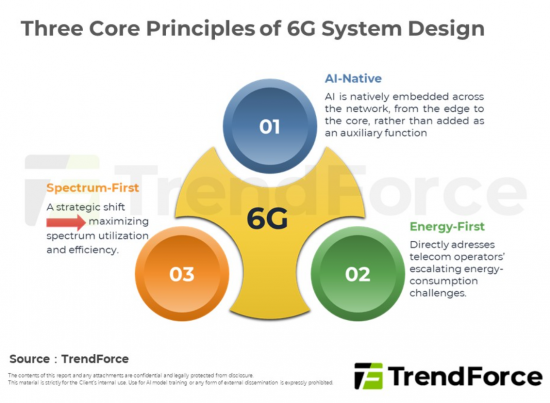
- Figure 1: Three Core Principles of 6G System Design
2. The WBG and III-V Materials Revolution: Laying the Physical Foundation for 6G
- Table 1: Energy Efficiency Assessment of Semiconductor Materials Across Cross-Domain Applications
- Figure 2: Technical and Performance Analysis of SiGe and CMOS in Advanced mmWave Transceivers
- Figure 3: Changes in Power Consumption and Antenna Count in Transmitter Architectures Using CMOS, SiGe, and InP
3. TRI's View

 客户对客户 (C2C) 社群市场分析及至 2035 年预测:按类型、产品类型、服务、技术、组件、应用、部署类型、最终用户和模式划分
 全球客户参与解决方案市场规模、份额、趋势和成长分析报告(2026-2034)
 客户参与解决方案市场规模、份额和成长分析(按组件、部署类型、解决方案类型、公司规模、最终用户产业和地区划分)-2026-2033年产业预测全球客户互动解决方案市场:市场规模、占有率、成长率、产业分析、依类型、应用和地区划分的分析及预测(2026-2034 年)
 2026-2030年全球客户参与解决方案市场
 全球公共演讲培训市场:预测至2032年-按培训类型、技能重点、交付方式、最终用户和地区分類的分析
 客户参与:全球预测(2025年~2030年)
 客户参与:全球市场占有率(2024年)客户旅程地图软体市场规模,全球依功能、部署类型、组织规模、地理划分,预测至 2025 年
 市场占有率与预测:CRM客户参与中心(CRM CEC),2023~2028年,世界规模(双报告绑定套装)