


 |
市场调查报告书
商品编码
2019198
OEM电动驱动单元市场机会、成长要素、产业趋势分析及2026-2035年预测OEM Electric Drive Unit (EDU) Market Opportunity, Growth Drivers, Industry Trend Analysis, and Forecast 2026 - 2035 |
||||||

2025 年全球 OEM 电动驱动单元市场价值为 223 亿美元,预计到 2035 年将以 20.4% 的复合年增长率增长至 1396 亿美元。
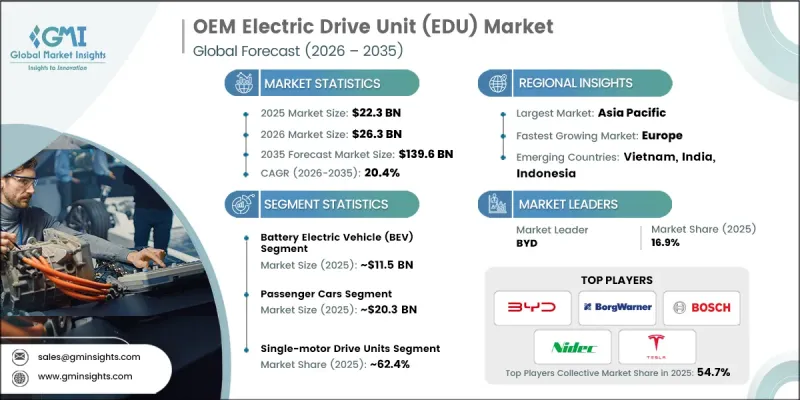
这一成长主要得益于全球汽车电气化趋势、主要汽车製造商加速投资以及电池技术的持续创新。随着世界各国政府实施严格的排放气体法规,许多国家计划逐步淘汰内燃机汽车并向电动车过渡,市场对电动驱动单元的需求日益强劲。锂离子电池和固态固态电池效率的提高、使用寿命的延长以及成本的降低,使得电动车对消费者更具吸引力,进一步扩大了电动驱动单元的普及。政府的奖励计画、补贴和支持政策也持续推动市场成长。此外,消费者环保意识的增强、对环境问题的关注以及对零排放出行解决方案的需求,也促使汽车製造商增加对电动驱动单元的投资。
| 市场范围 | |
|---|---|
| 开始年份 | 2025 |
| 预测期 | 2026-2035 |
| 上市时的市场规模 | 223亿美元 |
| 预测金额 | 1396亿美元 |
| 复合年增长率 | 20.4% |
电池式电动车(BEV)市占率占比高达51.3%,预计到2025年市场规模将达到115亿美元。 BEV市场的主导地位主要得益于严格的排放气体法规、汽车製造商(OEM)的努力以及政府奖励推动的消费者接受度。零排放车辆的强制性要求和日益增强的环保意识促使製造商优先发展BEV生产,从而推高了性能优于混合动力汽车汽车和燃料电池汽车的BEV的需求。
预计到2025年,乘用车市占率将达到91%,市场规模将达203亿美元。这反映出电动乘用车相比商用车市场更快被大众接受。丰富的车型选择、强劲的产能、不断完善的充电基础设施以及稳定的政策框架等因素,都支撑着乘用车市场持续主导地位。
美国面向整车製造商 (OEM) 的电动驱动单元 (EDU) 市场预计到 2025 年将达到 24 亿美元,并在 2026 年至 2035 年间以 16.5% 的复合年增长率增长。联邦和州政府的电动车政策、消费者接受趋势以及整车製造商的策略正在推动市场需求。诸如国家电动车基础设施 (NEVI) 公式计划等倡议正在支持电动车充电网路的部署,并透过缓解人们对续航里程的担忧,间接促进电动驱动单元的普及。政策调整,包括联邦政府资助的充电站对美国製造零件的要求发生变化,正在重塑市场生态系统。
目录
第一章:调查方法
第二章执行摘要
第三章业界考察
- 生态系分析
- 供应商情况
- 利润率
- 成本结构
- 每个阶段增加的价值
- 影响价值链的因素
- 中断
- 影响产业的因素
- 促进因素
- 严格的排放法规和强制引入零排放车辆
- 消费者对电动车和混合动力汽车的需求日益增长
- 政府为推广电动车提供奖励和补贴
- 增加对电动车基础设施和充电网路的投资
- 产业潜在风险与挑战
- 教育设备製造业初始成本高、资本密集度高
- 新兴市场对续航里程和基础设施差异的担忧
- 市场机会
- 拓展至非公路车辆及工业车辆领域。
- 原始设备製造商与一级供应商之间的策略合作伙伴关係
- 开发模组化、可扩展的教育平台
- 促进因素
- 成长潜力分析
- 监理情势
- 北美洲
- 美国环保署(EPA)
- 加拿大 - 加拿大运输部
- 欧洲
- 德国 - VDA(德国汽车工业协会)
- 义大利 - 基础设施和运输部
- 亚太地区
- 中国 - 中国国家标准化管理委员会(SAC)
- 日本 - 日本汽车标准国际化中心 (JASIC)
- 拉丁美洲
- 巴西 - 国家计量研究院 (INMETRO)
- 墨西哥 - 墨西哥通讯与运输部(SCT)
- 中东和非洲
- 沙乌地阿拉伯 - 沙乌地阿拉伯标准、计量和品质组织 (SASO)
- 南非 - 南非标准局 (SABS)
- 北美洲
- 波特五力分析
- PESTEL 分析
- 科技与创新趋势
- 目前技术
- 永磁同步马达(PMSM)
- 整合式电动驱动单元(电力驱动桥)
- 400V电气架构系统
- 用于温度控管的液冷系统
- 新兴技术
- 800V高压电气架构
- 轴流式马达
- 油冷式和直冷式马达技术
- 目前技术
- 专利趋势(基于初步调查)
- 成本細項分析
- 原料成本分析
- 製造和组装成本结构
- 电力电子和半导体的成本贡献
- 物流、供应链和管理费用
- 永续性和环境方面
- 永续倡议
- 减少废弃物策略
- 生产中的能源效率
- 具有环保意识的倡议
- 关于碳足迹的考量
- 交易数据分析(基于付费资料库)
- 进出口量及进口额趋势
- 主要贸易走廊及关税的影响
- 生产能力和生产趋势(基于初步调查)
- 按地区和主要生产商分類的安装能力
- 设备运转率和扩建计划
- 与先进车辆架构的集成
- 与软体定义车辆架构的集成
- 与高级驾驶辅助系统 (ADAS) 的兼容性
- 集中式与分散式动力传动系统控制系统
- 400V 和 800V系统结构的集成
- 主要汽车製造商的电气化蓝图
- 从内燃机汽车 (ICE) 到纯电动车的过渡时间表
- 电动车平台和技术的投资策略
- 针对教育开发和整合的OEM特定方法
- 伙伴关係、合资企业和技术合作
- 各区域电气化战略的差异
- 人工智慧和生成式人工智慧对市场的影响
- 利用人工智慧改造现有经营模式
- 针对特定领域的生成式人工智慧应用案例和实施蓝图
- 风险、限制和监管考量
- 预测假设和情境分析(基于初步研究)
- 基本案例-驱动复合年增长率的关键宏观经济与产业变量
- 乐观情境-宏观经济与产业的顺风
- 悲观情景-宏观经济放缓或产业逆风
第四章 竞争情势
- 介绍
- 企业市占率分析
- 北美洲
- 欧洲
- 亚太地区
- 拉丁美洲
- 中东和非洲(MEA)
- 主要市场公司的竞争分析
- 竞争定位矩阵
- 主要进展
- 併购
- 伙伴关係与合作
- 新产品发布
- 业务拓展计划及资金筹措
- 企业级分层基准测试
- 层级分类标准与选择标准
- 按收入、地区和创新能力分類的层级定位矩阵。
第五章 市场估计与预测:依驱动因素划分,2022-2035年
- 电池式电动车(BEV)
- 插电式混合动力汽车(PHEV)
- 燃料电池汽车(FCEV)
- 混合动力电动车(HEV)
第六章 市场估算与预测:依驱动单元配置划分,2022-2035年
- 单马达驱动单元
- 双马达驱动单元
- 多电机驱动单元
第七章 市场估计与预测:依冷冻技术划分,2022-2035年
- 水乙二醇
- 油腻的
- 空冷式
第八章 市场估价与预测:依车辆类型划分,2022-2035年
- 搭乘用车
- 掀背车
- 轿车
- SUV
- 商用车辆
- 轻型商用车(LCV)
- 中型商用车(MCV)
- 重型商用车(HCV)
第九章 市场估计与预测:依地区划分,2022-2035年
- 北美洲
- 我们
- 加拿大
- 欧洲
- 德国
- 英国
- 法国
- 义大利
- 西班牙
- 瑞典
- 捷克共和国
- 波兰
- 亚太地区
- 中国
- 日本
- 韩国
- 印度
- 澳洲
- 新加坡
- 越南
- 印尼
- 马来西亚
- 拉丁美洲
- 巴西
- 墨西哥
- 阿根廷
- 智利
- 中东和非洲(MEA)
- 南非
- 沙乌地阿拉伯
- 阿拉伯聯合大公国
第十章:公司简介
- 世界公司
- BorgWarner
- ZF Friedrichshafen
- GKN Automotive
- Dana
- Continental
- Linamar
- Aisin
- Magna
- Schaeffler
- Nidec
- Valeo
- Bosch
- 本地公司
- BYD
- Tesla
- American Axle &Manufacturing(AAM)
- JATCO
- Marelli
- 新兴企业
- Lucid Motors
- Rivian Automotive
- Protean Electric
The Global OEM Electric Drive Unit Market was valued at USD 22.3 billion in 2025 and is estimated to grow at a CAGR of 20.4% to reach USD 139.6 billion by 2035.
The growth is driven by the global shift toward vehicle electrification, accelerated investments by leading automakers, and continuous innovations in battery technology. Governments worldwide are implementing stringent emission standards, while many countries are planning to phase out internal combustion engine vehicles in favor of electric vehicles, creating strong demand for electric drive units. Improvements in lithium-ion and solid-state battery efficiency, longer life cycles, and reduced costs have made electric vehicles more appealing to consumers, further increasing the adoption of EDUs. Incentive programs, subsidies, and supportive policies from governments continue to boost market growth. OEM investments in EDUs are also influenced by increasing consumer awareness, environmental concerns, and the need for zero-emission mobility solutions.
| Market Scope | |
|---|---|
| Start Year | 2025 |
| Forecast Year | 2026-2035 |
| Start Value | $22.3 Billion |
| Forecast Value | $139.6 Billion |
| CAGR | 20.4% |
The battery electric vehicles (BEVs) segment held a 51.3% share, generating USD 11.5 billion in 2025. The BEV segment's dominance is driven by strict emission regulations, OEM commitments, and consumer adoption supported by government incentives. Zero-emission vehicle mandates and growing environmental consciousness are encouraging manufacturers to prioritize BEV production, driving demand for high-performance EDUs over hybrid and fuel cell variants.
The passenger car segment accounted for 91% share in 2025, valued at USD 20.3 billion, reflecting the faster adoption of electric passenger vehicles compared with commercial vehicles. Factors such as wider model availability, robust production scales, expanding charging infrastructure, and consistent policy frameworks support this segment's continued leadership in the market.
U.S. OEM Electric Drive Unit Market reached USD 2.4 billion in 2025 and is projected to grow at a CAGR of 16.5% from 2026 to 2035. Federal and state EV policies, consumer adoption trends, and OEM strategies drive demand. Programs like the National Electric Vehicle Infrastructure (NEVI) Formula Program are supporting the rollout of EV charging networks, indirectly facilitating EDU adoption by alleviating range anxiety. Policy adjustments, including changes to US-content requirements for federally funded charging stations, are shaping the market ecosystem.
Leading companies in the Global OEM Electric Drive Unit Market include Schaeffler, Valeo, BYD, Bosch, Tesla, BorgWarner, Vitesco Technologies, Aisin, Nidec, and ZF Friedrichshafen. Key strategies employed by companies in the OEM electric drive unit market include investing in R&D to develop high-efficiency, lightweight, and compact EDUs, collaborating with battery and EV manufacturers for integrated solutions, and expanding production capacities to meet growing global demand. Firms are establishing regional manufacturing hubs to reduce supply chain risks, forming strategic partnerships with automotive OEMs, and adopting advanced digital manufacturing technologies to enhance product quality and reliability. Companies are also focusing on cost reduction, modular platform development, and technology licensing to strengthen market presence. Marketing and after-sales support, along with participation in sustainability initiatives, help build brand credibility and customer trust, further reinforcing their foothold in the competitive market.
Table of Contents
Chapter 1 Methodology
- 1.1 Research approach
- 1.2 Quality Commitments
- 1.2.1 GMI AI policy & data integrity commitment
- 1.3 Research Trail & Confidence Scoring
- 1.3.1 Research Trail Components
- 1.3.2 Scoring Components
- 1.4 Data Collection
- 1.5 Data mining sources
- 1.5.1 Paid sources
- 1.6 Base estimates and calculations
- 1.6.1 Base year calculation for any one approach
- 1.7 Forecast
- 1.7.1 Quantified market impact analysis
- 1.8 Research transparency addendum
- 1.8.1 Source attribution framework
- 1.8.2 Quality assurance metrics
- 1.8.3 Our commitment to trust
Chapter 2 Executive Summary
- 2.1 Industry 360° synopsis
- 2.2 Key market trends
- 2.2.1 Regional
- 2.2.2 Propulsion
- 2.2.3 Drive Unit Configuration
- 2.2.4 Cooling Technology
- 2.2.5 Vehicle
- 2.3 TAM analysis, 2026-2035
- 2.4 CXO perspectives: Strategic imperatives
Chapter 3 Industry Insights
- 3.1 Industry ecosystem analysis
- 3.1.1 Supplier landscape
- 3.1.2 Profit margin
- 3.1.3 Cost structure
- 3.1.4 Value addition at each stage
- 3.1.5 Factor affecting the value chain
- 3.1.6 Disruptions
- 3.2 Industry impact forces
- 3.2.1 Growth drivers
- 3.2.1.1 Stringent emission regulations & zero-emission vehicle mandates
- 3.2.1.2 Increasing consumer demand for electric & hybrid vehicles
- 3.2.1.3 Government incentives & subsidies for EV adoption
- 3.2.1.4 Growing investment in EV infrastructure & charging networks
- 3.2.2 Industry pitfalls and challenges
- 3.2.2.1 High initial cost & capital intensity of EDU manufacturing
- 3.2.2.2 Range anxiety & infrastructure gaps in emerging markets
- 3.2.3 Market opportunities
- 3.2.3.1 Expansion into off-highway & industrial vehicle segments
- 3.2.3.2 Strategic partnerships between OEMs & Tier-1 suppliers
- 3.2.3.3 Development of modular & scalable EDU platforms
- 3.2.1 Growth drivers
- 3.3 Growth potential analysis
- 3.4 Regulatory landscape
- 3.4.1 North America
- 3.4.1.1 U.S. - Environmental Protection Agency (EPA)
- 3.4.1.2 Canada - Transportation Canada
- 3.4.2 Europe
- 3.4.2.1 Germany - VDA (German Association of the Automotive Industry)
- 3.4.2.2 Italy - Ministry of Infrastructure and Transport
- 3.4.3 Asia Pacific
- 3.4.3.1 China - China National Standardization Administration (SAC)
- 3.4.3.2 Japan - Japan Automobile Standards Internationalization Center (JASIC)
- 3.4.4 Latin America
- 3.4.4.1 Brazil - Instituto Nacional de Metrologia (INMETRO)
- 3.4.4.2 Mexico - Mexico’s Secretaria de Comunicaciones y Transportes (SCT)
- 3.4.5 Middle East & Africa
- 3.4.5.1 Saudi Arabia - Saudi Standards, Metrology and Quality Organization (SASO)
- 3.4.5.2 South Africa - South African Bureau of Standards (SABS)
- 3.4.1 North America
- 3.5 Porter's analysis
- 3.6 PESTEL analysis
- 3.7 Technology and innovation landscape
- 3.7.1 Current technologies
- 3.7.1.1 Permanent Magnet Synchronous Motors (PMSM)
- 3.7.1.2 Integrated Electric Drive Units (e-Axles)
- 3.7.1.3 400V Electrical Architecture Systems
- 3.7.1.4 Liquid Cooling Systems for Thermal Management
- 3.7.2 Emerging technologies
- 3.7.2.1 800V High-Voltage Electrical Architectures
- 3.7.2.2 Axial Flux Motors
- 3.7.2.3 Oil-Cooled and Direct Cooling Motor Technologies
- 3.7.1 Current technologies
- 3.8 Patent landscape (Driven by Primary Research)
- 3.9 Cost breakdown analysis
- 3.9.1 Raw material cost analysis
- 3.9.2 Manufacturing & assembly cost structure
- 3.9.3 Power electronics & semiconductor cost contribution
- 3.9.4 Logistics, supply chain, and overhead costs
- 3.10 Sustainability and environmental aspects
- 3.10.1 Sustainable practices
- 3.10.2 Waste reduction strategies
- 3.10.3 Energy efficiency in production
- 3.10.4 Eco-friendly Initiatives
- 3.10.5 Carbon footprint considerations
- 3.11 Trade Data Analysis (Driven by Paid Database)
- 3.11.1 Import/Export Volume & Value Trends
- 3.11.2 Key Trade Corridors & Tariff Impact
- 3.12 Capacity & Production Landscape (Driven by Primary Research)
- 3.12.1 Installed Capacity by Region & Key Producer
- 3.12.2 Capacity Utilization Rates & Expansion Pipelines
- 3.13 Integration with Advanced Vehicle Architectures
- 3.13.1 Integration with software-defined vehicle architectures
- 3.13.2 Compatibility with advanced driver assistance systems (ADAS)
- 3.13.3 Centralized vs distributed powertrain control systems
- 3.13.4 Integration with 400V vs 800V systems architecture
- 3.14 Electrification Roadmaps of Major Automotive OEMs
- 3.14.1 Transition timelines from ICE to full electrification
- 3.14.2 Investment strategies in EV platforms and technologies
- 3.14.3 Oem-specific approaches to EDU development and integration
- 3.14.4 Partnerships, joint ventures, and technology collaborations
- 3.14.5 Regional variations in electrification strategies
- 3.15 Impact of AI & Generative AI on the Market
- 3.15.1 AI-driven disruption of existing business models
- 3.15.2 GenAI use cases & adoption roadmap by segment
- 3.15.3 Risks, limitations & regulatory considerations
- 3.16 Forecast assumptions & scenario analysis (Driven by Primary Research)
- 3.16.1 Base Case - key macro & industry variables driving CAGR
- 3.16.2 Optimistic Scenarios - Favorable macro and industry tailwinds
- 3.16.3 Pessimistic Scenario - Macroeconomic slowdown or industry headwinds
Chapter 4 Competitive Landscape, 2025
- 4.1 Introduction
- 4.2 Company market share analysis
- 4.2.1 North America
- 4.2.2 Europe
- 4.2.3 Asia Pacific
- 4.2.4 LATAM
- 4.2.5 MEA
- 4.3 Competitive analysis of major market players
- 4.4 Competitive positioning matrix
- 4.5 Key developments
- 4.5.1 Mergers & acquisitions
- 4.5.2 Partnerships & collaborations
- 4.5.3 New product launches
- 4.5.4 Expansion plans and funding
- 4.6 Company tier benchmarking
- 4.6.1 Tier classification criteria & qualifying thresholds
- 4.6.2 Tier positioning matrix by revenue, geography & innovation
Chapter 5 Market Estimates & Forecast, By Propulsion, 2022 - 2035 ($Mn, Thousand Units)
- 5.1 Key trends
- 5.2 Battery Electric Vehicle (BEV)
- 5.3 Plug-in Hybrid Electric Vehicle (PHEV)
- 5.4 Fuel Cell Electric Vehicles (FCEV)
- 5.5 Hybrid Electric Vehicle (HEV)
Chapter 6 Market Estimates & Forecast, By Drive Unit Configuration, 2022 - 2035 ($Mn, Thousand Units)
- 6.1 Key trends
- 6.2 Single-Motor Drive Units
- 6.3 Dual-Motor Drive Units
- 6.4 Multi-Motor Drive Units
Chapter 7 Market Estimates & Forecast, By Cooling Technology, 2022 - 2035 ($Mn, Thousand Units)
- 7.1 Key trends
- 7.2 Water glycol
- 7.3 Oil-based
- 7.4 Air Cooling
Chapter 8 Market Estimates & Forecast, By Vehicle, 2022 - 2035 ($Mn, Thousand Units)
- 8.1 Key trends
- 8.2 Passenger cars
- 8.2.1 Hatchback
- 8.2.2 Sedan
- 8.2.3 SUV
- 8.3 Commercial vehicles
- 8.3.1 Light Commercial Vehicles (LCV)
- 8.3.2 Medium Commercial Vehicles (MCV)
- 8.3.3 High Commercial Vehicles (HCV)
Chapter 9 Market Estimates & Forecast, By Region, 2022 - 2035 ($Mn, Thousand Units)
- 9.1 Key trends
- 9.2 North America
- 9.2.1 US
- 9.2.2 Canada
- 9.3 Europe
- 9.3.1 Germany
- 9.3.2 UK
- 9.3.3 France
- 9.3.4 Italy
- 9.3.5 Spain
- 9.3.6 Sweden
- 9.3.7 Czech Republic
- 9.3.8 Poland
- 9.4 Asia Pacific
- 9.4.1 China
- 9.4.2 Japan
- 9.4.3 South Korea
- 9.4.4 India
- 9.4.5 Australia
- 9.4.6 Singapore
- 9.4.7 Vietnam
- 9.4.8 Indonesia
- 9.4.9 Malaysia
- 9.5 Latin America
- 9.5.1 Brazil
- 9.5.2 Mexico
- 9.5.3 Argentina
- 9.5.4 Chile
- 9.6 MEA
- 9.6.1 South Africa
- 9.6.2 Saudi Arabia
- 9.6.3 UAE
Chapter 10 Company Profiles
- 10.1 Global players
- 10.1.1 BorgWarner
- 10.1.2 ZF Friedrichshafen
- 10.1.3 GKN Automotive
- 10.1.4 Dana
- 10.1.5 Continental
- 10.1.6 Linamar
- 10.1.7 Aisin
- 10.1.8 Magna
- 10.1.9 Schaeffler
- 10.1.10 Nidec
- 10.1.11 Valeo
- 10.1.12 Bosch
- 10.2 Regional players
- 10.2.1 BYD
- 10.2.2 Tesla
- 10.2.3 American Axle & Manufacturing (AAM)
- 10.2.4 JATCO
- 10.2.5 Marelli
- 10.3 Emerging players
- 10.3.1 Lucid Motors
- 10.3.2 Rivian Automotive
- 10.3.3 Protean Electric

 电气和机械驱动装置市场:2026-2032年全球市场预测(按驱动系统、额定功率、速度范围、最终用户产业、应用和控制系统划分)
 电动装置:市场占有率分析、产业趋势与统计、成长预测(2026-2031)
 BEV电动装置的全球市场全球低压电力驱动市场:市场占有率分析、产业趋势与统计、成长预测(2025-2030 年)中东和非洲的电动式驱动:市场占有率分析、产业趋势和成长预测(2025-2030)亚太地区电动驱动:市场占有率分析、产业趋势与统计、成长预测(2025-2030 年)交流 (AC) 电力驱动器:市场占有率分析、行业趋势和成长预测(2025-2030 年)全球直流 (DC) 电力驱动市场:市场占有率分析、产业趋势与统计、成长预测(2025-2030 年)北美电动驱动器:市场占有率分析、行业趋势和统计、成长预测(2025-2030 年)拉丁美洲电力驱动:市场占有率分析、产业趋势与统计、成长预测(2025-2030 年)