


 |
市场调查报告书
商品编码
1910586
日本货运物流市场:市场占有率分析、产业趋势与统计、成长预测(2026-2031年)Japan Freight And Logistics - Market Share Analysis, Industry Trends & Statistics, Growth Forecasts (2026 - 2031) |
||||||

※ 本网页内容可能与最新版本有所差异。详细情况请与我们联繫。
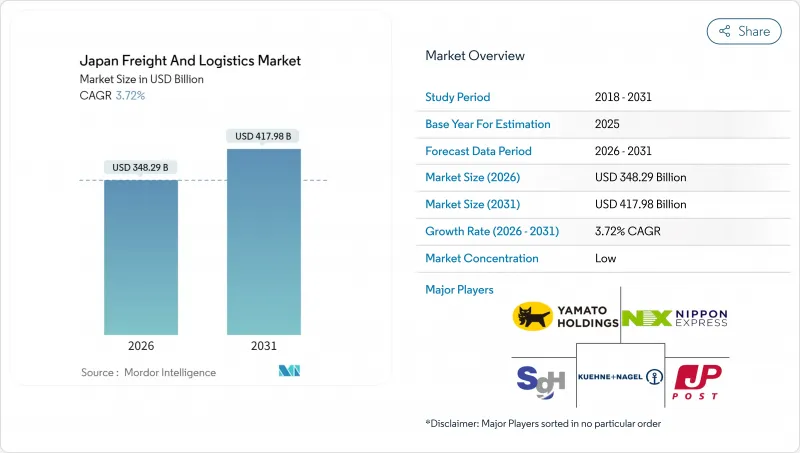
预计到 2026 年,日本货物和物流市场规模将达到 3,482.9 亿美元,高于 2025 年的 3,358 亿美元。
预计到 2031 年,该市场规模将达到 4,179.8 亿美元,2026 年至 2031 年的复合年增长率为 3.72%。
电子商务订单量的成长、製造地对第三方物流(3PL)的日益普及以及政府对智慧物流平台的新支持,正在拓展运输、仓储和附加价值服务领域的收入来源。内阁府「社会5.0」计画下的平台互通性要求正在加速数位化融合,而氢燃料电池走廊计划则为长途运输车辆的脱碳和缓解日益严重的司机短缺问题铺平了道路。同时,都市区仓储空间长期短缺以及公路货运燃料成本的上涨加剧了运输能力的竞争,迫使营运商转向自动化、多层仓储设施和网路重构。高调的勒索软体攻击事件显着增加了网路风险,促使营运商在推进供应链数位化的同时,采用零信任架构和冗余资料中心。
日本货运和物流市场的趋势和洞察
电子商务小包裹热潮
跨境和国内线上零售的扩张推动小包裹量创下历史新高,使CEP(宅配)成为成长最快的物流功能领域。国内业者正在部署自动化分类机、人工智慧路线规划和多层配送中心,以满足人口密集都市区的配送需求。国际专业营运商正在简化清关流程以缩短配送时间。大和控股与DHL的「GoGreen Plus」服务等合作案例表明,永续性目标与面向注重碳排放消费者的优质小包裹服务正在融合。温控微型仓配排放的增设旨在支援生鲜食品和药品的电商业务,这反映出物流模式正从通用处理转向专业的最后一公里配送解决方案。政府的数位商务政策正在简化跨境支付和资料共用,减少小规模出口商的行政障碍。小包裹密度的不断提高同时也给司机招募、加强对自动驾驶机器人的奖励以及在人口密集城市部署环保配送中心带来了挑战。
製造商的第三方物流外包
製造商正在重新定义第三方物流 (3PL) 关係,将其从单纯的成本节约协议转变为创造价值的伙伴关係关係。日本新的价值链实质审查法要求二氧化碳排放可追溯性和监管认证,而许多企业内部物流部门难以满足这些要求。像日立运输系统这样的供应商正在整合人工智慧规划套件和区块链可追溯性,以满足合规性审核的要求,这使得技术成为一项新的必要条件。三井物产收购一家餐饮物流企业的併购交易趋势表明,行业正朝着垂直专业化方向发展,将行业洞察与数位化能力相结合。製造商可以获得动态路线规划、实时可视性和嵌入式的可持续性评分,而第三方物流运营商则可以获得包含数据分析和监管咨询等长期合同,这些服务不仅限于实体运输。这一趋势使日本的货运和物流市场成为全球互联生产网路韧性的关键基础。
司机短缺和工时限制
2024年修订的加班限制规定将年工作时长限制在960小时以内,这抑制了车辆生产率,并加剧了工资压力。营运商正在加速併购以整合驾驶人队伍,例如名铁运输在2025年2月进行的区域整合。托运人要么接受更高的现货货运附加费,要么将不那么紧急的货物改走铁路或沿海运输以确保运力。这些限制扩大了自动驾驶卡车和转运枢纽模式的商业价值,这些模式可以减少每位驾驶者的驾驶时间。政府的燃料电池运输路线支援措施旨在提高中小型运输业者建造零排放设施的经济可行性,并减轻过度劳累员工的负担。目前,网路重新设计策略的特点是选择性地优化服务并提高载货率目标。
细分市场分析
到2025年,製造业将占日本货运物流市场的37.41%,这反映了该地区以出口为导向的汽车、电子和精密机械产业的集中度。严峻的生产週期迫使物流供应商投资于零件同步、保税仓库和供应商管理库存(VMI)专案。九州和东北地区的半导体製造工厂对无尘室级空运解决方案的需求不断增长,货运代理商也积极推广符合湿度和振动控制标准的托盘认证。为了确保价值链的韧性,製造商正在寻求港口路线和双源承运商的多元化,这增加了日本货运物流市场中第三方物流(3PL)协调的复杂性和价值。
批发和零售虽然规模较小,但预计将成为成长最快的客户群,2026年至2031年的复合年增长率将达到3.98%。全通路模式要求在门市、暗仓和线上平台实现近乎即时的SKU可见性,这迫使物流合作伙伴将库存管理API直接整合到客户的企业计画系统中。零售商正与承运商共同资金筹措区域配送中心,以确保大型促销活动的运力,并透过跳区配送降低最后一公里成本。微型仓配机器人和人工智慧需求预测减少了拆分订单的罚款,提高了托运人和服务供应商的盈利。随着日本货运和物流市场的成熟,零售商的物流支出预计将接近製造业水平,这将为第三方物流公司(3PL)向这些领域多元化发展奠定基础。
截至2025年,货运代理业务占日本货运和物流市场的70.52%。这得归功于日本密集的工业供应链,该供应链依赖卡车运输和沿海支线运输服务来实现准时制生产週期。该领域受益于综合多模态服务,这些服务在国内和出口运输中平衡了成本、可靠性和碳排放指标。儘管基础货运量依然强劲,但不断上涨的柴油额外费用和人事费用正给利润率带来越来越大的压力。为此,主要航运公司正在实施人工智慧驱动的动态定价和自动化转运场,以提高周转率并履行合约规定的服务水准协议。因此,日本货运和物流市场正在经历一场价值创造的转变,向数据驱动的货运协调和预测性维护计划转型。
同时,受生鲜食品和医疗保健领域向直接面向消费者的履约模式以及新型订阅模式的结构性转变的推动,宅配(CEP)正以4.27%的复合年增长率(2026-2031年)加速增长。机器人服务(RoaS)正在分类中心扩展,使营运商能够在季节性高峰期灵活调整运力,而无需拥有过多的资产。农村地区的无人机配送试办计画正在填补因司机短缺造成的服务缺口。同时,都市区的当日达服务依赖微型配送中心的电动货运自行车。随着小包裹密度的持续增加,轻资产网路平台正与实体店合作,扩大宅配柜和退货点的数量。竞争格局正从单纯的成本优势转向生态系统范围内的协调,这为技术型企业可持续地扩大其在日本货运和物流市场的份额创造了平台。
其他福利:
- Excel格式的市场预测(ME)表
- 3个月的分析师支持
目录
第一章 引言
- 研究假设和市场定义
- 调查范围
第二章调查方法
第三章执行摘要
第四章 市场情势
- 市场概览
- 人口统计数据
- 按经济活动分類的GDP分配
- 按经济活动分類的GDP成长
- 通货膨胀
- 经济表现及概览
- 电子商务产业的趋势
- 製造业趋势
- 运输和仓储业GDP
- 出口趋势
- 进口趋势
- 燃油价格
- 卡车运输营运成本
- 卡车运输车队规模(按类型)
- 主要卡车供应商
- 物流绩效
- 按交通方式分享
- 海运船队运力
- 班轮运输连接
- 停靠港口及航行记录
- 货运费率趋势
- 货物运输量趋势
- 基础设施
- 法规结构(公路和铁路)
- 法规结构(海事和航空)
- 价值炼和通路分析
- 市场驱动因素
- 电子商务小包裹热潮
- 製造商将物流外包给第三方物流(3PL)
- 政府推动智慧物流平台
- 加速自动驾驶卡车试营运(针对老年驾驶的措施)
- 半导体出口激增(准时)
- 氢燃料电池走廊计划
- 市场限制
- 驾驶人和工时限制
- 燃油和通行费上涨
- 都市区仓储空间短缺
- 与快速数位化相关的网路风险
- 市场创新
- 波特五力分析
- 新进入者的威胁
- 买方的议价能力
- 供应商的议价能力
- 替代品的威胁
- 竞争对手之间的竞争
第五章 市场规模与成长预测
- 终端用户产业
- 农业、渔业、林业
- 建设业
- 製造业
- 石油天然气、采矿和采石
- 批发和零售
- 其他的
- 物流职能
- 宅配、快捷邮件和小包裹(CEP)
- 按目的地
- 国内的
- 国际的
- 按目的地
- 货物运输
- 透过交通工具
- 航空
- 海路和内河航道
- 其他的
- 透过交通工具
- 货物运输安排
- 透过交通工具
- 航空
- 管道
- 铁路
- 路
- 海路和内河航道
- 透过交通工具
- 仓储
- 透过温度控制
- 非温控型
- 温度控制
- 透过温度控制
- 其他服务
- 宅配、快捷邮件和小包裹(CEP)
第六章 竞争情势
- 市场集中度
- 关键策略倡议
- 市占率分析
- 公司简介
- DHL Group
- DSV A/S(Including DB Schenker)
- FedEx
- Hitachi Transport System
- Japan Post Holdings Co., Ltd.
- Kintetsu Group Holdings Co., Ltd.
- Kuehne+Nagel
- Meitetsu World Transport
- Mitsubishi Logistics Corporation
- Mitsui OSK Lines
- Nippon Express Holdings
- Nissin Corporation
- NYK(Nippon Yusen Kaisha)Line
- Sankyu Inc.
- SBS Holdings, Inc.
- Seino Holdings Co., Ltd.
- Senko Group Holdings Co., Ltd.
- SG Holdings Co., Ltd.
- United Parcel Service of America, Inc.(UPS)
- Yamato Transport Co., Ltd.
第七章 市场机会与未来展望
The Japan freight and logistics market size in 2026 is estimated at USD 348.29 billion, growing from 2025 value of USD 335.80 billion with 2031 projections showing USD 417.98 billion, growing at 3.72% CAGR over 2026-2031.
Rising e-commerce order volumes, greater third-party logistics (3PL) adoption in manufacturing hubs, and new government incentives for smart-logistics platforms are widening revenue streams across transport, warehousing, and value-added services. Platform interoperability mandates under the Cabinet Office's Society 5.0 framework are accelerating digital integration, while hydrogen fuel-cell corridor projects create pathways to decarbonize long-haul fleets and mitigate mounting driver shortages. At the same time, persistent urban warehouse land scarcity and higher road freight fuel costs intensify competition for capacity and push operators toward automation, multistory facilities, and network redesign. Cyber-risk exposure climbed sharply after high-profile ransomware attacks, prompting operators to embed zero-trust architectures and redundant data centers into supply-chain-wide digital rollouts.
Japan Freight And Logistics Market Trends and Insights
E-commerce Parcel Boom
Cross-border and domestic online retail have lifted parcel volumes to record highs, making CEP the fastest-growing logistics function segment. Domestic operators deploy automated sorters, AI route planning, and multistory depots to handle dense urban drop-offs, while international specialists streamline customs clearance to compress delivery windows. Partnerships such as Yamato Holdings and DHL's GoGreen Plus service show convergence between sustainability goals and premium parcel offerings that appeal to carbon-conscious consumers. Temperature-controlled micro-fulfillment nodes are being added to support fresh food and pharma e-commerce, reflecting a shift from generic handling to specialized last-mile solutions. Government digital-commerce policies simplify cross-border settlement and data sharing, reducing administrative frictions for small exporters. Accelerating parcel density simultaneously stresses driver availability, thereby reinforcing incentives for autonomous sidewalk robots and eco-depot rollouts in dense cities.
3PL Outsourcing by Manufacturers
Manufacturers are redefining 3PL relationships as value-creation partnerships rather than cost-reduction contracts. New Japanese supply-chain due-diligence laws demand CO2 traceability and regulatory proof points that most in-house logistics departments cannot maintain. Providers like Hitachi Transport System integrate AI planning suites and blockchain traceability to satisfy compliance audits, elevating technology as the new table stakes. Deal activity, typified by Mitsui's bolt-on acquisitions in food-service logistics, signals a pivot toward vertical expertise that blends sector know-how with digital capabilities. Manufacturers gain dynamic routing, real-time visibility, and embedded sustainability scores, while 3PLs secure stickier, multiyear contracts that grow beyond physical transport into data analytics and regulatory advisory. The trend positions the Japan freight and logistics market as a critical resilience lever for globally linked production networks.
Driver Shortage and Work-Hour Caps
Revised 2024 overtime limits capped annual hours at 960, curbing fleet productivity and adding upward wage pressure. Operators accelerate M&A to pool driver rosters, as seen in Meitetsu Transport's February 2025 regional consolidation. Shippers accept higher spot-rate surcharges or shift non-urgent volumes to rail and coastal shipping to secure capacity. The constraint magnifies the business case for autonomous trucks and relay-hub models that cut on-road hours per driver. Government fuel-cell corridor incentives seek to make zero-emission equipment economically viable for smaller carriers, easing compliance for over-worked staff. In the interim, selective service rationalization and higher load-factor targets characterize network redesign strategies.
Other drivers and restraints analyzed in the detailed report include:
- Government Push for Smart-Logistics Platforms
- Autonomous-Truck Pilot Acceleration (Ageing Drivers)
- Urban Warehouse Land Scarcity
For complete list of drivers and restraints, kindly check the Table Of Contents.
Segment Analysis
Manufacturing accounted for 37.41% of the Japan freight and logistics market size in 2025, reflecting the country's export-oriented automotive, electronics, and precision machinery complexes. Tight production cycles force logistics providers to invest in synchronized parts-sequencing, bonded warehousing, and vendor-managed inventory programs. Semiconductor fabs in Kyushu and Tohoku elevate demand for clean-room grade air cargo solutions, pushing forwarders to certify pallets for controlled humidity and vibration thresholds. Supply-chain resiliency mandates drive manufacturers to diversify port routings and dual-source carriers, increasing the complexity-and value-of 3PL orchestration roles inside the Japan freight and logistics market.
Wholesale and Retail Trade, though smaller, is the fastest-expanding customer group, projected at a 3.98% CAGR between 2026-2031. Omnichannel models require near-real-time stock-keeping-unit visibility across stores, dark warehouses, and online platforms, compelling logistics partners to integrate inventory APIs directly with client enterprise planning systems. Retailers are co-financing regional fulfillment centers with carriers to secure capacity during mega sale events while lowering last-mile costs through zone skipping. Micro-fulfillment robotics and AI demand forecasting reduce split-order penalties, enhancing profitability for both shippers and service providers. As the Japan freight and logistics market matures, retail players are expected to approach manufacturing levels of logistics spend, underpinning segment diversification for 3PLs.
Freight Transport captured 70.52% of the Japan freight and logistics market share in 2025, anchored by dense industrial supply chains that rely on truck and coastal feeder services for just-in-time production cycles. The segment benefits from integrated multimodal offerings that balance cost, reliability, and carbon metrics across domestic and export flows. Although base volumes remain strong, margin pressure intensifies as diesel surcharges rise and labor costs climb. In response, leading carriers roll out AI-derived dynamic pricing and automated trans-shipment yards that elevate asset turns and support contractual service-level agreements. The Japan freight and logistics market is therefore witnessing a shift in value creation toward data-driven freight orchestration and predictive maintenance programs.
Conversely, CEP is accelerating at a 4.27% CAGR (2026-2031), supported by a structural pivot toward direct-to-consumer fulfillment and new subscription models in groceries and healthcare. Robotics-as-a-Service is scaling inside sortation hubs, allowing operators to flex capacity during seasonal peaks without owning surplus assets. Drone pilot deliveries in rural prefectures fill service gaps left by shrinking driver pools, while same-day urban cycles depend on electric cargo bikes operating from micro-depots. As parcel density further increases, asset-light network platforms partner with brick-and-mortar stores to extend parcel lockers and returns drop-off points. The competitive balance is moving from linear cost advantages to ecosystem orchestration, positioning tech-savvy players for lasting share gains in the Japan freight and logistics market.
The Japan Freight and Logistics Market Report is Segmented by Logistics Function (Courier Express, and Parcel (CEP), Freight Forwarding, Freight Transport, Warehousing and Storage, and Other Services), and by End User Industry (Agriculture, Fishing, and Forestry, Construction, Manufacturing, Oil and Gas, Mining and Quarrying, Wholesale and Retail Trade, and Others). The Market Forecasts are Provided in Terms of Value (USD).
List of Companies Covered in this Report:
- DHL Group
- DSV A/S (Including DB Schenker)
- FedEx
- Hitachi Transport System
- Japan Post Holdings Co., Ltd.
- Kintetsu Group Holdings Co., Ltd.
- Kuehne+Nagel
- Meitetsu World Transport
- Mitsubishi Logistics Corporation
- Mitsui O.S.K. Lines
- Nippon Express Holdings
- Nissin Corporation
- NYK (Nippon Yusen Kaisha) Line
- Sankyu Inc.
- SBS Holdings, Inc.
- Seino Holdings Co., Ltd.
- Senko Group Holdings Co., Ltd.
- SG Holdings Co., Ltd.
- United Parcel Service of America, Inc. (UPS)
- Yamato Transport Co., Ltd.
Additional Benefits:
- The market estimate (ME) sheet in Excel format
- 3 months of analyst support
TABLE OF CONTENTS
1 Introduction
- 1.1 Study Assumptions and Market Definition
- 1.2 Scope of the Study
2 Research Methodology
3 Executive Summary
4 Market Landscape
- 4.1 Market Overview
- 4.2 Demographics
- 4.3 GDP Distribution by Economic Activity
- 4.4 GDP Growth by Economic Activity
- 4.5 Inflation
- 4.6 Economic Performance and Profile
- 4.6.1 Trends in E-Commerce Industry
- 4.6.2 Trends in Manufacturing Industry
- 4.7 Transport and Storage Sector GDP
- 4.8 Export Trends
- 4.9 Import Trends
- 4.10 Fuel Price
- 4.11 Trucking Operational Costs
- 4.12 Trucking Fleet Size by Type
- 4.13 Major Truck Suppliers
- 4.14 Logistics Performance
- 4.15 Modal Share
- 4.16 Maritime Fleet Load Carrying Capacity
- 4.17 Liner Shipping Connectivity
- 4.18 Port Calls and Performance
- 4.19 Freight Pricing Trends
- 4.20 Freight Tonnage Trends
- 4.21 Infrastructure
- 4.22 Regulatory Framework (Road and Rail)
- 4.23 Regulatory Framework (Sea and Air)
- 4.24 Value Chain and Distribution Channel Analysis
- 4.25 Market Drivers
- 4.25.1 E-Commerce Parcel Boom
- 4.25.2 3PL Outsourcing by Manufacturers
- 4.25.3 Government Push for Smart-Logistics Platforms
- 4.25.4 Autonomous-Truck Pilot Acceleration (Ageing Drivers)
- 4.25.5 Semiconductor Export Surge (Time-Critical)
- 4.25.6 Hydrogen Fuel-Cell Corridor Projects
- 4.26 Market Restraints
- 4.26.1 Driver Shortage and Work-Hour Caps
- 4.26.2 Escalating Fuel and Toll Charges
- 4.26.3 Urban Warehouse Land Scarcity
- 4.26.4 Cyber-Risk From Rapid Digitalisation
- 4.27 Technology Innovations in the Market
- 4.28 Porter's Five Forces Analysis
- 4.28.1 Threat of New Entrants
- 4.28.2 Bargaining Power of Buyers
- 4.28.3 Bargaining Power of Suppliers
- 4.28.4 Threat of Substitutes
- 4.28.5 Competitive Rivalry
5 Market Size and Growth Forecasts (Value, USD)
- 5.1 End User Industry
- 5.1.1 Agriculture, Fishing, and Forestry
- 5.1.2 Construction
- 5.1.3 Manufacturing
- 5.1.4 Oil and Gas, Mining and Quarrying
- 5.1.5 Wholesale and Retail Trade
- 5.1.6 Others
- 5.2 Logistics Function
- 5.2.1 Courier, Express, and Parcel (CEP)
- 5.2.1.1 By Destination Type
- 5.2.1.1.1 Domestic
- 5.2.1.1.2 International
- 5.2.1.1 By Destination Type
- 5.2.2 Freight Forwarding
- 5.2.2.1 By Mode of Transport
- 5.2.2.1.1 Air
- 5.2.2.1.2 Sea and Inland Waterways
- 5.2.2.1.3 Others
- 5.2.2.1 By Mode of Transport
- 5.2.3 Freight Transport
- 5.2.3.1 By Mode of Transport
- 5.2.3.1.1 Air
- 5.2.3.1.2 Pipelines
- 5.2.3.1.3 Rail
- 5.2.3.1.4 Road
- 5.2.3.1.5 Sea and Inland Waterways
- 5.2.3.1 By Mode of Transport
- 5.2.4 Warehousing and Storage
- 5.2.4.1 By Temperature Control
- 5.2.4.1.1 Non-Temperature Controlled
- 5.2.4.1.2 Temperature Controlled
- 5.2.4.1 By Temperature Control
- 5.2.5 Other Services
- 5.2.1 Courier, Express, and Parcel (CEP)
6 Competitive Landscape
- 6.1 Market Concentration
- 6.2 Key Strategic Moves
- 6.3 Market Share Analysis
- 6.4 Company Profiles (Includes Global Level Overview, Market Level Overview, Core Segments, Financials as Available, Strategic Information, Market Rank/Share for Key Companies, Products and Services, and Recent Developments)
- 6.4.1 DHL Group
- 6.4.2 DSV A/S (Including DB Schenker)
- 6.4.3 FedEx
- 6.4.4 Hitachi Transport System
- 6.4.5 Japan Post Holdings Co., Ltd.
- 6.4.6 Kintetsu Group Holdings Co., Ltd.
- 6.4.7 Kuehne+Nagel
- 6.4.8 Meitetsu World Transport
- 6.4.9 Mitsubishi Logistics Corporation
- 6.4.10 Mitsui O.S.K. Lines
- 6.4.11 Nippon Express Holdings
- 6.4.12 Nissin Corporation
- 6.4.13 NYK (Nippon Yusen Kaisha) Line
- 6.4.14 Sankyu Inc.
- 6.4.15 SBS Holdings, Inc.
- 6.4.16 Seino Holdings Co., Ltd.
- 6.4.17 Senko Group Holdings Co., Ltd.
- 6.4.18 SG Holdings Co., Ltd.
- 6.4.19 United Parcel Service of America, Inc. (UPS)
- 6.4.20 Yamato Transport Co., Ltd.
7 Market Opportunities and Future Outlook
- 7.1 White-space and Unmet-Need Assessment

 2026-2030年全球货运物流市场
 中东和非洲货运物流市场:市场份额分析、行业趋势、统计数据和成长预测(2026-2031 年)北美货运与物流:市场占有率分析、产业趋势与统计、成长预测(2026-2031)欧洲货运与物流:市场份额分析、行业趋势、统计数据和成长预测(2026-2031 年)
 日本货运物流市场规模、份额、趋势及预测(按类型、最终用户及地区划分),2026-2034年
 货运和物流市场规模、份额和成长分析(按运输方式、服务、最终用户和地区划分)-2025-2032年产业预测中东欧货运与物流:市场占有率分析、产业趋势、统计数据与成长预测(2025-2030 年)新加坡货运与物流:市场份额分析、行业趋势、统计数据和成长预测(2025-2030 年)菲律宾货运与物流:市场份额分析、行业趋势、统计数据和成长预测(2025-2030 年)
 全球货物审核与结算市场预测(2025-2030)