


 |
市场调查报告书
商品编码
1885851
食品废弃物衍生蛋白水解物市场机会、成长驱动因素、产业趋势分析及预测(2025-2034年)Food Waste-Derived Protein Hydrolysates Market Opportunity, Growth Drivers, Industry Trend Analysis, and Forecast 2025 - 2034 |
||||||

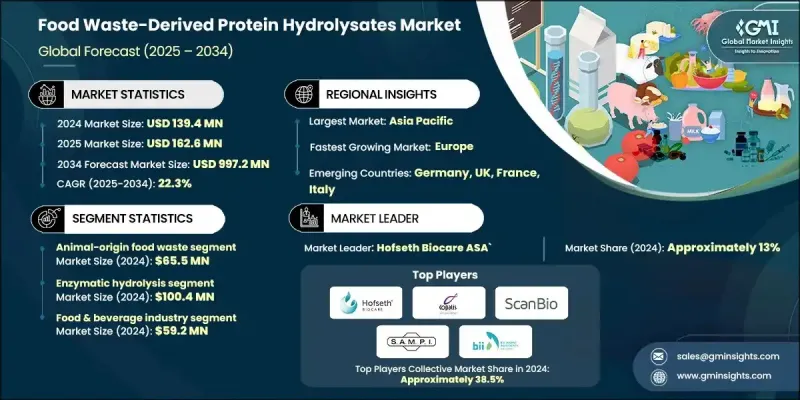
2024 年全球食品废弃物衍生蛋白质水解物市场价值为 1.394 亿美元,预计到 2034 年将以 22.3% 的复合年增长率增长至 9.972 亿美元。
这些蛋白质是透过对废弃动植物食品原料进行酶解和化学水解而产生的,在向循环生物经济转型过程中发挥核心作用。这个过程将原本浪费的资源转化为功能性蛋白质和生物活性胜肽,其性能与传统蛋白质来源相当甚至更优。随着人们对永续发展的期望日益提高,製造商越来越多地采用废弃物衍生原料,以符合严格的减废政策和环境标准。全球致力于减少食物损失和实现营养闭环的承诺,正在推动水解物融入功能性食品、膳食补充剂和永续动物营养解决方案中。由于食物废弃物处理方式的生态足迹低于传统方式,世界各地的监管机构持续推行鼓励食物废弃物升级再造的政策。食物废弃物的增值利用能够大幅减少温室气体排放,并防止大量有机废弃物进入垃圾掩埋场,使其成为兼具环境效益和经济效益的途径。这些监管、环境和产业驱动因素的共同作用,持续推动各行业对食物废弃物衍生水解物原料的需求成长。
| 市场范围 | |
|---|---|
| 起始年份 | 2024 |
| 预测年份 | 2025-2034 |
| 起始值 | 1.394亿美元 |
| 预测值 | 9.972亿美元 |
| 复合年增长率 | 22.3% |
2024年,动物性食品废弃物创造了6,550万美元的收入,预计2025年至2034年将以22.1%的复合年增长率成长。这个类别之所以占据主导地位,是因为其蛋白质含量高,营养丰富,且具有开发生物活性胜肽的巨大潜力。各种动物性残渣的高品质胺基酸组成、高生物利用度和优异的功能特性,使得这些水解产物非常适合用于营养补充剂、特种饲料配方以及需要强效生物活性的功能性食品。
2024年,酵素水解市场规模达到1.004亿美元,预计2025年至2034年将以22.4%的复合年增长率成长,占72%的市场份额。此方法之所以保持主导地位,是因为它能够精确地建构胜肽结构并保留敏感的生物活性成分。透过控制蛋白水解酶的使用,生产商可以调整分子量分布并生产出性能稳定的功能性成分,这使得酶水解成为生产高品质食品、营养保健品和功能性成分的首选方法。
预计2025年至2034年,北美食品废弃物衍生蛋白水解物市场将以20.7%的复合年增长率成长。对永续供应链的日益重视以及企业对循环生物经济策略的关注,正在推动该地区对该领域的应用。减少食物浪费和用环境友好型替代品取代传统蛋白质来源的日益增长的兴趣,促使企业投资于先进的提取和增值技术。
全球食品废弃物衍生蛋白水解物市场的主要企业包括 Scanbio Marine Group、Copalis Sea Solutions、Hofseth Biocare ASA、Bio-Marine Ingredients Ireland、Diana Aqua (Symrise)、Triplenine Group、Agropur、SAMPI、FrieslandCampina Ingredients、Ingredia、Arlaathaia Productss 和领先企业正透过扩大产能、改善萃取技术和加强供应链整合来巩固其市场地位。许多製造商正在投资先进的酵素加工系统,以提高胜肽的纯度、提高产量效率并保持品质稳定。与食品加工商和水产养殖企业的策略合作有助于确保长期稳定的原材料供应,从而减少浪费并稳定原材料来源。此外,各企业也致力于产品多元化,透过客製化的水解物配方服务于营养保健品、食品和动物营养市场。
目录
第一章:方法论与范围
第二章:执行概要
第三章:行业洞察
- 产业生态系分析
- 供应商格局
- 利润率
- 每个阶段的价值增加
- 影响价值链的因素
- 中断
- 产业影响因素
- 司机
- 陷阱与挑战
- 机会
- 成长潜力分析
- 监管环境
- 北美洲
- 欧洲
- 亚太地区
- 拉丁美洲
- 中东和非洲
- 波特的分析
- PESTEL 分析
- 价格趋势
- 按地区
- 按原料类型趋势
- 未来市场趋势
- 技术与创新格局
- 当前技术趋势
- 新兴技术
- 专利格局
- 贸易统计(HS编码)(註:仅提供重点国家的贸易统计资料)
- 主要进口国
- 主要出口国
- 永续性和环境方面
- 永续实践
- 减少废弃物策略
- 生产中的能源效率
- 环保倡议
- 碳足迹考量
第四章:竞争格局
- 介绍
- 公司市占率分析
- 按地区
- 北美洲
- 欧洲
- 亚太地区
- 拉丁美洲
- MEA
- 按地区
- 公司矩阵分析
- 主要市场参与者的竞争分析
- 竞争定位矩阵
- 关键进展
- 併购
- 合作伙伴关係与合作
- 新产品发布
- 扩张计划
第五章:市场估算与预测:依原料类型划分,2021-2034年
- 主要趋势
- 动物源性食物垃圾
- 植物源性食物垃圾
- 混合食物垃圾流
第六章:市场估算与预测:依水解技术划分,2021-2034年
- 主要趋势
- 酵素水解
- 化学水解
- 组合加工技术
第七章:市场估算与预测:依最终用途产业划分,2021-2034年
- 主要趋势
- 食品饮料业
- 功能性食品
- 烘焙食品和糖果
- 饮料和强化饮料
- 其他
- 动物饲料业
- 家禽饲料
- 水产饲料
- 牲畜饲料(牛、猪)
- 其他的
- 营养保健品产业
- 蛋白质补充剂
- 胺基酸补充剂
- 运动与表现营养
- 膳食补充剂
- 其他的
- 农业产业
- 生物肥料
- 生物刺激剂
- 土壤改良剂
- 其他的
- 其他终端用户产业
第八章:市场估算与预测:依地区划分,2021-2034年
- 主要趋势
- 北美洲
- 我们
- 加拿大
- 欧洲
- 德国
- 英国
- 法国
- 西班牙
- 义大利
- 欧洲其他地区
- 亚太地区
- 中国
- 印度
- 日本
- 澳洲
- 韩国
- 亚太其他地区
- 拉丁美洲
- 巴西
- 墨西哥
- 阿根廷
- 拉丁美洲其他地区
- 中东和非洲
- 沙乌地阿拉伯
- 南非
- 阿联酋
- 中东和非洲其他地区
第九章:公司简介
- Hofseth Biocare ASA
- Copalis Sea Solutions
- Scanbio Marine Group
- SAMPI
- Bio-Marine Ingredients Ireland
- Diana Aqua (Symrise)
- Triplenine Group
- Janatha Fish Meal & Oil Products
- Agropur
- FrieslandCampina Ingredients
- Ingredia
- Arla Foods Ingredients
The Global Food Waste-Derived Protein Hydrolysates Market was valued at USD 139.4 million in 2024 and is estimated to grow at a CAGR of 22.3% to reach USD 997.2 million by 2034.
These proteins, generated through enzymatic and chemical hydrolysis of discarded plant and animal food materials, play a central role in the transition toward a circular bioeconomy. The process transforms otherwise wasted resources into functional proteins and bioactive peptides that deliver performance equal to or better than traditional protein sources. As sustainability expectations intensify, manufacturers are increasingly adopting waste-derived ingredients to align with strict waste reduction policies and environmental standards. Global commitments to reduce food loss and close nutrient loops are supporting the integration of hydrolysates into functional foods, dietary supplements, and sustainable animal nutrition solutions. Regulatory authorities worldwide continue to enforce policies encouraging the upcycling of food waste due to its lower ecological footprint compared to conventional disposal. Valorization of food waste significantly cuts greenhouse gas emissions and prevents a major share of organic waste from reaching landfills, making it an environmentally and economically appealing pathway. These combined regulatory, environmental, and industry-driven factors continue to accelerate demand for food waste-derived hydrolysate ingredients across multiple sectors.
| Market Scope | |
|---|---|
| Start Year | 2024 |
| Forecast Year | 2025-2034 |
| Start Value | $139.4 Million |
| Forecast Value | $997.2 Million |
| CAGR | 22.3% |
The animal-origin food waste generated USD 65.5 million in 2024 and is expected to grow at a 22.1% CAGR from 2025 to 2034. This category leads because its protein content is highly nutritious and offers strong potential for bioactive peptides. High-quality amino acid profiles, elevated biological value, and excellent functional characteristics from various animal-based residues make these hydrolysates well-suited for nutritional supplements, specialized feed formulations, and functional food applications requiring robust bioactivity.
The enzymatic hydrolysis segment reached USD 100.4 million in 2024 and is anticipated to grow at a 22.4% CAGR from 2025 to 2034, accounting for 72% of the market. This method remains dominant because it enables the precise development of peptide structures and preserves sensitive bioactive components. Controlled use of proteolytic enzymes allows manufacturers to tailor molecular weight distribution and create consistent functional ingredients, making enzymatic hydrolysis the preferred approach for high-grade food, nutraceutical, and functional ingredient production.
North America Food Waste-Derived Protein Hydrolysates Market is projected to grow at a 20.7% CAGR from 2025 to 2034. Rising emphasis on sustainable supply chains and increasing corporate attention to circular bioeconomy strategies are strengthening regional adoption. Expanding interest in reducing food waste and replacing conventional protein sources with environmentally responsible alternatives is pushing companies to invest in advanced extraction and valorization technologies.
Major companies in the Global Food Waste-Derived Protein Hydrolysates Market include Scanbio Marine Group, Copalis Sea Solutions, Hofseth Biocare ASA, Bio-Marine Ingredients Ireland, Diana Aqua (Symrise), Triplenine Group, Agropur, SAMPI, FrieslandCampina Ingredients, Ingredia, Arla Foods Ingredients, and Janatha Fish Meal & Oil Products. Leading companies are strengthening their presence by expanding production capacity, improving extraction technologies, and enhancing supply chain integration. Many manufacturers are investing in advanced enzymatic processing systems to increase peptide purity, improve yield efficiency, and maintain consistent quality. Strategic partnerships with food processors and aquaculture firms help secure long-term access to raw materials, reducing waste and stabilizing sourcing. Firms are also focusing on product diversification to serve nutraceutical, food, and animal nutrition markets with tailored hydrolysate formulations.
Table of Contents
Chapter 1 Methodology & Scope
- 1.1 Market scope and definition
- 1.2 Research design
- 1.2.1 Research approach
- 1.2.2 Data collection methods
- 1.3 Data mining sources
- 1.3.1 Global
- 1.3.2 Regional/Country
- 1.4 Base estimates and calculations
- 1.4.1 Base year calculation
- 1.4.2 Key trends for market estimation
- 1.5 Primary research and validation
- 1.5.1 Primary sources
- 1.6 Forecast model
- 1.7 Research assumptions and limitations
Chapter 2 Executive Summary
- 2.1 Industry 3600 synopsis
- 2.2 Key market trends
- 2.2.1 Source material type trends
- 2.2.2 Hydrolysis technology trends
- 2.2.3 End use industry trends
- 2.2.4 Regional trends
- 2.3 TAM Analysis, 2025-2034
- 2.4 CXO perspectives: Strategic imperatives
- 2.4.1 Executive decision points
- 2.4.2 Critical success factors
- 2.5 Future Outlook and Strategic Recommendations
Chapter 3 Industry Insights
- 3.1 Industry ecosystem analysis
- 3.1.1 Supplier landscape
- 3.1.2 Profit margin
- 3.1.3 Value addition at each stage
- 3.1.4 Factor affecting the value chain
- 3.1.5 Disruptions
- 3.2 Industry impact forces
- 3.2.1 Drivers
- 3.2.2 Pitfalls & Challenges
- 3.2.3 Opportunities
- 3.3 Growth potential analysis
- 3.4 Regulatory landscape
- 3.4.1 North America
- 3.4.2 Europe
- 3.4.3 Asia Pacific
- 3.4.4 Latin America
- 3.4.5 Middle East & Africa
- 3.5 Porter's analysis
- 3.6 PESTEL analysis
- 3.7 Price trends
- 3.7.1 By region
- 3.7.2 By source material type trends
- 3.8 Future market trends
- 3.9 Technology and Innovation landscape
- 3.9.1 Current technological trends
- 3.9.2 Emerging technologies
- 3.10 Patent Landscape
- 3.11 Trade statistics (HS code) ( Note: the trade statistics will be provided for key countries only)
- 3.11.1 Major importing countries
- 3.11.2 Major exporting countries
- 3.12 Sustainability and environmental aspects
- 3.12.1 Sustainable practices
- 3.12.2 Waste reduction strategies
- 3.12.3 Energy efficiency in production
- 3.12.4 Eco-friendly initiatives
- 3.13 Carbon footprint consideration
Chapter 4 Competitive Landscape, 2024
- 4.1 Introduction
- 4.2 Company market share analysis
- 4.2.1 By region
- 4.2.1.1 North America
- 4.2.1.2 Europe
- 4.2.1.3 Asia Pacific
- 4.2.1.4 LATAM
- 4.2.1.5 MEA
- 4.2.1 By region
- 4.3 Company matrix analysis
- 4.4 Competitive analysis of major market players
- 4.5 Competitive positioning matrix
- 4.6 Key developments
- 4.6.1 Mergers & acquisitions
- 4.6.2 Partnerships & collaborations
- 4.6.3 New Product Launches
- 4.6.4 Expansion Plans
Chapter 5 Market Estimates and Forecast, By Source Material Type, 2021-2034 (USD Million & Kilo Tons)
- 5.1 Key trends
- 5.2 Animal-origin food waste
- 5.3 Plant-origin food waste
- 5.4 Mixed food waste streams
Chapter 6 Market Estimates and Forecast, By Hydrolysis Technology, 2021-2034 (USD Million & Kilo Tons)
- 6.1 Key trends
- 6.2 Enzymatic hydrolysis
- 6.3 Chemical hydrolysis
- 6.4 Combined processing technologies
Chapter 7 Market Estimates and Forecast, By End Use Industry, 2021-2034 (USD Million & Kilo Tons)
- 7.1 Key trends
- 7.2 Food & beverage industry
- 7.2.1 Functional foods
- 7.2.2 Bakery & confectionery
- 7.2.3 Beverages & fortified drinks
- 7.2.4 Other
- 7.3 Animal feed industry
- 7.3.1 Poultry feed
- 7.3.2 Aquaculture feed
- 7.3.3 Livestock feed (cattle, swine)
- 7.3.4 Others
- 7.4 Nutraceutical industry
- 7.4.1 Protein supplements
- 7.4.2 Amino acid supplements
- 7.4.3 Sports & performance nutrition
- 7.4.4 Dietary supplements
- 7.4.5 Others
- 7.5 Agricultural industry
- 7.5.1 Biofertilizers
- 7.5.2 Biostimulants
- 7.5.3 Soil conditioners
- 7.5.4 Others
- 7.6 Other end use industries
Chapter 8 Market Estimates and Forecast, By Region, 2021-2034 (USD Million & Kilo Tons)
- 8.1 Key trends
- 8.2 North America
- 8.2.1 U.S.
- 8.2.2 Canada
- 8.3 Europe
- 8.3.1 Germany
- 8.3.2 UK
- 8.3.3 France
- 8.3.4 Spain
- 8.3.5 Italy
- 8.3.6 Rest of Europe
- 8.4 Asia Pacific
- 8.4.1 China
- 8.4.2 India
- 8.4.3 Japan
- 8.4.4 Australia
- 8.4.5 South Korea
- 8.4.6 Rest of Asia Pacific
- 8.5 Latin America
- 8.5.1 Brazil
- 8.5.2 Mexico
- 8.5.3 Argentina
- 8.5.4 Rest of Latin America
- 8.6 Middle East and Africa
- 8.6.1 Saudi Arabia
- 8.6.2 South Africa
- 8.6.3 UAE
- 8.6.4 Rest of Middle East and Africa
Chapter 9 Company Profiles
- 9.1 Hofseth Biocare ASA
- 9.2 Copalis Sea Solutions
- 9.3 Scanbio Marine Group
- 9.4 SAMPI
- 9.5 Bio-Marine Ingredients Ireland
- 9.6 Diana Aqua (Symrise)
- 9.7 Triplenine Group
- 9.8 Janatha Fish Meal & Oil Products
- 9.9 Agropur
- 9.10 FrieslandCampina Ingredients
- 9.11 Ingredia
- 9.12 Arla Foods Ingredients

 蛋白质水解物市场规模、份额及成长分析(依产品类型、形态类型、应用类型及地区划分)-2026-2033年产业预测
 全球蛋白质水解物市场规模、份额、趋势和成长分析报告(2026-2034)
 有机蛋白水解物市场机会、成长驱动因素、产业趋势分析及预测(2025-2034年)单细胞蛋白水解物市场机会、成长驱动因素、产业趋势分析及预测(2025-2034年)精准发酵法製备蛋白水解物市场机会、成长驱动因素、产业趋势分析及预测(2025-2034年)老年营养蛋白水解物市场机会、成长驱动因素、产业趋势分析及预测(2025-2034年)下一代蛋白质水解物市场机会、成长驱动因素、产业趋势分析及预测(2025-2034)
 蛋白质水解物市场-全球产业规模、份额、趋势、机会和预测,按类型、来源、形态、製程、应用、地区和竞争格局划分,2020-2030年预测非基因改造蛋白水解物市场机会、成长驱动因素、产业趋势分析及预测(2025-2034年)发酵蛋白水解物市场机会、成长驱动因素、产业趋势分析及预测(2025-2034年)