


 |
市场调查报告书
商品编码
1911370
法国设施管理市场:市场占有率分析、产业趋势与统计、成长预测(2026-2031)France Facility Management - Market Share Analysis, Industry Trends & Statistics, Growth Forecasts (2026 - 2031) |
||||||

※ 本网页内容可能与最新版本有所差异。详细情况请与我们联繫。
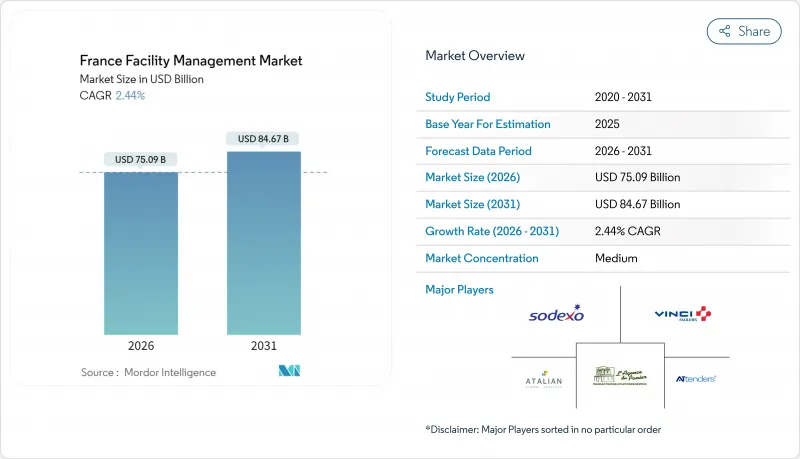
2025年法国设施管理(FM)市场价值为733亿美元,预计到2031年将达到846.7亿美元,高于2026年的750.9亿美元。
预计在预测期(2026-2031 年)内,复合年增长率将达到 2.44%。
更严格的能源效率法规、建筑系统的快速数位化以及政府对维修工程的支持,共同推动了这一缓慢但稳定的成长。市场需求集中在智慧化的、以结果为导向的基本契约上,这类合约将供应商的报酬与脱碳和营运绩效指标挂钩。随着企业优化供应商结构,软硬体一体化的服务包越来越受欢迎;而持续的劳动力短缺则促使供应商转向自动化、远端监控和基于状态的维护。随着全球巨头出售非核心业务,以及国内主要企业寻求扩张,竞争日益激烈。同时,中型专业公司正透过物联网赋能的预测服务、可再生能源技术和ESG合规支援来实现差异化竞争。
法国设施管理市场趋势与洞察
楼宇管理系统的技术进步
物联网感测器、行动电脑化维护管理系统 (CMMS) 平台和人工智慧驱动的分析技术的广泛应用,正在改变建筑物的监控、维护和最佳化方式。一家法国营运商已管理 42,000 个电动车充电桩,并透过结合数位双胞胎和预测分析技术,将暖通空调 (HVAC) 能耗降低了 15-20%。施耐德电机的 EcoStruxure™ 资源顾问能够即时追踪碳排放,从而满足到 2030 年将第三产业资产的能耗降低 40% 的要求。早期采用者已经体验到停机时间减少、故障解决速度加快以及检验的永续性指标,这提高了那些在技术投资方面落后的供应商的竞争门槛。这一趋势也推动了基于结果的定价模式,在这种模式下,演算法检验服务等级和节能保证。
房地产行业的成长
2025年第一季,商业不动产资本流入达34亿欧元,较去年同期成长67%。其中,光是办公空间就吸引了14亿欧元。大巴黎地区的大型企划持续创造新的办公室、零售、资料中心和交通枢纽供应,从一运作就需要承包的设施服务。新建专案通常包含绿色租赁条款,其中包含绩效仪表板,确保设施管理贯穿设计、施工和营运的各个阶段。同时,老旧物业面临监管规定的维修期限,进一步推动了对机械、电气和外部升级改造的需求,而这些升级改造通常透过综合设施管理合约来实现。
劳动市场限制因素与技能短缺
法国劳工部的报告指出,2025年,设施管理(FM)人才招聘计划仍有一半将面临挑战,报告强调了熟悉物联网平台、楼宇管理系统(BMS)分析和能源审核通讯协定的技术人员严重短缺。为了缓解人手不足,供应商正在实施技能提升培训、扩增实境(AR)工作指导和机器人技术,但不断上涨的薪资正在挤压利润空间。客户对全天候运作的需求进一步加剧了人员配置模式的复杂性,并提升了自动化远端监控的价值。对于需要专业试运行和合规知识的计划,持续的人才短缺可能会限制其发展。
细分市场分析
到2025年,硬性服务将占法国设施管理市场收入的61.74%,这主要得益于为满足日益严格的能源强度标准而必须提供的机电管道(MEP)和暖通空调(HVAC)服务。该领域直接受益于67亿欧元的「韧性基金」支出以及即将于2025年生效的职业安全法规,该法规要求更新通风和冷冻系统。消防安全合规仍然是必要条件,即使在宏观经济放缓时期也能确保市场需求的稳定。由于基于预测分析的状态维护模式的转变,资产管理子服务的采用率不断提高,从而推动了感测器维修和资产延寿研究的支出增加。同时,儘管规模较小,但预计到2031年,软性服务将以2.59%的复合年增长率增长,这反映了职场向健康和酒店式品牌体验的转变。索迪斯2024财年的数据显示,食品服务成长了5.7%,而传统设施管理业务仅成长了2.4%,这凸显了服务重点正从商品化的清洁服务转向以用户体验为导向的服务。此外,智慧楼宇应用程式的出现也进一步推动了软性服务业务的成长,这些应用程式整合了访客管理和室内空气品质仪表板,并将设施管理融入更广泛的员工参与策略中。
儘管到2031年,硬性服务仍将是法国设施管理市场规模的最大贡献者,但随着企业将职场体验视为人才招募和ESG品牌建设的手段,其与软性服务之间的差距将逐渐缩小。供应商正透过将清洁机器人与人工智慧驱动的节能技术结合,并将健康分析整合到整合式仪表板中,从而实现交叉销售协同效应。因此,差异化竞争的关键在于如何在资本密集技术维护与以人为本、透过数位化工作流程提供的灵活且便利的服务之间取得平衡。
其他福利
- Excel格式的市场预测(ME)表
- 3个月的分析师支持
目录
第一章 引言
- 研究假设和市场定义
- 调查范围
第二章调查方法
第三章执行摘要
第四章 市场情势
- 市场概览
- 主要商业地产领域的当前运转率
- 主要设施管理服务提供者的盈利基准
- 劳动指标-劳动参与率和技能拥有情形
- 按服务类型分類的设施管理市场占有率(%)
- 以硬体维修服务分類的设施管理市场份额(%)
- 以软性设施管理服务分類的设施管理市场份额(%)
- 主要都会区(巴黎、里昂、马赛、里尔、图卢兹)的都市化与人口成长
- 法国国家基础设施计画中的部门投资优先事项
- 劳动和安全标准的监管驱动因素
- 司机
- 楼宇管理系统的技术进步
- 房地产行业的成长
- 更重视绿建筑实践
- 对软性FM方法的需求日益增长
- 综合设施管理(IFM)合约的采用率不断提高
- 政府为现有建筑的节能维修提供奖励措施
- 抑制因素
- 劳动市场限制因素与技能短缺
- 经济波动和通膨压力
- 市场区隔程度过高限制了规模经济效益。
- 公共部门合约中复杂的竞标流程
- 价值链分析
- PESTEL 分析
- 新参与企业的监管和法律体制
- 宏观经济指标对FM需求的影响
- 波特五力模型
- 供应商的议价能力
- 买方的议价能力
- 新进入者的威胁
- 替代品的威胁
- 竞争对手之间的竞争
- 投资与资金筹措分析
第五章 市场规模与成长预测
- 按服务类型
- 硬服务
- 资产管理
- 机电及暖通空调服务
- 消防系统和安全措施
- 其他硬体维修服务
- 软服务
- 办公室支援与安全
- 清洁服务
- 餐饮服务
- 其他软性调频服务
- 硬服务
- 按规定表格
- 内部管理
- 外包
- 单频调频
- 捆绑式调频服务
- 整合调频
- 按最终用户行业划分
- 商业(IT/通讯、零售/仓储)
- 饭店餐饮业(饭店、餐厅等)
- 公共及公共基础设施(政府、教育、交通)
- 医疗保健(公立和私立机构)
- 工业流程(製造业、能源业、采矿业)
- 其他终端用户产业(多用户住宅、娱乐、运动和休閒)
第六章 竞争情势
- 市场集中度
- 策略趋势
- 市占率分析
- 公司简介
- Sodexo Group
- VINCI Facilities
- Atalian Group
- ONET SA
- Veolia Environnement SA
- ISS World Services A/S
- Equans
- SPIE Facilities
- Samsic Facility
- Elis SA
- DEF Network
- Bouygues Energies and Services
- Derichebourg Multiservices
- CBRE GWS France
- ENGIE Solutions
- Seris Group
- Dalkia
- Axima
第七章 市场机会与未来展望
The France facility management market was valued at USD 73.30 billion in 2025 and estimated to grow from USD 75.09 billion in 2026 to reach USD 84.67 billion by 2031, at a CAGR of 2.44% during the forecast period (2026-2031).
Heightened energy-efficiency mandates, the rapid digitalization of building systems, and government stimulus for retrofits underpin this moderate yet resilient expansion. Demand is concentrating around smart, outcome-based contracts that link provider remuneration to decarbonization and operational performance metrics. Integrated hard-and-soft service bundles are gaining traction as enterprises streamline supplier bases, while persistent labor shortages push providers toward automation, remote monitoring, and condition-based maintenance. Competitive intensity is rising as global majors divest non-core portfolios and domestic champions acquire scale; simultaneously, midsize specialists differentiate through IoT-enabled predictive services, renewable-energy know-how, and ESG-compliance support.
France Facility Management Market Trends and Insights
Technological Advancements in Building Management Systems
Widespread deployment of IoT sensors, mobile CMMS platforms, and AI-driven analytics is transforming how buildings are monitored, maintained, and optimized. French operators already manage 42,000 EV charging points, and digital twins combined with predictive analytics are cutting HVAC energy consumption by 15-20%. Schneider Electric's EcoStruxure(TM) Resource Advisor enables real-time carbon tracking that aligns with the 40% energy-reduction mandate for tertiary assets by 2030. Early adopters gain lower downtime, faster fault resolution, and verifiable sustainability metrics, raising competitive thresholds for providers lagging on tech investment. The trend also encourages outcome-based pricing, where algorithms verify service levels and energy-savings guarantees.
Growth of the Real Estate Sector
Commercial real-estate inflows reached EUR 3.4 billion in Q1 2025, up 67% year-on-year, with offices alone attracting EUR 1.4 billion. Mega-projects under the Grand Paris banner continue to create fresh inventories of offices, retail precincts, data centers, and transit hubs requiring turnkey facility services from day one. New-build assets frequently include green-lease clauses that embed performance dashboards, thereby ensuring facility-management engagement across design, construction, and operational phases. Simultaneously, aging stock faces regulatory retrofit deadlines, further lifting demand for mechanical, electrical, and envelope upgrades delivered through integrated FM contracts.
Labor Market Constraints and Skills Shortage
Half of all FM recruitment projects remained difficult in 2025 according to France Travail, underscoring acute scarcity of technicians competent in IoT platforms, BMS analytics, and energy-audit protocols. Providers deploy upskilling academies, augmented-reality work instructions, and robotics to ease manpower strain, yet wage inflation compresses margins. Client expectations around 24/7 uptime further complicate staffing models, amplifying the value of automated remote supervision. Continued shortages may cap growth for projects requiring specialized commissioning and compliance expertise.
Other drivers and restraints analyzed in the detailed report include:
- Increasing Emphasis on Green Building Practices
- Rising Adoption of Integrated Facilities Management Contracts
- Economic Fluctuations and Inflationary Pressures
For complete list of drivers and restraints, kindly check the Table Of Contents.
Segment Analysis
Hard Services delivered 61.74% of France facility management market revenue in 2025, led by MEP and HVAC functions required to meet tightening energy-intensity benchmarks. The segment benefits directly from the EUR 6.7 billion Recovery and Resilience outlay and from impending 2025 worker-safety rules that mandate upgraded ventilation and cooling systems. Fire-safety compliance remains non-discretionary, ensuring steady demand even during macro-slowdowns. Asset-management sub-services show rising adoption as predictive analytics push maintenance toward condition-based regimes, increasing spend on sensor retrofits and asset-life-extension studies. In contrast, Soft Services, while smaller, are the growth pacesetter at a 2.59% CAGR to 2031, reflecting a workplace shift toward health, hospitality, and brand-experience outcomes. Sodexo's FY 2024 data show food services progressing 5.7% versus 2.4% for traditional FM, highlighting a re-weighting from commodity cleaning to user-experience-centric offerings. Soft-service growth is further propelled by smart-building apps that integrate visitor management with indoor-air-quality dashboards, weaving FM into broader employee-engagement agendas.
Hard Services will remain the largest contributor to France facility management market size through 2031, yet Soft Services will progressively narrow the gap as enterprises view workplace experience as a lever for talent attraction and ESG branding. Providers capture cross-selling synergies by merging cleaning robotics with AI-driven energy shedding and by embedding wellness analytics in integrated dashboards. As a result, differentiation hinges on balancing capital-intensive technical maintenance with agile, people-focused touchpoints delivered through digitally-rich workflows.
The France Facility Management Market Report is Segmented by Service Type (Hard Services, and Soft Services), Offering Type (In-House, and Outsourced), End-User Industry (Commercial, Hospitality, Institutional and Public Infrastructure, Healthcare, Industrial and Process, and Other End-User Industries), and Geography. The Market Forecasts are Provided in Terms of Value (USD).
List of Companies Covered in this Report:
- Sodexo Group
- VINCI Facilities
- Atalian Group
- ONET S.A.
- Veolia Environnement S.A.
- ISS World Services A/S
- Equans
- SPIE Facilities
- Samsic Facility
- Elis S.A.
- DEF Network
- Bouygues Energies and Services
- Derichebourg Multiservices
- CBRE GWS France
- ENGIE Solutions
- Seris Group
- Dalkia
- Axima
Additional Benefits:
- The market estimate (ME) sheet in Excel format
- 3 months of analyst support
TABLE OF CONTENTS
1 INTRODUCTION
- 1.1 Study Assumptions and Market Definition
- 1.2 Scope of the Study
2 RESEARCH METHODOLOGY
3 EXECUTIVE SUMMARY
4 MARKET LANDSCAPE
- 4.1 Market Overview
- 4.1.1 Current Occupancy Rates in Key Commercial Real Estate Segments
- 4.1.2 Profitability Benchmarks of Major FM Providers
- 4.1.3 Workforce Indicators - Labour Participation and Skill Availability
- 4.1.4 Facility Management Market Share (%) by Service Type
- 4.1.5 Facility Management Market Share (%) by Hard FM Services
- 4.1.6 Facility Management Market Share (%) by Soft FM Services
- 4.1.7 Urbanisation and Population Growth in Top Metros (Paris, Lyon, Marseille, Lille, Toulouse)
- 4.1.8 Sector Investment Priorities in France's National Infrastructure Pipeline
- 4.1.9 Regulatory Drivers Specific to Labour and Safety Standards
- 4.2 Drivers
- 4.2.1 Technological Advancements in Building Management Systems
- 4.2.2 Growth of the Real Estate Sector
- 4.2.3 Increasing Emphasis on Green Building Practices
- 4.2.4 Growing Demand for Soft FM Practices
- 4.2.5 Rising Adoption of Integrated Facilities Management (IFM) Contracts
- 4.2.6 Government Incentives for Energy-Efficiency Retrofits in Existing Buildings
- 4.3 Restraints
- 4.3.1 Labor Market Constraints and Skills Shortage
- 4.3.2 Economic Fluctuations and Inflationary Pressures
- 4.3.3 High Market Fragmentation Limiting Economies of Scale
- 4.3.4 Complex Tendering Processes in Public Sector Contracts
- 4.4 Value Chain Analysis
- 4.5 PESTEL Analysis
- 4.6 Regulatory and Legislative Framework for Market Entrants
- 4.7 Impact of Macroeconomic Indicators on FM Demand
- 4.8 Porter's Five Forces
- 4.8.1 Bargaining Power of Suppliers
- 4.8.2 Bargaining Power of Buyers
- 4.8.3 Threat of New Entrants
- 4.8.4 Threat of Substitute Services
- 4.8.5 Intensity of Competitive Rivalry
- 4.9 Investment and Funding Analysis
5 MARKET SIZE AND GROWTH FORECASTS (VALUE)
- 5.1 By Service Type
- 5.1.1 Hard Services
- 5.1.1.1 Asset Management
- 5.1.1.2 MEP and HVAC Services
- 5.1.1.3 Fire Systems and Safety
- 5.1.1.4 Other Hard FM Services
- 5.1.2 Soft Services
- 5.1.2.1 Office Support and Security
- 5.1.2.2 Cleaning Services
- 5.1.2.3 Catering Services
- 5.1.2.4 Other Soft FM Services
- 5.1.1 Hard Services
- 5.2 By Offering Type
- 5.2.1 In-house
- 5.2.2 Outsourced
- 5.2.2.1 Single FM
- 5.2.2.2 Bundled FM
- 5.2.2.3 Integrated FM
- 5.3 By End-user Industry
- 5.3.1 Commercial (IT and Telecom, Retail and Warehousing)
- 5.3.2 Hospitality (Hotels, Eateries, Restaurants)
- 5.3.3 Institutional and Public Infrastructure (Govt, Education, Transport)
- 5.3.4 Healthcare (Public and Private Facilities)
- 5.3.5 Industrial and Process (Manufacturing, Energy, Mining)
- 5.3.6 Other End-user Industries (Multi-housing, Entertainment, Sports and Leisure)
6 COMPETITIVE LANDSCAPE
- 6.1 Market Concentration
- 6.2 Strategic Moves
- 6.3 Market Share Analysis
- 6.4 Company Profiles (includes Global level Overview, Market level overview, Core Segments, Financials as available, Strategic Information, Market Rank/Share for key companies, Products and Services, and Recent Developments)
- 6.4.1 Sodexo Group
- 6.4.2 VINCI Facilities
- 6.4.3 Atalian Group
- 6.4.4 ONET S.A.
- 6.4.5 Veolia Environnement S.A.
- 6.4.6 ISS World Services A/S
- 6.4.7 Equans
- 6.4.8 SPIE Facilities
- 6.4.9 Samsic Facility
- 6.4.10 Elis S.A.
- 6.4.11 DEF Network
- 6.4.12 Bouygues Energies and Services
- 6.4.13 Derichebourg Multiservices
- 6.4.14 CBRE GWS France
- 6.4.15 ENGIE Solutions
- 6.4.16 Seris Group
- 6.4.17 Dalkia
- 6.4.18 Axima
7 MARKET OPPORTUNITIES AND FUTURE OUTLOOK
- 7.1 White-space and Unmet-Need Assessment
- 7.2 Technology-led Integrated FM (IoT, BMS, AI-based Predictive Maintenance)
- 7.3 ESG-Compliant FM Solutions Demand
- 7.4 Future Service-Model Shifts (Outcome-Based Contracts)
- 7.5 Data-Driven Energy Optimisation and Carbon Reporting Services

 设施管理市场:2026-2032年全球市场预测(依产品、产品模式、部署类型、公司规模及最终用途划分)
 设施管理市场规模、份额、趋势和预测:按解决方案、服务、部署类型、组织规模、行业和地区划分,2026-2034 年设施管理服务市场:2026-2032年全球市场预测(依服务类型、合约类型、服务交付方式、最终用户和组织规模划分)
 2026年全球地下设施维护与管理市场报告2026年全球硬性服务设施管理市场报告2026年全球设施支援服务市场报告2026年全球设施管理服务市场报告2026年全球软性服务设施管理市场报告
 设施管理市场规模、份额、成长及全球产业分析:按类型、应用和地区分類的洞察,2026-2034 年预测硬设施管理市场:依服务类型、合约类型、所有权类型和最终用户产业划分-2026-2032年全球市场预测